Don’t read too much into health care’s high poll rankings

https://www.axios.com/dont-read-too-much-into-health-cares-high-poll-rankings-2521856369.html

Image result for ap/norc poll healthcare

An AP/NORC poll published late in December found that health care ranked number one on the list of the public’s priorities for government. It’s a well done and well reported poll, and as the head of a health policy and journalism organization, I suppose I should be happy that health ranked number one.

Yes, but: Having conducted and watched health care polling for decades, I’d caution readers not to over-interpret health care’s first place finish, which may not mean very much for upcoming elections. They are unlikely to be about health care and are much more likely to be about the candidates and President Trump.

Between the lines: For one thing, health care has been in the news and hotly debated. So when given a list of issues to choose from on a poll, or asked to name issues on their mind in an open ended question, the public is more likely to pick health care.

The economy is doing well, and health care’s other major competitor on a polling list of issues, the tax legislation, has not grabbed the public yet and may not until people begin paying their taxes.

The catch: When a topic like health care ranks high on a list of issues, it doesn’t mean voters will vote on that issue. In many races, they are more likely to vote on the basis of how they feel about the candidate overall than on issues. These upcoming elections are also likely to become a referendum on President Trump, as the race in Virginia largely was.

We also cannot assume that when the public picks “health” or “health care” on a poll they always mean the Affordable Care Act, whether that’s repealing it for Republicans or protecting it for Democrats.

  • People will give you a typically partisan view of the ACA if you ask for it. But most Americans are not covered by the ACA, and our own polling at the Kaiser Family Foundation shows that the public is mostly concerned their own health care costs.
  • Other health concerns also creep into the mix on various polls, such as CHIP funding and opioids.

What to watch: In the AP/NORC poll, Republicans placed a lower priority on health than Democrats and Independents did; they were about equally likely to pick immigration and taxes as health care. But we know from other polling that Democratic intensity about the ACA has increased, while Republican intensity is flat.

For that reason, Democrats are likely to put forward a variety of health care plans in 2018 and 2020, which will keep health care on the agenda. Health care could be for Democrats what it has been for Republicans in recent elections — a jump starter for the base. This could be the main way in which it plays a role in the election.

The bottom line: It’s always good to remember that the top issues in polls are not often the top factors in elections, especially in a year when, one way or another, Donald Trump will be on every ballot.

https://www.apnews.com/d0d4166afad649ac994e60f8d0b0da48


Trump Asked Kellyanne Conway To Tackle The Opioid Crisis & Here’s Why Experts Are So Worried

https://www.bustle.com/p/trump-asked-kellyanne-conway-to-tackle-the-opioid-crisis-heres-why-experts-are-so-worried-6743045

Image result for opioid crisis

On Wednesday, Attorney General Jeff Sessions announced that President Donald Trump’s counselor Kellyanne Conway will take on the opioid crisis, overseeing all White House initiatives combating the current overdose epidemic. More than 52,000 people lost their lives to drug overdoses in 2016 alone, according to a CNN report, with at least 33,000 of them were due to opioid drugs, including prescription painkillers. Trump labeled the opioid crisis a public health emergency in October.

Now, the president is calling for an “opioids czar” to lead efforts against the epidemic — and Conway is taking on that role. She will “coordinate and lead the effort from the White House” related to the opioid crisis, Sessions said at a news conference on Wednesday.

One opioid policy expert, Andrew Kolodny of Brandeis University’s Opioid Policy Research Collaborative, told BuzzFeed he thinks this is a good move.

However, he also pointed out that the administration still doesn’t have anyone leading the Office of National Drug Control Policy, nor has it released a comprehensive strategy for addressing this public health crisis. Trump has previously said he’d like to launch an advertising campaign similar to Nancy Reagan’s “Just Say No” campaign, which was widely unsuccessful.

Christie also called the need for an opioids czar “overblown.” He feels that they already know how to handle the issue, and it starts with limiting the prescriptions for painkillers, cutting fentanyl exports from China, and providing naloxone to communities, BuzzFeed reported. Naloxone blocks and reverses the effects of opioid drugs, and gives non-medical people the ability to save lives. While it’s controversial, as some say it enables more drug use, it’s been shown to decrease the number of overdoses. There are also drugs, like methadone and buprenorphine, shown to help recovering addicts stay in treatment longer.

Kelly Pfeifer, director of high-value care at California Health Care Foundation, an Oakland-based philanthropic nonprofit, explains to Bustle:

Unfortunately, there’s a stigma surrounding a lot of these treatments — people view it as trading one drug, for instance heroin, for another, like methadone. But scientific evidence continues to show the benefits of medication-assisted treatment versus complete abstinence. This has led the Hazelden Betty Ford Foundation, a top treatment provider in the United States, to even start providing anti-addition medications as part of its recovery program.

But Conway’s expertise isn’t so much in medicine or addiction as it is in “messaging,” according to Sessions.

He also emphasized a focus on law enforcement to deal with the crisis.

Still, many feel the country needs a lot more than a good ad campaign and stricter laws. “We have spent billions on the failed ‘war on drugs’ and have learned that exclusive focus on law enforcement will not end the epidemic or save lives,” Pfeifer says. “The evidence is with addiction treatment — and that is where funding should go.”

Five health-care fights facing Congress in December

Five health-care fights facing Congress in December

Five health-care fights facing Congress in December

Health-care issues are at the top of Congress’s hefty December to-do list.

Republicans spent much of the year on a failed bid to repeal and replace ObamaCare. That’s left several programs and taxes hanging in the balance as the year draws to a close, in addition to the latest health-care drama thrust into the GOP tax-reform debate.

Here are five of the biggest health-care issues Congress will face next month.

Will Republicans repeal the individual mandate?

Weeks ago, Sen. Tom Cotton (R-Ark.) began to push for a repeal of the individual mandate to be added into the GOP tax overhaul. It worked, at least in the upper chamber.

To Democrats’ dismay, the Senate Finance Committee passed a tax-reform bill before breaking for Thanksgiving that included repeal of the ObamaCare mandate that Americans without health insurance pay a fee.

The House already passed a bill out of its chamber on a party-line vote — legislation that didn’t include repealing the individual mandate. But leaders have said they’re open to it if the Senate is able to muster enough votes to pass tax reform with the repeal.

It appears that the upper chamber might be able to pull it off.

Sen. Susan Collins (R-Maine) has said the repeal shouldn’t be in the bill, but hasn’t said she would vote against the tax-reform bill if it was included. Sen. John McCain (R-Ariz.) hasn’t rung any alarms that he would vote against the bill, saying he wants to see the whole package before deciding, and applauding the Finance Committee for holding hearings on the measure.

In a boost to the effort, Sen. Lisa Murkowski (R-Alaska) wrote in the Fairbanks Daily News-Miner Tuesday that she backs repealing the individual mandate. All three senators voted against a scaled-down version of an ObamaCare repeal bill in late July, effectively sinking the measure.

GOP leaders have signaled that a bipartisan stabilization bill from Sens. Lamar Alexander (R-Tenn.) and Patty Murray (D-Wash.) could pass if the individual mandate is repealed. On Sunday, Collins said she would like the Alexander-Murray bill, along with a bipartisan bill to provide funding for high-cost enrollees she introduced, to pass before tax reform does.

Sen. John Cornyn (Texas), the Senate’s No. 2 Republican, said that the deal is “likely” to be included in an end-of-the-year package.

But that effort could face resistance from Democrats, who have balked at repealing the individual mandate, and say that runs counter to the bipartisan spirit that Alexander-Murray was crafted under.

Will Congress reauthorize critical health programs it let lapse?

It’s been nearly two months since funding for the Children’s Health Insurance Program (CHIP) and community health centers expired. Advocates are holding out hope that lawmakers will reauthorize both before the new year, but are frustrated that Congress failed to reauthorize the dollars by a Sept. 30 deadline.

Roughly 9 million low- and middle-income children rely on CHIP for health coverage. Some states have asked the Centers for Medicare and Medicaid Services for funding to hold them over in the interim, and the agency has awarded about $607 million in redistributed funds to states and U.S. territories.

Community health centers have been crafting contingency plans as they wait for Congress to reauthorize a fund that amounts to 70 percent of their federal funding. These centers are a large source of comprehensive primary care for over 26 million of the nation’s most vulnerable people.

Some have already instituted hiring freezes. Others are examining which services they could cut or scale back. If the funding lapses, staff could be laid off, facility renovations or expansions could be canceled or delayed and hours of operation could be reduced.

Though the uncertainty has caused angst for health centers, they haven’t yet seen a monetary impact. But that impact could come on Jan. 1 for 25 percent of centers and on Feb. 1 for another 17 percent, because that’s when their new grant periods begin.

The Health Resources and Services Administration plans to help out on a prorated, monthly basis, according to a spokesperson.

But advocates hope it won’t come to that. The House passed a bill to fund CHIP for five years and community health centers for two. It passed on a party-line vote, as Democrats criticized how Republicans planned to pay for the bill.

The Senate Finance Committee passed a bipartisan, five-year CHIP extension, but hasn’t yet released offsets. Sens. Debbie Stabenow (D-Mich.) and Roy Blunt (R-Mo.) have introduced a bipartisan bill to extend community health center funding for five years.

Will Congress fund the opioid response?

In late October, President Trump declared the opioid epidemic a national public health emergency.

But the move didn’t come with millions of new dollars to combat the crisis, nor did it include a funding ask to Congress. This has frustrated Democrats and many advocates, who say a significant infusion of federal funds is needed to make an emergency declaration effective.

It’s not clear if money will come.

Senate Democrats introduced a bill to provide $45 billion over 10 years to address the crisis — a nod to a similar amount of funding Republicans included in an ObamaCare repeal bill, in part to attempt to offset changes to Medicaid.

But Republicans haven’t named a dollar figure. With a jam-packed December, advocates worry the new year could begin without more money to help curb the crisis of prescription painkillers and heroin that’s ravaged the country.

As for the administration, Hogan Gidley, White House deputy press secretary, said in a statement that “we will continue discussions with Congress on the appropriate level of funding needed to address this crisis” but didn’t say how much that would be.

What does Congress do on ObamaCare taxes?

Behind the scenes, industry lobbyists are working hard to ensure several ObamaCare taxes won’t kick in come January.

The medical device industry wants a full repeal of a 2.3 percent tax on the sale of certain medical devices, such as pacemakers and MRI machines.

“We feel we’re very much in play and that is for full repeal,” said Greg Crist, a spokesman for the medical device trade association AdvaMed. “We’re talking with staff and leadership for the right vehicle.”

The insurance industry is pushing for at least a one year delay of the health insurance tax. Both taxes were delayed in a 2015 spending bill, though for different durations; the medical device tax was paused for two years, and the health insurance tax for just 2017.

Ways and Means Chairman Kevin Brady (R-Texas) addressed the ObamaCare taxes during a marathon hearing on House Republican’s tax-reform bill, saying the legislation wasn’t the right vehicle to repeal or delay them. But, he added, he is working to do so by the end of the year.

“As the ranking member and members on both sides of the aisle know — we have been working with them over the past month to find a path forward,” Brady said. “We are working on common-sense temporary and targeted relief from many of these taxes to be acted on in the House before the end of the year.”

Employer groups are also pushing for a delay of the so-called Cadillac tax, a 40 percent fee levied on pricey employer-sponsored plans slated to begin in 2020. Critics of the tax argue a delay is needed now because employers will begin planning for 2020 next year.

Will Congress help Puerto Rico fund its Medicaid program?

The storm-ravaged island territory could be out of federal dollars for its Medicaid program in a matter of months.

Federal disaster funds haven’t been earmarked to go to the joint state-federal health insurance program for low-income and disabled Americans. On Nov. 17, the White House asked Congress for $44 billion for disaster relief. The notice mentioned Puerto Rico’s Medicaid program, but didn’t put a dollar amount on it.

“Though the Administration expects to work with Puerto Rico and the Congress on medium-term liquidity issues through a future request, the Administration is aware of legislation being considered to address Medicaid sooner,” the letter stated.

Puerto Rico Gov. Ricardo Roselló has asked for $1.6 billion annually for five years. Democratic lawmakers and advocates have been pushing to fulfill that request.


Why Advertising Is a Poor Choice to Tackle the Opioid Crisis

Why Advertising Is a Poor Choice to Tackle the Opioid Crisis

Image result for public money for opioids crisis

In declaring the opioid epidemic a public health emergency last week, President Trump promised that the federal government would start “a massive advertising campaign to get people, especially children, not to want to take drugs in the first place.” But past efforts to prevent substance abuse through advertising have often been ineffective or even harmful.

Perhaps the most famous American antidrug advertisement featured a sizzling egg in a frying pan to the sound of ominous music and a stern voice-over warning, “This is your brain on drugs.” A sequel to this ad featured Rachael Leigh Cook smashing an egg and the better part of a kitchen to dramatize the impact of heroin.

Many other ads denouncing drugs and emphasizing their destructive effects — as in the “Just Say No” campaign — appeared regularly on television and in print beginning in the 1980s. Most of them were funded by the White House Office of National Drug Control Policy, which received hundreds of millions of dollars a year from Congress for such campaigns.

Visually dramatic though the ads were, evaluations of them were deeply discouraging. The billions spent from the late 1980s through the mid-2000s at best had no effect on drug use, research shows. At worst, exposure to the campaign might have actually increased the likelihood of adolescent marijuana use. A study of over 20,000 youths 9 to 18 found that those who had been exposed to more antidrug ads expressed weaker intentions to avoid marijuana and more doubts that marijuana was harmful.

Why was the original campaign such a failure? In part it suffered from perverse incentives. Congress provided substantial money for the ads and was intensely interested in them at the height of the so-called war on drugs, creating internal pressure to make the ads appealing to members of Congress. But while ads that lectured or scared people about drugs might have seemed compelling to the modal member of Congress (a 60-year-old white male), they did not necessarily dissuade drug use by adolescents. In some cases, this kind of approach may make drugs more attractive as a sign of rebellion.

Other reasons that campaigns backfire is that they make adolescents aware of a drug that they might not have heard of, sparking curiosity in some to try it. Campaigns against drugs can also create a false sense that drug use is more common than it is, making those who don’t use drugs feel socially abnormal.

After the failure of the government’s initial antidrug media campaign, which was highlighted in the press and congressional hearings, it was significantly redesigned. The new approach, named Above the Influence, moved more toward the message that not using drugs exemplified and maximized youth freedom.

The retooled campaign had stronger results, with one study of over 4,000 adolescents showing that it reduced teenage marijuana use.

In switching tack, antidrug campaigns were taking a page from antismoking campaigns like the “truth.”This campaign, which research has estimated has deterred hundreds of thousands of adolescents from beginning to smoke, turns youthful rebellion to its advantage. Refraining from smoking was not about pleasing a parental authority figure; the “truth” pointed out to adolescents that people their parents’ age ran the tobacco companies and took them for saps (not cool). To be free thus meant to snub their seduction (cool).

Still, the positive results for Above the Influence and the “truth” are not the norm. A recent Cochrane review of rigorous studies collectively examining over 180,000 people reported that the average effect of mass media campaigns on drug use in randomized studies was essentially zero. Why is it so hard for media to change young people’s drug use?

By the time they reach adulthood, Americans are typically exposed to tens of thousands of advertisements promoting substance use, be it beer, cigarettes or more recently cannabis in some locations. Although opioids are not directly advertised to the public, seeking relief through pills certainly is (“Ask your doctor about …”).

Given this environment, it is not surprising that the comparatively small number of ads promoting the opposite message do not make much difference. In fact, it would probably be more consequential as a media strategy to stop the promotion of addictive products, but American courts are almost alone in the developed world in treating commercial speech comparably to the protection given free speech.

Media campaigns against drug use by young people thus can at most make a modest contribution to turning around the opioid epidemic, with some risk of making it worse if the lessons of past failed antidrug campaigns are not heeded. But the safest bet is that the results will be between those two end points: zero. To fight the opioid crisis, public money is probably best spent elsewhere.

Opioid Commission Unveils Blueprint To Fight Crisis, But Passes Funding Buck To Congress

Image result for show me the money

The group’s 56 recommendations include tightening prescription practices and expanding drug courts, prevention efforts, treatment access and law enforcement tactics.

President Trump’s bipartisan commission on the opioid crisis made dozens of final recommendations on Wednesday to combat a deadly addiction epidemic, ranging from creating more drug courts to vastly expanding access to medications that treat addiction, including in jails.

The commissioners did not specify how much money should be spent to carry out their suggestions, but they pressed Congress to “appropriate sufficient funds” in response to Mr. Trump’s declaration last week of a public health emergency.

The 56 recommendations — which covered opioid prescribing practices, prevention, treatment, law enforcement tactics and funding mechanisms — did not so much advocate a new approach as expanding strategies already being used.

Reaction from treatment advocates was mixed, with many expressing frustration that the commission had not called for a specific level of funding. Chuck Ingoglia, a senior vice president at the National Council for Behavioral Health, which represents treatment providers, said that his group agreed with many of the recommendations, but that the report “starves the country for the real resources it needs to save American lives.”

Although the commission did not put a dollar amount on its recommendations, it had specific ideas for how federal money should be funneled to states. Its top recommendation was to streamline “fragmented” federal funds for addiction prevention and treatment into block grants that would require each state to file only a single application instead of seeking grants from dozens of programs scattered across various agencies.

The commission also appealed to the Trump administration to track more carefully the huge array of interdiction, prevention and treatment programs it is funding and to make sure they are working. “We are operating blindly today,” its report said.

Regina LaBelle, who was chief of staff in the White House Office of National Drug Control Policy under President Barack Obama, said the recommendations recognized “the importance of proper and appropriate treatments” for addiction, particularly medications that help people avoid cravings and symptoms of withdrawal. But, she added, “There needs to be more funding for this.”

The head of the commission, Gov. Chris Christie of New Jersey, a Republican, suggested in a television interview Sunday that Mr. Trump would soon ask Congress to allocate far more money for fighting the nation’s addiction problem. “I would say that you’re going to see this president initially ask for billions of dollars to deal with this,” he said on ABC’s “This Week.”

The White House issued a statement thanking the commission and saying it would review the recommendations.

It is hard to determine how much money is truly needed. When Senate Republicans added $45 billion in addiction treatment funds to an Obamacare repeal bill that ultimately failed, Gov. John Kasich of Ohio, a Republican, said that amount was akin to “spitting in the ocean.”

Richard Frank, a health economics professor at Harvard Medical School who worked in the Obama administration, estimated that it could cost roughly $10 billion a year to provide medication and counseling to everyone with opioid use disorder who is not already in treatment. Treating opioid-dependent newborns, meeting the needs of children in foster care because of their parents’ addiction and treating hepatitis C and other illnesses common among opioid addicts would cost “many billions more,” Mr. Frank said.

Mr. Frank also cautioned that block grants would not work if the administration decided to include federal Medicaid funding for addiction treatment in them. “When one starts to carve out certain services as grants, as opposed to insurance funding, one undermines the insurance,” he said. “It is a method of killing Medicaid with 1,000 nicks.”

Some of the commission’s other recommendations included making it easier for states to share data from prescription drug monitoring programs, which are electronic databases that track opioid prescriptions, and requiring more doctors to check the databases for signs of “doctor shopping” before giving a patient opioids.

The commission encouraged the federal Centers for Medicare and Medicaid Services to review policies that it claimed discouraged hospitals and doctors from prescribing alternatives to opioids, especially after surgery. According to the commission’s report, C.M.S. pays a flat, “bundled” payment to hospitals after patients undergo surgery, which includes treatment for pain. Because they get a flat fee, hospitals are encouraged to use cheap products – and most opioid medications are generic and inexpensive.

“Purchasing and administering a non-opioid medication in the operating room increases the hospital’s expenses without a corresponding increase in reimbursement payment,” the report said.

More broadly, the report said the federal government as well as private insurers should do a better job of covering a range of pain-management and treatment services, such as non-opioid medicationsphysical therapy and counseling. And it recommended that the Department of Health and Human Services and other federal agencies eliminate any reimbursement policies that limit access to addiction medications and other types of treatment, including prior authorization requirements and policies that require patients to try and fail with one kind treatment before getting access to another.

One prevention measure the commission did not embrace is expanding syringe exchange programs, which public health experts say save money and lives by reducing the spread of H.I.V. and hepatitis C with contaminated syringes.

“I was hoping to see that in this report,” Ms. LaBelle said.

The commission’s members – Mr. Christie, Gov. Charlie Baker of Massachusetts, a Republican; Gov. Roy Cooper of North Carolina, a Democrat; Pam Bondi, the Republican attorney general of Florida; Patrick Kennedy, a former Democratic congressman from Rhode Island and Bertha Madras, a Harvard professor – all voted for the final recommendations, which came about a month later than expected.

His voice quaking with emotion, Mr. Kennedy said during the commission’s meeting Wednesday that Congress needed to appropriate sufficient funds for the initiative, suggesting at least $10 billion.

”This town doesn’t react unless it hears from real people“ who will vote in the next election, he said, nodding to guests who had testified about their families’ searing experiences with addiction, stigma, lack of treatment options and the refusal of insurance companies to cover treatment.

Mr. Kennedy also noted that insurance coverage is crucial to fighting addiction; in another commission meeting earlier this year, he took Republicans to task for working to repeal the Affordable Care Act and cut Medicaid.


Editorial: Trump’s response to opioid epidemic is more pep talk than plan

http://www.stltoday.com/opinion/editorial/editorial-trump-s-response-to-opioid-epidemic-is-more-pep/article_d87072e3-4a28-5cae-a0aa-9c000eff82b7.html

Image result for pep talk

President Donald Trump promised to come out swinging with Thursday’s emergency declaration on opioid abuse. Swing, he did, but he failed to make contact.

By labeling the crisis a public health emergency, Trump skirted a legal definition that would have prompted emergency federal funding and placed the drug epidemic on a scale similar to major disaster response. He should have pledged a dollar amount equal to the challenge of combating an addiction epidemic that, by his own assessment, contributed to at least 64,000 U.S. overdose deaths last year.

Trump clearly grasps the magnitude of the problem, outlining it in the starkest terms: “Citizens across our country are currently dealing with the worst drug crisis in American history and even, if you really think about it, world history. … Drug overdoses are now the leading cause of unintentional death in the United States by far. More people are dying from drug overdoses today than from gun homicides and motor vehicles combined,” he said.

The driving force behind this epidemic is heroin and opioid abuse among an estimated 12 millions Americans. Trump labeled the United States as “by far the largest consumer of these drugs” in the world. “Opioid overdose deaths have quadrupled since 1999 and now account for the majority of fatal drug overdoses.”

Surely, a problem of this magnitude deserves a gargantuan plan of action. Trump’s speech Thursday contained no plan at all. He said the administration planned to announce a new policy to help relax restrictions that limit the number of beds in treatment facilities. He called for greater resolve.

He said he awaited a report from New Jersey Gov. Chris Christie, the head of a presidential commission on opioid abuse, to address the problem. Trump reiterated the previous administration’s program to alert doctors about the dangers of over-prescribing opioids. He promised lawsuits against “bad actors.”

As if invoking First Lady Nancy Reagan’s “just say no” campaign in the 1980s, Trump said, “One of the things our administration will be doing is a massive advertising campaign to get people, especially children, not to want to take drugs in the first place because they will see the devastation and the ruination it causes to people and people’s lives.”

Trump did outline expenditures for programs already in place to boost law enforcement, border security, addiction treatment and pain management. None of those programs, however, has stemmed the addiction tide.

“We’re going to do it. We’re going to do it,” Trump insisted.

This was Trump’s moment to go big and bold in confronting a crisis that kills more Americans in a single year than all the hurricanes, earthquakes, floods and fires the nation has suffered in the past decade. America needs a plan of action, not a pep talk.

What Trump’s opioids plan will — and won’t — accomplish

Image result for opioid crisis

“We can be the generation that ends the opioid epidemic,” President Trump said yesterday. But there’s broad agreement among public health experts that the plan Trump released isn’t enough to get there.

The bottom line: The steps Trump announced yesterday will help, experts say. At a minimum, they won’t hurt. But they’re not enough. To tackle this public health crisis, the administration will need a more complete strategy and a lot of money.

What they’re saying:

  • “What’s missing is a comprehensive plan,” Georges Benjamin, the executive director of the American Public Health Association, told me in an interview. “We’ve got to understand what success means.”
  • And with such a sprawling problem — one that reaches into health care, law enforcement, border control, labor and beyond — it would help to have someone focused on, and accountable for, the opioid response as a whole, Benjamin said.
  • “President Trump ran a business based on results. And so far, when it comes to the opioid epidemic, we have seen no results,” Shatterproof, a non-profit focused on addiction recovery, said in a statement.
  • Democrats and outside experts also emphasized that tackling the opioid epidemic will require more money — a lot of it.

The bright side: Trump’s actions might not be enough to tame the opioid crisis, but some of them could make a real difference.

  • Benjamin singled out expanded access to telemedicine, which could help people in rural areas gain quicker access to alternative pain treatments and addiction-recovery resources.
  • Loosening some regulatory restrictions will also help, according to public health experts, who said states’ hands have been tied as they try to redirect some of their own resources toward the problem.

Are implants for opioid addicts a new hope or a new scam?

Are implants for opioid addicts a new hope or a new scam?

OCR-L-IMPLANTS-1022

If a stake could be driven through the vampire heart of the nation’s opioid epidemic, it might look something like this: Four tiny spines, each smaller than a matchstick, sunk into a drug addict’s upper arm.

These implants remain beneath the skin for months, delivering a continuous dose of a drug called buprenorphine, which blunts the euphoria of an opioid high. Ideally, its manufacturer says, patients will get the implants replaced every six months, helping achieve the lasting sobriety that currently eludes an estimated 2.5 million Americans who are addicted to heroin or other opioids.

As the addiction crisis grows, implants that deliver buprenorphine, naltrexone and opioid-blocking drugs like them might offer light in an otherwise oppressive darkness. One recent study found that nearly 86 percent of the people who used the buprenorphine implant refrained from using opioids during a six-month window. And in Russia, more than half of heroin-addicted patients who got a naltrexone implant were abstinent over a six-month clinical trial.

But here in Southern California — a region known as Rehab Riviera because there are so many drug and alcohol recovery centers — implants might also be a new way to turn an illicit buck.

In one of the latest twists on the profit-before-patient mindset so common in the addiction treatment industry, addicts are demanding to be paid for agreeing to get implants, knowing that rehab centers and the doctors who surgically insert the devices can bill insurance providers thousands of dollars per patient, according to professionals in the rehab industry.

“Hey Bud. I have at least me and 3 other people looking to come … and all 4 of us want the implant,” said a text from an addict to an executive with New Existence Treatment Center in Fountain Valley, according to screen shots of a text exchange reviewed by the Southern California News Group.

“If I can get others with the same insurance any chance I could possible (sic) make little something, I got nothing… ”

Requested payouts for agreeing to the treatment, according to an apparently unsent text on the addict’s phone, were $700 for his implant plus $300 for each additional person he recruited to get implants.

Dylan Walker, one of New Existence’s owner-operators, was trading texts with the addict, and said he did nothing irregular. “If you actually read them, nowhere in there does it say I’m paying clients to get the implant,” Walker said when contacted about the exchange.

Later, in a prepared statement, the company said Walker simply offered encouragement and support to a former client, nothing more.

“New Existence has not and will not engage in any unlawful or unethical treatment or business practice such as payments to clients or other organizations for procedures or treatments,” it said by email.

“Unfortunately, the addiction treatment industry is fraught with questionable practices, and we have encountered similar requests or demands in the past—which have all been rejected.”

New Existence — a non-medical enterprise — also said it is carefully reviewing its own policies and procedures “to ensure that our communication with clients regarding treatment are clear, making sure that they understand their treatment plan as it relates to their own recovery process.”

Other addiction professionals say such demands aren’t unusual. Paying addicts to get implants – and other forms of insurer-covered treatments – is at least widespread enough to prompt some addicts to make the request.

“Does it surprise me? No. That’s part of toxic behavior.,” said Cynthia Moreno Tuohy, executive director of the National Association for Alcoholism and Drug Abuse Counselors.

The requests amount to, “Give me money to help me help you get money,” she said, and they constitute a basic corruption of how the industry should work.

“In our code of ethics, you can’t do that.”

Probuphine — the brand name of the implant that delivers buprenorphine — was developed by Braeburn Pharmaceuticals of New Jersey with partner Titan Pharmaceuticals in San Francisco. Company officials didn’t say if they’ve heard of the shakedown proposed by the addict, but promised to probe further.

“We take all reports of potential misconduct, violations of internal Braeburn policy or applicable laws, very seriously,” said Braeburn spokeswoman Nancy Leone by email.

Officials with BioCorRx, the Anaheim company that’s working on FDA approval for implants delivering naltrexone, said they have received demands for money directly from addicts.

“We have an 800 number and people just flat-out ask, ‘How much will you pay me to get your implant?’ ” said Brady Granier, the company’s chief executive. “We tell them we don’t treat people, and the people we work with don’t do that. It shouldn’t be happening.

“It’s a form of patient-brokering,” he added. “And it gives what we do a bad name.”

Naltrexone implants are inserted into the abdomen and last several months. They’ve been widely used in Europe for years and have been prescribed in the U.S. as well, even without the FDA’s official stamp of approval – which is usually required before health insurers will agree to pay for them.

The chatter is that some illicit implants are imported from overseas, Granier said.

“There’s a black market for them. Patients who are considering this should always ask their doctor, ‘Where are you getting your implants?’”

Billing opportunity

Probuphine is, for now, the only long-acting FDA-approved implant for opioid addiction. It got the green light last year, hit the market in January, and lasts six months.

A single Probuphine implant costs $5,000, and billings for follow-up care can run thousands more. It’s covered by most private and public health insurance plans and, in a recent statement, the FDA backed such coverage, saying “expanded use and availability of medication-assisted treatment is a top priority of federal effort to combat opioid epidemic.”

Since most insurance companies don’t cover naltrexone implants yet, those are often billed as surgeries, insiders said.

Health insurance officials confirmed that they’ve heard of irregularities connected to anti-opioid implants. Many insurers and treatment providers are embroiled in lawsuits over alleged billing fraud on other fronts, and insurers claim they’ve seen all manner of creative billings in the addiction treatment industry.

“We have heard anecdotally of a California facility that makes its own implants…  for use with its clients,” said Mark Slitt, spokesman for Cigna. “We would not cover that.”

Ashton Abernethy of AVA medical billing, a Costa Mesa company that works with behavioral health centers, said she started hearing about pay-for-implants scams over the last 18 months or so.

Abernethy, who said she works with rehab operators to help them understand the law, said the implant situation reminds her of the “sweaty palms” surgeries of about a decade ago. In those operations, doctors paid people with generous insurance policies to undergo unnecessary surgeries. Authorities later said the schemes generated $154 million in fraudulent billing.

The Southern California News Group recently investigated the addiction industry and found it peppered with financial abuses that bleed untold millions from public and private pockets, can upend neighborhoods and often fails to set addicts on a path to sobriety. The revolving door between detox centers, treatment facilities, sober living homes and, often, the streets generates huge money for operators who know how to game the system. And even obvious fixes prohibiting patient brokering can be hard to enact.

Some professionals in the industry, frustrated by what they see as abuses, are trying to force change from within.

David Skonezny created “It’s Time for Ethics in Addiction Treatment,” a closed Facebook group for industry professionals that has more than 2,000 members. It’s a destination for people to challenge themselves and have honest dialogue about ethics in the industry, he said, and where people are calling out what they deem as questionable behavior.

News of the pay-for-implant texts recently created a social media firestorm.

“Changing the face of addiction treatment needs to happen, and I’ve jumped on the grenade to do that,” said Skonezny, a certified drug and alcohol counselor who has served on the board of directors for California Consortium of Addiction Programs and Professionals.

“I’m ether in the process of doing really good work, or committing career suicide.”

Why implants?

Walter Ling, professor of psychiatry and founding director of the integrated Substance Abuse Programs at UCLA, says most people don’t really understand how much time drug addicts think about getting drugs.

It’s on their minds constantly.

When the freeway collapsed during the 1994 Northridge quake, he said, the panic for some addicts wasn’t about houses falling; it was about being unable to get to the local methadone clinic, where they could get at least a substitute for heroin.

The power of long-acting anti-opioid implants, he said, is that they can interrupt that pattern.

“Anything that can free (addicts) from the constant preoccupation with (their drug of choice) allows them to think about getting a life,” said Ling.

Implants can offer a consistency that’s lacking in other medications aimed at preventing relapse, he said. Methadone, the best known anti-opioid drug, must be taken daily and essentially marries an addict to a methadone clinic. Naltrexone blocks the effects of opioids by turning off pleasure receptors, and patients often hate it. Buprenorphine, Ling said, strikes something of a middle ground.

The current delivery systems for most of these drugs are pills or under-the-tongue film strips that a patient must keep in the mouth for 15 minutes, one or more times a day, to get the full dose. Addicts often grow weary of the routine and drop out. Pills and strips also become a commodity on the street, bought and sold from one addict to another.

Injectable drugs taken weekly or monthly, and implants, offer potential solutions to those problems. The addict isn’t making a daily decision about taking the anti-opioid, reducing the odds of relapse though not entirely wiping it out. Also, injections and implants can be invisible, meaning sobriety doesn’t include the stigma of visiting a methadone center or popping pills every day.

The manufacturers claim this helps addicts keep jobs, take care of their families and lead productive lives.

Ling is inclined to agree. He was the lead researcher on a study published in the Journal of the American Medical Association in 2010, which found that buprenorphine implants were indeed effective in treating opioid dependence over the six months following implantation.

“Of particular clinical importance are the favorable urinalysis toxicology results and the good patient retention—with 65.7% of patients who received the active implants completing 24 weeks of treatment without experiencing craving or withdrawal symptoms that necessitated withdrawal from the study,” the study said.

Naltrexone implants worked wonders as well. “The implant device, which releases a steady dose of naltrexone continuously for two months, averted relapse to heroin use three times as effectively as daily oral doses of the medication,” said the National Institute on Drug Abuse.

Drug abusers are notoriously ambivalent, said study co-leader Dr. George Woody, a professor of psychiatry at the University of Pennsylvania, in a NIDA statement. Just because they decide to quit using heroin one week doesn’t mean they’ll be motivated to quit a week later. The rationale for extended-release implants is to protect against that ambivalence.

The implants’ success in preventing relapse cuts a marked contrast to traditional social-based treatment approaches. Addicts have a relapse rate between 40 and 60 percent, according to the U.S. Surgeon General’s most recent probe, and it can take as long as 8 or 9 years to achieve sustained recovery.

Taking medication is the best guarantee that you don’t die from an overdose and actually stay off drugs, Ling said. “You can’t get a life if you can’t stay off drugs. And you can’t stay off drugs for long if you can’t get a life.”

Michael M. Miller, past president of the American Society of Addiction Medicine and medical director of the Herrington Recovery Center at Rogers Memorial Hospital in Wisconsin, also likes the idea of making it easier for an addict to get medicine for treatment, but says implants are only one way to do that.  He is on the manufacturer’s physicians advisory committee for Probuphine, a paid position, but  has not yet prescribed it.

“Implants probably have a role, but probably a fairly small role,” Miller said. “The 30-day injectables are going to have tremendous impact.”

On the street, stories about addicts who’ve cut implants out of their skin so they can get high are not uncommon, and some physicians worry about potential complications.  

Both Miller and Ling said many in the addiction field resist the idea of using drugs as a long-term treatment. That patients might need to be on medication for the rest of their lives to manage their addiction makes physicians and patients uncomfortable; Ling chalks it up to a strain of Puritanism that runs through American culture.

Moreno Tuohy, executive director of the NAADAC, the Association for Addiction Professionals, believes that medication is one piece of the treatment puzzle, but that counseling is essential to address the psychological, social and spiritual aspects of an addict’s behavior.

Medications may make patients more available to do the work they need to do in counseling to fully recover, she said. She also predicted that the number of medications designed to fight opioid and other addictions is going grow considerably over the next few years.

“The hope is it will help people to reduce cravings for marijuana and cocaine and other drugs, and become more available to comprehensive treatment,” Moreno Tuohy said. “That’s the goal, not just (short-term) recovery.”

Where the Opioids Go

https://www.theatlantic.com/health/archive/2017/10/the-opiate-map/543255/

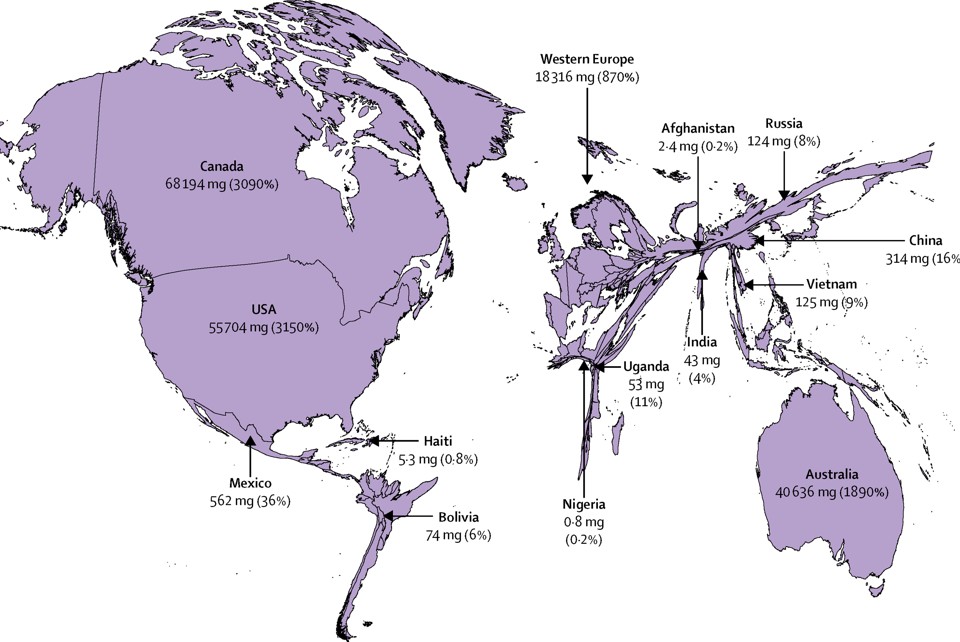
A map using size to show the relative opioid needs that are met by countries around the world in which North America is enormous and Africa and Asia are tiny

While the United States faces an epidemic of narcotic addiction, most of the world dies in pain.

The rate of death from opioid overdoses in the United States has more than doubled over the past decade. Amid a deluge of reports on the national crisis, it’s easy to lose sight of the fact that in much of the world many people die in preventable pain, without access to morphine for end-of-life care.

This is the finding of a global commission published in The Lancet, which includes analysis of the global distribution of narcotics. The above map shows a relative distribution of how much of the need for opioids is met in various places.

The focus of the report is addressing a relatively new target in global health, “serious health-related suffering” as a measure of the need for care. Palliative care, specifically, “should be focused on relieving the serious health-related suffering that is associated with life-limiting or life-threatening conditions or the end of life,” the authors write.

The idea is that suffering isn’t always preventable, but a few cents’ worth of morphine can make an enormous difference. Some 45 percent of the 56.2 million people who died in 2015 experienced serious suffering, the authors found. That included 2.5 million children. More than 80 percent of the people were from developing regions, and the vast majority had no access to palliative care and pain relief.

The authors conclude that the American opioid-overdose epidemic must be addressed in the same stroke as the narcotic famine: “A well-functioning and balanced global system must both prevent nonmedical use and misuse of medicines and ensure effective access to essential medicines for palliative care, including opioids for pain relief.”

That would involve including morphine in something called an Essential Package of palliative care and pain-relief interventions “to remedy the abyss in access to care.” These medications could be administered not just by doctors and nurses, but also by trained community health workers. The packages would be integrated into national health systems as part of universal health coverage, with the global scale helping make the model cost-effective.

They recommend immediate-release oral and injectable morphine for severe pain, which costs pennies per dose. At that rate, the “pain gap” could be closed for $145 million. This is less than some American pharmaceutical companies spend in any given year on marketing. To that end, the commission recommends prohibiting drug companies from marketing to patients or care providers—as the U.S. epidemic was driven by heavy marketing of powerful, expensive narcotics to address relatively moderate pain.

The United States stands as an outlier among wealthy countries in that it does not have a universal health-care system. As the country debates whether health care is a right, many objections come down to different understandings of what constitutes care—what it means to have a right to life and pursuit of happiness. The concept of serious health-related suffering may come to play in that discussion. Even the most austere fiscal conservatives have been reluctant to say that people with acute emergencies should be turned away from hospitals to die in the streets.

Access to morphine at the end of life would seem an area of agreement that transcends ideology—where the suffering of millions of people could be prevented at very little cost. Yet on a global scale, that’s not happening.

Don’t take opioids off the market – make it harder to abuse them

https://theconversation.com/dont-take-opioids-off-the-market-make-it-harder-to-abuse-them-79730?utm_medium=email&utm_campaign=Latest%20from%20The%20Conversation%20for%20October%201%202017%20-%2084576980&utm_content=Latest%20from%20The%20Conversation%20for%20October%201%202017%20-%2084576980+CID_49b12b4a2a39e7f173235a40290664ab&utm_source=campaign_monitor_us&utm_term=Dont%20take%20opioids%20off%20the%20market%20-%20make%20it%20harder%20to%20abuse%20them

Image result for Don’t take opioids off the market - make it harder to abuse them

How can we combat the opioid epidemic?

One of the government’s most recent suggestions is to take Opana ER, an opioid indicated for very severe pain, off the market. The request, filed by the U.S. Food and Drug Administration in June, was linked to concerns of abuse-related HIV and hepatitis C outbreaks.

But removing access to opioids altogether isn’t the solution. There are individuals suffering from chronic pain who need or strongly benefit from these drugs. The National Center for Health Statistics estimates that a fourth of the nation’s population suffers from pain lasting longer than 24 hours. Millions more suffer from acute pain.

As a researcher who studies how pharmaceuticals are used and what effects they have, I believe it makes more sense to reduce both the supply and demand side of prescription drug abuse – without interfering with their safe and appropriate use. We can do this by reimagining how we design and prescribe addictive drugs.

Redesigning the pill

Opioids such as morphine typically relieve pain by acting on opioid receptors distributed throughout the central nervous system.

The FDA has come up with a number of ways to deter abuse by changing the way drugs work. For example, manufacturers could include an opioid antagonist in the formulation. This is essentially a drug that blocks the opioid’s effect by binding to the same receptors in the brain that the opioid would. Changing the formulation in this way would reduce the chances of experiencing the euphoric high that leads to addiction.

A good example of an opioid that does this is Targiniq ER. If Targiniq ER is crushed or dissolved, it releases Naloxone, an opioid antagonist that blocks the effect of the opioid.

Another option is to redesign the drug so it must be injected or implanted, instead of taken orally. That way, the drug would potentially have to be delivered under medical supervision. Requiring the drugs to be delivered under medical supervision could also potentially reduce the improper use of needles and related outbreaks.

Even so, no method is foolproof; abusers can sometimes manipulate a changed drug. For example, Opana ER was designed to be difficult to crush, but abusers began to dissolve the drug into a solution and injecting it. To deter drug abuse, Opana ER’s manufacturer, Endo Pharmaceuticals, devised a new medication formula that made the coating more difficult to crush or dissolve. Unfortunately, abusers still found a way to remove the coating and inject the drug.

Required prescription monitoring

Prescription drug monitoring programs have shown considerable promise in tracking potential abusers.

These programs provide emergency departments and physicians with information about a patient’s past use of controlled substances at the point of care. This can immediately flag any potential for abuse, making the doctor’s decision to prescribe opioids – or not – much easier.

Now, the U.S. Substance Abuse and Mental Health Services Administration has funded at least nine states to combine their prescription monitoring programs with local hospital electronic health records and other systems already in place. These collaborations provide clinicians with a comprehensive history of controlled substance, so they can make informed decisions about patient health.

This has already had some success. For example, Illinois saw a 22 percent decrease in number of opioid prescriptions issued by prescribers and a 41 percent decrease in the number of patients who received at least one opioid prescription.

More information on the nature of the epidemic – particularly its link to rural areas – could yield clues about where and how to intervene. However, publicly available data have limited geographical information and don’t cover all information we might need, such as data about dose or treatment duration. What data are available are restricted to protect the identity of individuals.

Rather than look at patients with opioid issues, we decided to look at the doctors who prescribe the drugs. Our group has been working with the state of South Carolina to combine our prescription drug monitoring program, called South Carolina Reporting and Identification Prescription Tracking System, or SCRIPTS, with Medicaid data.

While we were able to combine only two years’ worth of data, our research led to important insights into the abuse potential within South Carolina.

By geocoding state prescription information, we found that a relatively small percentage of providers, concentrated in a few counties, accounted for most opioid prescriptions. In 2010, the top 10 percent of prescribers wrote more than half of all opioid prescriptions.

This group represents a potential target for physician education and engagement in handling pain management and appropriate use of opioids.

Rethinking how we assess patients

Many solutions to the opioid crisis tend to focus on how far it has come and how to mitigate it. However, a more sustainable approach would be to rethink the process of care and engage the patient – who is at the center of it all.

When patients are engaged in the care process, they tend to adhere more to their prescribed regimens and experience better health outcomes.

In most primary care settings, it is considered standard practice to ask patients to rate their pain on a scale from one to 10. This is a very crude measure, but now we need a more sophisticated method. Medical care should consider not only the providers’ preferences, but the patient’s, too.

We need a tool that gets at not only the level of pain an individual experiences, but also their preferences in dealing with pain. Studies showthat patient-provider communication plays an important role in pain management. If patients could share their specific concerns regarding their pain and their goals for treatment, then clinicians would be able to find the best treatment plan that is tailored to individual patient preferences.

Rather than using a standardized approach that matches pain level to doses of an analgesic or opioid, clinicians should assess each patient individually, looking at their tolerance for pain, their priorities for treatment and how they value outcomes.

By centering pain management on individual patients, we can give them a voice in the decision-making process. Given the issues with opioid abuse, I think such a pain management tool would yield a multitude of benefits, such as cutting down unnecessary prescriptions, matching the therapy to the patient’s needs and improving outcomes.