Asking the wrong question about physician consolidation

https://journals.sagepub.com/doi/10.1177/1077558719828938?utm_source=The+Weekly+Gist&utm_campaign=41103e2ef1-EMAIL_CAMPAIGN_2019_02_14_09_16&utm_medium=email&utm_term=0_edba0bcee7-41103e2ef1-41271793&

Image result for healthcare vertical integrationImage result for healthcare vertical integration

A paper out this week from Rice University healthcare economist Vivian Ho is the latest analysis to posit that vertical integration of doctors and hospitals does little to improve care quality. Researchers evaluated 29 primarily hospital-focused quality and patient satisfaction measures and found that higher levels of vertical integration were associated with improved performance on just a small number of metrics—and increased market concentration was associated with lower scores on all patient satisfaction measures.

Before concluding that vertical integration generates little improvement in quality, it’s worth looking a little deeper at the methodology of this study, as well as the larger drivers of hospital-physician integration. Researchers used a blunt measure of vertical integration, combining health systems’ self-reported physician alignment model with a standard index of hospital market concentration (on the theory that lower hospital-to-hospital competition indicates greater vertical integration). The performance measures examined are hospital-focused, ignoring outpatient care quality, as well as the nuance of whether the “integrated” physicians in any market are responsible for the outcomes measured (employing primary care doctors and orthopedic surgeons would have little impact on measures of hospital treatment of heart attacks).

In a press release, the author notes: “If patient welfare doesn’t improve after integration, there may be other reasons why physicians and hospitals are forming closer relationships—perhaps to raise profits.” That’s right: there are many motives for vertical integration. Surely profitability has been a driver, as well as the rising complexity and deteriorating economics of running an independent practice. In the real world, physician alignment strategies are rarely driven by the primary goal of improved quality. However, many health systems have begun to recognize that closer financial alignment is a necessary (but far from sufficient) requirement to enable real progress on quality improvement. Regardless of alignment approach, though, quality improvement results from the hard work of care process redesign and cultural change, not as the inevitable result of vertical integration. Success stories are still too few and far between, but we believe there is value in leveraging vertical integration to make this work easier. Condemning vertical integration seems a harsh verdict; a more appropriate criticism would be that much of the heavy lifting of care redesign is yet to begin.


These 6 healthcare leaders say quality improvement is an organizationwide effort and a cultural imperative

https://www.fiercehealthcare.com/healthcare/6-inspiring-quotes-improving-quality-from-6-healthcare-leaders?mkt_tok=eyJpIjoiWVRNeE1HSTFPREkwTmpsbSIsInQiOiJtcHFUTmw4bU5UWE0rbE44Q0ExcUc5cEI5SSt0UVdcL0ZYVDllbUhMN3VNXC9ab2JTTlwvKzVYOXMyTmVmRlwvZjJ2VzNZWmp5Z2VJeERzVytyWUZOdkVyRmdnVWNWSEV6SVhkSWVHSFljSkhRV05rMUt5WFwvemVvM2dsMEpUeW1rYUx2In0%3D&mrkid=959610

Executive looking out window

Despite recent uncertainty about the government’s commitment to value-based care, healthcare organizations remain focused on efforts to improve quality, patient care and employee engagement.

In 2017 the Centers for Medicare & Medicaid Services cancelled mandatory bundled payment models for hip fractures and cardiac care and also asked providers for feedback on other value-based payment models.

But healthcare organizations seem committed to the initiatives they have already put in place to improve quality. Indeed, last year healthcare leaders shared their successes, challenges and lessons learned as they worked to improve quality and patient outcomes. We’ve rounded up the most memorable quotes from these healthcare thought leaders about quality, the importance of physician engagement and how to achieve a culture of patient safety.

Here are six of our favorite quotes from our interviews and industry news and event coverage over the past 12 months:

1. “We had to challenge our old paradigms. Physicians are instrumental in setting the tone, and unless the physicians believe we’re on the right path we don’t have the kind of alignment that will help us move forward.”

Gary Kaplan, M.D., chairman and CEO of Virginia Mason Health System, explained in a webinar this fall how the Seattle system improved patient safety using a patient-centered approach. Virginia Mason’s safety culture transformation began in 2001, Kaplan said, when system leaders realized that a physician-centered approach alone would not improve patient care.

2. “You need to start with the early adopters. You can’t start with folks who will fight you tooth and nail. You want to start with early successes and then evolve from there.”

Felipe Osorno, an executive administrator at Keck Medicine of the University of Southern California, spoke at the Institute for Healthcare Improvement’s annual quality forum about strategies to engage physicians in improvement initiatives. The secret was designing a program in which physicians were respected for their competency and skills, their opinions were valued, they had good relationships with their medical colleagues, they had a broader sense of meaning in their work and they had a voice in clinical operations and processes, he said.

3. “We really want to attract folks who believe at their core, not just intellectually but in their heart, that kindness can heal. … If we do it right the first time and we assess candidates based on the fit of the organization, ideally we will have more engaged employees who deliver care in a way that is patient-centered.”

Wanda Cole-Frieman, vice president of talent acquisition at Dignity Health, talked to FierceHealthcare this summer after the California system was named by an online job platform as the best place to interview in 2017. Among its techniques: It assesses candidates’ behavioral competencies for human kindness, compassion and the human experience.

4. “To create a true culture of safety and reliability we need to engage everyone, and it can only be driven when we have strong alignment. Everyone can play a role in safety.”

Gary Yates, M.D., a partner in strategic consulting at Press Ganey, explained in an interview that building and promoting a culture of safety at healthcare organizations is important to retain current staff members, but is also an especially effective recruiting tool for millennials, who will make up half of the workforce by the year 2020.

“People talk, and people ask about the culture inside different organizations,” Yates said. Putting the spotlight on safety and quality could “tip the scales” for young people.

5. “Our focus is safety, to fundamentally be a safe hospital. If we start there or if any hospital starts there, patient experience will take care of itself, quality metrics will take care of itself as will employee morale.”

FierceHealthcare caught up with Nicholas “Nico” R. Tejeda, CEO of The Hospitals of Providence Transmountain Campus in El Paso, Texas, at an American College of Healthcare Executives event. He talked about opening a new teaching hospital and establishing the culture of the organization from the beginning and with every hire.

There are no acceptable levels of errors, he said. And while it may be nearly impossible to achieve zero incidents, he still wants the organization he leads to strive for perfection.

6. “We don’t see quality as just a clinical goal. It’s an enterprisewide priority that encompasses customer service, compliance and wellness.”

A few years ago, Anthem decided to make a “rigorous” effort to boost the quality of its plans. And it’s demonstrating results, Anthem’s then-CEO Joseph Swedish said during the 2017 AHIP Institute & Expo. Now, more than half of the insurer’s Medicare Advantage enrollees reside in 4-star plans, compared to just 22% the year before.


The Opportunities and Challenges of the MSSP ACO Program: A Report From the Field

https://www.aledade.com/new-journal-article-a-report-from-the-field/

table

The trillion dollar shift in healthcare payment “from volume to value” is well underway with both public and private payers and purchasers pushing provider organizations to participate in outcome-based risk contracts, stepping up from pay-for-performance and medical home models to a variety of accountable care and bundled payment programs.

But what are we to take away from the mixed results of these programs — from the lack of savings in the Comprehensive Primary Care demonstration, to the dropouts from the Pioneer program, the recently released underwhelming results from the first year of the Bundled Payment for Care Improvement Initiative, or the 2015 results from the Medicare Shared Savings Program?

One approach would be for partisans for each of these approaches to search for positive nuggets in the results from their preferred program, while heaping scorn on the other “competing” reforms.

Another would be to retreat altogether from the aspirations of achieving better care at lower cost, towards either resignation towards ever-escalating health care costs or more likely to (altogether regretful!) rationing of access to good healthcare for the most vulnerable in our society.

A third path would be to acknowledge that there is no magic bullet for “transforming healthcare” overnight, and that the work of redesigning our delivery systems to meet the expectations of the outcome-based payment models will be slow, hard, and uneven. We would accept that there are likely multiple payment reforms that will need to be implemented alongside each other, targeting different healthcare markets and different participants. (Capitated payments for truly integrated delivery networks. Mandatory bundled payments for proceduralists and hospitals. Accountable care for independent physician networks). And each model will need to be iterated and tweaked and incrementally improved.

That is what I choose to believe.

We are publishing today in the new issue of the American Journal of Managed Care, “A Report From the Field,” the detailed description of what our two ACO “freshman” accomplished in 2015, and openly discussing the challenges we faced, what we are doing differently now, and some policy changes that can put more wind to the backs of those in these trenches.

Here are a few of the key findings:

http://www.ajmc.com/journals/issue/2016/2016-vol22-n9/The-Opportunities-and-Challenges-of-the-MSSP-ACO-Program-A-Report-From-the-Field

Conclusions:

We have learned that, given the right support and incentives, independent primary care practices can embrace population health and practice redesign. These efforts can begin to bear fruit in improved patient access, quality of care, and appropriate utilization in the short term. We strongly believe that the benefits of the program to patients and the taxpayer are not limited to those ACOs that received shared savings distributions. However, lack of recognition of these contributions may stifle continued innovation and physician engagement with alternative payment models. Aledade is committed to navigating these challenges and we are committed to sharing our learning so that more independent physician-led ACOs can succeed in their mission to profitably deliver better care at lower cost. We also hope that policy makers and commercial payers continue to work to remove the unintended policy headwinds ACOs must presently overcome. – See more at: http://www.ajmc.com/journals/issue/2016/2016-vol22-n9/the-opportunities-and-challenges-of-the-mssp-aco-program-a-report-from-the-field/P-5#sthash.3V1BtAtZ.dpuf


One in Five U.S. Hospitals Fail to Adopt Crucial “Never Events” Policies

http://www.4-traders.com/CASTLIGHT-HEALTH-INC-16000944/news/Castlight-Health-One-in-Five-U-S-Hospitals-Fail-to-Adopt-Crucial-Never-Events-Policies-22497774/

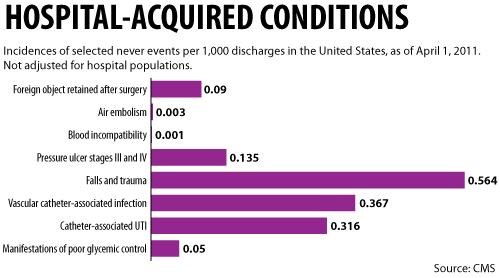
Hospital Acquired Conditions

“Never Events are egregious and they truly should never happen, but at the very least if they do happen, we expect hospitals to take the most humane and ethical approach,” said Leah Binder, president and CEO of Leapfrog. “Unfortunately, many hospitals still won’t commit to doing the right thing, including apologizing to the patient or family and not charging for the event. We should see 100% of hospitals with the Leapfrog policy.”