


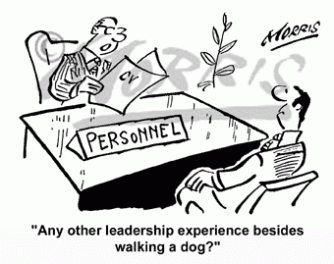
Cartoon – Leadership Experience?



Mercy Health, a 23-hospital system based in Cincinnati, has launched a student loan repayment program to attract and retain nurses in hard-to-fill roles, according to WVXU.
Due to tough competition for nurses and an increase in voluntary turnover, Mercy Health typically has between 1,500 and 2,000 openings for nursing positions. “We’ve seen voluntary turnover of almost 18 percent,” Allan Calonge, Mercy Health’s human resources vice president, told WVXU. “That’s quite a bit higher than it has been historically.”
Officials hope the new student loan repayment program will help address the problem. Mercy will make monthly contributions toward outstanding student loan debt for nurses who qualify. The system will contribute up to $20,000 to each nurse’s loans, according to WLWT.
“Talented nurses are vital to ensuring the health and well-being of our patients,” Mr. Calonge told WLWT. “Our new student loan repayment program is a win-win for us and our nurses.”


How do you define a valuable employee? Is it experience or maybe work ethic? Do you see competence in a specific area as the be-all and end-all of determining employee value?
What about soft skills? Do they hold the same value when interviewing for a rock star engineer or strategist position? Well, they should.
While technical skills and other hard skills defined in the job description matter, it’s an employee’s people skills and a whole host of other personal attributes that are crucial for long-term success.
Most companies undervalue soft skills or the impact people development will have on an organization. They assume the hard stuff holds more weight and makes the business go around. In turn, when difficult personalities and egos emerge, when sudden change and uncertainty takes place, and when conflict seems inevitable, it’s the employees with the natural ability to communicate and respond to crisis who hold the most value.
When crafting the people elements for fostering a great company culture, here are eight employees you’ll want to consider hiring:
Effective communication isn’t just about talking; it is also the ability to listen and understand what’s happening on the other side of the fence. The best people-centered employees will listen and reflect back what they hear to clarify (“What I hear you saying is …”), and they’ll ask questions to probe the other person’s feelings or opinions. This can be as simple as: “Tell me how you feel about this.”
While IQ still remains the best predictor of job success, once you land a job and start thinking about increasing your role, managing multiple priorities, getting promoted, leading others, and navigating political landscapes, IQ will be begging for EQ to show up. Daniel Goleman, the foremost authority on emotional intelligence, has put together these nine important questions to help a person evaluate his or her emotional intelligence.
People with patience have the capacity to process a situation about to go south, get perspective, listen without judgment to someone they disagree with, and hold back from reacting head on. Practicing this rare business virtue may mean deciding to sit on your decision. By thinking over things with a rational and level head, you’ll eventually arrive at a more sane conclusion. These are the people you want to build a company culture around.
Employees with emotional intelligence have a clear advantage: they cut through the drama by telling the facts as they see them and how it affects them. Let me unpack that further: These people are able to diffuse an emotionally-charged moment with a calm demeanor, explain the outcome they’re hoping for, and ask for other ideas for solutions with an open mind. By hiring people with the ability to manage conflict, you’ll see more constructive, productive, and respectful discussions taking place, which can help resolve hairy situations to everyone’s satisfaction.
Self-control (or “self-management”) is a personal competence developed in every person. The question behind self-control is: Can I manage my emotions and behavior to a positive outcome? Not everyone can. Daniel Goleman says this about people with self-control:
“Reasonable people–the ones who maintain control over their emotions–are the people who can sustain safe, fair environments. In these settings, drama is very low and productivity is very high. Top performers flock to these organizations and are not apt to leave them.”
Productive people are successful in managing their time because they avoid juggling many things. Research says multitasking is a myth and can be damaging to our brains. You end up splitting your focus over many tasks, losing focus, lowering the quality of your work and taking longer to hit your goals.
Top employees are looking for companies that allow them to integrate work and life during their schedule, and the smartest bosses are giving them that flexibility because it makes business sense. One example is the workplace habit of taking short, frequent breaks. A 2016 study showed that hourly five-minute walking breaks (out in nature with a friend, for example) boosted energy levels, sharpened focus, and improved mood throughout the day. These “microbursts of activity” increase motivation and concentration and enhance creativity, according to researchers at Stanford University.
Forget time management –you want people who are good managers of “self.” By managing your life, tasks, and priorities efficiently, you can seamlessly transition to more productivity, higher work satisfaction, and better personal well-being. And that’s what the most valuable employees do to reach their most optimal level of self-management. For example:
Your turn: What traits or behaviors have you seen the most valuable employees exhibiting?


 HENRY KOTULA