Uninsurance of children, parents inched back up in 2017, report finds

https://www.healthcaredive.com/news/uninsurance-of-children-parents-inched-back-up-in-2017-report-finds/554590/

Dive Brief:

  • After improving for several years, insurance gains and participation in Medicaid and the Children’s Health Insurance Program tilted downward in 2017, a new Urban Institute report shows.
  • In the first three years following implementation of the Affordable Care Act, the uninsurance rate dropped from 7% to 4.3% among children and from 17.6% to 11% among parents, or about 40% for both groups. In 2017, however, the children’s uninsurance rate inched back up to 4.6%, or an additional 281,000 uninsured children, and parents’ coverage rate stalled.
  • Uninsurance rates rose both in states with and without the ACA’s Medicaid expansion, but the increase was more pronounced in states without expansion programs.

Dive Insight:

The findings jibe with recent data from the Centers for Disease Control’s National Health Interview Survey, which showed more than 1.1 million Americans lost health coverage in 2018, pushing the total number of uninsured from 29.3 million in 2017 to 30.4 million last year. Among surveyed adults between 18 and 64 years old, 13.3% were uninsured, 19.4% had public health coverage and 68.9% had private coverage.

The trend coincides with Trump administration efforts to weaken the ACA by eliminating several mechanisms meant to stabilize payers participating in ACA exchanges and pushing stripped-down, noncompliant health plans. The result has been rising premiums and a resurgence in the number of uninsured.

Adding to uncertainty about the ACA’s future is the U.S. Department of Justice’s support for a Texas federal district court that ruled the law unconstitutional without its individual mandate penalty, which a Republican-led Congress removed in 2017. A previous Urban Institute report estimated up to 20 million Americans would lose health insurance if the lawsuit prevails — a majority of whom are currently covered through Medicaid expansions and ACA exchanges.

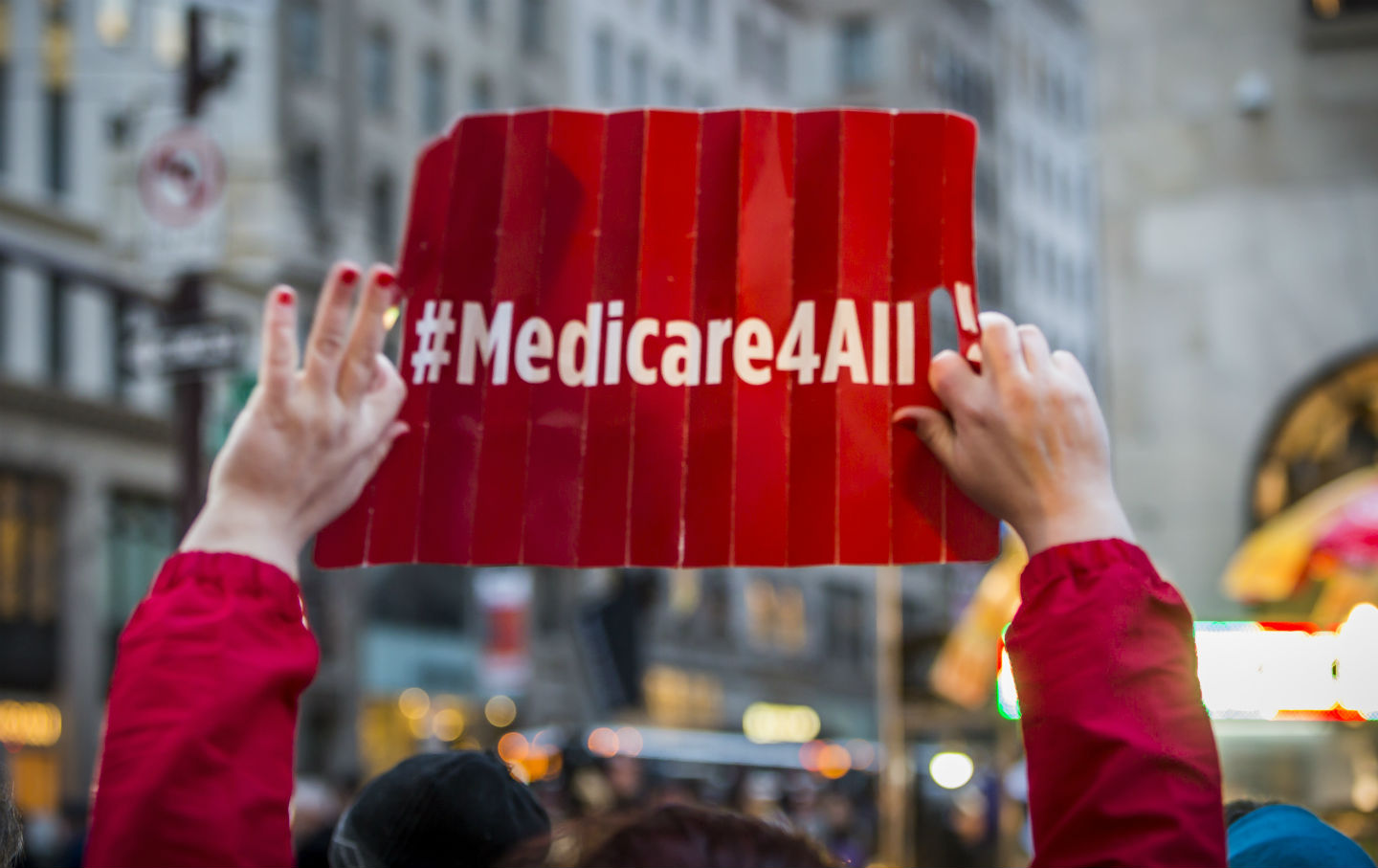
While the ACA remains in legal jeopardy, Democrats and presidential candidates are looking at ways to increase the numbers of insured Americans, from shoring up the ACA to implementing some type of single-payer system or “Medicaid for All.”

According to the Urban Institute, participation in Medicaid/CHIP among children increased from 88.7% in 2013 to 93.7% in 2016, and from 67.6% to 79.9% for parents. Those gains reversed in 2017, however, with Medicaid/CHIP participation dropping to 93.1% among children and remaining unchanged for parents.

Among those who did not enroll in Medicaid/CHIP in 2017, 2 million children and 1.7 million parents were eligible for the programs — versus 1.9 million and a steady 1.7 million, respectively, in 2016.

More than half of the uninsured children and parents who were eligible for the Medicaid/CHIP lived in California, Florida, Georgia, Illinois, Indiana, New York, Pennsylvania and Texas, according to combined 2016-2017 data.

Parents were more than twice as likely to be uninsured as children in 2017. For example, children’s uninsurance rate was less than 5% in most states and under 10% in nearly every state, while parents’ uninsurance was less than 5% in just four states and over 10% in close to half the states, the report says.

The decline in improvement was worse among certain subgroups. “In 2017, the uninsurance rate was nearly 6% or higher among adolescents, Hispanic and American Indian/Alaska Native children, citizen children with noncitizen parents, and noncitizen children,” according to the report. “And consistent with prior years, one in six parents or more who were ages 19 5o 24, Hispanic or American Indian/Alaska Native, below 100 percent of FPL [federal poverty level], receiving SNAP [Supplemental Nutrition Assistance Program] benefits, or noncitizen were uninsured in 2017.”


Can Paying for a Health Problem as a Whole, Not Piece by Piece, Save Medicare Money?

Can Paying for a Health Problem as a Whole, Not Piece by Piece, Save Medicare Money?

Among the standard complaints about the American health care system is that care is expensive and wasteful. These two problems are related, and to address them, Medicare has new ways to pay for care.

Until recently, Medicare paid for each health care service and reimbursed each health care organization separately. It didn’t matter if tests were duplicated or if a more efficient way of delivering care was available — as long as doctors and organizations were paid for what they did, they just kept providing care the way they always had.

But ordinary people do not think this way. We focus on solving our health problem, not which — or how many — discrete health care services might address it. New Medicare programs are devised to more closely align how care is paid for with what we want that care to achieve.

One of these programs is known as bundled payments. Instead of paying separately for every health care service associated with a medical event, you pay (or Medicare pays, in this case) one price for the entire episode. If health care providers can address the problem for less, they keep the difference, or some of it. If they spend more, they lose money. Bundled payment programs vary, but some also include penalties for poor quality or bonuses for good quality.

Medicare has several bundled payment programs for hip and knee replacements — the most common type of Medicare procedures — and associated care that takes place within 90 days. This includes the operation itself, as well as follow-up rehabilitation (also known as post-acute care). In theory, if doctors and hospitals get one payment encompassing all this, they will better coordinate their efforts to limit waste and keep costs down.

Do bundled payments work? They certainly appear promising, at least for some treatments. But it’s important to conduct rigorous evaluations.

Previous studies for Medicare by the Lewin Group and other researchers suggest that Medicare’s Bundled Payments for Care Improvement program has reduced the amount Medicare pays for each hip and knee replacement.

But that doesn’t mean the program saved money over all.

One possible issue would be if, despite saving money per procedure, health care providers wastefully increased the number of procedures — replacing hips and knees that they might not otherwise. A related concern is if hospitals try to increase profits by nudging services toward patients who may not need a procedure as much as patients with more severe and more expensive conditions. An average joint replacement costs $26,000, split almost equally between the initial procedure and post-acute care. But more expensive cases can be $75,000 to $125,000 — a costly proposition for hospitals.

A recent study published in JAMA examined whether the volume of Medicare-financed hip and knee replacements changed in the markets served by hospitals that volunteered for a bundled payments program, relative to markets with no hospitals joining the program. It found no evidence that the bundled payment program increased hip and knee replacement volume, and it found almost no evidence that hospitals skewed their services toward patients whose procedures cost less.

“These results suggest bundled payments are a win-win,” said Ezekiel Emanuel, a co-author of the study. “They save payers like Medicare money and encourage hospitals and physicians to be more efficient in the delivery of care.”

But Robert Berenson, a fellow at the Urban Institute, urges some caution. “Studying one kind of procedure doesn’t tell you much about the rest of health care,” he said. “A lot of health care is not like knee and hip replacements.”

Michael Chernew, a Harvard health economist, agreed. “Bundles can certainly be a helpful tool in fostering greater efficiency in our health care system,” he said. “But the findings for hip and knee replacements may not generalize to other types of care.”

Christine Yee, a health economist with the Partnered Evidence-Based Policy Resource Center at the Boston Veterans Affairs Healthcare System, has studied Medicare’s previous efforts and summarized studies about them. (I and several others were also involved in compiling that summary.) “Medicare has tried bundled payments in one form or another for more than three decades,” Ms. Yee said. “They tend to save money, and when post-acute care is included in the bundle, use of those kinds of services often goes down.”

One limitation shared by all of these studies is that they are voluntary: No hospital is required to participate. Nor are they randomized into the new payment system (treatment) or business as usual (control). Therefore we can’t be certain that apparent savings are real. Maybe hospitals that joined the bundled payment programs are more efficient (or can more easily become so) than the ones that didn’t.

Another new study in JAMA examines a mandatory, randomized trial of bundled payments. On April 1, 2016, Medicare randomly assigned 75 markets to be subject to bundled payments for knee and hip replacements and 121 markets to business as usual. This policy experiment, known as the Comprehensive Care for Joint Replacement program, will continue for five years. The JAMA study analyzed just the first year of data.

“In this first look at the data, we examined post-acute care because it is an area where there is concern about overuse,” said Amy Finkelstein, an M.I.T. health economist and an author of the study. “In addition, prior work suggested that it’s a type of care that hospitals can often avoid.”

The study found that bundled payments reduced the use of post-acute care by about 3 percent, which is less than what prior studies found. “Those prior studies weren’t randomized trials, so some of the savings they estimate may really be due to which hospitals chose to participate in bundled payment programs,” Ms. Finkelstein said. Despite reduced post-acute care use, the study did not find savings to Medicare once the costs of paying out bonuses were factored in. The study also found no evidence of harm to health care quality, no increase in the volume of hip and knee replacements, and no change in the types of patients treated.

“Savings could emerge in later years because it may take time for hospitals to fully change their behavior, “ Ms. Finkelstein said. In addition, the program’s financial incentives will increase over time; bonuses for saving money and penalties for failing to do so will rise.

On the other hand, Dr. Berenson said, health care providers could figure out how to work the system: “In three to five years, we may see volume go up in a way that offsets savings through reduced payments for a procedure. We’ll wait and see.”

Medicare put its best foot forward by using a randomized design. Not only were the markets selected in a randomized fashion, but providers in those markets were also required to participate. Though common in medical studiesrandomization is rare in health care policy, as is mandatory participation. Nearly 80 percent of medical studies are randomized trials, but less than 20 percent of studies testing health system change are. Organizations that would be subject to the experiments often strongly resist randomizing health system changes and forcing providers to participate.

Unfortunately, the randomization of the Comprehensive Care for Joint Replacement program will be partly compromised in coming years. The Centers for Medicare and Medicaid Services announced last year that hospitals in only half of markets under the program would have to stay in it. Participation is voluntary in the other half, and only one-quarter of hospitals opted in.

Going to a partly voluntary program will make it harder to learn about longer-term effects, Ms. Finkelstein said, and to get at the answers we’re seeking.

Behind the Debate Over ‘Medicare for All’

https://www.weeklystandard.com/chris-deaton/behind-the-debate-over-medicare-for-all

Image result for Behind the Debate Over ‘Medicare for All’

The federal price tag of Bernie Sanders’s proposal is not surprising. But the implications are kind of insane.

Bernie Sanders’s “Medicare for all” proposal is receiving new scrutiny because of an estimate released this week by economist Chuck Blahous of the right-leaning Mercatus Center. Blahous projects that the plan would cost the government $32.6 trillion over 10 years but also reduce the country’s overall level of health expenditures by $2 trillion. “M4A” advocates say that these numbers are two sides of the same coin: that because the program would redirect spending for health care to the government and lower aggregate expenses in the economy, the exorbitant cost to taxpayers would be, as multiple left-leaning analyses have put it, “a bargain.” But Blahous’s research of the Sanders plan, like that of his contemporaries, is loaded with assumptions and caveats that reduce conclusions about the idea’s cost-saving to speculation. If anything, it’s fair to say that the research shows how M4A is a risk of historic price.

For the average individual, the point of “Medicare for all” is to have federal tax revenue pay for health coverage that is comprehensive and basically free to use. Sanders’s proposal includes wide-ranging benefits applicable in “medically necessary or appropriate” circumstances and eliminates cost-sharing, meaning no copays, deductibles, or similar charges. The expense to households is less take-home pay: a new, de facto “premium” paid to Washington, maybe higher payroll taxes, and, depending on income level and economic behavior, higher income taxes from rate hikes.

Similar trade-offs would appear elsewhere: Businesses would not offer their employees coverage under an M4A scheme, for example. But they, too, would have to foot the cost, through a higher corporate tax rate, potential taxes on their own behavior (like on carbon), and perhaps an employer-specific premium like the one paid by individuals. Some of these ideas are incorporated into Sanders’s thinking; depending on the bill’s projected cost, more of them may be necessary to compensate for the government’s expense.

This is where Blahous’s work comes in. Whereas Sanders’s campaign forecast his M4A plan to cost $1.38 trillion per year, Blahous projected that number to be more than double, at $3.26 trillion, in the paper he published on Monday. “For perspective on these figures, consider that doubling all currently projected federal individual and corporate income tax collections would be insufficient to finance the added federal costs of the plan,” he wrote. His assessment met skepticism from some in the press, given Mercatus’s affiliation with the Koch brothers.

Notwithstanding the sloppiness of such a charge—Mercatus is directed by a world-class economist respected across the political spectrum, Tyler Cowen, and Blahous’s paper was peer-reviewed and reflected his own research, regardless—Blahous’s findings were similar to the Urban Institute’s, a well-regarded and left-leaning think tank that examined the Sanders proposal in 2016. Its 10-year federal cost estimate was $3.20 trillion a year.

The Urban Institute economists ran their numbers based on the Vermont senator’s framework for Medicare for all. But Sanders introduced his legislation in the Senate last year, which provided Blahous more specifics to analyze and alternative scenarios to consider. For example: Sanders’s plan caps reimbursements to physicians and hospitals for services at the Medicare reimbursement rate, which is significantly lower than reimbursements under private plans (but higher than those under Medicaid). “In 2014, Medicare hospital payment rates were 62 percent of private insurance payment rates and are currently projected to decline to below 60 percent by the time M4A would be implemented, and to decline further afterward. Medicare physician payment rates were 75 percent of private insurance rates in 2016 and … are projected to decline sharply in relative terms in future years, also falling below 60 percent within the first full decade of M4A,” Blahous writes.

The surprising finding in his study is that Sanders’s Medicare for all bill would decrease national health expenditures (NHEs) over the next decade by $2 trillion. Many M4A advocates celebrated this estimate, given the unlikely source of it. But there are two things to keep in mind. One, national health expenditures are different from government expenditures: They comprise aggregate spending on health care in the United States, in both the private and public sectors. (They have a specific definition, per the Centers for Medicare and Medicaid services, available on Page 6 here.) Two, while keeping reimbursement rates at the relatively low Medicare level would help contain the total dollar figure of NHEs, it also would jar the finances of medical providers.

“Perhaps some facilities and physicians would be able to generate heretofore unachieved cost savings that would enable their continued functioning without significant disruptions,” writes Blahous. “However, at least some undoubtedly would not, thereby reducing the supply of healthcare services at the same time M4A sharply increases healthcare demand.” Difficulty accessing care “almost certainly must arise”—which is not a controversial statement, but mere economic intuition.

“Setting provider payment rates for acute care services at levels consistent with the current law Medicare program may be too restrictive,” the Urban Institute study stated. “Payment rates may in fact have to be higher, at least initially and perhaps indefinitely, to be acceptable to providers.”

Anticipating this scenario, Blahous runs the numbers keeping reimbursements to providers and physicians on pace with current projections. This situation results in an annual cost to government of $3.80 trillion, not $3.26 trillion—and a net increase in NHEs of $3.25 trillion over a decade, instead of a decrease of $2.05 trillion. This represents a range of realistic outcomes, and given political and economic realities, something close to the alternative payment arrangement has to be considered a likelihood.

Of course, all this discussion pertains only to finances, not the pluses and minuses of access and quality of care: low-income individuals getting covered, but consumers demanding more care while suppliers shrink the availability of it, for instance. It also does not consider how the goalposts of whether the public scores a good deal with M4A could move. Jacobin magazine called the Sanders plan “a bargain” based on Blahous’s score, since “[w]e get to insure every single person in the country, virtually eliminate cost-sharing, and save everyone from the hell of constantly changing health insurance all while saving money.” But what if the public doesn’t save money, as in the alternative scenario Blahous evaluates? The same advocates could argue so what?—even if the public is paying more money on net, it’s doing so in the cause of insuring 30 million more people. They could frame those numbers as being worth it.

The thrust of the costs is that M4A is not some unassailable good and an easy system relative to the status quo, even for all the inefficiencies of the current, messy health insurance market. Again, this is not a critique confined to a right-of-center perspective. As the Center for American Progress’s Topher Spiro wrote on Monday (in a since-deleted tweet):

spiro-m4a.jpg

Medicare for all would represent an historically large cost shift between the American economy and federal government. Simply citing the budget impact of such a proposal—$32.6 trillion over a decade—to invalidate the merits of the idea cuts the debate unjustifiably short, as left-of-center critics have stated. But incorporating the other financial aspects of M4A does not cinch their case. It instead complicates it, undermines it, and brings the debate about American health care back to philosophical grounds.

Does the public believe Washington should have total financial control of the market, to the tune of more than $3 trillion in tax revenue a year? Does it trust Washington to allocate those taxes fairly? And given the range of outcomes for reducing health costs—to the point it may not reduce them at all—does it believe that such a transition merits the risk?