


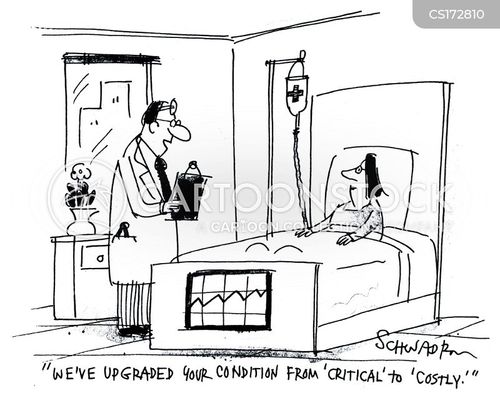
Cartoon – A Barrier to Progress

As employees shoulder a greater portion of medical costs, finance has become an important factor in patients’ healthcare decisions.
ClearBalance’s healthcare consumerism survey is designed to measure patients’ awareness and perception of healthcare finances. More than 2,700 ClearBalance customers completed the survey in August.
ClearBalance partners with hospitals and healthcare providers to offer interest free financing programs to patients who are unable to afford their medical treatment upfront.
Below are four survey findings.
Earlier this month, Modern Healthcare reported that CHS plans to sell more than the 12 hospitals it has for sale, quoting CFO Larry Cash speaking at the Wells Fargo Securities Healthcare Conference in Boston.
Cash said they are getting interest in additional hospitals. And after examining its portfolio of 159 hospitals, it likely will see “other transactions” before the end of the year, he said.
The hospitals previously up for sale will likely be sold as part of five transactions. Not-for-profit hospital systems are among the prospective buyers, he said.
CHS is not disclosing which hospitals it is negotiating to sell. But the company said that combined, they generate annual revenue of about $1.45 billion and expect to yield net proceeds of $850 million. The proceeds will be used to reduce overall indebtedness, Cash said.
In April, CHS completed the spinoff of 38 mostly small and rural hospitals into a new public company, Quorum Health Corp. That divestiture brought about $1.2 billion in net proceeds, money that also was used to reduce debt.
Plunging earnings complicated by continued low margins at Health Management Associates hospitals that CHS purchased for $3.9 billion in 2014 has caused CHS’ stock price to plummet.
The stock traded at $60 a share a year ago.

People who warn that President Obama’s health-care law is in dire straits often point to rising health insurance premiums as proof. Sen. John McCain (R-Ariz.) has called premium increases on Affordable Care Act exchanges “astronomically high.” Sen. Ron Johnson (R-Wis.) says premiums have “skyrocketed.”
But are these growing premiums actually high?
A new analysis from the Urban Institute found that the average unsubsidized premiums in the Affordable Care Act exchanges, commonly known as Obamacare, are actually 10 percent lowerthan the full premiums in the average employer plan nationally in 2016.
Nationally, the average employer-sponsored premium was $516 a month, while the unsubsidized marketplace premium was $464. To make an apples-to-apples comparison, the researchers adjusted marketplace premiums to account for the age of enrollees and the different value of the health coverage provided by the marketplace plans.
The exchanges offer health coverage to people who aren’t insured through their jobs, with subsidies based on income. About 11 million people are insured through the marketplaces, compared with about 155 million Americans who receive insurance coverage through employer-provided plans.
Recent news of large insurance carriers pulling out of some states’ marketplaces and hiking premiums in others has raised concerns that offering health insurance through exchanges isn’t sustainable and the health care offered isn’t affordable.

Between one million and three million Americans are given diagnoses of sepsis each year, and 15 percent to 30 percent of them will die, Dr. Frieden said. Sepsis most commonly affects people over 65, but children are also susceptible. According to one estimate, more than 42,000 children develop sepsis in the United States every year, and 4,400 die.
Sepsis develops when the body mounts an overwhelming attack against an infection that can cause inflammation in the entire body. When that happens, the body undergoes a cascade of changes, including blood clots and leaky blood vessels that impede blood flow to organs. Blood pressure drops, multiple organs can fail, the heart is affected, and death can result.
“Your body has an army to fight infections,” said Dr. Jim O’Brien, the chairman of Sepsis Alliance. “With sepsis, your body starts suffering from friendly fire.”
Sepsis appears to be rising. The rate of hospitalizations that listed sepsis as the primary illness more than doubled between 2000 and 2008, according to a 2011 C.D.C. study, which attributed the increase to factors like the aging of the population, a rise in antibiotic resistance and, to some extent, better diagnosis.
Sepsis is a contributing factor in up to half of all hospital deaths, but it’s often not listed as the cause of death because it often develops as a complication of another serious underlying disease like cancer. So although death certificates list sepsis as a cause in 146,000 to 159,000 deaths a year, a recent report estimated that it could play a role in as many as 381,000.
Yet advocacy organizations say many Americans have never heard of sepsis and don’t know the signs and symptoms.

Rising drug costs are a big problem at St. Louis, Missouri-based Ascension, the largest nonprofit health system in the United States. Despite efforts to monitor the drugs used by the health system, the cost of many older generic drugs has increased by as much as 10.5% in the last year, says Roy Guharoy, PharmD, vice president and chief pharmacy officer for The Resource Group at Ascension. This cost increase, which only includes older generics, cost the health system as much as $70 million between May 2015 and May 2016.
These and other drug price increases are untenable, especially in the midst of the transition from fee-for-service to value-based care, he says. And it’s particularly challenging, given that Ascension is a faith-based healthcare organization that provided approximately $1.8 billion in charity care in 2015.
GuharoyAscension monitors price changes in as close to real time as possible, so that leadership can take immediate action, such as switching to generic drugs or another drug at a better price, says Guharoy. Integral to this process is having physician leaders and specialists in the field review the literature to look at the efficacy of certain drugs to determine their appropriate usage for Ascension’s patients.

The pharmaceutical industry is complex—it’s ever changing and growing. That’s why Managed Healthcare Executive (MHE) conducted its first-ever managed care pharmacy survey to better identify top industry trends and challenges. To conduct the survey, which was performed during the second quarter of 2016 and received nearly 230 responses, MHE partnered with Access Market Intelligence and the National Institute of Collaborative Healthcare. Here’s a look at some of the key trends reflected by the survey findings, and analysis from experts. Here’s a look at some of the key findings from the survey, with experts weighing in on the results.


 HENRY KOTULA