

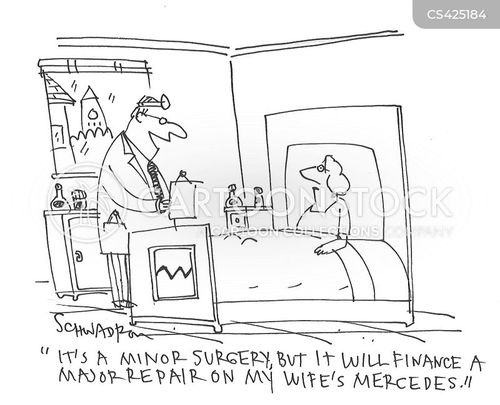
Cartoon – Minor Surgery


Diagnosing why innovation hasn’t stopped healthcare productivity declines

Autonomous vehicles. Augmented reality. Artificial Intelligence.
The world is undergoing radical transformation via technological innovation. Healthcare is not immune to this trend and has lately unleashed its own wonders from CRISPR to 3D-printed prosthesis to sensor-enabled pills. We can truly transform lives in ways unimaginable even just 10 years ago.
In other ways, however, healthcare lags.
In transportation, Google’s first “driverless” Street View cars were on the road a scant few years after the DARPA Grand Challenges of the mid-2000s that paved the way for them, and Uber become a verb in the same amount of time it takes to implement a current EHR system. Furthermore, Amazon’s chatty Alexa now interacts with you in your home, having arrived just a short time after Siri became the personal assistant in your pocket.
Healthcare innovation has been incapable of gaining similar traction even with profound technological advances.
There is an unmentionable dark side of healthcare innovation.
Advances in productivity via utilization of new tools and technologies has been anemic. Healthcare is struggling to keep pace with other industries. In fact, in a recent McKinsey study, healthcare is one of only two industries (construction is the other) that has shown a productivity decline. Read that again: Despite IT spending growth increasing by over 5 percent per year over the last 10 years, we’ve actually seen the healthcare labor pool and service environment become less efficient!

Hospital and health system consolidation will continue to build, giving the delivery system a significant makeover during the next decade, according to Health Care 2020: Consolidation, a new report published by the Healthcare Financial Management Association. Over that time, healthcare organizations will be challenged to prove that the changing landscape actually improves value to consumers.
The report is the third in a series of four that comprise an environmental assessment designed to guide healthcare organizations in their strategic planning efforts over the next several years.
One major trend cited by the report is that Independent physician practices are increasingly becoming an endangered species, due principally to the healthcare industry’s accelerating transition from volume to value. Regardless of whether pending mergers are allowed to go forward, the health insurance sector should remain highly consolidated for the near future.
HFMA President and CEO Joseph J. Fifer, FHFMA, CPA, said in a statement that consolidation is a trend that’s here to stay.

Most major healthcare organizations lavished praise on Price in statements released Tuesday, but Keckley paints a much less rosy picture.
“The big losers from November 8 on, with repeal a virtual certainty, are hospitals,” Keckley said. “They end up getting the raw end of the deal on doing away with the exchanges. They end up with uncertainly about ACO and bundles they’ve been developing.”
Keckley said healthcare systems are being cautious and are taking a second look at their value-based programs.
“The CFOs are saying to CEO, it’s time to be rethinking our capital commitments, interest rates are going to go up, the cost of borrowing is going up, margins are going down,” he said. “This is not a forward view where the knowns are clear. The only thing they can count on right now is, margins are going to shrink, cost of capital is going to go up.”

Moody’s Investors Service revised Danville, Pa.-based Geisinger Health System’s outlook to negative from stable.
The outlook revision is based on a number of financial and strategic challenges, including an operating loss related to Geisinger’s health plan’s exchange product.
Moody’s Investors Service also affirmed the “Aa2” and “Aa2/VMIG 1” ratings on Geisinger’s outstanding bonds. The rating affirmations are based on Geisinger’s large size, leading market position and exceptional clinical reputation.

Catholic Health Initiatives, a nonprofit 103-hospital system based in Englewood, Colo., recorded an operating loss of $483.3 million in fiscal year 2016, compared to an operating surplus of $23.9 million in the year prior.
CHI reported revenue of $15.9 billion in FY 2016, up 7.4 percent from $14.8 billion in FY 2015.
However, rising expenses offset the system’s revenue gains. CHI said expenses increased 10.2 percent year over year to $16.1 billion in FY 2016.
“Lower patient volumes, higher labor costs, increased pharmacy prices and reduced reimbursement in Medicare and Medicaid all contributed to CHI’s financial performance in the 2016 fiscal year,” the system said in a written statement.
CHI ended FY 2016 with a net loss of $703.2 million, compared to a net gain of $113.6 million in FY 2015.
CHI officials expect financial performance to improve in FY 2017. “CHI is focused on several key areas for increased efficiency and expense reduction — including labor, supply chain, administrative overhead, revenue cycle and pharmacy services,” the system said. “We are confident these efforts will yield substantial improvement in overall operating and financial performance as we progress through the current fiscal year.”

 HENRY KOTULA