

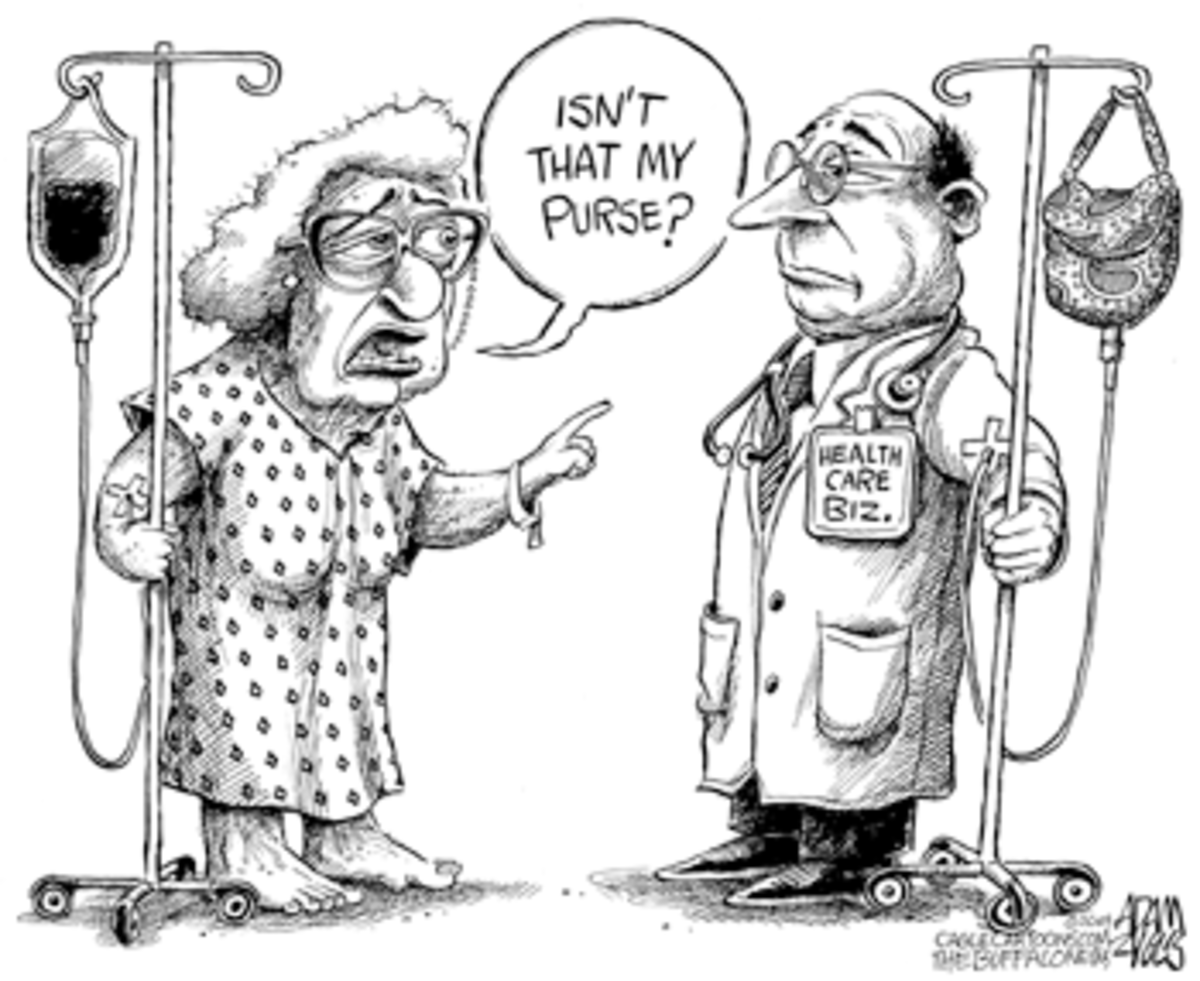
Cartoon – Healthcare Biz Today


The Senate proposal, which would funnel away higher state Medicaid payments to hospitals with a large fraction of Medicaid patients, would need to be reconciled with the House’s budget preserving the current policy.
Lidia Amoretti, a spokeswoman for Jackson Health System, called the Senate’s plan “alarming,” though she added “it is still early in the process.”
https://khn.org/news/bipartisan-senate-budget-deal-boosts-health-programs/

In a rare show of bipartisanship for the mostly polarized 115th Congress, Republican and Democratic Senate leaders announced a two-year budget deal that would increase federal spending for defense as well as key domestic priorities, including many health programs.
Not in the deal, for which the path to the president’s desk remains unclear, is any bipartisan legislation aimed at shoring up the Affordable Care Act’s individual health insurance marketplaces. Senate Majority Leader Mitch McConnell (R-Ky.) promised Sen. Susan Collins (R-Maine) a vote on health legislation in exchange for her vote for the GOP tax bill in December. So far, that vote has not materialized.
The deal does appear to include almost every other health priority Democrats have been pushing the past several months, including two years of renewed funding for community health centers and a series of other health programs Congress failed to provide for before they technically expired last year.
“I believe we have reached a budget deal that neither side loves but both sides can be proud of,” said Senate Minority Leader Chuck Schumer (D-N.Y.) on the Senate floor. “That’s compromise. That’s governing.”
Said McConnell, “This bill represents a significant bipartisan step forward.”
Senate leaders are still negotiating last details of the accord, including the size of a cut to the ACA’s Prevention and Public Health Fund, which would help offset the costs of this legislation.
According to documents circulating on Capitol Hill, the deal includes $6 billion in funding for treatment of mental health issues and opioid addiction, $2 billion in extra funding for the National Institutes of Health, and an additional four-year extension of the Children’s Health Insurance Program (CHIP), which builds on the six years approved by Congress last month.
In the Medicare program, the deal would accelerate the closing of the “doughnut hole” in Medicare drug coverage that requires seniors to pay thousands of dollars out-of-pocket before catastrophic coverage kicks in. It would also repeal the controversial Medicare Independent Payment Advisory Board (IPAB), which is charged with holding down Medicare spending for the federal government if it exceeds a certain level. Members have never been appointed to the board, however, and its use has not so far been triggered by Medicare spending. Both the closure of the doughnut hole and creation of the IPAB were part of the ACA.
The agreement would also fund a host of more limited health programs — some of which are known as “extenders” because they often ride along with other, larger health or spending bills.
Those programs include more than $7 billion in funding for the nation’s federally funded community health centers. The clinics serve 27 million low-income people and saw their funding lapse last fall — a delay advocates said had already complicated budgeting and staffing decisions for many clinics.
And in a victory for the physical therapy industry and patient advocates, the accord would permanently repeal a limit on Medicare’s coverage of physical therapy, speech-language pathology and outpatient treatment. Previously, the program capped coverage after $2,010 worth of occupational therapy and another $2,010 for speech-language therapy and physical therapy combined. But Congress had long taken action to delay those caps or provide exemptions — meaning they had never actually taken effect.
According to an analysis by the nonpartisan Congressional Budget Office, permanently repealing the caps would cost about $6.47 billion over the next decade.
Lawmakers would also forestall cuts mandated by the ACA to reduce the payments made to so-called Disproportionate Share Hospitals, which serve high rates of low-income patients. Those cuts have been delayed continuously since the law’s 2010 passage.
Limited programs are also affected. The deal would fund for five years the Maternal, Infant and Early Childhood Home Visiting Program, a program that helps guide low-income, at-risk mothers in parenting. It served about 160,000 families in fiscal year 2016.
“We are relieved that there is a deal for a 5-year reauthorization of MIECHV,” said Lori Freeman, CEO of advocacy group the Association of Maternal & Child Health Programs, in an emailed statement. “States, home visitors and families have been in limbo for the past several months, and this news will bring the stability they need to continue this successful program.”
And the budget deal funds programs that encourage doctors to practice in medically underserved areas, providing just under $500 million over the next two years for the National Health Service Corps and another $363 million over two years to the Teaching Health Center Graduate Medical Education program, which places medical residents in Community Health Centers.

Patrick Soon-Shiong, MD, the billionaire founder and CEO of NantHealth, has purchased the Los Angeles Times from Tronc, according to The Washington Post.
Under the $500 million deal, Dr. Soon-Shiong, who is a major shareholder of Tronc, will also acquire the San Diego Union-Tribune.
Dr. Soon-Shiong, who is said to be the nation’s wealthiest physician, is a surgeon by training. He made the bulk of his fortune, estimated at around $7.8 billion, starting and selling drug companies, according to the Chicago Tribune.
Read more about Dr. Soon-Shiong here.

Carolinas HealthCare System, a 40-hospital system based in Charlotte, N.C., has changed it name to Atrium Health.
Officials said the new name reflects the system’s evolution from a single hospital to a health system with a strong regional footprint.
“It’s quite remarkable to think back to our humble beginnings in 1940, when a group of ambitious, young clinicians answered the call to serve everyone and opened our doors as Charlotte Memorial Hospital,” said Atrium Health President and CEO Gene Woods. “Now, nearly 80 years later, our doors remain open, and we’ve helped our community thrive. As we have maintained our mission to serve all, we have also evolved. Our new name reflects our organization today and where we are going in the future to make a greater impact for the people we will serve.”
The health system evaluated more than 100 names and conducted consumer research on a few of them before making a decision. The system said Atrium was selected because of its meaning: a place filled with light; the chamber of the heart where every heartbeat begins; and a gathering ground where diverse thinkers come together and connections are made.
Although the system is changing its name, the organization will keep elements associated with the Carolinas HealthCare System brand, including an updated “Tree of Life” icon.
“Our Tree of Life is strong and our mission to provide care for all will not change,” Mr. Woods said. “Atrium Health will allow the organization to grow and impact as many lives as possible and deliver solutions that will help even more communities thrive.”
The system said full implementation of the new name would take about two years, and changes to signage at hospitals and other care locations will begin at the end of 2018. Advertisements will immediately begin to carry the new name.
The name change comes as Atrium Health is pursuing a merger with Chapel Hill, N.C.-based UNC Health Care. The two systems signed a letter of intent to merge in August 2017. The combined entity would control more than 50 hospitals.

Republican and Democrat Senate leaders unveiled a two-year budget deal Wednesday that would boost federal spending for several health programs.
Here are five things to know about the budget agreement.
1. The budget deal includes an additional four-year extension of the Children’s Health Insurance Program. That extension is on top of the six years of CHIP funding Congress approved in late January.
2. The plan includes more than $7 billion in funding over two years for the nation’s community health centers. Federal funding for community health centers, which serve more than 27 million people, expired Sept. 30.
3. The spending deal would delay payment cuts to Disproportionate Share Hospitals mandated by the ACA, which have been pushed back since 2010, according to Kaiser Health News.
4. The budget deal includes $2 billion in additional funding for the National Institutes of Health and $495 million for the National Health Service Corps.
5. The budget deal would repeal the ACA’s Independent Payment Advisory Board, which was intended to hold down Medicare payments if the program’s spending exceeded a certain threshold. Members have never been appointed to the IPAB, according to Kaiser Health News.
Health Care Is a Universal Value. It’s Time for a Universal Effort.

California is the most diverse place on earth. You see that diversity in our people, our culture, and our landscape. Our differences are our strength – but only if we remember the things that bind us together and the values we all share.
The belief that everyone should have health care is one of those universal values. From the day we are born, health care gives people the opportunity to have full lives and the vitality to pursue their dreams. And no one should lack support when illness strikes.
Over the last year, the California Health Care Foundation (CHCF) has been re-examining the work we do, because we want to make sure our efforts and our dollars are making the greatest possible impact in light of what’s happening in the world around us. As we went through that process, one unavoidable truth remained as our top concern: Too many low-income Californians are held back or suffer because it is too hard to get the care they need. Our board of directors and CHCF’s deeply committed staff have decided that the foundation’s top priority should be to address that problem.
Certainly, this undertaking will not be easy, but the good news is that there are clear ways to make health care work for low-income Californians. Here are three that are top of mind for us now.
California has made huge gains in recent years under the Affordable Care Act (ACA). We’ve cut our number of uninsured by half. Now we must finish the job and work to ensure everyone has health benefits.
Achieving universal coverage would level the playing field in two key ways. It would allow all Californians to meet basic needs for care, and it would protect all Californians financially from extraordinary health care expenses. Today, three million of our friends and neighbors remain uninsured. Most have jobs and are contributing to our economy and communities, but those jobs do not include health insurance. We must also remember that one in three uninsured Californians is an undocumented immigrant. These people are part of the fabric of California’s society; if we allow them to remain vulnerable, all of California will pay the price.
Never has California been so close to achieving universal coverage. There is no one pathway to get to that goal, but get there we must.
Coverage is not an end in itself – it’s really just the gateway to better health. To deliver on this promise, coverage must lead to better care. Our biggest opportunity to improve care for low-income Californians is to make sure that California’s approach to coverage for low-income populations – the Medi-Cal program – delivers high-value care. The program covers one in three Californians. And two-thirds of Californians say Medi-Cal is important to them and their families. When we get Medi-Cal right, the impact is broad and deep because of the program’s overall reach and the profound ways in which it improves a person’s prospects for health.
In the last year, we have seen major new federal threats to Medicaid’s fiscal and policy stability. Given the importance of Medi-Cal to California, we must continue working together locally and with other states to protect Medicaid from ill-advised budget and policy changes.
But it isn’t enough for California to protect the status quo. There is so much potential for improvement in Medi-Cal, which serves Californians with the greatest health burdens. We must be diligent and vigilant in finding new ways to reduce the struggle of those who depend on the program and to give them opportunities to live healthy lives. We can and should make the system easier to navigate and care easier to access. We must modernize the state’s health workforce to make treatment more effective and more cost-effective. And we can and should expect innovation in Medi-Cal to keep pace with the evolution of care in the private sector.
Our health care safety net still is organized around the outdated assumption that one person’s body and mind require two or more separate systems of care. Today we know that physical health and mental health are inextricably bound together. It is past time to update our health care system to reflect that understanding.
It is especially important that we better integrate care for low-income Californians who experience mental illness, drug or alcohol addiction, or other complex health conditions. Even though they comprise a relatively small share of the population, they account for half of health care spending. Siloed systems of care cause needless and profound suffering.
Health care leaders and providers across California have been working harder than ever to address this problem. Innovations in policy, like Medi-Cal’s Whole Person Care and Drug Medi-Cal pilots, are giving communities new opportunities to integrate care. Technology innovations can help providers extend those opportunities to larger and larger numbers of people.
California has the power to accomplish each of these goals. We boast the world’s sixth largest economy. California is rich in health care and innovation talent. But even with those advantages, we cannot succeed without working together across sectors, across professions, and across ideological camps.
Health care is a universal value. It will take a universal effort to make sure all Californians can meet their basic need for care.
 HENRY KOTULA