

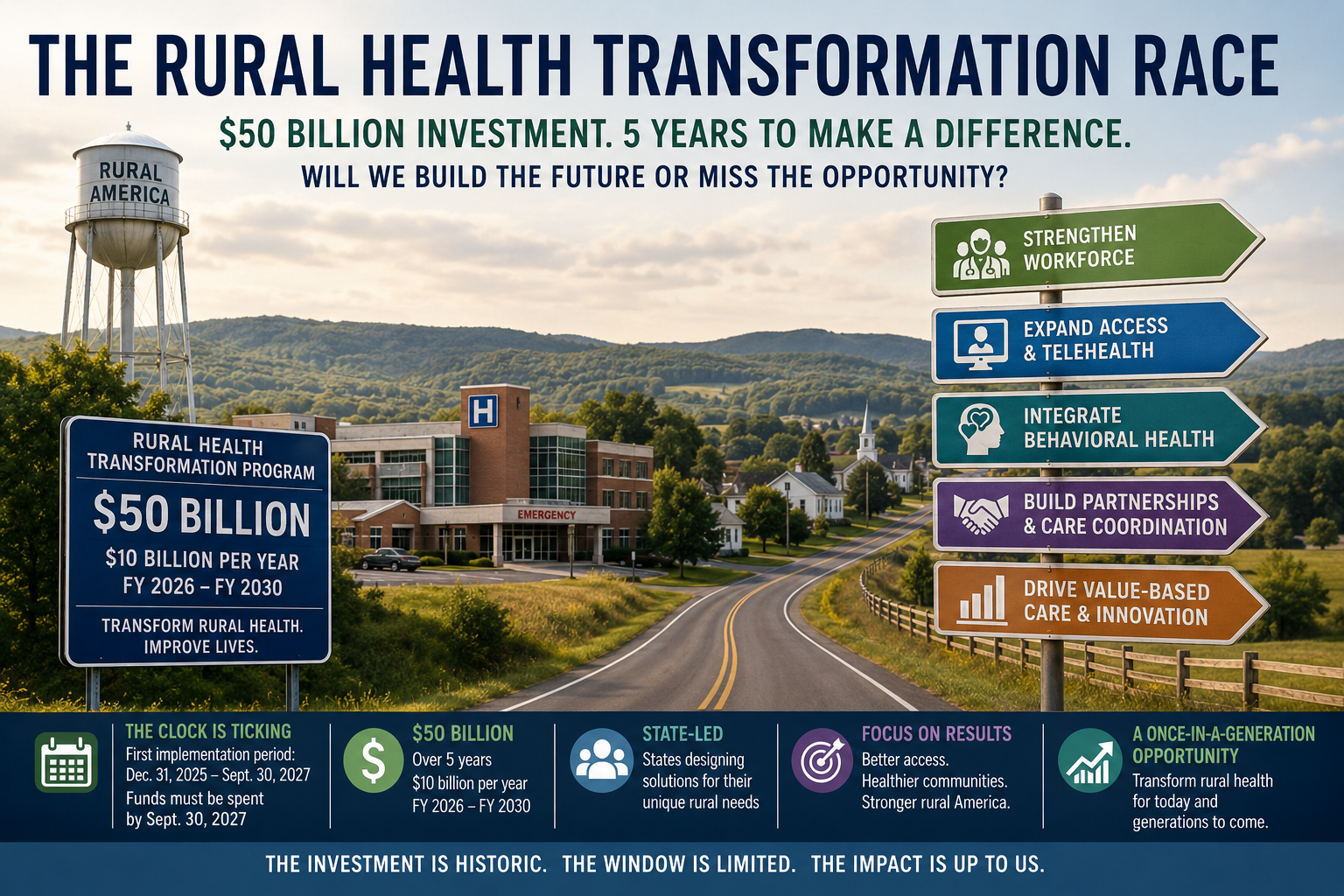
Funding from the Rural Health Transformation Program is beginning to flow to the states. The purpose is larger, but some say its success should be measured by whether it preserves access to care at rural hospitals.
The Rural Health Transformation Program represents one of the largest federal investments ever made in rural healthcare, with $50 billion authorized over five years to help states improve access, strengthen the workforce, and modernize care delivery in rural areas. Still, as states move from planning to implementation, the program faces an immediate test: Can it deliver meaningful transformation while rural hospitals continue to face mounting financial and operational pressures?
The answer is not so cut-and-dried.
Some rural health advocates view the program as an unprecedented opportunity to rethink how care is delivered in underserved communities. Others caution that although the funding can accelerate innovation, it was never designed to replace revenue that providers could lose because of Medicaid policy changes, such as work requirements.

Alan Morgan is CEO of the National Rural Health Association.
“It’s apples and oranges,” says Alan Morgan, M.P.A., CEO of the National Rural Health Association. “The Rural Health Transformation Program was created to invest in long-term innovation, not to replace Medicaid funding. Comparing the two misses the intent of the legislation.”
At the same time, Morgan acknowledged that rural providers remain deeply concerned about what lies ahead.
“The math just doesn’t work,” he said. “Nearly one-half of rural hospitals already operate at a loss, and hundreds remain at risk of closure if financial pressures continue to mount.”
Innovation versus stabilization
Congress created the Rural Health Transformation Program as part of the One Big Beautiful Bill Act that President Donald Trump signed into law on July 4, 2025. It was added in part to offset the federal Medicaid cuts in the bill, which the Congressional Budget Office estimated will total $911 billion over a 10-year period. The program provides $10 billion annually through 2030 to help states invest in new care models, workforce development, technology and other initiatives intended to improve healthcare delivery in rural areas.

Ryan Cohn is chief strategy officer at Sachs Media.
Ryan Cohn, chief strategy officer at Sachs Media, who has advised multiple states, health systems and healthcare organizations on Rural Health Transformation Program applications, says that the funding is not sufficient to offset the broader financial challenges facing rural healthcare, noting that the fund was created after lawmakers expressed concern that the Medicaid cuts could disproportionately affect rural providers, especially rural hospitals. And once CMS implemented the program, its focus shifted toward transforming healthcare delivery rather than serving as a financial backstop for struggling hospitals.
“The real question isn’t whether $50 billion is enough money,” Cohn comments. “It’s whether we can stand up a new care model fast enough to replace a hospital that may close in the next few years.”
Harold D. Miller, M.S., president and CEO of the Center for Healthcare Quality and Payment Reform, says he believes the program has the potential to preserve services in rural communities, but only if states have enough flexibility to direct funding where it is needed most.
“The $10 billion per year in new funds under RHTP [Rural Health Transformation Program] could go a long way to preventing the loss of services in rural areas if the money could be directed to the hospitals that are currently being underpaid,” Miller observes.
Instead, he adds, CMS has limited the amount states can use for direct provider payments while encouraging investment in new initiatives and technology.
“Although those investments may ultimately prove valuable, technology alone cannot replace essential healthcare services,” he says. “A phone app can’t deliver a baby, draw blood, stitch a wound or do a CT scan.”
Implementation
After months spent developing applications, states are now beginning the nuts-and-bolts work of turning proposals into operational programs.
According to Cohn, five priorities appear consistently across state plans: workforce development; telehealth and data infrastructure; prevention; new payment and delivery models; and bringing care closer to patients through mobile clinics and regional care networks.
Joe Ganley, J.D., vice president of government and regulatory affairs for athenahealth, says rural practices already operate with no room to spare. “The margin for error has essentially disappeared,” Ganley said.
Among those priorities, workforce development stands out as the dominant theme, he says. Many states are investing in residency programs, loan repayment initiatives and “grow your own” workforce strategies that encourage students from rural communities to pursue healthcare careers locally in hopes they will eventually remain there.
Technology investments also extend well beyond telehealth. Cohn says states are focusing on improving interoperability so rural hospitals, clinics and emergency medical services can share patient information more effectively. Others are proposing artificial intelligence for population health, drone delivery of medications and laboratory tests, and technology-enabled transportation programs designed to improve access to care.
Even so, implementation presents significant challenges. “This money was built to move fast,” Cohn says. Some states first had to establish entirely new administrative structures before funding could reach providers. Others continue to develop procurement processes while preparing to demonstrate measurable outcomes that will influence future funding allocations.
Sustainability also remains an open question. “A new residency slot or telehealth program only counts if it outlives the initial RHTP funding,” Cohn says. “Not every plan has a fully formed answer for what happens in year six.”
Financial pressures
Although much of the discussion surrounding the Rural Health Transformation Program focuses on future transformation, many providers continue grappling with immediate financial realities.
Joe Ganley, J.D., vice president of government and regulatory affairs for athenahealth, says rural practices already operate with no room to spare. “The margin for error has essentially disappeared,” Ganley said.
When patients delay appointments, ration medications or postpone treatment because of cost, practices experience more than declining revenue. Patients often arrive later with more complex medical needs, increasing clinical and operational burdens. “Providers feel it immediately — in no-shows, in collections and in the clinical complexity of patients who arrive later and sicker,” Ganley says.
Beyond those financial pressures, Ganley notes that rural physician practices also continue to struggle with workforce shortages and limited interoperability.
“Many rural practices operate with one to two months of reserves,” Ganley said. “That’s not a buffer — it’s a cliff. Any disruption to payment flows, whether from coverage losses, billing delays or reimbursement changes, can threaten the viability of organizations that communities depend on as their only access point for primary care.”
He adds that recruiting and retaining clinicians remains difficult, while limited interoperability makes it harder for rural providers to coordinate care and participate in value-based payment models.
Measuring success
Even as the rural health program dollars begin reaching states, many believe it is far too early to determine whether the $50 billion fund will live up to its name and change rural healthcare for the better. “I think it’s too early to determine, and that’s the honest truth,” says Morgan. Many states are only beginning to release requests for proposals and identify where funding will be directed. Although states must obligate the funds within required timelines, many providers are still waiting to learn whether they will receive support and how they will be permitted to use it. “Our members are concerned,” Morgan adds. “Are we going to receive any of the money? How are we going to be able to use the funds? There’s just a lot yet unknown.”
Miller notes the program’s success should not be measured by the number of grants awarded or technology projects launched. He says he believes there is a relatively simple way to take stock of the program.
“If hospitals continue to close and eliminate services in 2026 and 2027, even with $10 billion in new funds available each year, the Rural Health Transformation Program should be viewed as a failure,” Miller says.
In his opinion, preserving essential healthcare
services — including obstetrics, emergency care and primary care — must remain the priority. Even if federal Medicaid policy changes were reversed tomorrow, many small rural hospitals would continue struggling because reimbursement from Medicare Advantage, commercial insurers and other payers often fails to cover the cost of providing care in sparsely populated communities.
The No. 1
Morgan said workforce issues remain the No. 1 concern among rural hospitals, followed closely by financial stability. He’s particularly optimistic about states using the rural health funds to create “grow your own” workforce initiatives that recruit students from rural communities, train them locally and encourage them to practice close to home
after graduation.
“I think that’s going to be interesting,” Morgan says, noting that locally trained clinicians are far more likely to remain in rural communities over the long term. Cohn heard similar priorities while working with states on their applications. “Workforce development is in most states’ plans because providers everywhere are facing significant staffing shortages,” he says.
Some states are investing in rural residency programs, loan repayment initiatives and accelerated licensing efforts. Others are combining workforce initiatives with telehealth and regional partnerships designed to extend scarce clinical expertise across larger geographic areas.
Ganley notes that technology can help relieve administrative burdens, but only if it simplifies clinicians’ work rather than adding complexity.
“The practices that will sustain access are the ones that can operate efficiently under financial constraints, reduce administrative burden without growing their administrative head count and connect their patients to the right level of care regardless of where that care is delivered,” he says.
Behavioral health providers are experiencing many of the same pressures. Shannon Werb, CEO of Array Behavioral Care, says that disruptions in Medicaid coverage often interrupt outpatient behavioral healthcare, causing patients to delay treatment until they require crisis care.
“When patients lose coverage or face affordability challenges, they often delay care until their condition reaches a crisis point,” says Werb. “At that stage, the emergency room becomes the default access point for treatment.” The result, he said, is longer behavioral health boarding times, increased uncompensated care and additional strain on hospitals.
The long haul
The biggest question about the infusion of federal funds into rural healthcare is whether the investment will continue paying dividends after federal funding expires. For a problem that has been decades in the making, five years is not that much time, and $50 billion is not that much money.
Because the program is scheduled to end after five years, healthcare leaders repeatedly emphasized the importance of building sustainable systems rather than launching short-lived projects.
“The real measure isn’t dollars spent or programs announced,” Cohn says. “It’s whether a rural patient can access care in 2028 that they couldn’t get in 2025.”
Morgan agrees that outcomes, not spending, will determine whether the initiative succeeds. The first warning sign, he says, would be an increase in rural hospital and rural health clinic closures. He says life expectancy is the ultimate yardstick. “We continue to see a decline in the overall life expectancies of rural communities versus urban. At the end of the day, that’s the measure that really matters.”

