

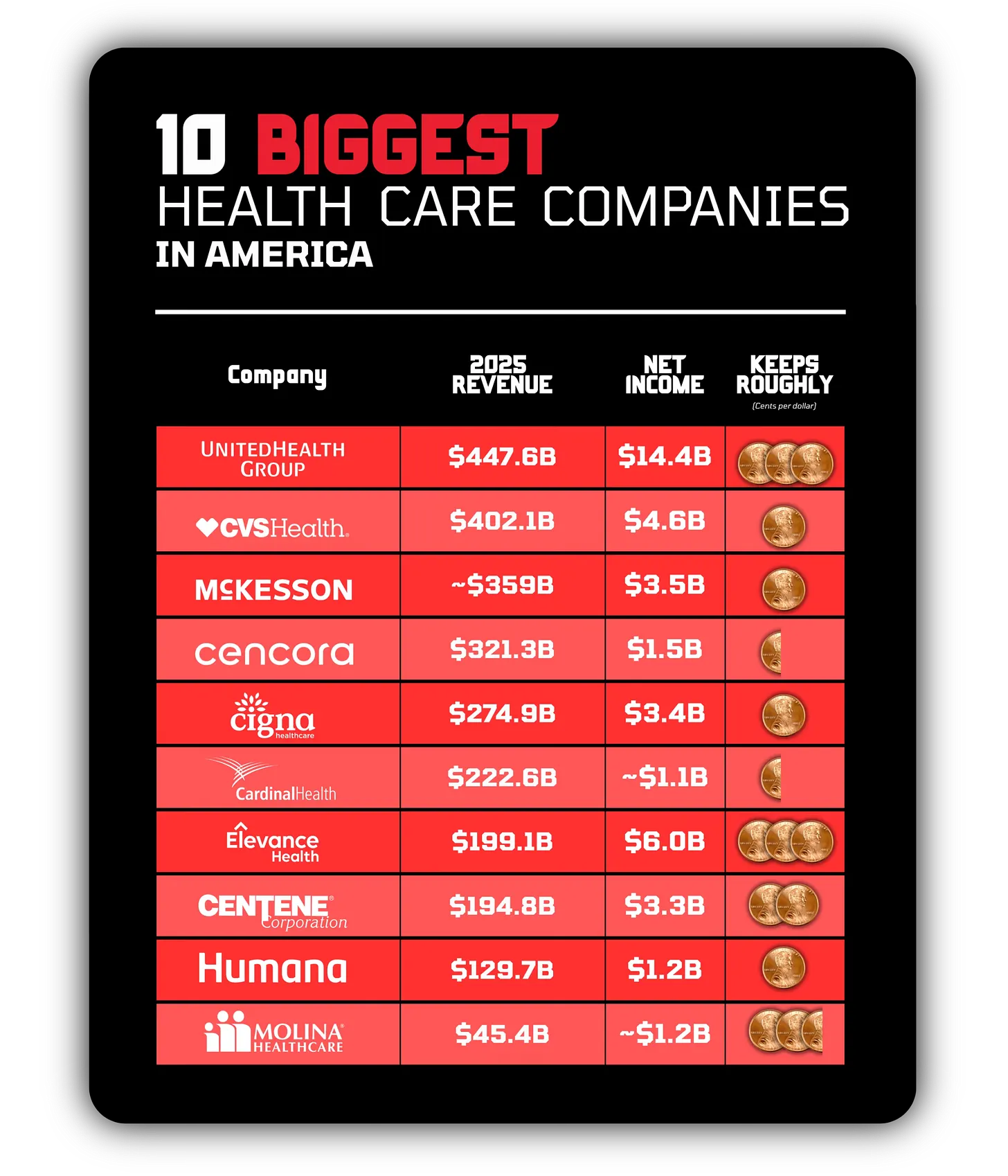
It started as a simple question. Who are the biggest health care companies in the United States?
If you rank the ten largest health care companies in America by revenue, you will not find a single hospital system or drugmaker. Not Pfizer, not Eli Lilly, not the Mayo Clinic or HCA. Every company in the top ten is a middleman, and together they take in about $2.6 trillion a year.
Above is a list showing how much of every dollar of revenue each company keeps as net income. Then read about what these companies actually do.
Three of these companies are insurers that swallowed pharmacy benefit managers: UnitedHealth owns Optum Rx; CVS owns Caremark and Aetna; and Cigna owns Express Scripts. Three are drug distributors that move pills from the factory to the pharmacy and touch almost none of them. Three more are built on Medicare and Medicaid managed care. Every one of them sits between the people who deliver care and the money that pays for it.
McKesson, Cencora and Cardinal Health each keep somewhere between half a cent and a penny of profit on every dollar of revenue. Cencora reported $294 billion in sales in fiscal 2024 and $1.5 billion in profit. That is a rounding error as a margin. And yet all three rank among the thirty largest companies in the world.
No other rich country works this way
The sheer size of these companies is another distinctly American feature of the system. On the 2026 Fortune Global 500, UnitedHealth ranks fourth in the world, ahead of Apple; McKesson is seventh; CVS is ninth; and Cigna, where I worked for 15 years, ranks 14th in the U.S. and 21st in the world. Every health care company near the top of the global list is an American intermediary in one way or another. There is no foreign health care business of any nature that comes close.
The closest thing another country has to one of our giants is Allianz, in Germany. Allianz is the largest insurance company in Europe. But it is a general insurer built on property, life and asset management, and health is a minor line. Even at home, Allianz is only the third largest health insurer in Germany. There, roughly nine in ten people are covered by nonprofit sickness funds, which are barred by law from operating as for profit and must send any surplus in funds back into the system.
And then there are Britain’s National Health Service (NHS), which is funded by taxes; Canada’s single-payer system financed through the provinces; and Japan’s nonprofit insurance system based on a standardized national fee schedule.
None of these countries built the kind of for-profit middleman layer that exists in the U.S., where some of those companies have grown into the largest corporations in the world. Pharmacy benefit managers are also a uniquely American creation, which helps explain why that entire category of health care giant does not exist elsewhere.
What the middleman layer costs
The United States spent $5.3 trillion on health care in 2024. That was the first year the country ever crossed $5 trillion, and it is the most recent year with actual figures rather than projections. (The Centers for Medicare and Medicaid Services estimates total U.S. health spending will reach $6 trillion this year.)
A large share of that money never reaches care and instead is consumed by the U.S. health care system’s complicated administration and payment systems.
In 2021, the United States spent $925 per person on health administration, meaning the overhead of insurers and government programs. The average wealthy country spent $245. That gap of $680 a person accounts for about 12% of the entire difference between what America spends on health and what its peers spend. As a share of the total, administration eats about 7.6% of U.S. health spending against 3.8% across comparable nations. We devote twice the share of every health dollar to running our absurd machinery.
The $925 figure counts insurer and government overhead and does not include what hospitals and doctors spend on billing, coding and prior authorization just to get paid. When those costs are included, estimates put total administrative spending between 15% and 25% of all U.S. health care spending — or, based on 2024 spending, roughly $800 billion to $1.3 trillion a year.
The countries with the leanest administrative spending tend to be those (you guessed it!) with the fewest middlemen.
Middlemen spend to keep the status quo
I know how a system this profitable defends itself because I used to help do it. Back at my old gig at Cigna, my team and I wrote talking points for lobbyists to use with lawmakers, and we doled out campaign cash to candidates we liked.
The health sector spent $743.9 million lobbying the federal government in 2024, more than any other sector of the economy and the only one to clear $700 million. UnitedHealth alone spent $16.6 million in the 2024 election cycle. The insurance industry’s trade group, AHIP, and the biggest insurance conglomerates pour tens of millions more into the same effort year after year, and the pharmacy benefit managers keep their own operation running through another insurance industry funded trade group called the Pharmaceutical Care Management Association (PCMA), whose spending has roughly doubled since 2022.
That spending helps protect Medicare Advantage payments, fight efforts to rein in pharmacy benefit managers and oppose proposals that would move the country toward universal coverage. Compared with the $70 billion in combined profit of the seven biggest for-profit insurers last year, the lobbying bill is relatively small.
The price of “choice”
The industry says all of this is the price of “choice,” which they want folks to believe is sacred. It is the argument insurers and their allies reach for every time Congress looks at a single-payer bill or public option or any other approach, for that matter, that could move us closer to reining in the worst abuses of the industry.
Americans say they want to choose their own doctor and their own hospital, but that is exactly the kind of choice the middleman system can take away through narrow networks and prior authorization. What the industry defends instead is the choice among insurers. And for most working people, even that choice is made by an employer. We pay hundreds of billions of dollars a year to run a marketplace of middlemen, and in return we get narrower networks and more denials than patients face in the countries that never built the marketplace at all.
Depending on the results of the next two election cycles, Congress will almost certainly debate how to restructure health care again, with the familiar goals of lowering costs, expanding coverage and improving care. But any serious attempt to do that will have to confront the enormous middleman industry the current system has created and allowed to flourish.

