

https://www.semafor.com/newsletter/11/05/2026/semafor-healthcare-reading-tea-leaves

It’s healthcare costs, stupid. Washington is still collecting itself after a blue tsunami delivered House and Senate majorities on Tuesday — but Democrats are already gearing up a healthcare agenda to goad President Donald Trump into vetoing policies voters support.
Easy initial targets include rolling back Medicaid cuts and restoring Affordable Care Act enhanced tax credits that the GOP allowed to lapse, two policies hitting household budgets as healthcare premiums spike. But lawmakers will need to figure out how to pay for those efforts, and California voters demonstrated this week that even in a blue wave, raising taxes on wealthy Americans is challenging.
Other legislative pushes could preview what Democrats run on in 2028.
Progressives will inevitably demand a House vote on a Medicare for All bill, even if Rep. Hakeem Jeffries, the expected House speaker, would prefer to first have a “family conversation.” Trump’s propensity to support most-favored-nation drug pricing legislation could mean Democrats could attempt to codify paying what other wealthy nations offer for drugs.
“Democrats and President Trump talk similarly about addressing drug prices, so there may be opportunities for a strange-bedfellows kind of deal,” said Larry Levitt, who will become the CEO of KFF in January.
Sen. Bernie Sanders, I-Vt., will try to use his likely perch atop the Senate Health Committee to add dental, vision, and hearing coverage to Medicare. And expect a fight over whether to reauthorize user fees that fund roughly half the FDA — legislation that pharma considers must-pass and that Sanders has opposed for decades.
Of course there’ll be a contingent of Democratic lawmakers intent on using this moment to drag health insurer and drugmaker executives before Congress and slow-roll Trump nominees in open roles atop the FDA and HHS.
But the real opportunity for Democrats is to lay out what they will do if they take control of the presidency.
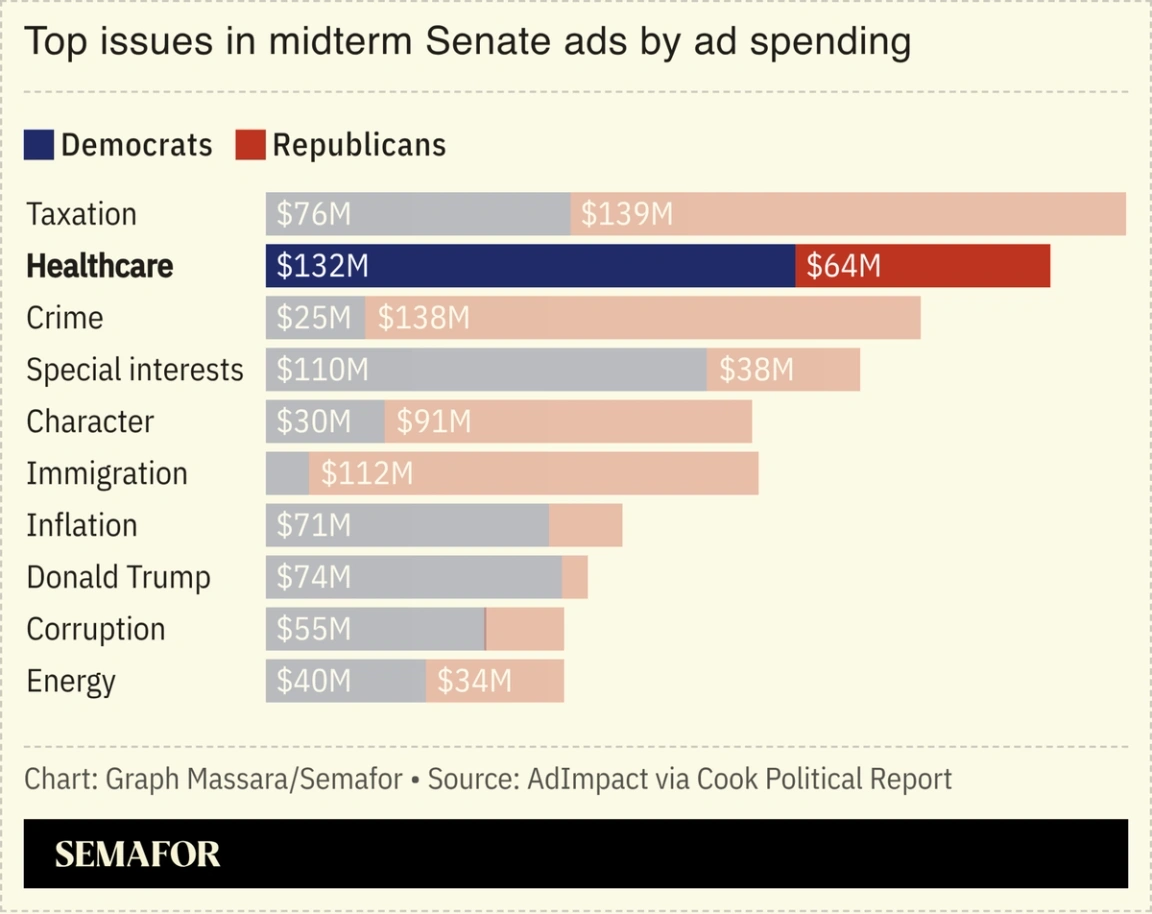
Democrats put healthcare at the center of their “affordability” message in key races. Democratic candidates, party committees, and outside groups spent a combined $226 million on healthcare-related TV ads supporting Democrats in competitive House and Senate races — dwarfing all other issues, including Donald Trump ($151 million), inflation ($141 million), and taxes ($185 million), according to an analysis of AdImpact data by the nonpartisan Cook Political Report.
Democrats sought to tie the 2025 Republican tax bill, which cut Medicaid and allowed subsidies for Affordable Care Act premiums to expire, to voter worries about rising healthcare costs as they pressed their affordability agenda. Democrats used a similar playbook in 2018, winning control of the House on a message of protecting the ACA from repeal.
Voters have historically trusted Democrats more than Republicans on healthcare. A recent Conference Board survey found Democrats held an 18-point advantage over Republicans on the question of healthcare affordability. NBC found Democrats held a 22-point advantage on “handling healthcare.”
This week’s blue wave wiped out Republican policymakers who’d been vying to define the party’s health agenda.
Sen. Roger Marshall, R-Kansas, a physician and founder of the MAHA Caucus, lost to Democrat Adam Hamilton on Tuesday. (Hamilton aired ads featuring patients who Marshall sued for unpaid medical bills.) Marshall was arguably the strongest ally of HHS Secretary Robert F. Kennedy, Jr. in the Senate. He was also in contention to become the top Republican on the powerful Senate health committee, where he could have prioritized MAHA legislation and oversight priorities if Republicans had retained Senate control.
Sen. Susan Collins, R-Maine, who was defeated this week, and Sen. Bill Cassidy, R-La., who lost a primary to a Trump-backed candidate this spring, are both Kennedy critics who led key health-related committees. Collins, the chair of the Appropriations Committee, protected funding at the NIH and CDC as the White House pushed for further cuts over the last two years. Cassidy, a physician, chaired the health committee, where he regularly challenged Trump nominees during nomination hearings. We reported earlier this year that Sen. Josh Hawley, R-Mo., may emerge the frontrunner for the top Republican spot on the health panel, as other contenders may prefer to take top GOP seats on other committees.
Reps. Mariannette Miller-Meeks, R-Iowa, and Richard Hudson, R-N.C., also both lost reelection, and their absences will erode the Republican bench on the House Energy and Commerce Committee in the next Congress.
Democrats will have a pediatrician in the Senate after Annie Andrews emerged victorious in South Carolina. Andrews ran on a detailed, wonky healthcare platform that includes increasing scrutiny of hospital mergers, setting site-neutral Medicare payments to standardize reimbursement, reforming Medicare Advantage payments, and replacing prior authorization with a new system.
Other new Democratic faces like Michigan Sen.-elect Abdul El-Sayed, an epidemiologist and former Detroit health director, and Troy Jackson of Maine, a logger-turned-politician, campaigned on Medicare for All. El-Sayed and Jackson were two of the only Democrats in competitive states to run on it. Americans increasingly support the concept of a single-payer system, long championed by the Democratic Party’s progressive wing: In October, 66% of respondents told KFF they supported Medicare for All, up from 53% six years ago. But when told such a program may require paying higher taxes, support dropped to 35%.
State healthcare ballot initiatives tested the public’s mood on abortion rights, Medicaid and new approaches to healthcare funding. Voters largely supported existing abortion rights and Medicaid programs, but were reluctant to try novel tax schemes to pay for healthcare.
In Nevada and Virginia, voters established state constitutional rights to abortion, though the measures didn’t expand access. In Missouri, voters struck down an attempt to reverse a constitutional right to abortion passed two years ago, as well as a ban on gender care for minors. Idaho voters, by contrast, rejected a measure to expand abortion access by restoring rights eliminated by a near-total ban that took effect in 2022.
In South Dakota, voters blocked a measure that would have allowed the state legislature to end funding for a Medicaid expansion approved by voters in 2022 if the federal government were to cover less than 90% of the cost.
But there are limits to what voters will support to bolster Medicaid: A tax on billionaires in California never got the traction organizers had hoped, and the measure remains far behind in the ballot count. The one-time, 5% levy was supposed to shore up existing healthcare programs and compensate for 2025 Medicaid cuts. In New Mexico and Rhode Island, meanwhile, voters endorsed a more conventional approach to funding narrower healthcare programs: They approved new bonds.
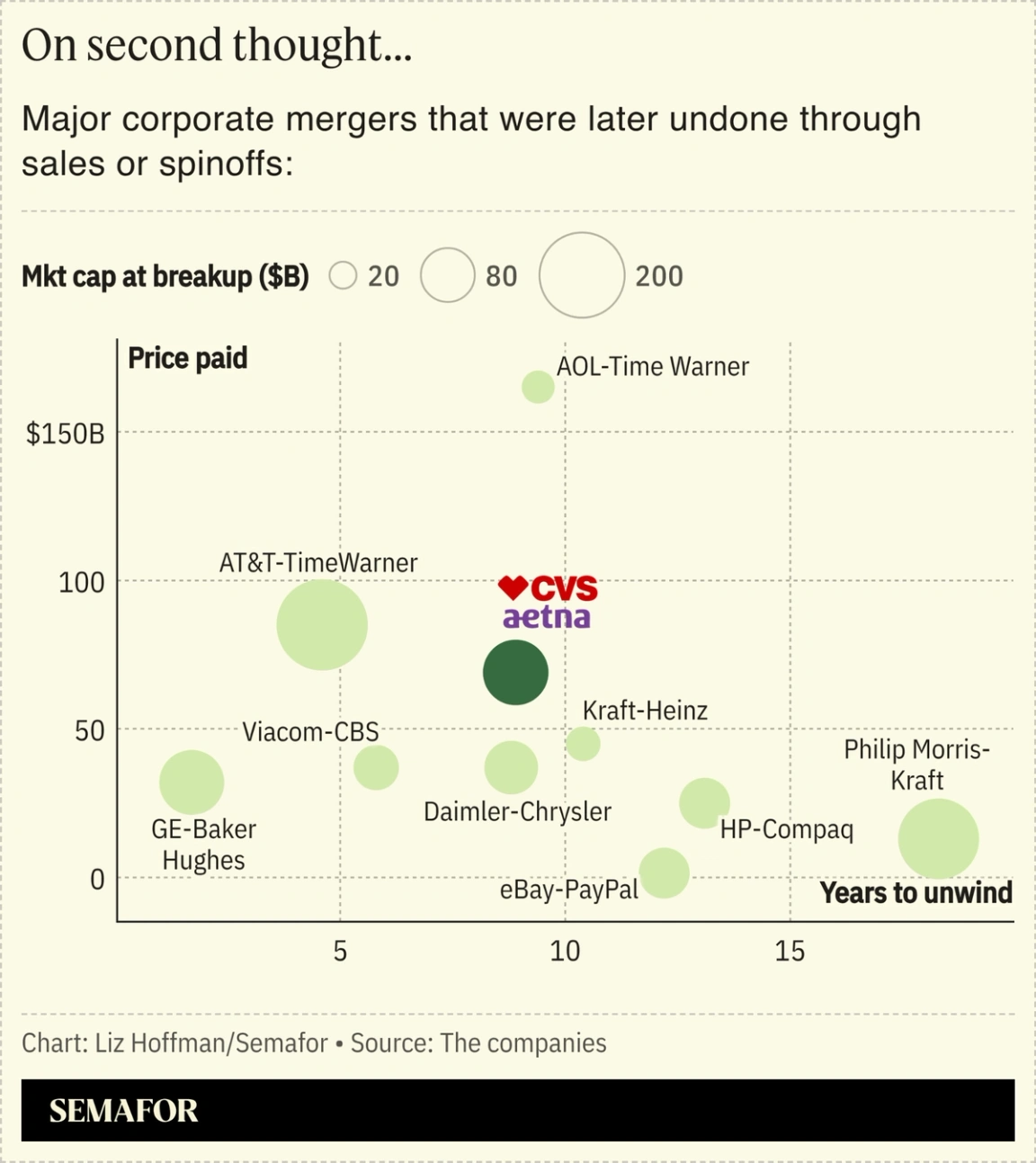
CVS unwinding its 2018 purchase of Aetna is not quite the biggest, fastest corporate M&A about-face of all time, but it’s close. The breakup, which essentially calls time on the $69 billion merger that aimed to create a healthcare giant across insurance and pharmacies, joins the top tier of corporate M&A whoopsies. It’s also a warning signal to other healthcare companies trying to read the tea leaves in Washington.
The original thesis of the CVS deal was that combining Aetna’s insurance data and CVS’ 10,000 retail pharmacies would cut costs and make care more seamless. But the savings were small relative to the deal’s price tag, and its drug-middleman business became a political drag on the retail arm. A new era of healthcare consolidation ensued, lacing together huge swaths of an uber-regulated industry into a conglomerate that critics said led to less competition and higher consumer prices.
Now, as Democrats take Congress, healthcare companies are only bracing for more regulatory scrutiny and political pressure.
“We believe, based off of where we are and how we’re performing, the businesses are best served by splitting,” CVS CEO David Joyner told The Wall Street Journal. A sign that he, indeed, is reading the room.

