Why have Medicare costs per person slowed down?

https://usafacts.org/reports/medicare-cost-slowed-down-hospital-baby-boomers?utm_source=EM&utm_medium=email&utm_campaign=medicaredive

Image result for Why have Medicare costs per person slowed down? Baby boomers and fewer hospital stays

The 65+ population now makes up 16% of the US population, up from 11% in 1980. In response to an aging population, Medicare costs are going up. Benefits totaled $713 billion in 2018, 25% higher than in 2009, and Medicare spending accounts for a fifth of all healthcare spending as of the latest year of data.

However, while program costs are increasing, there is an interesting counter-trend – the per person cost for insuring someone through Medicare has actually decreased.

In 2018, the overall cost of Medicare per enrollee was $13,339 per year, about $30 less than it was in 2009, adjusting for inflation. That’s even as benefits across Medicare totaled $713.4 billion, $144.4 billion more than in 2009.

Why are the costs of insuring someone through Medicare going down? A combination of demographics and policy changes may point to an answer.

THE AVERAGE MEDICARE BENEFICIARY IS GETTING YOUNGER

The average age fell from 76 to 75 between 2007 and 2017Enrollment in all types of Medicare increased 29% during that period from 44.4 million to 58.5 million.

That one year drop in average age is significant for Medicare costs.

An influx of Baby Boomers enrolling in Medicare is playing a role in slowing down an increase in costs for Medicare Part A, which funds hospital stays, skilled nurse facilities, hospice and parts of home health care. In 2008, the share of Original Medicare (Part A or B) beneficiaries who were 65 to 74 years old was 43%. In 2017, 65- to 74-year-olds made up 48% of beneficiaries, the group’s highest share in the 21st century.

A 2015 Congressional Budget Office study showed that we spend 73% more on an enrollee in the 75 to 84 bracket than we do on those in the 65 to 74 bracket.

Our analysis below show how demographics factor into Medicare costs, especially age.

In 2017, there were 38,347,556 Medicare Part A enrollees, making up 100.0% of total enrollees. The federal government spent $188,093,274,340 on program payments for this group, 100.0% of the total Total Part A program payments for this type of enrollee changed from $5,052 in 2013 to $4,905 in 2017, a -2.9% change.

With Medicare Part B there were 33,562,359 enrollees, making up 100.0% of total enrollees. The federal government spent $188,886,121,627 on program payments for this group, 100.0% of the total Total Part B program payments for this type of enrollee changed from $5,287 in 2013 to $5,628 in 2017, a 6.4% change.


Even Democrats prefer more moderate “Medicare for All”

https://www.axios.com/even-democrats-prefer-more-moderate-medicare-for-all-2fc79e20-70e7-47f1-890d-711ef0adeb92.html

Image result for Even Democrats prefer more moderate "Medicare for All"

Allowing people to buy into Medicare is more popular than establishing a single-payer health care system — including among Democrats, according to a recent Navigator poll.

Why it matters: Bernie Sanders made “Medicare for All” a popular concept, but even its supporters have different ideas about what it entails. And more moderate versions have the upper hand.

Between the lines: Most people don’t have a nuanced understanding of health policy, and even within the same poll, different ways of describing the same policy yielded different results.

By the numbers: Even a majority of Republicans said that they would support a Medicare buy-in, when given a choice between that or single-payer.

  • In another section of the poll, though, a 40% plurality of Republicans said “expanding Medicare” was a bad idea, and 59% said that “Medicare for anyone who wants it” is a bad idea.

Yes, but: A version of Medicare for All that eliminates private insurance is still supported by a majority of both Democrats and independents.

  • 78% of Democrats said a “universal health care system” is a good idea, 76% said that a “‘Medicare for All’ program” is a good idea, and 52% said that a “single payer health care system” is a good idea.

What they’re saying: Polling aside, I think Medicare for All is what the American people want and need,” Sanders said in a brief interview.

  • “I think the vision of a simple, seamless system of health care where you have the care that you need, your loved ones have the care that they need…is very, very appealing. Many ideas are being presented for how do we get to that,” said Sen. Jeff Merkley, who has a Medicare buy-in proposal.

The bottom line: There’s plenty of opportunity to sway the health care debate, but moderate Democrats seem to have the most popular ideas right now.


Ominous sign in ACA case

Image result for aca in court

The 5th Circuit Court of Appeals yesterday added a new question to the high-stakes lawsuit over the Affordable Care Act’s survival: Whether Democratic attorneys general or the House of Representatives have the legal standing to defend the ACA in court.

Translation, from Axios’ Sam Baker: The court is asking whether it ought to kick out the entire pro-ACA side of the case.

  • Technically Texas (with a group of other red states) is suing the Trump administration. But the Trump administration says it agrees with Texas’ position.
  • Blue states and House Democrats stepped in so that somebody would be arguing the pro-ACA position.

The intrigue: If the 5th Circuit does boot Democrats off of this lawsuit, that would likely mean no one can appeal a lower court’s ruling striking down the entire law.

  • As University of Michigan law professor Nicholas Bagley explained on Twitter, it’s not necessarily clear how all that would play out.
  • Presumably, the Supreme Court would be disinclined to let a single district court judge have the final say on whether the Affordable Care Act lives or dies. So there would probably be fresh procedural wrangling to revive some kind of appeal.

The bottom line: This could be a bad development for the ACA — or it could end up not mattering much at all, if the court decides Democrats do have standing. But it’s definitely not a positive development for the health care law.

What’s next: The 5th Circuit will hear oral arguments July 9.


Healthcare Reform: “150 million Americans won’t give up their private health insurance to get Medicare for all.” Really?

Healthcare Reform: “150 million Americans won’t give up their private health insurance to get Medicare for all.” Really?

Former Representative Jim Delaney (D-Md) threw down the gauntlet to the left-leaning attendees at the California Democratic convention on June 2 by challenging Medicare-for-all.

”The problem with Medicare for all, it’s actually really simple, is that it makes private insurance illegal. And 150 million Americans have private insurance, and 70% of them like it according to polling. So if we want to actually create universal health care, we’re never going to do it by trying to get 150 million Americans to give up what they want.”

The crowd booed at first, but then gave him a respectful hearing. Pundit George Will and commentator Charlie Sykes think Delaney has a good point politically. But let’s look at Delaney’s claim through the apolitical lens of this blog.

1. Why Did Delaney make this claim?

Two reasons:  He wanted to move the debate over U.S. healthcare from sound bites to substance. And Rep. Delaney wanted to distinguish himself from the rest of the pack of Democrat Presidential contenders and position himself as a moderate on this and other issues.

2. Does Medicare-for-all mean making private health insurance illegal?

Clearly for Sen. Bernie Sanders the answer is yes. But not for any of the other Democrat Presidential candidates, at least not right away.  Some like Mayor Pete Buttigieg and entrepreneur Andrew Yang contemplate a gradual path, eventually leading to a single public payer. In Yang’s case, he expects that public health insurance will eventually out-compete private insurance, not that it will be outlawed. Others like Senators Cory Booker and Amy Klobuchar, Governors Hickenlooper and Inslee, and Rep. Eric Swalwell contemplate using public insurance, alongside private insurance, as the means to get to universal coverage, more like “Medicare for all who want it.”  This month’s Kaiser Family Foundation poll found that 55% do not perceive that Medicare-for-all would mean abolishing private insurance.

3. How many Democratic candidates advocate Medicare-for-all?

Of the 24 Democrats who have announced their candidacy (25, if you count former Sen. Mike Gravel), 13 advocate some version of Medicare-for-all, but 10 prefer some other approach to achieve universal coverage. Former Vice-President Joe Biden has not put forward a clear position yet. (Sen. Gravel supports universal healthcare “like Medicare.”)

4. What about Republicans?

Many Republicans, including the President himself, have at times given lip service to universal healthcare coverage. Most of them also advocate “protecting” Medicare, in some cases by scaling it back and limiting it. However, the President and Senate Republicans are once again pledging to “repeal and replace Obamacare” with a new plan, touted as “phenomenal” (though no details so far). At first the new plan was promised “in a very short period of time,” then “in next 2 months,” and now most recently “after the 2020 election.” For them, opposition to Medicare-for-all is a political matter of faith, not just a strategy for preserving private health insurance for those who want it.

5. How many Americans have private health insurance?

Private employer-based insurance covered 181 million Americans in 2017. According to the Census Bureau the full 2017 breakdown is:

  • Any insurance at least part-year           295 million
    • Employer-based, private              181 million
    • Direct purchased, private              52 million
    • Government                                  122 million

(Note: Some individuals had more than one type of insurance during year)

  • Uninsured entire year                              29 million

6. Are Americans satisfied with their own private employer-based healthcare insurance?

Americans currently rate the “coverage” (69%) and “quality” (80%) for their own individual health plans as “good” or “excellent,” according to a December 2018 Gallup poll.

7. How does this compare with Medicare satisfaction statistics?

For Medicare recipients the ratings for “coverage” (88%) and “quality” (88%) are even better, in the same poll.

8. Do Americans see any downside to having employer-based healthcare insurance?

Many Americans feel locked into their current jobs lest they lose health benefits. This is especially so if they have chronic pre-existing conditions. Fear of losing coverage subtly puts them at the mercy of the employer for wages and work conditions. In addition, employees are shouldering a larger share of premiums and copays with each passing year.  A Rand study showed that in the first decade of the 2000s, workers gains in productivity were offset by higher healthcare costs, holding their take-home wages flat.  Increasingly, employees are switching to plans with high deductibles and less doctor choice.

Americans also express dissatisfaction with the wider system, even if they are satisfied with their own plans.  They rate “coverage” at 34% and “quality” at 55% nationally.

Americans polled by Gallup are especially dissatisfied with costs. Only 58% are satisfied with cost of their own plan, while a low 20% are satisfied with overall cost in the national system.

9. Who are other stakeholders in the healthcare debate besides employees with employer-based insurance?

All Americans have a stake in healthcare reform.  But here are some stakeholder sub-groups with special issues:

  • small business
  • big business
  • federal, state and local government employers
  • healthcare insurers
  • healthcare systems
  • healthcare professionals
  • other healthcare suppliers (of equipment, drugs, software, subcontractors)
  • healthcare academia.

The uninsured are special stakeholders, as well.

10. Which of these stakeholders have the most to lose with Medicare-for-all?

In the first instance, healthcare insurers would be most directly affected. On closer look, I predict that several functions would not change much at all under a single-payer. There would still be enrollments, benefits management, claims processing, chronic disease management, contract negotiation, and customer service. These functions would continue, either in the form of subcontracts with government payers or in the form of direct government employment. Meanwhile, some would say that insurance companies have abdicated their job of true risk management, and have simply become pass-throughs for local health system monopolies and oligopolies. Under Medicare-for-all administrative complexities would be simplified, and inflated profits and salaries would be constrained, with resultant cost savings for the overall system

11. Which of these stakeholders have the most to gain with Medicare-for-all?

Big business and public sector employers probably have the most to gain from Medicare-for-all or other healthcare reform.  In 1991, Sam Walton famously railed to his managers, “These people are skinnin’ us alive not just here in Bentonville but everywhere else, too….They’re charging us five and six times what they ought to charge us….So we need to work on a program where we’ve got hospitals and doctors…saving our customers money and our employees money.” Walmart and others like Bezos, Buffet and Dimon’s innovative Haven healthcare management enterprise are taking matters into their own hands out of frustration with traditional insurance’s inability to control healthcare costs and deliver value.

Small businesses also stand to gain much from jettisoning healthcare costs and administrative burdens under a single payer system. Small businesses feel a disproportionate brunt of current high healthcare costs.  For them, a single sick employee can jack up their experience-rating. Tracking payments and maintaining regulatory compliance saps valuable administrative time. For these reasons, just 29 percent of small businesses with fewer than 50 employees provided group health insurance in 2016.  Many dropped insurance for their employees and referred them to the public exchanges instead.

12. Is Medicare-for-all the end goal for its supporters, or only the means to a further goal?

Democrat candidates base their arguments for Medicare-for-all, or for their alternative approaches, primarily on achieving universal coverage. This is a worthy goal in itself. Having healthcare insurance has been linked to quality of life, life expectancy, worker productivity, and financial security.

But this blog has argued that an even more critical goal is constraining costs. Climbing healthcare costs are consuming an ever-greater share of the GDPdiverting resources from other worthy projects, and stressing household, corporate and public budgets.

This blog, thus, sees single payer as a means to the end of leveraging cost containment.

 13. If Medicare-for-all in some form would give government the ability to finally constrain costs, who would be the biggest losers?

Clearly, potentially the biggest losers would be the healthcare industry, from front-line workers to professionals to health system CEOs.  However, many could shift into higher-value healthcare activities. Others could transition to equivalent jobs in other service industries. True, a few might need to accept cuts in their bloated incomes. Since healthcare currently comprises almost one-fifth of all economic activity, these transitions should be done slowly. Leaders should do some industrial policy planning to facilitate changes and mitigate disruptions. Having said that, we should keep in mind that healthcare professionals are generally well educated, motivated, adaptable and resourceful, thus able to successfully navigate change.

Conclusion

Rep. Delaney asks a good question:  Whether Americans with current employer-based health insurance would trade it for Medicare-for-all.  Would they recognize that Medicare gets better quality and coverage ratings than private insurance? Would they view changing to Medicare-for-all as a fair bargain to achieve universal access for all? Do they think that single-payer would give the government leverage to finally constrain costs?  Do they recognize that the total cost of healthcare – whether in the form of out-of-pocket payments, paycheck deductions, or new “$30 trillion” healthcare taxes  – comes out of their wallets, one way or another?

On the other hand, could a larger public insurer (Medicare-for-all-who-want-it) gain sufficient reach and clout to tame the healthcare tapeworm without a Sanders-style single payer system?  This blog will tackle that question in another post.

Now, take action.


Health care price transparency: Fool’s gold, or real money in your pocket?

http://theconversation.com/health-care-price-transparency-fools-gold-or-real-money-in-your-pocket-115103?utm_medium=email&utm_campaign=Latest%20from%20The%20Conversation%20for%20June%2025%202019%20-%201343712591&utm_content=Latest%20from%20The%20Conversation%20for%20June%2025%202019%20-%201343712591+CID_58c7f956f838d44f75c126a23c41100c&utm_source=campaign_monitor_us&utm_term=Health%20care%20price%20transparency%20Fools%20gold%20or%20real%20money%20in%20your%20pocket

Related image

The news is full of stories about monumental surprise hospital billssky-high drug prices and patients going bankrupt. The government’s approach to addressing this, via an executive order that President Trump signed June 24, 2019, is to make hospitals disclose prices, including negotiated rates with insurers, so that patients supposedly can comparison shop. But this is fool’s gold – information that doesn’t address the real question about why these prices are so high in the first place.

I know from my time as an academic researcher, hospital board member, adviser to Congress and health insurance CEO that the problems in health care are far deeper than just knowledge about hospital charges that few will ever pay.

While it is easy to blame greedy pharmaceutical manufacturers, health insurers and hospital executives, the problem comes from the very nature of our confused system. Who actually benefits from these high prices and why do they persist? Is it just greed, or something endemic in the system?

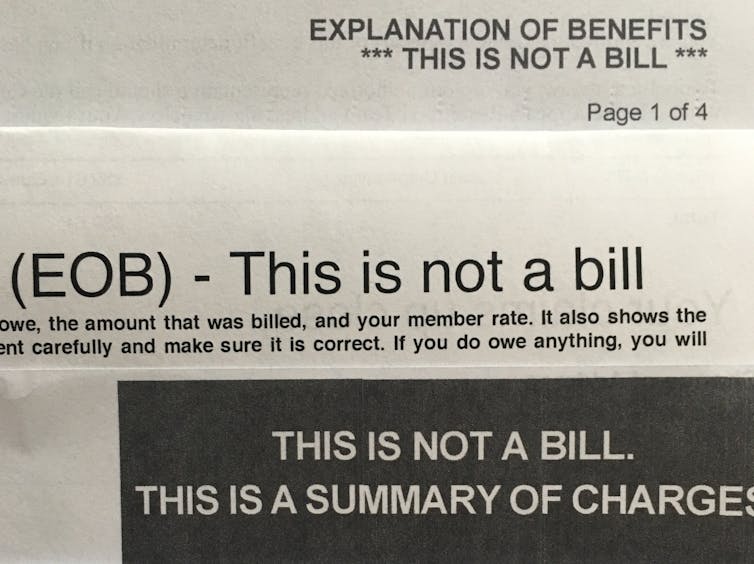
Should the EOB be DOA?

The EOB is not a bill, the insurance companies want you to know. Lynne AndersonCC BY-SA

Many in the health care system, including hospitals, doctors and insurers, are complicit in this confusing mess, although all can justify their individual actions.

The confusion begins for the patient when he or she receives an explanation of benefit (EOB). This typically says it is “Not a Bill,” although it really looks like one. What it actually shows is incredibly high provider prices and an equally implausible discount. The bottom line lists the actual payment and the amount the patient owes. Patients are supposed to be grateful for the discounts after they recover from the sticker shock of the listed price.

When a service is provided out-of-network, or is not covered at all, or the person doesn’t have insurance, the patient is supposed to pay this full amount. Such surprise bills” typically come to those least prepared to pay and, as a result, providers typically recover very little. So no one wins, except the collection agency and the lawyers.

I believe the standard EOB is the beginning of unnecessary complexity that leads to higher prices and an impossibly flawed market where shopping can never really work properly.

This ridiculous situation actually starts with insurance companies selling policies to ill-informed employers who don’t understand health care but effectively are the purchasers. Employers hire brokers and consultants to collect proposals from insurers; by some estimates, as many as 50 million people in the U.S. are covered by such plans.

These proposals frequently focus on the size of the discount from providers’ list prices as an indicator of how much the employer can save. The overall total cost or coverage is more important, but harder to estimate, since it depends on actual care delivered to employees. The unrecognized incentive for providers and insurers is to increase prices in order to increase the size of the discount.

I have actually seen cases where the insurer requests higher list prices from a provider to pump up the discount they can report to employers. This is crazy.

Stop the madness

One solution to this mess would be to require uniform prices by all providers to all purchasers. Maryland has a form of this “all-payer” system where everyone pays the same under rate regulation or negotiation. France, Germany, Japan and the Netherlands also use this form of control.

Benchmark pricing against what Medicare pays would do something similar, with everyone paying a fixed percent of these nationally regulated rates. This would blunt the ability of hospitals to arbitrarily jack up list charges and negotiate contract prices with insurers based on relative market power.

Unfortunately for consumers, such rate setting may be a political “bridge too far.” While some progressives might like regulation, conservatives likely will not because it challenges their faith in the superiority of free-market negotiations around prices.

And it might dampen innovation and even competition, depending on how realistic and flexible the regulators are in responding to new technology, alternative procedures, quality differentials and consumer demands – the decisions where markets are supposed work well.

Can price competition work?

It’s hard to shop around for some procedures, such as complex surgeries. Yulai Studio/shutterstock.com

The overarching question is whether patients and employers can ever do comparison shopping effectively. Clearly for many things, there can be no head-to-head choice. Trauma, highly complex surgery and other care cannot be predicted ahead of time or standardized to fit a consumer market model.

However, some things can be compared. Insurers now routinely let consumers know if a test or image could be done for less elsewhere. Perhaps comparing just a few services as an overall cost indicator is the best we can do.

But it may also be possible to determine overall relative bargains for a typical package of care to guide choices. My Cleveland hospital, MetroHealth System, manages Medicaid patients for a total cost which is 29% less than when they wander around without a medical home. This is a meaningful difference.

A first step towards comparison shopping might be eliminating the EOB as we know it. Rather than showing meaningless list prices, it would be more revealing if hospitals and insurers had to disclose their actual payment terms.

An alternative benchmark might be to provide health care consumers with a range of contract rates or the Medicare rate for a service. Then the difference between what you and others actually pay could be useful in comparing providers and insurers.

Those who long for a total overhaul of our system through “Medicare for All” or its variants, such as many Democrats vying for the nomination,will still have to deal with the question of how to contract and pay for all these moving parts. The temptation will be toward simple solutions involving prices, discounts and rate regulation – still, I believe, effectively a pursuit of fool’s gold.


Nurse viewpoint: Modern healthcare system prioritizes profits over care quality

https://www.beckershospitalreview.com/quality/nurse-viewpoint-modern-healthcare-system-prioritizes-profits-over-care-quality.html

The American healthcare system benefits companies, hospital systems and administrators over patients and providers, wrote Theresa Brown, PhD, BSN, RN, in an op-ed for CNN.

 Five highlights from Dr. Brown’s opinion piece:

1. Providers work in an environment of “scarcity,” whereas CEOs, pharmaceutical companies and hospital systems live in “a world of plenty.”

2. Dr. Brown cites her own experience at a teaching hospital in the University of Pittsburgh Medical Center system, where she says nurses who requested more life-saving devices were told to do “more with less,” despite the hospital system’s multibillion-dollar revenues.

3. Dr. Brown writes nurses at the teaching hospital also faced staff shortages, which have been shown to negatively affect patient health outcomes.

4. In contrast, 14 pharmaceutical companies made profits of at least $1 billion in 2018. Yet Dr. Brown argues that vilifying such companies misinterprets the problem, which is the long line separating cash-strapped hospital floors from the large profits that benefit systems, companies and administrators over patients.

5. Dr. Brown supports Medicare for All, writing that it is a critical measure for the 66 percent of American households that say they must choose between purchasing food and healthcare.


Trump’s health care focus puts GOP on edge

Trump’s health care focus puts GOP on edge

Image result for healthcare policy


President Trump has put the issue of health care back on the political front burner, providing ammunition to Democrats and worrying Republicans who think a new battle over ObamaCare will hurt their party in next year’s elections.

Senate Republicans, defending 22 seats next year, thought they had put ObamaCare repeal behind them when they told Trump earlier this year that they have no intention of acting on a health care overhaul before the election.

But Trump threw the issue back at them in an interview with ABC News that aired Sunday, saying his administration will unveil “something terrific” to overhaul the nation’s health care system “in a month.” He argued that action is needed because “ObamaCare has been a disaster.”

Republican lawmakers have little idea of what to expect and say there hasn’t been communication from the administration on the issue.

“All the members of Congress thought it had subsided and hope that it continues to be subsided,” one senior GOP aide said.

“We don’t actually agree with each other on what replacement should be, which means we don’t have a replacement that Republicans can unite around,” added the aide, who called Trump’s remarks a “political gift for Democrats.”

Speaker Nancy Pelosi (D-Calif.), signaling she likely agrees with the GOP aide, released a statement Monday denouncing Trump’s plan and saying Democrats would “fight relentlessly” against it.

“The American people already know exactly what the president’s health care plans mean in their lives: higher costs, worse coverage and the end of lifesaving protections for people with pre-existing conditions,” she said.

Senate Majority Leader Mitch McConnell (R-Ky.) offered a cautious take, stating of Trump in an interview with Fox News that “we’re looking forward to seeing what he’s going to recommend.”

McConnell added that there’s no chance Congress will act on anything Trump proposes until after next year’s election.

“The problem in the Senate and the House is the Democrats control the House. Se we can’t pass what we would like to do,” he said in an interview on “Fox & Friends.”

McConnell has told colleagues he wants to play offense by making the 2020 health care debate about Democrats’ calls for a single payer “Medicare for All” system. Trump’s move makes that more difficult.

“Democrats would much rather say, ‘Republicans are trying to take away ObamaCare and are trying to repeal the law on preexisting conditions’ and not make it about Medicare for All,” the GOP aide said.

Senate Minority Leader Charles Schumer (D-N.Y.) also took a shot at the president, saying Trump had repeatedly promised but failed to provide a “magic health care plan.”

“It never comes out,” Schumer tweeted. “Instead they just keep trying to sabotage your health care and suing to end protections for pre-existing conditions.”

The administration filed a legal brief in May calling for an appeals court to strike down all of ObamaCare. This represented a switch, first revealed in March, days after special counsel Robert Mueller’s report was filed with the Department of Justice, from the administration’s earlier position that only portions of the law should be struck down.

Many Republicans were caught off guard by the administration’s legal brief, which was widely seen in GOP circles as a mistake.

Republicans in the Senate, rather than focusing upon repealing the health care law, have sought to work on bipartisan legislation to lower health care costs.

Senate Health, Education, Labor and Pensions Committee Chairman Lamar Alexander (R-Tenn.) last month introduced a bill with Sen. Patty Murray (Wash.), the ranking Democrat on his committee, to address surprise medical billing and improve transparency for drug pricing.

In a statement last week, he emphasized the bipartisan nature of the proposal.

Separately, Senate Finance Committee Chairman Chuck Grassley (R-Iowa) is working with Sen. Ron Wyden (Ore.), the top-ranking Democrat on his panel, on legislation to cap seniors’ prescription drug expenses under Medicare.

Polls show why Republicans are nervous about ObamaCare.

A Wall Street Journal-NBC News poll published earlier this month showed that 24 percent of respondents nationwide think health care should be the federal government’s top priority, and Democrats lead Republicans on the issue by 8 points.

Democrats also won back the House majority last fall largely by talking about health care and the GOP’s failed effort to repeal ObamaCare.

“It’s been a loser of an issue for them,” said John Weaver, a GOP strategist who previously worked for former Ohio Gov. John Kasich (R) and the late Sen. John McCain (R-Ariz.). “In the last cycle it was one of the main causes for them losing the House.”

Some Republicans on Capitol Hill are skeptical about whether the White House will come out with a detailed health care plan and suspect that Trump’s latest comments may be more motivated by the desire to signal to his conservative base that he hasn’t given up on repealing ObamaCare.  

“The president and congressional Republicans have two fundamentally different political views on health care — not substantive views but political views. The president thinks any health care reform, repeal and replace, is a win and goes into his column and helps him and the Republicans,” said Vin Weber, a Republican strategist.

Weber said the GOP’s best strategy going into 2020 is “attacking the Democrats for being too far to the left, and the Democrats are giving them ammunition.”

McConnell in April said the key to GOP success in 2020 is to make the election “a referendum on socialism,” while Weaver on Monday said Republicans would like Trump to simply focus on the economy.

“You think he would be focused on the economy,” Weaver said. “Republicans have no credibility when it comes to health care.”

He called Trump’s renewed health care push “politically irresponsible.”


Efforts to save new moms clash with GOP’s Medicaid cuts

https://www.politico.com/story/2019/06/14/new-moms-clash-gop-medicaid-cuts-1364564

Image result for medicaid cuts

The push to address the soaring U.S. maternal morality rate is colliding with a broader, more ideological public health imperative: Republican-led efforts to scale back Medicaid.

The safety net program pays for half of all births in the nation. Democrats and many public health experts see it as a natural vessel for slowing the death toll of pregnant women and new mothers, by extending care in the crucial year following childbirth.

But concern over the potentially staggering cost has already quashed efforts in states such as Texas and left liberals in Congress glum over the prospects for a nationwide legislative fix.

“Medicaid represents the best of America and the administration’s effort to gut it would be a massive step backwards on confronting America’s maternal mortality crisis,” Sen. Elizabeth Warren (D-Mass.) wrote in an email.

The dynamic mirrors the federal response to the opioid epidemic, in which Republicans and the Trump administration support making addiction services more available while simultaneously working to shrink Medicaid, the largest single payer of behavioral and maternal health care.

Research has shown the risk of death after childbirth persists for a full year, from such factors as heart disease, stroke, infections and severe bleeding. Black and Native American women are about three times more likely to die from a pregnancy-related cause as white women, according to the Centers for Disease Control and Prevention.

Warren, along with fellow 2020 Democratic presidential contenders Sens. Bernie Sanders, Cory Booker and Amy Klobuchar, back extending Medicaid’s current requirement to cover new mothers from 60 days to one year after childbirth. Democratic proposals in the Senate from Dick Durbin of Illinois, and in the House, from Reps. Robin Kelly of Illinois and Ayanna Pressley of Massachusetts would do that along with provide states grants to improve hospital deliver practices, among other things.

But the efforts aren’t yielding GOP buy-in across the country, as conservative lawmakers keen on shrinking the program press for narrower fixes, such as increased data collection on deaths and a national standard of best medical practices. Proposals to enhance Medicaid coverage to address maternal mortality haven’t attracted a single Republican co-sponsor in Congress, with both sides at loggerheads on whether to grow or shrink the entitlement program.

“All mothers must have access to adequate care before and after delivery, and we should provide states with the tools and flexibility they need to ensure coverage of their most vulnerable populations,” Sen. John Cornyn (R-Texas) told POLITICO.

A Republican aide said GOP lawmakers are focused on getting a better picture of how many pregnant and postpartum women actually need coverage before exploring how to expand access to care. “That is a laborious process to undertake as we have to talk to both the states, stakeholders, and CMS to discern what coverage gaps exist. And we need to know the role other sources of coverage play as well,” the aide said.

Democrats say the prospect of expanding Medicaid benefits scares Republicans in an era of pitched partisan battles over health policy.

“Following the ACA and repeal Obamacare debates, health care, especially Medicaid experience, has become a hot issue — not quite a third rail but definitely hot and our GOP counterparts are a little squeamish,” a Democratic aide working on the issue said.

President Donald Trump last year signed a maternal care measure that directed millions of dollars in new spending to help states collect data on maternal mortality, but has been mum on extending Medicaid coverage to new mothers. His administration will weigh whether to allow Missouri to use its Medicaid programs to offer extended coverage to mothers struggling with addiction — but not the broader Medicaid population.

Meanwhile, the administration is aggressively pursuing an overhaul of Medicaid, finalizing proposals to allow states to apply for block grants that cap program spending and approving requests to condition benefits on work. The administration’s separate efforts to overturn Obamacare would also jeopardize federal subsidies that low-income mothers use to purchase coverage.

The focus on maternal mortality is driven by rising trend lines showing about 700 women die each year due to pregnancy related conditions a rate that’s more than doubled over the last three decades. About a third of the fatalities occur between one week and one year postpartum, according to a recent CDC report, putting the U.S. behind other developed countries for maternal health. And 60 percent of maternal deaths are preventable, with African American women and other minorities disproportionately affected.

Researchers studying the pattern say that extending Medicaid coverage would provide comprehensive benefits for chronic health conditions like heart disease, which accounts for a quarter of maternal deaths.

The postpartum period is such a period of vulnerability,” said Houston physician Lisa Hollier, immediate past president of American College of Obstetricians and Gynecologists and chair of Texas’s Maternal Mortality and Morbidity task force. “The transition time [from pregnancy to full recovery] is one when we see unmet health needs.”

Obamacare helped boost coverage for new mothers. The uninsured rate for women who reported giving birth in the past year fell to 11.3 percent in 2016 from 19.2 percent in 2013 according to a study in Health Affairs.

The gains in states that expanded their Medicaid programs under Obamacare were especially pronounced, with the uninsured rate among new mothers falling 56 percent compared with 29 percent in non-expansion states.

But the Republican-led push to dial back Medicaid expansion has put a spotlight on controlling spending across the entire program.

Some states are exploring alternatives. Missouri’s Department of Social Services this month intends to ask the Trump administration for a waiver that would allow it to offer Medicaid coverage to postpartum women struggling with substance abuse for one year after they give birth. The move would cover about 1,500 of the 24,000 women in the state whose benefits lapse 60 days after childbirth.

The state’s Republican-controlled legislature endorsed the idea last year after killing a broader expansion of Medicaid benefits to postpartum women.

In Texas, where 382 women died within a year of giving birth between 2012 and 2015, Republican Gov. Greg Abbott this week downplayed the state’s maternal mortality rate on Twitter and said that the state was already doing enough to deal with the issue.

Last month, legislators opted to develop postpartum care services within an existing state program geared towards family planning, which will cost about $56 million over five years, instead of extending Medicaid for 12 months, which carried a five-year price tag of nearly $1 billion in state and federal funds.

Kay Ghahremani, the state’s Medicaid director disputes the cost analysis, saying it would actually save money in the long run by promoting wellness and averting potential emergencies.

“It’s the most important thing we can do for maternal health in this state,” said Ghahremani, now president of the Texas Association of Community Health Plans. “We don’t want to see a single mom die from things that are avoidable.”


Trump admin opens door to fundamental changes in healthcare benefits

https://www.healthcaredive.com/news/trump-admin-opens-door-to-fundamental-changes-in-healthcare-benefits/556927/

The Trump administration has opened the door to altering how healthcare benefits are provided to millions of American employees. A new rule, set to go into effect next year, will allow employers to provide workers with funds to shop for coverage on their own, an option that could dramatically upend employer-sponsored coverage.

Instead of working with an insurer and allowing employees to pick from a few insurance options, employers will be able to funnel money into a standalone tax-exempt HRA (health reimbursement account) and employees could use those funds to shop for coverage on their own, either on the Affordable Care Act marketplaces or off.

“Long term, this added flexibility may reshape a significant number of employer coverage offerings and result in sizable shifts from employer to individual coverage,” Chad Brooker, an associate principal at Avalere who consults on healthcare reform and the impacts on business strategy, said in a statement.

White House officials said the change provides more flexibility to employers and gives workers greater choice when choosing coverage. The White House expects 800,000 employers to choose this defined benefit contribution option, which is expected to affect 11 million employees and their families.

The American Benefits Council cheered the move.

“We commend the Administration for taking what we believe is an important step toward greater flexibility in health care coverage,” the employer group’s president, James Klein, said in a statement.

But others voiced their concerns about potential costs and access issues.

Paul Fronstin of the Washington, D.C.-based Employee Benefit Research Institute said it may be overwhelming for some employees used to relying on their employers to do the bulk of the shopping for them or going to bat for them when an issue with the insurance carrier arises.

“Some people are going to like that and some people are going to hate it,” Fronstin told Healthcare Dive.

Positives of the idea are that it could lessen job lock, when an employee is somewhat stuck in a job because they don’t want to, or can’t afford to lose benefits, including health insurance.

With the unemployment rate near a historic low, Fronstin doesn’t expect large employers to switch immediately. However, when the next recession hits, “I think the future of health benefits gets put to the test,” he said.

But others say the idea that it solves job lock is overplayed.

The options on the ACA exchange, particularly in St. Louis, may come as a shock to employees who are used to robust networks, Kevin Guss, vice president of private client benefit services for St. Louis-based benefits consulting firm J.W. Terrill, told Healthcare Dive.

There are few providers selling individuals plans, out-of-pocket maximums are far higher and many have very limited networks with little out-of-network availability, he said.

“You can save money if you pursue this path, but buyer beware,” Guss said.