Democrats Yet To Successfully Explain Medicare For All

https://www.forbes.com/sites/brucejapsen/2019/05/26/from-bernie-to-warren-democrats-yet-to-successfully-explain-medicare-for-all/#3e8b63126daf


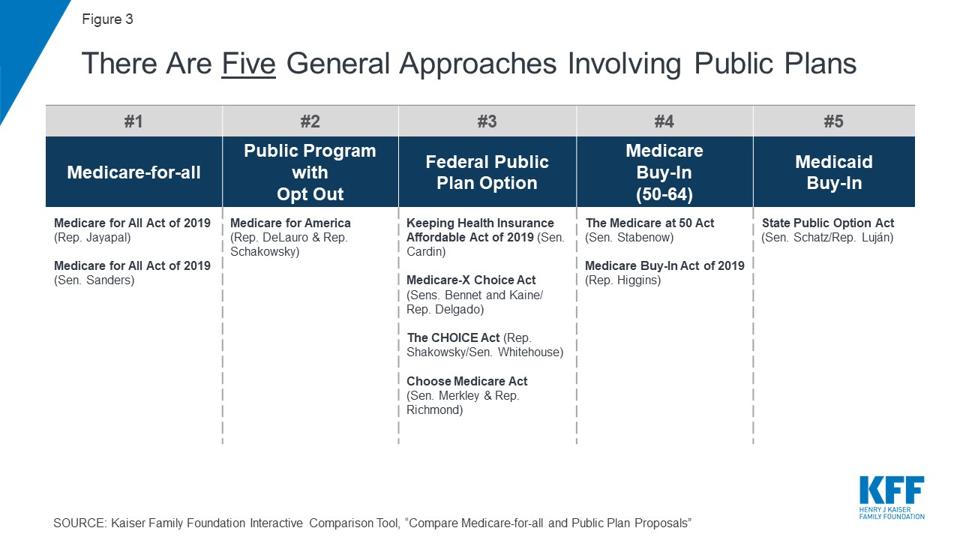
Kaiser Family Foundation Medicare For All briefing on national public healthcare plan approaches introduced in Congress (May 21, 2019).

Even with two dozen Democrats running for President and most touting an expansion of Medicare benefits to everybody, the public is still unclear how a national single payer health plan like “Medicare for All” will benefit them.

A briefing from experts at the nonpartisan Kaiser Family Foundation for health reporters last week revealed there are five general approaches to expanding coverage involving public plans.

Within those approaches are 10 national plans introduced in Congress that include everything from a single payer version of Medicare for All that would uproot private coverage to a “public program with an opt out” that would be offered along side commercial coverage. Other plans would allow Americans to buy into Medicare as young as 50 years old or buy into Medicaid coverage for the poor.

But no matter the effort to expand health insurance coverage, much is to be done to educate the public at large even as single payer supporters like Sens. Bernie Sanders, Elizabeth Warren and Kamala Harris push Medicare for All on the campaign trail.

“Our polling shows some Americans are unaware of how the implementation of a national health plan could impact them,” said Mollyann Brodie, Kaiser’s senior vice president and executive director, public opinion and survey research. “For example, many people (55%) falsely assume that would be able to keep their current health insurance under a single-payer plan.”

Democrats on the campaign trail hoping to challenge President Donald Trump should Republicans nominate him to run for re-election in 2020 see rising support for a national health plan that would make the government the only insurance carrier.

Kaiser data shows 56% favor a national health plan “in which all Americans would get their insurance from a single government plan.” Just 40% favored such a national health plan 20 years ago, Kaiser data shows.

“Our polls have shown a modest increase in support for the idea of a national health plan,” Kaiser’s Medicare for All presentation showed. Some of these health insurance expansions would be single payer versions of “Medicare for All’ like that proposed by Sanders in the U.S. Senate and Rep. Pramila Jayapal (D-Washington) in the U.S. House of Representatives that would uproot private coverage and replace it with government run Medicare.

Other public approaches would involve a “public program with an opt out” known as Medicare for America or a “Medicare Buy in” like that proposed by Sen. Debbie Stabenow (D-Michigan). Other public plans would involve a so-called “federal public plan option” that would be offered along side commercial coverage on a government exchange and there are also Medicaid buy-in proposals being floated in a number of states.

Politically, the lack of knowledge of Medicare for All and public option proposals offers opportunities for both Democrats who favor Medicare for All and Republicans who want to derail a government expansion of health benefits, particular an approach that would essentially replace much of the private system.

“As the public learns more about the implications of each of these proposals, support may increase or decrease,” Kaiser’s Brodie said.


Who is blocking ‘Medicare for All’?

Who is blocking ‘Medicare for All’?

Who is blocking 'Medicare for All'?

Decades of corporate-friendly politics and policy have decimated communities throughout the country. Centrist Democrats who have chosen corporate profits over people’s needs have aided and abetted this decimation. People are hungry for big ideas to improve their lives and to change the rules that serve only to make the rich richer.

Nowhere is this hunger more apparent than in the demand for improved “Medicare for All”. During a hearing at the House Budget Committee this week it was also apparent that the center-right and their wealthy donors won’t go down without a fight when it comes to health care. 

With guns-a-blazing, they are out to block an incredibly successful and popular program: Medicare, from being improved, expanded and provided to everyone.

Yet polling shows that across party lines,majority of Americans are in favor of Medicare for All. And why not? Right now, nearly 30 million people in this country are uninsured; 40 million can’t afford health-care co-pays and deductibles and 45,000 die annually as a result of not having access to health care.

Those reaping the excessive profits from our illnesses and injuries are in a panic. They’re laying all their chips on the table to make sure Medicare for All never becomes reality. It would mean the end of private insurance companies that profit mightily off the most costly and least effective health-care system in the industrialized world.

So, to continue to rake in their profits, they’ve created the Partnership for America’s Health Care Future, a partnership of corporate hospitals, insurance and drug companies. They must have a lot to lose: last year alone, the group spent $143 million developing attack ads and launching fear campaigns to kill Medicare for All.

It’s time to admit it, while nearly every modern country in the world provides quality, accessible health care for free or very inexpensively to their citizens, the United States stands alone in its willingness to let corporations suck the last pennies out of sick or injured people.

Well, the jig is up. Decades under a corporate-run private health insurance system have proven that we can’t rely on profiteers to provide access to quality health care. We need a publicly held system that is accountable to the people who rely on it. We are able to do so and save trillions of dollars over the next decade.

Medicare for All would reduce national health-care spending by anywhere between $2 trillion to $10 trillion over ten years. Research shows that countries with single-payer systems spend much less on drugs.

Yet opponents continue to decry the “costs” of Medicare for All. They will continue to focus on the cost to taxpayers, conveniently avoiding the truth that already we pay excessive health care costs through insurance premiums, co-pays and deductibles.

Americans suffer from poor health outcomes because they can’t afford to see a doctor until their illness becomes catastrophic. Many weigh the choice between financial ruin and life-saving medicines and treatment. In one of the richest countries in the world that is nothing short of shameful.

The U.S. is a country with abundant resources and more than enough wealth to go around. It’s time to share the wealth in America. It’s a new day and it starts with Medicare for All. Buckle up — because the fight is just beginning.


Toward 2020: A Survey of ACA Market Insurers

Click to access Toward_2020_A_Survey_of_ACA_Market_Insurers.pdf


ACA Litigation Round-Up: Risk Corridors, CSRs, AHPs, Short-Term Plans, And More

https://www.healthaffairs.org/do/10.1377/hblog20190523.823958/full/?utm_campaign=HASU&utm_medium=email&utm_content=ACA+Litigation+Round-Up%3B+Medication+Overload%3B+Surprise+Billing%3B+Uncertainty+About+DACA+And+Its+Impact+On+Health%3B+Recognizing+Trauma+In+The+Healer&utm_source=Newsletter

Litigation over various parts of the Affordable Care Act (ACA) and related regulations continues. ACA challenges are now under consideration by the Supreme Court and federal appellate and district courts across the country. This post provides a status update on ongoing litigation over the risk corridors program, cost-sharing reductions, the risk adjustment program, association health plans, and short-term plans. A previous post discussed the status of litigation over the contraceptive mandate.

Risk Corridors

As regular readers know, insurers sued the Department of Health and Human Services (HHS) for failure to make more than $12 billion in outstanding risk corridors payments. Lower court rulings were mixed. In June 2018, a three-judge panel of the Federal Circuit held that the government did not have to pay insurers the full amount owed to them in risk corridors payments. By a 2-1 majority, the court concluded that the ACA required the government to make risk corridors payments, but this obligation was suspended by subsequent appropriations riders that required these payments to be budget neutral.

The insurers’ request for en banc review by the Federal Circuit (meaning the case would be reheard by the entire Federal Circuit bench) was denied in November 2018. The insurers then petitioned the Supreme Court to hear their appeal in early February 2019. The petitions from the four insurers can be found here: Moda Health PlanBlue Cross and Blue Shield of North CarolinaLand of Lincoln, and Maine Community Health Options. The case is focused on whether Congress can use the appropriations process to amend or repeal substantive statutory payment obligations and whether these changes can be applied retroactively.

In early March, an array of stakeholders filed nine amici briefs, all in support of the Supreme Court hearing the cases. Briefs were filed by the U.S. Chamber of CommerceAmerica’s Health Insurance Plans, the Blue Cross Blue Shield Association, the National Association of Insurance Commissioners, the Association for Community Affiliated Plans19 state attorneys general led by Oregonsix insurers led by Highmark, and economists and professors.

The federal government’s response was initially due on February 4 but the Trump administration requested and received two extensions to file its response on May 8, 2019. In its opposition brief, the federal government asks the Supreme Court not to accept the appeal. The brief includes many of the same arguments made in the lower courts. In the government’s view, it was not required to make full risk corridor payments under the ACA because there was no appropriation to make such payments. Even if there was an obligation to do so, this obligation was subsequently eliminated by appropriation riders added by Congress. The federal government asks the court to look at the congressional history and context of the appropriations riders in precluding HHS from making full risk corridor payments.

The insurers have one more opportunity to respond before the Supreme Court considers whether to accept the appeal or not. If the Supreme Court does not agree to hear the case, the ruling by the Federal Circuit will stand, and insurers will not receive the more than $12 billion they are seeking.

Cost-Sharing Reduction Payments

In a related challenge, insurers have sued HHS for at least $2.3 billion in unpaid cost-sharing reduction payments (CSRs) since the Trump administration decided to stop making the payments in October 2017. To date, six insurers—in front of three different judges at the Court of Federal Claims—have succeeded in their challenges over unpaid CSRs. One of these lawsuits, brought by Common Ground Healthcare Cooperative, is a class action that includes more than 90 insurers. More insurers are being added to the class action on a regular basis, including four March, four in April, and one in May.

Federal Circuit

Three of the cases—brought by Montana Health CO-OP, Sanford Health Plan, and Community Health Choice—have already been appealed to the Federal Circuit and were consolidated. This means the three cases will be heard and decided together by the same panel of judges. The federal government filed its opening brief on March 22. Montana Health CO-OP and Sanford Health Plan filed their brief on May 1. Other insurers with pending lawsuits for unpaid CSRs filed amicus briefs in support of the insurers. Amicus briefs were filed by Blue Cross Blue Shield of North Dakota, L.A. Health Care Plan, Molina, and Common Ground.

Rulings for Montana Health CO-OP and Sanford Health Plan were limited to unpaid CSRs for 2017. However, Judge Elaine D. Kaplan of the Court of Federal Claims suggested that insurers could recover for 2018 and beyond even if insurers had used silver loading to insulate themselves from losses. (In mid-April, both insurers filed new complaints before Judge Kaplan for unpaid CSRs for 2018. Montana Health CO-OP sued for an additional $27 million, and Sanford Health Plan sued for an additional $11 million. Judge Kaplan stayed both cases pending a decision in the Federal Circuit.) The third case, for Community Health Choice, includes unpaid CSRs for 2017 and 2018. The amount of unpaid CSRs for 2018 was agreed to by the federal government and estimated based on 2017 costs.

Lower Courts

At least nine cases for unpaid CSRs, including the class action lawsuit, remain pending in the Court of Federal Claims. Two additional cases, brought by Maine Community Health Options and Common Ground, remain before Judge Margaret M. Sweeney. Judge Sweeney previously held that the insurers were owed unpaid CSRs for 2017 and 2018 and recently allowed Maine Community Health Options to amend its complaint to include nearly $36 million in unpaid CSRs for 2018. Common Ground separately estimated that its class is owed more than $2.3 billion for 2017 and 2018.

These estimates notwithstanding, the final amount owed will be determined through the CSR reconciliation process. In theory, insurers will complete this process in May 2019 and then the court can enter a final judgment reflecting actual 2018 CSR amounts by June. Judge Sweeney directed the parties to file a status report proposing the amount due to the class for 2018 within seven days of when HHS notifies all of the CSR class members of actual 2018 payments.

In mid-April, the plaintiffs asked for an extension of HHS’s deadline for the CSR reconciliation process, arguing that some class members would not have sufficient time to complete the submission process by the May 3 deadline. Judge Sweeney denied this request but noted that the government assured the court that all class members who ask for an extension to May 31 will be granted one. If a class member cannot meet the extended May 31 deadline and the government refuses to provide an additional extension, the plaintiffs can refile their motion.

In a separate challenge, Judge Thomas C. Wheeler held that L.A. Health Care Plan was entitled to unpaid CSRs for 2017. While the parties disagreed on the amount owed, L.A. Care filed an amended complaint on March 29 to reflect unpaid CSRs for 2018 and 2019 in the amount of about $83.5 million. L.A. Care will no longer seek unpaid CSRs for 2017 because it received more in advance CSR payments in 2017 than it ultimately paid out.

Most other CSR lawsuits—with a few exceptions like the lawsuits brought by Blue Cross Blue Shield insurers in North Dakota and Vermont—have now been stayed pending a decision by the Federal Circuit. The lawsuit brought by Guidewell Mutual Holding Corporation (which includes Blue Cross and Blue Shield of Florida, Florida Health Care Plan, and Health Options) was recently stayed as was a lawsuit brought by Health Alliance Medical Plans. The lawsuit brought by Harvard Pilgrim Health Care was separately stayed , but the insurer received permission to file an amended complaint to include about $21.5 million in unpaid CSRs for 2018. Molina’s $160 million challenge remains stayed until after a final, non-appealable judgment is issued in Moda Health Plan.

Risk Adjustment Program

Litigation continues over the methodology used in the risk adjustment program. A lawsuit brought by New Mexico Health Connections (NMHC) resulted in the brief suspension of about $10.4 billion in 2017 risk adjustment payments. The suspension occurred after Judge James O. Browning set aside the part of the risk adjustment methodology that uses a statewide average premium from 2014 to 2018. He later denied a request from the federal government to reconsider and overturn this ruling.

The federal government then appealed the decision to the Tenth Circuit. In mid-February, the Tenth Circuit directed the parties to address whether the court has jurisdiction to review Judge Browning’s order and judgment. The court is interested in whether the judgment is ripe for review since Judge Browning vacated part of the risk adjustment methodology and remanded the case to HHS. The cases cited by the Tenth Circuit’s clerk suggest that courts have answered this question differently: some have treated remand to an agency as a final decision (meaning it is appealable) while others have not.

The federal government filed a revised opening brief on March 22, with a request for oral argument. The government reiterates the reasons why it adopted a statewide average premium and a budget-neutral risk adjustment program and argues that NMHC waived its objections because these issues were not raised during the rulemaking process. The government also takes issue with the district court’s decision to vacate parts of the rule entirely (as opposed to limiting its ruling to NMHC or New Mexico). The government believes vacatur was inappropriate, did not reflect a balance of equities or the public interest, and was nationally disruptive to the risk adjustment program.

This point was echoed in an amicus brief from America’s Health Insurance Plans and the Blue Cross Blue Shield Association, noting that vacating the entire rule was “not only inequitable, but also unworkable” and “needlessly and retrospectively pull[ed] the rug out from under health plans that have relied on the final risk adjustment rules.” The brief highlights the impracticalities of adjusting the risk adjustment methodology (and thus the billions of dollars in risk adjustment transfers and medical loss ratios) for 2014 to 2016. They encourage the court to remand the risk adjustment regulations to HHS, without vacating them, to allow the agency to provide an additional explanation for its methodology for the 2014 to 2016 benefit years. These organizations filed a similar statement with the district court after HHS unexpectedly froze risk adjustment payments for 2017.

NMHC filed its opening brief on April 22, taking issue again with HHS’ use of a statewide average premium and arguing that the district court’s remedy—to vacate part of the risk adjustment methodology—was appropriate. The federal government’s reply brief was due on May 13 but it requested and received an extension to June 3.

Second Challenge

Separately, HHS issued new final rules to justify its risk adjustment methodology for 2017 and 2018. In August 2018, NMHC filed a new lawsuit challenging the final rule on the 2017 risk adjustment methodology. This means there are currently two lawsuits pending against the federal government brought by NMHC over the risk adjustment program. In late January, the parties asked Judge Browning to stay the second lawsuit while the original lawsuit is on appeal to the Tenth Circuit.

Association Health Plans

In July 2018, a coalition of 12 Democratic attorneys general filed a lawsuit challenging the final rule to expand access to association health plans (AHPs). Judge John D. Bates of the District of Columbia ruled in March 2019 that the rule violated federal law and was “clearly an end-run around the ACA.” The court set aside the rule’s provisions related to working owners and commonality of interest and remanded the rule back to the Department of Labor (DOL) to determine how the regulation’s severability provision affected the remainder of the rule.

The Trump administration appealed the ruling to the Court of Appeals for the District of Columbia (D.C. Circuit) where a panel of judges will consider the legal questions anew. The DOL also issued guidance that lays out its enforcement stance for already-in-existence AHPs, directs AHPs to pay claims, and prohibits AHPs from marketing to or enrolling new members.

On May 9, the federal government asked the D.C. Circuit for an expedited appeal in light of the fact that some consumers have already enrolled in AHPs. The DOL estimates that there are tens of thousands of enrollees in AHPs, many of whose plans will end between September and December 2019. Although the guidance and enforcement stance noted above are designed to mitigate disruption for enrollees, the administration urged a swift appeal. The D.C. Circuit granted this request. The government’s opening brief is due on May 31; the plaintiffs will file their opening brief on July 15. Final briefs will be due August 8. Oral argument has not yet been scheduled.

Short-Term Plans

Litigation continues over a separate final rule that expanded access to short-term plans. In September 2018, a coalition of consumer advocates and safety-net health plans sued over the new rule, arguing that it is contrary to Congress’s intent in adopting the ACA and should be invalidated. In November 2018, the plaintiffs withdrew their request for a preliminary injunction, and the case proceeded to the merits. The parties traded briefs throughout February and March, and amicus briefs were filed in support of the plaintiffs by patient advocates, AARP, and a range of medical associations.

Judge Richard J. Leon of federal district court in D.C. held oral argument on May 21. Media reports suggest that Judge Leon expressed continued skepticism of the plaintiffs’ arguments and whether (and the degree to which) they are harmed by the final rule. The court questioned enrollment data presented by the safety net health insurers and suggested that more time is needed to assess the impact of the new rule. Judge Leon also focused on why Congress had not acted to curb enrollment in short-term plans after the ACA if they were so harmful. He hopes to issue his decision this summer.


Federal Reserve Report on the Economic Well Being of U.S. Holdholds in 2018

Click to access 2018-report-economic-well-being-us-households-201905.pdf

2018 Employer Health Benefits Survey – Section 7: Employee Cost Sharing

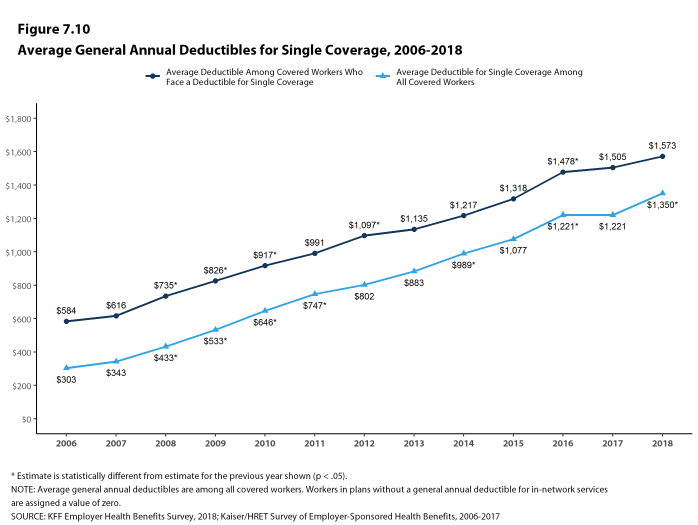
Figure 7.10: Average General Annual Deductibles for Single Coverage, 2006-2018

Shot: Almost 40% of Americans would struggle to handle a surprise expense of $400, according to a new Federal Reserve report.

Chaser: The average deductible today among all workers is more than $1,300, according to the Kaiser Family Foundation.


The Health 202: Large employers don’t want Medicare-for-all

https://www.washingtonpost.com/news/powerpost/paloma/the-health-202/2019/05/20/the-health-202-large-employers-don-t-want-medicare-for-all/5ce1aa38a7a0a435cff8c0d4/?utm_term=.47900c042418

Medicare-for-all advocates argue enacting their plan would lift a heavy burden off employers to provide their workers with health-care coverage, which is the way 180 million Americans get their insurance.

But large employers are just fine with being the suppliers of insurance and don’t want to give up that role, according to an association that represents them.

Overwhelmingly they would like to continue doing it,” Jim Klein, president of the American Benefits Council, told me. “They think they’re doing a good job.”

The American Benefits Council — which represents the country’s largest employers including Walmart, ExxonMobil and Apple — hasn’t joined the large industry coalition of insurers, pharmaceutical makers and hospitals who are vigorously fighting every iteration of Medicare-for-all proposals coming from Capitol Hill (we’ve written about that partnership here).

But its leaders are plenty skeptical of the prospect of a single-payer system, stressing it would upend the way most people in the United States get their coverage and potentially subject employers to big new taxes so the government could pay for the whole thing.

“I think they’re very concerned about sort of a blank check which the government would be filling in the blank, in terms of cost,” Klein said of his members.

The future of employer-sponsored coverage is one of the stickiest questions raised by the Medicare-for-all debate. The shortcomings — and merits — of the system got a lot of airtime during last month’s Medicare-for-all hearing at the House Rules Committee and probably will be part of the debate at a similar hearing House Budget Chairman John Yarmuth (D-Ky.) has scheduled for Wednesday.

Just look at how some of the Democrats running for president have recently danced around the issue.

Sens. Cory Booker (D-N.J.) and Kamala Harris (D-Calif.) are co-sponsors of the latest Medicare-for-all bill from Sen. Bernie Sanders (I-Vt.), which would upend the country’s health insurance system, replacing virtually all private plans with a generous set of benefits provided by the federal government. But both candidates have tried to take a softer stance on what would happen to workplace coverage.

—“I stand by supporting Medicare-for-all, but I’m also that pragmatist that, when I’m chief executive of the country … I’m going to find the immediate things that we can do,” Booker told CNN’s Jake Tapper this month.

“Because I’m telling you right now, we’re not going to pull health insurance from 150 million Americans who have private insurance who like their insurance — my union friends, brothers and sisters, who have negotiated for their health insurance,” Booker added.

—Sen. Kamala Harris (D-Calif.) told Tapper last week “that’s not what I meant” when he asked her to clarify previous comments in which she said she supports eliminating the private insurance industry.

“I support Medicare-for-all but I really do need to clear up what happened on that stage,” Harris said. “It was in the context of saying let’s get rid of all the bureaucracy.”

— Yarmuth poured cold water on the idea of Medicare-for-all being law anytime soon, despite the hearing he’s holding on the issue this week.

“A lot of people, I think, co-sponsored Pramila’s bill for the same reason they co-sponsored H.R. 676; it was the metaphor for Medicare-for-all,” Yarmuth told my colleague Dave Weigel last week. Yarmuth was referring to the House bill proposed by Rep. Pramila Jayapal (D-Wash.).

“Now, people have seen some of the details and said, ‘Okay, we need to look at this.’ There doesn’t seem to be much of a sense of urgency because it’s not going anywhere,” Yarmuth added.

Rep. Donna Shalala (D-Fla.), former Health and Human Services secretary under President Bill Clinton, is also a Medicare-for-all skeptic:

Perhaps these Democrats recall President Barack Obama’s infamous “if you like it, you can keep it,” pledge, where Obama learned the hard way what happens when people lose insurance they wanted to keep. Obama repeatedly promised people they could retain coverage they liked under his 2010 Affordable Care Act. When around 4 million people got notices their plans were being canceled — because they weren’t ACA-compliant — the administration came under heavy fire. The website PolitiFact dubbed Obama’s promise its “Lie of the Year” in 2013.

Yet employer-sponsored plans are still far from perfect. In fact, many health policy wonks have said many of the problems with health insurance in the United States stem from people getting it through the workplace instead of shopping for it on their own.

Costs are a big problem for both employers and their workers. For years, employers have grappled with rapid health-care cost inflation, resulting in higher monthly premiums and annual deductibles. Last year, health benefits for the average employee at a large company cost more than $13,000, according to a Mercer survey of employer-sponsored plans.

In response, employers have trended toward high-deductible plans or asked their workers to contribute more to their monthly premiums. Some have also invested in workplace wellness programs, in hopes of creating a healthier, lower-cost workforce.

“It puts a huge burden on employers,” House Rules Committee Chairman James McGovern (D-Mass.) said at his committee’s Medicare-for-all hearing.

Then there’s the issue of portability — the problem created when people change jobs and are forced to also change their health plan. This can be especially costly for those with chronic health conditions, who can’t afford any gaps in coverage and may find themselves having to satisfy an annual deductible for the second time in one year.

Yet to those enmeshed in the system, such as large employers, overhauling the whole thing is a daunting prospect. While health-care costs continue to rise, employers are more fearful of having to help fund the expensive single-payer system proposed in the Sanders and Jayapal bills.

Sanders argues his Medicare-for-all plan would be net cheaper for employers. He has proposed charging them either 75 percent of what they’re paying for each of their employees enrolling in Medicare-for-all or a 7.5 percent payroll tax, whichever is higher.

This would result in a net savings for employers, Sanders argues. Large employers don’t appear convinced.

Klein said the council isn’t necessarily opposed to expanding Medicare to more people — and stresses that its members are deeply interested in reining in cost growth.

But he said employers don’t want a health insurance overhaul, arguing they spend more than $4 on health benefits for every dollar the government loses by exempting the benefits from taxes.

“Our employers are not calling for Uncle Sam,” he said.


GOP Needs a Health Care Plan, Not an Immigration Plan

https://www.realclearpolitics.com/articles/2019/05/20/gop_needs_a_health_care_plan_not_an_immigration_plan_140372.html?utm_source=morning-scan&utm_medium=email&utm_campaign=mailchimp-newsletter&utm_source=RC+Health+Morning+Scan&utm_campaign=85626cbe0d-MAILCHIMP_RSS_EMAIL_CAMPAIGN&utm_medium=email&utm_term=0_b4baf6b587-85626cbe0d-84752421

Image result for health policy

On Thursday, President Trump unveiled his proposal for shifting the United States to a merit-based program for admitting future immigrants. The plan, which offers meaningful change and deserves serious consideration, is a non-starter politically, given that it does nothing to address the question of the Dreamers, or the millions of other immigrants already in the country illegally. Democrats, as expected, quickly condemned the president’s plan.

Trump isn’t wrong to highlight immigration. A broad-based restructuring of our immigration system is a laudable goal, and we do have a crisis on our southern border – as some Democrats now begrudgingly admit.

So immigration, legal and illegal, is an important issue, particularly to the president’s political base. The problem is that it’s not the most important issue for a most Americans, including many Republicans. It’s not even close. On the issue that is considered the most important – health care –Trump and the Republican Party have no plan at all.

Last week our polling firm, RealClear Opinion Research, released a new survey showing that health care is far and away the most important issue to Americans. At 36%, it was 10 percentage points above the number two issue – the economy – and more than 21 points ahead immigration, which ranked as the number three issue at 15%. (Education and the environment were tied at 11%, and foreign policy ranked last at just 3%.)

Attitudes about our current health care system were even more striking. Although 72% of registered voters rated their own health care as “excellent” or “good,” just 4% said the system was working for all Americans well enough that it needs no significant changes, while 28% think the current system is broken and needs to be replaced.  The vast majority (68%) is somewhere in the middle, viewing the current system either positively or negatively but agreeing that it is in need of improvements.

RealClear Opinion Research pollster John Della Volpe described the findings this way: “Significant proportions of Democrats, Republicans, and Independents agree that the current system needs substantial reform. The debate will be where to start, and how dramatic the correction.”

Democrats are already having that debate. Every single one of the 23 candidates running for the party’s nomination has embraced some form of reform, from expanding Obamacare or advocating “Medicare for All” to calling for a government-run single-payer system.

Meanwhile Trump and the GOP are standing on the sidelines. Nearly two months ago, Trump’s Justice Department came out in support of a Texas district court ruling striking down all of Obamacare. At the same time, the president took to Twitter (where else?) to declare that “the Republican Party will become ‘The Party of Healthcare!'”

Trump claimed that “the Republicans are developing a really great healthcare plan with far lower premiums (cost) & deductibles than Obamacare,” further promising that a “vote will be taken right after the Election when Republicans hold the Senate & win…”

After Republicans complained Trump had caught them off guard, on April 3 the president tweeted, “I was never planning a vote prior to the 2020 Election on the wonderful HealthCare package that some very talented people are now developing for me & the Republican Party. It will be on full display during the Election as a much better & less expensive alternative to ObamaCare…”

Since then, crickets. The thumping the GOP took in the House in 2018 should have been a wake-up call given the prominent role health care played in sending Republicans down to defeat. According to exit polls, 41% of voters in 2018 said health care was the most important issue facing the country, with immigration and the economy running a distant second and third place at 23% and 22%, respectively. More than two-thirds of voters said the health care system needed “major changes.”

Notice how closely those numbers mirror our new findings from RealClear Opinion Research. Six months after Republicans lost the House, voters’ opinions about the importance of health care and the need for reform haven’t budged. If  the president and his party don’t come up with a viable plan to address voters’ concerns, they may find it’s “déjà vu all over again” in 2020.