On Monday, national supermarket giant Kroger announced that it had reached a definitive agreement to sell its specialty pharmacy business to insurer Elevance Health, which plans to fold the business into its CarelonRx pharmacy benefit manager (PBM) division. Kroger’s in-store retail pharmacies and walk-in clinics are not included in the deal, which could close in the second half of 2024. Kroger’s specialty pharmacy is the sixth largest by revenue, serving two percent of the US market. The planned sale comes as Kroger pursues a merger with rival supermarket chain Albertsons, which also operates a specialty pharmacy, although the Federal Trade Commission (FTC) recently announced that it’s challenging that merger.
The Gist: With total pharmacy spend up 25 percent since 2019, including a 34 percent growth for specialty drugs, Elevance is capitalizing on a booming market by pushing into pharmacy services, following last year’s acquisition of BioPlus, another specialty pharmacy.
Administering high-cost drugs to patients with rare or complex diseases, specialty pharmacies now account for more than half of all prescription drug spending despite making up only around two percent of total prescription volumes.
Wall Street has fallen out of love with big insurers that depend heavily on the federal government’s overpayments to the private Medicare replacement plans they market, deceptively, under the name, “Medicare Advantage.”
I’ll explain below. But first, thank you if you reached out to your members of Congress and the Biden administration last week as I suggested to demand an end to the ongoing looting by those companies of the Medicare Trust Fund.
As I wrote on March 26, the Center for Medicare and Medicaid Services was scheduled to announce this week how much more taxpayer dollars it would send to Medicare Advantage companies next year. On January 31, CMS said it planned to increase the amount slightly to account for the increased cost of health care, based on how much more the government likely would spend to cover people enrolled in the traditional Medicare program. It uses traditional Medicare as a benchmark.
Big insurers like UnitedHealthcare, Humana and Aetna, owned by CVS, howled when CMS released its preliminary 2025 rate notice that day. They claimed they wouldn’t be getting enough of taxpayers’ dollars. So they launched a high-pressure campaign to get CMS to give them more money. They demanded extra billions because, they said, their Medicare Advantage enrollees had used more prescription drugs and went to the doctor more often in 2023 and January of this year than the companies had expected.
CMS announced after the market closed Monday that it was sticking to its plan to increase payments to Medicare Advantage plans by 3.7% – more than $16 billion –from 2024 to 2025. That would mean that it would pay companies that operate MA plans between $500 and $600 billion next year, considerably less than insurers wanted.
Shocked investors began running for the exits right away. When the New York Stock Exchange closed at 4 p.m. ET on Tuesday, more than 52 million shares of the companies’ stock had been traded–many millions more than average–driving the share prices of all of them way down. And the carnage has continued throughout this week.
By the end of trading yesterday, UnitedHealth, Humana and CVS/Aetna had lost nearly $95 billion in market capitalization. To put that in perspective, that’s more than the entire market cap of CVS, which fell to $93 billion yesterday.
All seven of the big for-profit companies with Medicare Advantage enrollment had a bad week, although Cigna, where I used to work and which announced recently it is getting out of the Medicare Advantage business next year, suffered the least. Its shares were down a little more than 1% as of yesterday afternoon.
Humana, the second largest MA company, which last year said it was getting out of the commercial insurance business to focus more fully on Medicare Advantage, by contrast, was the biggest loser of the bunch–and one of the biggest losers on the NYSE. Its shares fell more than 13% on Tuesday. As of yesterday, they were still down nearly 12%.
Noting that Humana’s stock has fallen 40% this year, he wrote:
Last fall, the insurer Humana was on top of the world. The stock was trading above $520 per share, as the company’s major bet on Medicare Advantage—the privately-run, publicly-funded insurance program for U.S. seniors—seemed to be paying off.
Long a darling of Wall Street’s analyst class, the stock had returned nearly 290% since the start of 2015, handily outperforming the S&P 500 over the same period.
Over the past five months, that position has crumbled. Humana shares were down to $308 Tuesday morning, as the outlook for Medicare Advantage and, by extension, for Humana’s business, has grown dimmer and dimmer.
Humana shares dived 12.3% early Tuesday, after the latest blow to the future prospects for the profitability of the Medicare Advantage business. Late Monday, the Centers for Medicare and Medicaid Services announced Medicare Advantage payment rates for 2025 that fell short of investor expectations.
The other companies also had a disastrous week. Shares of UnitedHealth, the biggest of the group in terms of Medicare Advantage enrollment (and overall revenues and profits), had fallen by 7% by the end of the day yesterday. CVS/Aetna’s shares were down 7.1%; Elevance’s were down 3.37%; Molina’s were down 7.15%; and Centene’s were down 7.33%.
When I was at Cigna, one of my responsibilities was to handle media questions when the company announced quarterly earnings, mergers and acquisitions, and whenever there was a major event like the CMS rate notice. The worst days of my 20-year career in the industry were when some kind of news triggered a stock selloff. I had to try to put the best spin possible on the situation. But my job was relatively easy compared to what the CEO, CFO and the company’s investor relations team had to do.
You can be certain they have been on the phone and in Zooms all week with Wall Street financial analysts, big institutional investors and even the company’s big employer customers in attempts to persuade them that the sky has not fallen.
You can also be certain that the companies will now shift their focus to the political arena. To keep this from happening again, they will begin pouring enormous sums of your premium dollars into campaigns to help elect industry-friendly candidates for Congress and the presidency this November. We provided a glimpse of where they’re already sending those donations in a story last November. We will continue to monitor this in the months ahead.
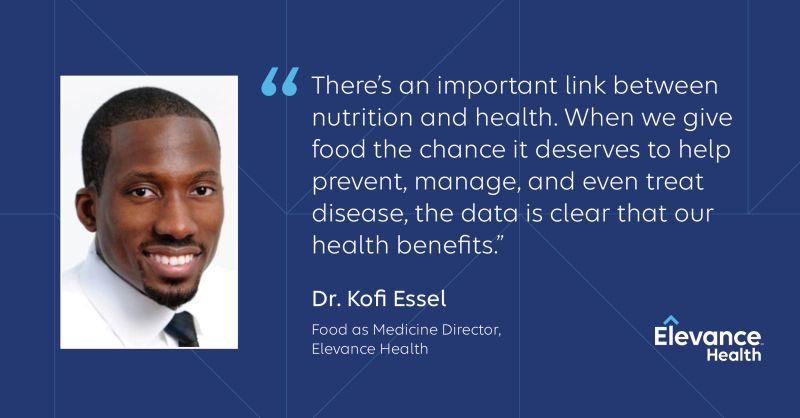
In June, Elevance Health named Kofi Essel, MD, as its first food as medicine program director, signaling a paradigm shift within one of the country’s largest healthcare organizations.
Dr. Essel is a community pediatrician by training, having most recently worked at Children’s National Health System in Washington, D.C. Before that, he was the director of the culinary medicine program at George Washington University’s School of Medicine and Health Sciences.
He sat down with Becker’s to discuss how Elevance is building a food as medicine strategy intended to eventually touch and improve the lives of its more than 47 million members nationwide.
Question: How do you define “food as medicine” as it relates to your role at Elevance Health?
Dr. Kofi Essel: The definition I’ve been leading around “food as medicine” are the strategies or interventions that work alongside healthcare and give access to high-quality foods, and a focus on prevention, management and treatment of disease. We also love to center this around health equity and thinking strongly about the importance of high-quality nutrition education as well.
Q: What’s your plan to integrate the “food as medicine” concept into Elevance Health’s insurance and other product offerings?
KE: We as a company strongly believe in the concept of whole health and really recognizing that the health of our members around the country is far more than what’s happening in the four walls of the clinical setting. We also believe that because we get great insight into the lives of our members in a variety of different settings, we are uniquely positioned to be able to respond to their whole health, including socioeconomic and behavioral health backgrounds. Food as medicine fits into this concept because we’re thinking about challenges around food and nutrition insecurity, and diet-related chronic diseases. This is a quite prevalent issue across the country, and we’re thinking about this through every line of business in Medicaid, commercial and Medicare.
We’ve been doing a lot of work in this space as an organization, and our philanthropic arm has committed $30 million over a three-year period to authentic foods as medicine solutions. One of the grantees that we supported in their community based efforts has been Feeding America, the largest umbrella organization for the majority of food banks around the country. They’ve been doing some phenomenal work creating what we call food pharmacies, which team up with health clinics. We’ve seen them collect some unique data, so we’re really excited about what we expect to see from that partnership in particular.
I will also say one of the big things that I’ve been working with our teams around is building our actual strategy. How are we going to incorporate this concept into every line of business? We are getting ready to roll out some pilots because the data is quite clear that these interventions are effective.
Q: Are there emerging trends or innovations in nutritional science that you think can enhance traditional health plans?
EF: The science around food as medicine is emerging and exciting and exists — and the data is quite clear that diet affects disease and health outcomes. There are a few different kinds of food as medicine interventions, such as medically tailored meals, medically tailored groceries and produce prescriptions.
There’s also strategies around using federal nutrition programs and other population or community-level policies and programs that we can lean into, including around quality nutrition education. I reviewed one recent study that looked at the power of produce prescription initiatives, which a lot of people have asked me, “What’s the point?” I point them to the data: One in 10 adults and children consume enough fruits and vegetables, meaning our consumption of fiber and other nutrients is quite low.
When families are provided a produce prescription, we see significant changes in hemoglobin A1C, which is a marker for diabetes. We see significant changes in blood pressure and significant improvement in weight management and overall health outcomes. So the data that these interventions can work is a powerful reminder to keep this great work going.
Q: Why should every major healthcare organization employ someone in your role?
EF: When you look at professional guidelines for organizations addressing a variety of different diet-related chronic diseases, one of the first things you’re going to see as an intervention option for patients is using lifestyle components such as food as a priority.
Unfortunately, the reality is we as medical providers aren’t always given the training that’s necessary to be able to engage in these meaningful conversations with our patients and families. It’s important to have a paradigm shift in how we incorporate this priority topic into how we engage with members across the country. Having a food as medicine director, or prioritizing food as medicine within an organization, is a key element to improving the health of patients and members.



 HENRY KOTULA