CHS debt swap plan is unsustainable, Moody’s says

https://www.beckershospitalreview.com/finance/chs-debt-swap-plan-is-unsustainable-moody-s-says.html?origin=cfoe&utm_source=cfoe

Related image

Although Franklin, Tenn.-based Community Health System’s proposed debt exchange plan will alleviate short-term liquidity concerns, it will also add to an already unsustainable capital structure, Moody’s Investors Service said Nov. 4

On Oct. 29, CHS said it plans to offer $700 million in new senior secured notes due in 2027 and up to $1.9 billion in senior unsecured notes due in 2028 in exchange for its $2.6 billion worth of outstanding senior unsecured notes due in 2022.

The plan would increase how much CHS pays in interest.

Moody’s didn’t alter the health system’s current “Caa3” rating in its public comment about the debt swap plan, but said if the plan moves forward it would likely result in downward pressure on some of its ratings.

“If the transaction is completed in its proposed form, the addition of incremental first lien debt will likely result in downward pressure on the existing senior secured first lien ratings of ‘Caa1,'” Moody’s said.


Tenet posts 3rd consecutive quarter of volume growth

https://www.healthcaredive.com/news/tenet-posts-3rd-consecutive-quarter-of-volume-growth/566597/

Dive Brief:

  • Shares of hospital chain Tenet Healthcare rose more than 3% Tuesday morning after reporting its third quarter results Monday evening showing broad-based volume growth.
  • Comparing hospital-to-hospital performance, Tenet reported a 3.6% increase in admissions and a slight uptick for inpatient surgeries (1.9%) and outpatient visits (1.6%).
  • The Dallas-based company reported a net loss of $232 million for the quarter attributable to the company’s common shareholders, compared to a loss of $9 million a year earlier.

Dive Insight:

Tenet CEO Ronald Rittenmeyer touted the results on Tuesday’s call with investors and said the company is raising its outlook for the year based on the numbers.

“We had a very positive third quarter with performance improvement in each of our operating segments,” Rittenmeyer said in a statement.

It’s the third consecutive quarter of volume growth, executives said Tuesday.

Rittenmeyer attributed positive trends over the past few years to a strong leadership team. “Tenet is in a much different place than it was two years ago,” he said.

Same-hospital patient revenue grew 5.8% and surgical revenue increased 6.9% on a same-facility basis.

Commercial volume trends were also very positive, executives said.

Still, they said the company faced more than $50 million in unanticipated headwinds including closures and costs related to Hurricane Dorian, lower California provider fee revenues and costs related to a nursing strike at 12 facilities.

The company is raising its outlook for adjusted earnings per share for the year. It expects adjusted diluted earnings per share from continuing operations of $2.25 to $2.91 for the year.

The company’s other segments also showed growth.

Conifer, the revenue cycle management unit, reported adjusted EBITDA of $90 million, an 11% increase from the previous year period. Tenet announced earlier this year it will spin off Conifer into an independent publicly traded company by the second quarter of 2021.

USPI, the outpatient surgical business, has a steady pipeline of health systems willing to send patients to the outpatient facilities, executives said during the call. During the third quarter, the company added three health systems and expects to reach a total of seven by end of year.


Top 5 Differences Between NFPs and For-Profit Hospitals

https://www.healthleadersmedia.com/finance/top-5-differences-between-nfps-and-profit-hospitals
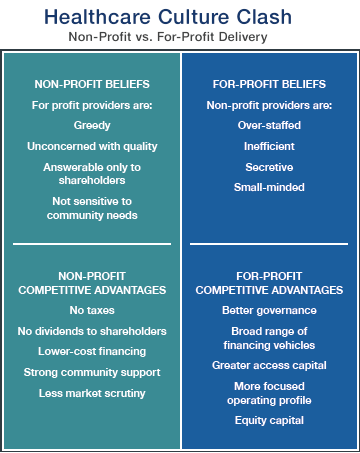
Image result for Non-Profit and For-Profit Hospitals

Although nonprofit and for-profit hospitals are fundamentally similar, there are significant cultural and operational differences, such as strategic approaches to scale and operational discipline.

All hospitals serve patients, employ physicians and nurses, and operate in tightly regulated frameworks for clinical services. For-profit hospitals add a unique element to the mix: generating return for investors.

This additional ingredient gives the organizational culture at for-profits a subtly but significantly different flavor than the atmosphere at their nonprofit counterparts, says Yvette Doran, chief operating officer at Saint Thomas Medical Partners in Nashville, TN.

“When I think of the differences, culture is at the top of my list. The culture at for-profits is business-driven. The culture at nonprofits is service-driven,” she says.

Doran says the differences between for-profits and nonprofits reflect cultural nuances rather than cultural divides. “Good hospitals need both. Without the business aspects on one hand, and the service aspects on the other, you can’t function well.”

There are five primary differences between for-profit and nonprofit hospitals.

1. Tax Status

The most obvious difference between nonprofit and for-profit hospitals is tax status, and it has a major impact financially on hospitals and the communities they serve.

Hospital payment of local and state taxes is a significant benefit for municipal and state governments, says Gary D. Willis, CPA, a former for-profit health system CFO who currently serves as CFO at Amedisys Inc., a home health, hospice, and personal care company in Baton Rouge, LA. The taxes that for-profit hospitals pay support “local schools, development of roads, recruitment of business and industry, and other needed services,” he says.

The financial burden of paying taxes influences corporate culture—emphasizing cost consciousness and operational discipline, says Andrew Slusser, senior vice president at Brentwood, TN-based RCCH Healthcare Partners.

“For-profit hospitals generally have to be more cost-efficient because of the financial hurdles they have to clear: sales taxes, property taxes, all the taxes nonprofits don’t have to worry about,” he says.

“One of the initiatives we’ve had success with—in both new and existing hospitals—is to conduct an Operations Assessment Team survey. It’s in essence a deep dive into all operational costs to see where efficiencies may have been missed before. We often discover we’re able to eliminate duplicative costs, stop doing work that’s no longer adding value, or in some cases actually do more with less,” Slusser says.

2. Operational Discipline

With positive financial performance among the primary goals of shareholders and the top executive leadership, operational discipline is one of the distinguishing characteristics of for-profit hospitals, says Neville Zar, senior vice president of revenue operations at Boston-based Steward Health Care System, a for-profit that includes 3,500 physicians and 18 hospital campuses in four states.

At Steward, we believe we’ve done a good job establishing operational discipline. It means accountability. It means predictability. It means responsibility. It’s like hygiene. You wake up, brush your teeth, and this is part of what you do every day.”

A revenue-cycle dashboard report is circulated at Steward every Monday morning at 7 a.m., including point-of-service cash collections, patient coverage eligibility for government programs such as Medicaid, and productivity metrics, he says. “There’s predictability with that.”

A high level of accountability fuels operational discipline at Steward and other for-profits, Zar says.

There is no ignoring the financial numbers at Steward, which installed wide-screen TVs in most business offices four years ago to post financial performance information in real-time. “There are updates every 15 minutes. You can’t hide in your cube,” he says. “There was a 15% to 20% improvement in efficiency after those TVs went up.”

3. Financial Pressure

Accountability for financial performance flows from the top of for-profit health systems and hospitals, says Dick Escue, senior vice president and chief information officer at the Hawaii Medical Service Association in Honolulu.

Escue worked for many years at a rehabilitation services organization that for-profit Kindred Healthcare of Louisville, Kentucky, acquired in 2011. “We were a publicly traded company. At a high level, quarterly, our CEO and CFO were going to New York to report to analysts. You never want to go there and disappoint. … You’re not going to keep your job as the CEO or CFO of a publicly traded company if you produce results that disappoint.”

Finance team members at for-profits must be willing to push themselves to meet performance goals, Zar says.

“Steward is a very driven organization. It’s not 9-to-5 hours. Everybody in healthcare works hard, but we work really hard. We’re driven by each quarter, by each month. People will work the weekend at the end of the month or the end of the quarter to put in the extra hours to make sure we meet our targets. There’s a lot of focus on the financial results, from the senior executives to the worker bees. We’re not ashamed of it.”

“Cash blitzes” are one method Steward’s revenue cycle team uses to boost revenue when financial performance slips, he says. Based on information gathered during team meetings at the hospital level, the revenue cycle staff focuses a cash blitz on efforts that have a high likelihood of generating cash collections, including tackling high-balance accounts and addressing payment delays linked to claims processing such as clinical documentation queries from payers.

For-profit hospitals routinely utilize monetary incentives in the compensation packages of the C-Suite leadership, says Brian B. Sanderson, managing principal of healthcare services at Oak Brook, IL–based Crowe Horwath LLP.

“The compensation structures in the for-profits tend to be much more incentive-based than compensation at not-for-profits,” he says. “Senior executive compensation is tied to similar elements as found in other for-profit environments, including stock price and margin on operations.”

In contrast to offering generous incentives that reward robust financial performance, for-profits do not hesitate to cut costs in lean times, Escue says.

“The rigor around spending, whether it’s capital spending, operating spending, or payroll, is more intense at for-profits. The things that got cut when I worked in the back office of a for-profit were overhead. There was constant pressure to reduce overhead,” he says. “Contractors and consultants are let go, at least temporarily. Hiring is frozen, with budgeted openings going unfilled. Any other budgeted, but not committed, spending is frozen.”

4. Scale

The for-profit hospital sector is highly concentrated.

There are 4,862 community hospitals in the country, according to the American Hospital Association. Nongovernmental not-for-profit hospitals account for the largest number of facilities at 2,845. There are 1,034 for-profit hospitals, and 983 state and local government hospitals.

In 2016, the country’s for-profit hospital trade association, the Washington, DC–based Federation of American Hospitals, represented a dozen health systems that owned about 635 hospitals. Four of the FAH health systems accounted for about 520 hospitals: Franklin, TN-based Community Hospital Systems (CHS); Nashville-based Hospital Corporation of America; Brentwood, TN–based LifePoint Health; and Dallas-based Tenet Healthcare Corporation.

Scale generates several operational benefits at for-profit hospitals.

“Scale is critically important,” says Julie Soekoro, CFO at Grandview Medical Center, a CHS-owned, 372-bed hospital in Birmingham, Alabama. “What we benefit from at Grandview is access to resources and expertise. I really don’t use consultants at Grandview because we have corporate expertise for challenges like ICD-10 coding. That is a tremendous benefit.”

Grandview also benefits from the best practices that have been shared and standardized across the 146 CHS hospitals. “Best practices can have a direct impact on value,” Soekoro says. “The infrastructure is there. For-profits are well-positioned for the consolidated healthcare market of the future… You can add a lot of individual hospitals without having to add expertise at the corporate office.”

The High Reliability and Safety program at CHS is an example of how standardizing best practices across the health system’s hospitals has generated significant performance gains, she says.

“A few years ago, CHS embarked on a journey to institute a culture of high reliability at the hospitals. The hospitals and affiliated organizations have worked to establish safety as a ‘core value.’ At Grandview, we have hard-wired a number of initiatives, including daily safety huddles and multiple evidence-based, best-practice error prevention methods.”

Scale also plays a crucial role in one of the most significant advantages of for-profit hospitals relative to their nonprofit counterparts: access to capital.

Ready access to capital gives for-profits the ability to move faster than their nonprofit counterparts, Sanderson says. “They’re finding that their access to capital is a linchpin for them. … When a for-profit has better access to capital, it can make decisions rapidly and make investments rapidly. Many not-for-profits don’t have that luxury.”

5. Competitive Edge

There are valuable lessons for nonprofits to draw from the for-profit business model as the healthcare industry shifts from volume to value.

When healthcare providers negotiate managed care contracts, for-profits have a bargaining advantage over nonprofits, Doran says. “In managed care contracts, for profits look for leverage and nonprofits look for partnership opportunities. The appetite for aggressive negotiations is much more palatable among for-profits.”


HCA Misses on Key Financials, Stock Drops Sharply

https://www.healthleadersmedia.com/finance/hca-misses-key-financials-stock-drops-sharply

The Nashville-based for-profit hospital operator’s revenues went up slightly, but other metrics missed the mark.

Though HCA Healthcare’s total revenues increased to $12.6 billion in Q2, the company missed on other key areas, according to its latest earnings released Tuesday morning.

HCA reported a net income of $783 million, down from $820 million this time last year, and an adjusted EBTDA of $2.29 that was better than Q2 2018 but fell from Q1 2019.

The Nashville-based for-profit hospital operator’s financial numbers from Q2 sent its stock tumbling in early morning trading, where it was down more than 10% by 10 a.m.  

Same facility admissions and same facility equivalent admissions each rose by 2.1% and 2.6%, respectively, while same facility emergency room visits jumped 3% year-over-year.

However, growth in same facility outpatient surgeries and same facility revenues per equivalent admission slowed in Q2 while same facility inpatient surgeries declined 0.1%.

The company updated its financial guidance in light of its Q2 results, projecting diluted earnings per share in a range between $10.25 and $10.65.

HCA had two major developments in Q2, asking a federal judge to dismiss a class action lawsuit alleging unfair billing practices at three Florida hospitals and its acquisition of 24 MedSpring urgent care centers from Fresenius Medical Care.

ADDITIONAL HCA Q2 EARNINGS REPORT HIGHLIGHTS:

  • Salaries, benefits, supplies, and other operating expenses accounted for 81.9% of revenues, down from 80.8% this time last year.
  • The company repurchased $242 million worth of stock in Q2 and has just over $1.75 billion remaining under its existing repurchase agreement.
  • The company also declared a quarterly cash dividend of $0.40 per share to be paid on September 30.
  • By the end of Q2, HCA was operating 184 hospitals, down from 185 hospitals at the end of Q2.

For complete financial information, review HCA Healthcare’s filing with the Securities and Exchange Commission.


Tenet plans to spin off revenue-cycle subsidiary Conifer

https://www.modernhealthcare.com/finance/tenet-plans-spin-revenue-cycle-subsidiary-conifer?utm_source=modern-healthcare-daily-dose-wednesday&utm_medium=email&utm_campaign=20190724&utm_content=article1-readmore

After nearly two years of fielding underwhelming offers for its revenue-cycle subsidiary, Tenet Healthcare Corp. has settled on a decidedly different maneuver: It will spin it off as a separate, publicly-traded company.

Leaders with Dallas-based Tenet have spent the past 18 months finalizing a deal on Conifer Health Solutions. While CEO Ron Rittenmeyer conceded on an investor call Wednesday that an outright sale would have been the company’s first choice, there are several benefits to a tax-free spin off.

Shareholders win in that they’ll get shares in the new company in addition to their Tenet stock, but Rittenmeyer couldn’t say say yet how many they will receive.

“From a shareholder standpoint, I believe it’s a no-brainer,” he said.

The stock market responded positively to Wednesday’s news. Tenet’s shares were up about 14.5% at market close.

Rittenmeyer said the deal, which isn’t scheduled to close for another two years, is also the best path forward for Tenet in that it will have a “reasonable” impact on the company’s debt. Tenet’s long-term debt stood at $14.8 billion as of March 31. He characterized the deal as a “debt-for-debt exchange” that will be tax free. Tenet also would have had to pay taxes on a sale.

The aim of Tenet’s asset sales, including—hypothetically—Conifer, have been to lower the company’s debt. But analysts questioned how much spinning off Conifer will truly achieve that purpose, and some said they believe it could actually increase the company’s debt ratio.

Rittenmeyer said in an interview Tenet has long maintained it will bring down debt through a combination of performance and asset sales, which are ongoing.

“The spin-off will be a debt-to-debt exchange that will put debt on the new company and pay off debt at Tenet,” he said. “So our debt will come down by that process.”

Tenet won’t disclose how much of its debt will shift to Conifer until 6 months before the deal closes, Rittenmeyer told investors on Wednesday morning’s call. He wouldn’t say whether Conifer will have more, less or similar leverage to Tenet. One thing’s for sure, he said Tenet does not plan to overleverage the new company.

“There’s no way we plan to load up Conifer and cause that to have a capital structure problem on the way out,” Rittenmeyer said. “We want it to be successful, so it’s a balancing act.”

Others aren’t convinced that will be the case. Brian Tanquilut, a healthcare equity analyst with Jefferies, thinks the deal will actually increase Tenet’s debt ratio because Conifer’s departure from Tenet will pull more from its earnings than it will from its debt, he said.

“There will be more debt sitting on Tenet’s books than what you’re moving off earnings proportionally to the Conifer spin,” he said.

John Ransom, a managing director in healthcare equity research with Raymond James & Associates, agreed that the deal could nudge Tenet’s debt ratio higher depending on how it plays out, although Conifer will likely pay a dividend to Tenet.

It makes sense that Tenet doesn’t want to load up the new company with debt, Ransom said.

“I think they want to try to dress this up as more of a growth company,” he said.

The deal won’t close until the end of the second quarter of 2021. To get there, Tenet will have to meet regulatory approvals from the Internal Revenue Service and Securities and Exchange Commission, Rittenmeyer said.

Tenet also announced Wednesday the departure of Conifer’s CEO, Stephen Mooney. He will be replaced on an interim basis by Tenet’s Chief Operating Officer, Kyle Burtnett, while the company searches for a permanent replacement. Rittenmeyer said that wasn’t connected to the Conifer announcement, but that Mooney simply wanted to pursue other endeavors.

“It’s very positive; no negative,” Rittenmeyer said. “We’re not pushing him out the door.”

In February, Tenet was in exclusive talks over what would have been a very different Conifer deal. Rittenmeyer revealed Wednesday Tenet had considered a merger with another company that would have ultimately been spun out. He said Tenet decided against that because it wasn’t clear that plan would have yielded enough of a financial return.

Tenet received nine preliminary bids to purchase Conifer, including three that were high enough to consider, Rittenmeyer said. Tenet spoke with 74 potential buyers overall, including 16 strategic buyers and 58 financial buyers. However, the company encountered a number of setbacks when it came to those deals.

Some of the would-be buyers were offering company stock in addition to cash, but Tenet wanted an all-cash sale, Rittenmeyer said. Additionally, he said the bids were not high enough to reflect the performance improvements Tenet has added to Conifer.

A number of the bids included stipulations Tenet could not agree to, such as not being accountable for collecting 100% of Tenet’s cash, “which is critically important to us,” Rittenmeyer said. In the end, none of the proposals would have assured Tenet would have effective recourse if cash collection fell short, Rittenmeyer said.

Some would-be buyers expected Tenet to guarantee that if it sold a hospital, the buyer would continue to use Conifer or, if it didn’t, Tenet would pay Conifer’s new owner for the sold asset’s revenue-cycle management, Rittenmeyer said.

This deal was complicated by the fact that Tenet continues to divest hospitals to pay down its debt, Tanquilut said. Since Tenet is Conifer’s largest customer, buyers would be taking on a shrinking company, he said.

“How do you value an asset that we know at least for its largest client will see shrinking revenue?” Tanquilut said.

On Wednesday’s call, Rittenmeyer said early in the process, shareholders said they believed buyers would pay high multiples for Conifer, possibly in the mid- to high-teens.

Ransom said Tenet likely received an unreasonably high valuation from an investment bank, which may have contributed to the extended time it spent seeking a buyer.

“Whoever told them they were going to get a high-teens valuation, that’s insane,” Ransom said. “They probably shouldn’t have bought that.”


CHS shares close at all-time low

https://www.beckershospitalreview.com/finance/chs-shares-close-at-all-time-low-071619.html

Image result for community health systems stock

Shares of Franklin, Tenn.-based Community Health Systems closed July 15 at $2.40, their lowest closing price ever and down 2 percent from July 12. 

The hospital chain’s stock price traded as low as $2.37 and as high as $2.52 on July 15 after closing July 12 at $2.45. Over the past year, CHS shares have traded between $2.35 and $5.35.

CHS has been selling off hospitals in recent years to improve its financial position and reduce its heavy debt load. In late 2017, the company announced a plan to sell a group of hospitals with combined annual revenue of $2 billion. During an earnings call on April 30, CHS Chairman and CEO Wayne Smith said the company expects to complete the hospital divestiture plan in 2019.

CHS carried $13.88 billion in long-term debt when it announced its divestiture plan at the end of 2017. As of March 31, CHS said its long-term debt totaled $13.39 billion.