UnitedHealth to jumpstart Q2 results with eyes on volume, ‘Medicare for All’

https://www.healthcaredive.com/news/unitedhealth-to-jumpstart-q2-results-with-eyes-on-volume-medicare-for-all/558855/

UnitedHealth Group on Thursday kicks off second quarter earnings as the first major healthcare firm to report results, setting the tone and expectations for the quarter. Wall Street analysts expect the insurance giant to post a strong showing, buoyed by its Optum business.

Volume trends, talk of “Medicare for All” on the campaign trail and emerging CMS payment models are among the topics likely to bubble up as payers begin reporting their earnings over the next few weeks.

Utilization subdued

Utilization is slowing in the second quarter, according to a June survey of 48 hospital administrators. SVB Leerink analysts noted this is a positive for payers and their medical cost trends and for hospital operators heavily invested in outpatient settings, including HCA and Tenet Healthcare with its outpatient surgical unit, USPI.

“Share of procedures in [inpatient] declined across all service lines except for spine, reinforcing the shift from [inpatient],” SVB Leerink analysts said.

Lab data is another good indicator of overall utilization and volume trends, Brian Tanquilut, an analyst with Jefferies, said. Tanquilut said he’ll be watching LabCorp and Quest closely next week to get a better idea of utilization trends for the quarter.

Drug rebate reform may not be dead

The White House last week pulled its proposal to ban drugmaker rebates to pharmacy benefit managers in Medicare and Medicaid in a win for payers. Stocks for UnitedHealth, CVS and Cigna rose sharply following the announcement.

That may not be the end for the proposal, however.

“It’s still alive and moving along in Congress,” Tanquilut said, referencing the Lower Health Care Costs Act sponsored by Sen. Lamar Alexander, R-Tenn., which was passed out of committee and is expected to be brought to the floor soon.

That legislation is broad reaching and includes efforts to ban surprise billing and boost price transparency, other payer hotspots.

With the rebate proposal, the administration had proposed to fundamentally alter the way drugs are paid for in the U.S. But federal budget forecasters warned it would increase spending by $177 billion over the next decade, given many of those rebates are used to lower premiums for Part D beneficiaries.

PBMs, most of which are owned by major payers, have come under fire as many grow skeptical of whether rebates really drive down drug spending.

The Alexander bill includes limitations on spread pricing — which have also garnered intense criticism — and would require PBMs to pass all of the rebates back to insurance plans.

Kidney overhaul positive for most payers

One issue on payers’ minds is the Trump administration’s recent effort aimed at overhauling the country’s approach to kidney care. The plan includes an executive order intended to incentivize home dialysis, increase prevention, make more organs available for transplant and spur development of artificial and wearable kidneys.

The Center for Medicare and Medicaid Innovation also introduced five new payment models, including one that’s mandatory. The center’s chief, Adam Boehler, told reporters the plan would “be broad and sweeping, impacting half the country.”

Analysts at SVB Leerink called the announcement a medium-term win for payers like CVS, Humana, UnitedHealth Group and Anthem. Humana in particular has upside potential because of its focus on Medicare Advantage and with Kindred at Home, which it acquired a year ago.

Cigna stands to benefit from its investment in Cricket Health, which aims to improve early detection of high-risk kidney patients, and UnitedHealth’s Optum arm continues to invest in home dialysis, analysts said.

They also noted CVS executives discussed early detection of kidney disease at the company’s recent investor day, saying home hemodialysis could drive as much as $1 billion in new business through 2022 (possibly accelerated by the CMS announcement). With CVS’ experience in complex patient home care and chronic disease management and the acquisition of Aetna, the company is “an ideal partner to manage chronic kidney disease.”

‘Medicare for All’ debate continues

With the 2020 campaign heating up among Democrats, Medicare for All was a hot topic during last quarter’s calls. A number of executives singled the idea out for criticism, sending payer stocks tumbling.

Since then, talk on the campaign trail of expanding government coverage has continued, although Medicare for All is just one of the ideas being discussed. This week, former Vice President Joe Biden rolled out a plan for building on the Affordable Care Act and increasing premium subsidies for people on the exchanges.

The issue will certainly resurface at the end of this month when candidates have their second primary debate.




There Is No Single, Best Policy for Drug Prices

There Is No Single, Best Policy for Drug Prices

Image result for There Is No Single, Best Policy for Drug Prices

A majority of Americans prefer greater regulation of prescription drug prices, meaning government intervention to lower them.

But don’t count on a single policy to address a nuanced problem.

“All low-priced drugs are alike; all high-priced drugs are high priced in their own way,” Craig Garthwaite, a health economist from Northwestern University’s Kellogg School of Management, wrote with a colleague.

Outside of a few government programs — like Medicaid and the Veterans Health Administration — low-priced drugs are alike in that competition is the sole source of downward pressure on prices. When many generic versions of a brand-name drug enter the market, competition can push their prices 80 percent below the brand price, or sometimes even more.

In contrast, high-priced drugs lack competition for various reasons, “not all of which imply our goal should be to reduce prices,” Mr. Garthwaite said.


Healthcare stocks rally after Trump administration nixes drug rebate plan

https://www.beckershospitalreview.com/finance/healthcare-stocks-rally-after-trump-administration-nixes-drug-rebate-plan.html

Shares of major health insurers and other healthcare companies surged July 11 after the Trump administration yanked a plan to curb drug rebates. The healthcare rally helped push the Dow Industrial Average to 27,088 — its highest close ever.

UnitedHealth Group led the Dow to its all-time high, according to The Wall Street Journal. UnitedHealth climbed 5.5 percent July 11 to $261.16 per share.

Shares of major pharmaceutical companies, including Merck, Pfizer and Eli Lilly, lost ground on July 11, hampering the Dow’s climb, according to TheStreet.

“Pharma is getting absolutely shellacked,” Jamie Cox, managing partner for Harris Financial Group, told TheStreet. “I think being in the crosshairs of both parties in advance of an election year is definitely not a good place to be. It’s the one area where Democrats and Republicans can agree-they can beat up on pharma and there’s no negative repercussions.”

The S&P 500 also reached a record July 11, trading 0.2 percent higher. In the S&P 500, Cigna jumped 9.2 percent to $175.34 per share, while shares of CVS Health climbed 4.7 percent to $57.97. However, pharmaceutical companies and biotechnology firms broadly declined, according to The Wall Street Journal. 


Judge rules against Trump on drug pricing disclosures

Judge rules against Trump on drug pricing disclosures

Image result for federal judge ruling on drug price transparency

A federal judge on Monday sided with a coalition of drug companies and blocked the Trump administration from implementing a policy that would require prescription drug manufacturers to disclose list prices in TV ads.

The pharmaceutical companies — Amgen, Merck, and Eli Lilly — were joined in the lawsuit by the Association of National Advertisers. The rule was scheduled to take effect Tuesday.
U.S. District Court Judge Amit P. Mehta in Washington, D.C., agreed with the drug companies that the Department of Health and Human Services (HHS) does not have the authority to compel drug companies to disclose prices.

“To be clear, the court does not question HHS’s motives in adopting the [rule],” Mehta wrote. “Nor does it take any view on the wisdom of requiring drug companies to disclose prices. That policy very well could be an effective tool in halting the rising cost of prescription drugs. But no matter how vexing the problem of spiraling drug costs may be, HHS cannot do more than what Congress has authorized. The responsibility rests with Congress to act in the first instance.”

Under the rule, which was announced by HHS Secretary Alex Azar in May, drug manufacturers would have to state the list price of a 30-day supply of any drug that is covered through Medicare and Medicaid and costs at least $35 a month.

Azar argued that forcing drugmakers to disclose their prices in direct-to-consumer TV advertising could shame companies into lowering their prices. In announcing the rule, Azar said there’s no reason patients should be kept in the dark about the full prices of the products they’re being sold.

“Patients have a right to know, and if you’re ashamed of your drug prices, change your drug prices. It’s that simple,” Azar said in May when the administration announced the final rule.

Drug companies fought the rule from the start, arguing it would confuse consumers because a drug’s list price — which doesn’t reflect the discounts negotiated with insurers or through patient assistance programs — is often higher than what the patient actually pays.

PhRMA, the nation’s top drug lobby, wants its members to disclose pricing on separate websites.

The companies also argued that the rule violates their First Amendment rights. However, Mehta’s ruling noted that because the agency did not have the authority to issue the rule in the first place, the First Amendment claim was not valid.

In a statement, HHS spokeswoman Caitlin Oakley said the administration was “disappointed” in the ruling.

“We are disappointed in the court’s decision and will be working with the Department of Justice on next steps related to the litigation,” Oakley said.  “Although we are not surprised by the objections to transparency from certain special interests, putting drug prices in ads is a useful way to put patients in control and lower costs.”


Purdue Pharma struggling amid lawsuits

https://www.axios.com/newsletters/axios-vitals-1b40c794-c913-4681-b2ac-7a6e9746718f.html?utm_source=newsletter&utm_medium=email&utm_campaign=newsletter_axiosvitals&stream=top

Related image

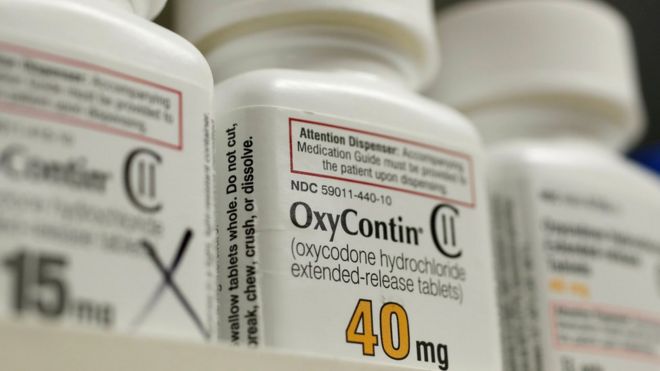
Purdue, the maker of OxyContin, is facing sluggish sales, a dwindling workforce and restructuring challenges as it fights a slew of lawsuits claiming that the company contributed to the opioid epidemic, WSJ reports.

  • The company’s revenue is expected to be less than $1 billion this year for the first time in a decade, and it has said it’s considering filing for bankruptcy.
  • Sales for OxyContin have been declining since 2010, as providers have changed their prescribing habits and the public has grown more aware of the threat of opioid addiction.

Purdue’s financial reliance on OxyContin was a result of business decisions made by the company and its board, including members of the Sackler family — which is also under legal scrutiny.

  • The company’s leaders are now more focused on dealing with the ongoing litigation than growing the business, sources told the WSJ.


Nurse viewpoint: Modern healthcare system prioritizes profits over care quality

https://www.beckershospitalreview.com/quality/nurse-viewpoint-modern-healthcare-system-prioritizes-profits-over-care-quality.html

The American healthcare system benefits companies, hospital systems and administrators over patients and providers, wrote Theresa Brown, PhD, BSN, RN, in an op-ed for CNN.

 Five highlights from Dr. Brown’s opinion piece:

1. Providers work in an environment of “scarcity,” whereas CEOs, pharmaceutical companies and hospital systems live in “a world of plenty.”

2. Dr. Brown cites her own experience at a teaching hospital in the University of Pittsburgh Medical Center system, where she says nurses who requested more life-saving devices were told to do “more with less,” despite the hospital system’s multibillion-dollar revenues.

3. Dr. Brown writes nurses at the teaching hospital also faced staff shortages, which have been shown to negatively affect patient health outcomes.

4. In contrast, 14 pharmaceutical companies made profits of at least $1 billion in 2018. Yet Dr. Brown argues that vilifying such companies misinterprets the problem, which is the long line separating cash-strapped hospital floors from the large profits that benefit systems, companies and administrators over patients.

5. Dr. Brown supports Medicare for All, writing that it is a critical measure for the 66 percent of American households that say they must choose between purchasing food and healthcare.


5 Ways Technology is Transforming the Healthcare Industry

5 Ways Technology is Transforming the Healthcare Industry

5 Ways Technology is Transforming the Healthcare Industry


Democrats Yet To Successfully Explain Medicare For All

https://www.forbes.com/sites/brucejapsen/2019/05/26/from-bernie-to-warren-democrats-yet-to-successfully-explain-medicare-for-all/#3e8b63126daf


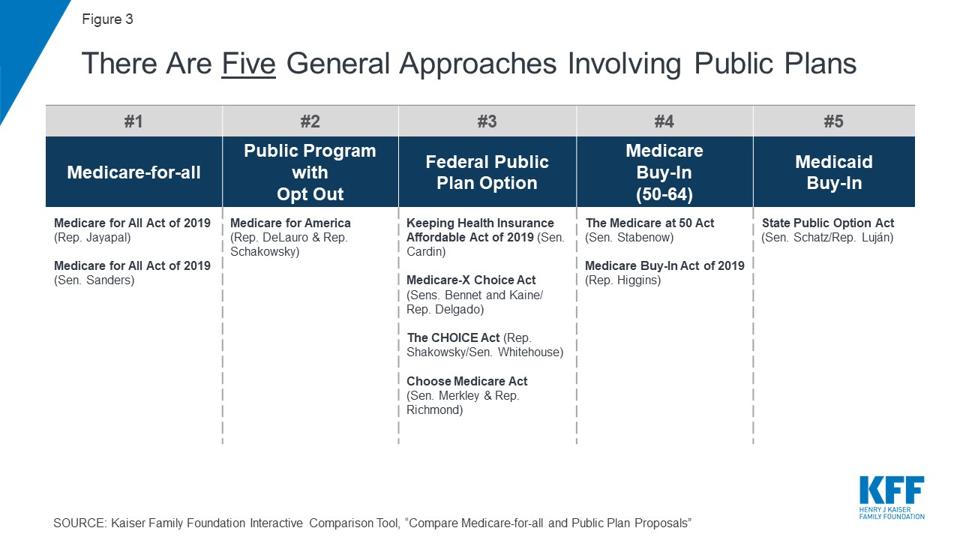
Kaiser Family Foundation Medicare For All briefing on national public healthcare plan approaches introduced in Congress (May 21, 2019).

Even with two dozen Democrats running for President and most touting an expansion of Medicare benefits to everybody, the public is still unclear how a national single payer health plan like “Medicare for All” will benefit them.

A briefing from experts at the nonpartisan Kaiser Family Foundation for health reporters last week revealed there are five general approaches to expanding coverage involving public plans.

Within those approaches are 10 national plans introduced in Congress that include everything from a single payer version of Medicare for All that would uproot private coverage to a “public program with an opt out” that would be offered along side commercial coverage. Other plans would allow Americans to buy into Medicare as young as 50 years old or buy into Medicaid coverage for the poor.

But no matter the effort to expand health insurance coverage, much is to be done to educate the public at large even as single payer supporters like Sens. Bernie Sanders, Elizabeth Warren and Kamala Harris push Medicare for All on the campaign trail.

“Our polling shows some Americans are unaware of how the implementation of a national health plan could impact them,” said Mollyann Brodie, Kaiser’s senior vice president and executive director, public opinion and survey research. “For example, many people (55%) falsely assume that would be able to keep their current health insurance under a single-payer plan.”

Democrats on the campaign trail hoping to challenge President Donald Trump should Republicans nominate him to run for re-election in 2020 see rising support for a national health plan that would make the government the only insurance carrier.

Kaiser data shows 56% favor a national health plan “in which all Americans would get their insurance from a single government plan.” Just 40% favored such a national health plan 20 years ago, Kaiser data shows.

“Our polls have shown a modest increase in support for the idea of a national health plan,” Kaiser’s Medicare for All presentation showed. Some of these health insurance expansions would be single payer versions of “Medicare for All’ like that proposed by Sanders in the U.S. Senate and Rep. Pramila Jayapal (D-Washington) in the U.S. House of Representatives that would uproot private coverage and replace it with government run Medicare.

Other public approaches would involve a “public program with an opt out” known as Medicare for America or a “Medicare Buy in” like that proposed by Sen. Debbie Stabenow (D-Michigan). Other public plans would involve a so-called “federal public plan option” that would be offered along side commercial coverage on a government exchange and there are also Medicaid buy-in proposals being floated in a number of states.

Politically, the lack of knowledge of Medicare for All and public option proposals offers opportunities for both Democrats who favor Medicare for All and Republicans who want to derail a government expansion of health benefits, particular an approach that would essentially replace much of the private system.

“As the public learns more about the implications of each of these proposals, support may increase or decrease,” Kaiser’s Brodie said.


Who is blocking ‘Medicare for All’?

Who is blocking ‘Medicare for All’?

Who is blocking 'Medicare for All'?

Decades of corporate-friendly politics and policy have decimated communities throughout the country. Centrist Democrats who have chosen corporate profits over people’s needs have aided and abetted this decimation. People are hungry for big ideas to improve their lives and to change the rules that serve only to make the rich richer.

Nowhere is this hunger more apparent than in the demand for improved “Medicare for All”. During a hearing at the House Budget Committee this week it was also apparent that the center-right and their wealthy donors won’t go down without a fight when it comes to health care. 

With guns-a-blazing, they are out to block an incredibly successful and popular program: Medicare, from being improved, expanded and provided to everyone.

Yet polling shows that across party lines,majority of Americans are in favor of Medicare for All. And why not? Right now, nearly 30 million people in this country are uninsured; 40 million can’t afford health-care co-pays and deductibles and 45,000 die annually as a result of not having access to health care.

Those reaping the excessive profits from our illnesses and injuries are in a panic. They’re laying all their chips on the table to make sure Medicare for All never becomes reality. It would mean the end of private insurance companies that profit mightily off the most costly and least effective health-care system in the industrialized world.

So, to continue to rake in their profits, they’ve created the Partnership for America’s Health Care Future, a partnership of corporate hospitals, insurance and drug companies. They must have a lot to lose: last year alone, the group spent $143 million developing attack ads and launching fear campaigns to kill Medicare for All.

It’s time to admit it, while nearly every modern country in the world provides quality, accessible health care for free or very inexpensively to their citizens, the United States stands alone in its willingness to let corporations suck the last pennies out of sick or injured people.

Well, the jig is up. Decades under a corporate-run private health insurance system have proven that we can’t rely on profiteers to provide access to quality health care. We need a publicly held system that is accountable to the people who rely on it. We are able to do so and save trillions of dollars over the next decade.

Medicare for All would reduce national health-care spending by anywhere between $2 trillion to $10 trillion over ten years. Research shows that countries with single-payer systems spend much less on drugs.

Yet opponents continue to decry the “costs” of Medicare for All. They will continue to focus on the cost to taxpayers, conveniently avoiding the truth that already we pay excessive health care costs through insurance premiums, co-pays and deductibles.

Americans suffer from poor health outcomes because they can’t afford to see a doctor until their illness becomes catastrophic. Many weigh the choice between financial ruin and life-saving medicines and treatment. In one of the richest countries in the world that is nothing short of shameful.

The U.S. is a country with abundant resources and more than enough wealth to go around. It’s time to share the wealth in America. It’s a new day and it starts with Medicare for All. Buckle up — because the fight is just beginning.