Behavioral health utilization driven by fast-growing telehealth use

https://mailchi.mp/e1b9f9c249d0/the-weekly-gist-september-15-2023?e=d1e747d2d8
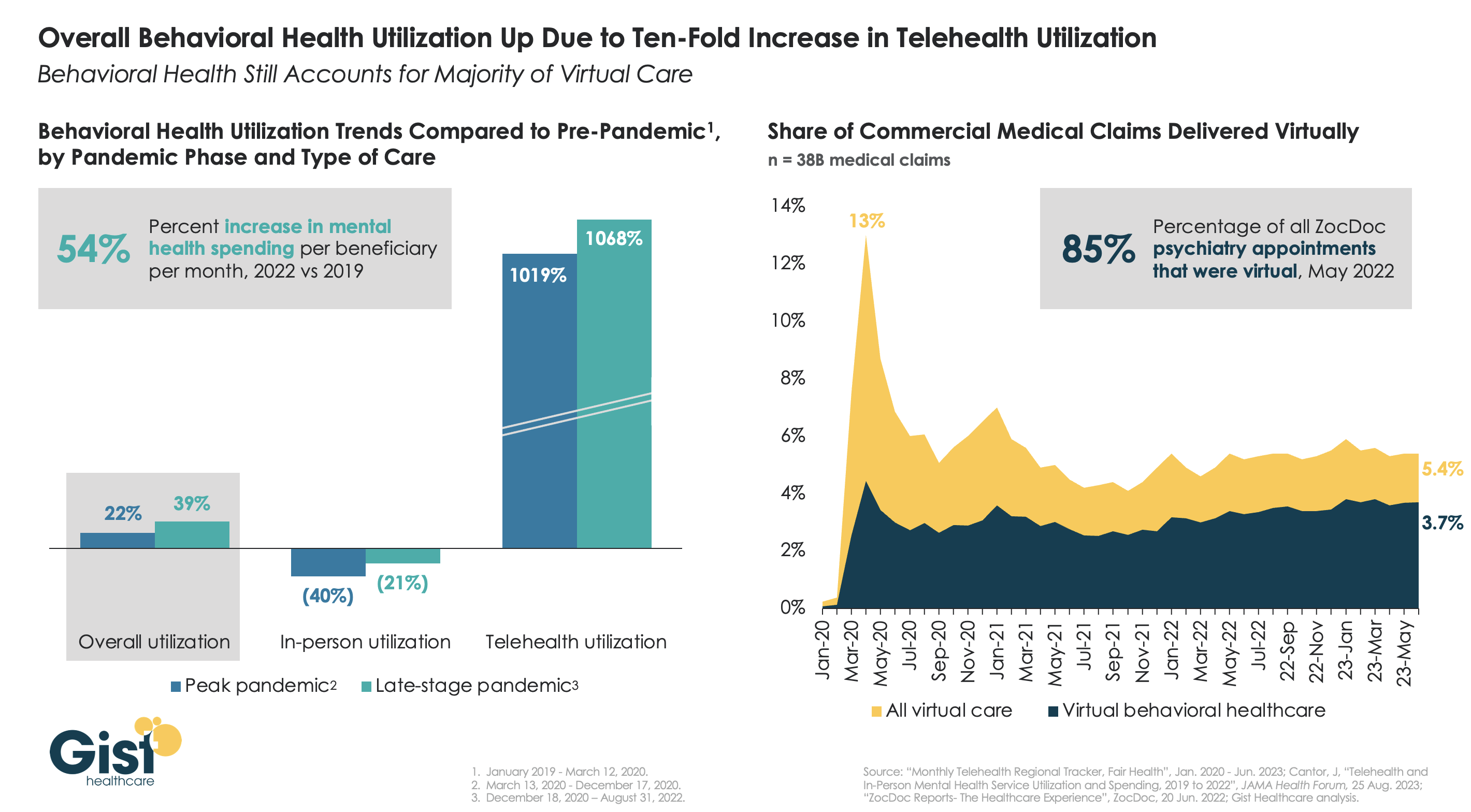
The pandemic worsened the existing mental health crisis in the United States, greatly increasing demand for care. In this week’s graphic, we highlight new data from JAMA Health Forum on mental healthcare trends from 2019 to 2022. 

Overall behavioral health utilization increased in 2022 compared to pre-pandemic and peak-pandemic levels, fueled by a ten-fold increase in telehealth usage. 

In-person behavioral health utilization decreased early in the pandemic and declines continued in 2022, compared to pre-pandemic levels. Behavioral health still accounts for more than two-thirds of all telehealth visits, a trend that has remained largely unchanged since 2021. 

While many consumers and mental health providers continue to embrace telehealth as a means to expand access and increase affordability, a recent Morning Consult survey found that most Americans actually favor in-person visits for quality and efficiency—that is, if they can access it. 

Additionally, the future of some types of virtual behavioral healthcare remains murky as the Drug Enforcement Agency (DEA) has yet to establish rules for prescribing controlled substances via telehealth beyond November 2024. 

Virtual care solidifying its post-COVID role 

https://mailchi.mp/4587dc321337/the-weekly-gist-october-14-2022?e=d1e747d2d8

After COVID restrictions introduced millions of Americans to telehealth, it became an open question whether virtual care would revolutionize healthcare delivery, or turn out to be a flash in the pan. Using commercial claims data from Fair Health, the graphic above reveals that roughly one in twenty commercial medical claims are now for virtual care, a rate that has held fairly steady since dropping from its early pandemic peak. (These use rates likely extend to Medicare, as a Kaiser Family Foundation analysis showed that the virtual share of outpatient visits barely differed between those younger and older than 65.) 

What could be considered a true revolution is virtual care’s impact on behavioral healthcare, which makes up nearly two-thirds of overall virtual care volume. According to Zocdoc, an online marketplace booking both in-person and virtual care services, 85 percent of psychiatric appointments booked in the first half of 2022 were for virtual care, dwarfing the virtual visit levels of the other top specialties.

Meanwhile, consumers have incorporated virtual care into their lives as a useful option, though not as the sole way they access care. A recent survey found that a near-majority of consumers have accessed care both virtually and in-person, far more than the number who rely exclusively on one channel or the other. The pandemic changed consumers’ baseline expectation of what care could be delivered at home. The ability to deliver accessible, efficient virtual visits and connect that care to in-person care delivery will be a competitive advantage in the “hybrid” care environment sought by many consumers.

Searching for value in a sea of health apps

The explosion of apps, wearables, and other health tech solutions targeted at employers has overwhelmed and frustrated many HR executives who make decisions about employee health benefits. At a recent convening of health insurance brokers we participated in, several bemoaned the challenge of helping their clients understand which solutions might bring real value.

One shared, “For the past few years, it’s felt like ‘App-apalooza’ out there. CHROs [chief human resource officers] get pitches for new apps every day…there are literally thousands out there saying they’ll reduce costs and improve employee health, but it’s next to impossible to tell which ones of them actually work.”

Brokers expressed surprise at how little evidence, or in some cases, actual patient and client experience, some health tech companies brought to the table: “We have startups coming to our clients talking about their millions of dollars in funding, but when you dig into what they’re actually doing, not only can they not show outcomes data, you find out they’ve only worked with a few dozen patients!”

But among the sea of apps purporting to manage any and every employee health need, from chronic disease to fertility to sleep quality, brokers reported their clients were finding value in a few distinct areas. 

Technology-based mental health solutions received high marks for increasing access to care, with the prediction that “tele-behavioral health could become a standard part of most benefits packages very quickly”.

More surprisingly, employers shared positive feedback on the impact of virtual physical therapy solutions: “I was skeptical that it would work, but people like being able to rehab at home. And not only is it cheaper, we’re seeing higher adherence rates.”

But even the best apps are often challenged by a lack of connectivity to the rest of a patient’s healthcare. The technologies that will have the greatest staying power will be those that not only deliver results, but are able to move beyond point solutions to become part of an integrated care experience, meaningfully connected to other providers involved in a patient’s care.