Conservatives Are Using the Courts to Attack Health Care for All Americans

https://www.americanprogress.org/issues/healthcare/news/2018/12/20/464562/conservatives-using-courts-attack-health-care-americans/

A doctor in Milton, Massachusetts, wheels his patient into his office, February 2018.

Conservative state officials, in conjunction with the Trump administration, have launched an all-out attack on health care in the United States. They have brought a suit to overturn the entirety of the Affordable Care Act (ACA), which would have serious consequences for nearly every American who has health coverage, whether through their employer, the individual market, Medicare, or Medicaid. And they found a partisan judge who, last Friday, proved willing to ignore the rule of law and help them advance their political agenda through the courts.

For now, the ACA remains the law of the land. But if the partisan decision in Texas v. United States is upheld, the consequences could be devastating. The Urban Institute estimates that overturning the ACA would result in 17 million more Americans being uninsured in 2019—in addition to coverage reductions that would occur due to the elimination of the individual mandate penalty. Millions of American families could be left without access to health care—and without the financial safety and peace of mind that health insurance provides. Overturning the law would also have serious negative effects on public health and drug development and would shorten the life of the Medicare trust fund. Moreover, it would provide a major tax break to the wealthiest Americans, insurance companies, and drug manufacturers.

Supporters of the decision have talked about this as an effort to end “Obamacare,” which may cause some people to mistakenly believe it only affects those who obtain coverage through the individual marketplace. Nothing could be further from the truth: Virtually no American’s health care coverage would be safe from the effects of this decision. Here are just some of the impacts that this decision, if upheld, would have.

Risks for people who obtain coverage through their employer

  • Lifetime and annual limits on coverage: Polling shows that without the ACA’s ban on lifetime and annual caps on benefits, firms would choose to reinstate limits on coverage. Tens of millions of workers and dependents could face annual or lifetime limits.
  • Loss of coverage for young adult children: The ACA requires employer plans that cover dependents to include young adults up to age 26. More than 2 million young adults have gained coverage under the ACA’s dependent coverage provision.
  • Loss of free preventive services, including contraception: The ACA requires preventive services—such as immunizations; screenings for cancer, diabetes, and depression; and well-child visits—to be available at no cost to the patient. Womensave about $250 annually thanks to the lack of cost sharing for contraception.
  • Elimination of rebates to cover excessively high premiums: The ACA requires insurers to provide rebates if they overprice premiums relative to actual medical costs. Under the ACA’s medical loss ratio provision, insurance companies paid back $344 million in 2016 to people with employer coverage.

Risks for people who receive coverage through Medicare

  • Increases in premiums and out-of-pocket costs: Elimination of the ACA would increase some beneficiaries’ premiums, deductibles, and copayments in Medicare Part A and Part B; overturning the law would eliminate Medicare savings, and premiums are based on program spending.
  • Cost sharing for preventive services such as mammograms: Under the ACA, Medicare provides preventive services and covers a yearly wellness visit at no cost to the patient.
  • Possibility of falling back into the prescription drug coverage gap: The ACA narrowed the Part D coverage gap and was on track to completely fill it by 2020. Without the ACA, many seniors could face higher costs for prescription medications.

Risks for people who receive coverage through Medicaid

  • Loss of coverage under the Medicaid expansion: About 12 million people are covered under the Medicaid expansion, which was funded mostly by the federal government under the ACA.
  • Higher costs for preventive services such as children’s vaccines: The ACA provided a financial incentive for states to provide preventive services to Medicaid beneficiaries free of charge, which a number of states currently utilize.
  • Fewer options to receive care in homes and communities: The ACA provided new options to states to allow elderly enrollees and enrollees with disabilities to receive care in their homes. If the law is overturned, more enrollees will be forced into institutional care.

Risks for people who buy insurance on their own

  • Loss of tax credits that make coverage affordable: Nearly 9 in 10 enrollees in the ACA marketplaces receive premium tax credits. Without the ACA, enrollees would lose financial assistance toward monthly premiums, as well as funding that helps lower deductibles and copayments.
  • Increased costs or denial of coverage due to pre-existing conditions: Without the ACA, individual market insurers would be allowed to charge more, exclude coverage benefits, or turn away people based on medical history. More than 133 millionAmericans with pre-existing conditions could be subject to discrimination if they ever needed individual market coverage.
  • Increased costs for older enrollees: The ACA limits how much more insurance companies can charge older people for coverage relative to younger ones. Without the ACA’s protections, the elderly and near-elderly would see their premiums rise

The legal reasoning behind the lower court’s decision to overturn the ACA is so poor that it has been decried by even some of the most strident conservative legal critics of the law—including those who have backed the previous efforts to overturn it through the courts. Congress has tried and failed to repeal the ACA, and voters in the midterm elections made it clear that they care about keeping protections for pre-existing conditions. Yet the court’s ruling has been approvingly cited by conservative political officials, including President Donald Trump. As such, the decision is best understood not as a legal opinion but instead as a policy preference pursued through the U.S. judiciary. That preference could not be clearer: to give the country’s wealthy and special interests massive taxes cuts—and pay for them with everyone else’s health care.


Amazon’s vision for the future of health care is becoming clear

https://www.cnbc.com/2018/12/17/amazon-vision-future-health-care.html

Image result for Amazon’s vision for the future of health care is becoming clear

KEY POINTS
  • Amazon made some bold first steps into health care this year.
  • We asked health-care experts to help us figure out where the company is going next.
  • Amazon could innovate in a lot of areas from pharmacy to subsidizing healthy food.

Amazon might take its time getting into new industries. But whether it’s online retail, cloud computing or groceries, its vision is typically ambitious.

Now, it’s health care’s turn.

This year, the company made a few early strides in the $3.5 trillion sector. Here are some of the highlights:

With all that in mind, we talked to some experts in the space to put the pieces together and figure out where Amazon might be going next.

Becoming Dr. Amazon

So imagine you have a sore throat. You let Alexa know, and it responds by asking if you want to book an appointment at the doctor’s office or get a virtual consult. You pick the virtual option, and the doctor through Alexa asks you about your symptoms. It decides to send a courier to your home with a tiny portable device to do some basic tests for things like strep throat. The strep test is positive, so the virtual doc sends over a prescription for an antibiotic. (We’re assuming that all the Amazon services are fully compliant with privacy and other laws.)

All this happens within a few hours, and you never need to leave your house to sit in a medical office or stand in line at the pharmacy.

That vision of the future might seem like science fiction, but it’s plausible to some health industry insiders.

“I wouldn’t be surprised if Amazon starts out in health by providing things like over-the-counter medicines, and then moves into making the experience easier for managing your health,” said Tom Robinson, a San Francisco-based partner at Oliver Wyman, who consults with health and life sciences companies.

Robinson said it’s possible for Amazon’s Alexa to become a “front door” of sorts for health care. If it can provide virtual care, including diagnostic testing and pharmacy, it could become a “closed loop” system. It wouldn’t be able to deal with all problems, Robinson points out, as some can only be managed in person. But it could do a lot for basic ailments, preventative care and potentially even to help people with chronic medical conditions.

Food as medicine?

Now that Amazon owns Whole Foods, it could also help people eat healthier.

As Jason Langheier, CEO of a food-tech start-up called Zipongo, told CNBC, Amazon could create a web-based service for people to access meal plans, kits, recipes and even subsidies on fresh foods for those who are already suffering or at risk for disease.

It might inch closer to that, he suggests, by nudging people to eat healthier food options online, which could include some advertising and product placements. “With its underbelly of e-commerce, Amazon can touch the one thing (food) that has the greatest public health impact.”

We haven’t seen many signs of progress around in this area yet, although its employer group is likely looking at poor diet as a leading contributor of preventative (and expensive) illness.


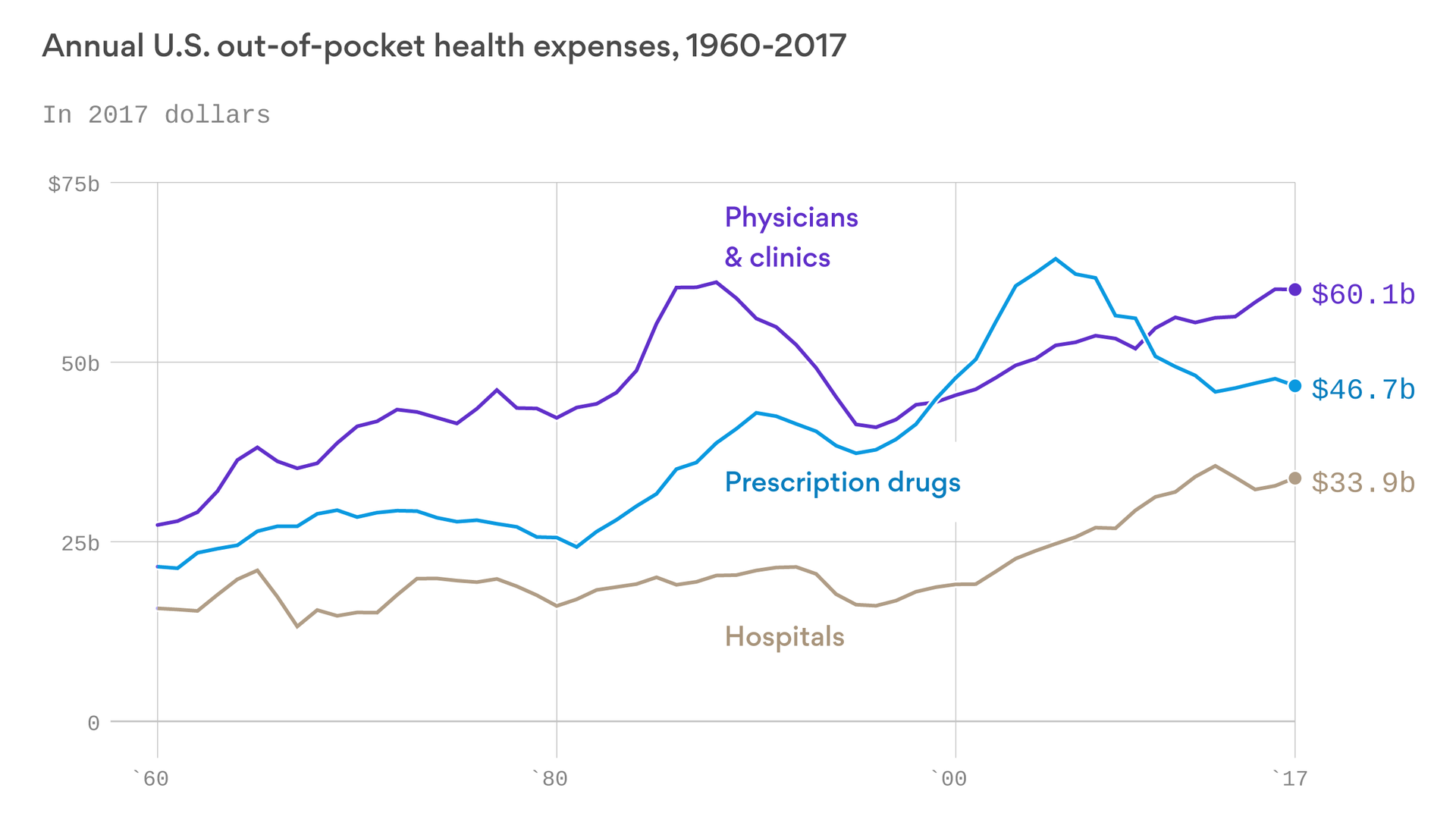
Hospitals smallest part of out-of-pocket costs

https://www.healthsystemtracker.org/interactive/?utm_campaign=KFF-2018-Peterson&utm_source=hs_email&utm_medium=email&utm_content=68267802&_hsenc=p2ANqtz–ktue7Wpa6NlVV1m5K05fMVx7jZNGoCLlk_ATmPS8Y6TgyNwDww1IGCz7sUIjYm69FTQmPft_pPBXXoE4h62JNKY1rEA&_hsmi=68267802&display=U.S.%2520%2524%2520Billions&service=Hospitals%252CPhysicians%2520%2526%2520Clinics%252CPrescription%2520Drug&source=Out%2520of%2520Pocket&tab=0

Image result for Hospitals smallest part of out-of-pocket costs


We spend more on hospital care than any other type of health care service, but hospitals make up the smallest amount of out-of-pocket spending.

  • That means insurers are passing on a smaller percentage of hospital costs to enrollees, although they indirectly pay for hospital care through premiums.

Between the lines:

  • “A big role of patient cost-sharing is to discourage use of inappropriate or unnecessary services. So much of hospital care is non-discretionary from the perspective of patients,” Kaiser Family Foundation’s Larry Levitt says.
  • Levitt adds that insurance tends to pay a bigger part of hospital bills versus other services because hospital bills tend to be large, causing patients to blow through their deductible or hit their out-of-pocket maximum.


Congress could get rid of ACA lawsuit, but won’t

https://www.axios.com/congress-could-get-rid-of-aca-lawsuit-ba906df5-57fd-492a-b365-baab06421ac1.html

 Illustration of hand with gavel breaking a red cross symbol

Congress could kill the lawsuit that threatens to wipe out the Affordable Care Act, legal experts say, but the politics of the issue will almost certainly keep it from doing so.

Why it matters: While these same legal experts think it’s very likely that this case gets thrown out on appeal, that doesn’t mean it definitely will — and a failure to overturn it would wreak havoc on the entire health care system.

The big picture: A federal judge ruled that since Congress repealed the ACA’s fine for not having health insurance, the still-existing-yet-toothless mandate that people have insurance is now unconstitutional, as is the rest of the law.

  • That’s because the requirement for having insurance is no longer bringing in any revenue. Its status as a revenue-generating tax is why the ACA survived its first major legal challenge.
  • The judge wrote in his decision that “both [the 2010 and 2017] Congresses manifested the same intent: The Individual Mandate is inseverable from the entire ACA.” That means the rest of the law is, by association with the mandate, unconstitutional as well.

What they’re saying: Each of the three legal experts I spoke to offered a different idea as to how Congress could make the entire lawsuit moot, if it wanted to.

  • Law professor Nicholas Bagley said that Congress could pass a law, signed by the president, stating that it believes the individual mandate is separable from the ACA – making its intent clear.
  • Legal expert and ACA supporter Tim Jost said that Congress could pass a $1 penalty for not having health insurance, essentially recreating its status as a (constitutional) tax.
  • Legal expert and ACA critic Jonathan Adler told me that Congress could just repeal the health insurance requirement entirely. “The surest way you make that go away is by officially getting rid of the part of the law that is allegedly unconstitutional,” he said.

Yes, but: Doing any of these things would require Republicans to vote to protect the ACA — giving up yet another chance to get rid of it — and Democrats to admit that the lawsuit is reasonable, as well as potentially to vote to repeal the individual mandate.

  • “We shouldn’t be jumping through hoops to try to respond to a judge who just broke decades of legal precedent on severability,” Sen. Chris Murphy said. “Maybe there’s creative things we could do if it got upheld on appeal, but I don’t think it’s going to be upheld on appeal.”
  • “This is an interesting case and we’re going to have to see how it ultimately plays out,” Finance Chairman Orrin Hatch said in a statement.

Incoming House Speaker Nancy Pelosi and Senate Minority Leader Chuck Schumer have said that they want to intervene in the case.

  • While only Pelosi has the power or the votes to make that happen without Republican assistance, it would have little practical effect, the experts said.
  • “Courts care what Congress does, not what Congress says,” Adler said. “And intervening to defend the law in court is really more Congress talking than Congress doing.”

Ironically, the precedent for the House filing a lawsuit or becoming party to a case is when the House sued the Obama administration over the ACA’s cost-sharing reduction payments.

  • “Just like [former Speaker John] Boehner’s intervention was a political stunt, I also think Pelosi’s intervention would be a political stunt,” Bagley said.


The GOP’s health problem: They like big chunks of the Affordable Care Act

https://www.axios.com/aca-ruling-republicans-politics-changed-f54f7a3f-53f4-47f2-9deb-2c4c424534b6.html

A protester in New York holds a sign saying, "ACA saves lives"

Now that a Texas judge has ruled that the entire Affordable Care Act is unconstitutional — all because of its individual mandate — Republicans may find themselves wishing for a different outcome.

The big picture: There is little hope of a deal with Democrats on health reform in a divided Congress if the decision is upheld. Democrats will now use the 2020 campaign to paint Republicans as threatening a host of popular provisions in the ACA. And here’s the kicker: protections for pre-existing conditions, the provision that played such a big role in the midterms, is not even the most popular one.

Here are just some of the more popular provisions that would be eliminated — in order of their popularity, according to the Kaiser Family Foundation’s November tracking poll:

  • Young adults can remain on their parents’ health insurance policies until age 26: 82% of the public supports this, including 66% of Republicans.
  • Subsidies for lower and moderate income people: 81% support this, including 63% of Republicans.
  • Closing the “donut hole” so there’s no gap in Medicare prescription drug coverage: 81% like this, as do 80% of Republicans.
  • Eliminating costs for many preventive services: 79% support this, as do 68% of Republicans.
  • Medicaid expansion: 77% like it, as do 55% of Republicans.

The list goes on, but notably, further down but still very popular: 65% of the public supports protecting people with pre-existing conditions, as do 70% of Democrats, 66% of independents and 58% of Republicans. The fact the pre-existing conditions does not top the list shows how popular all of the other provisions are.

The Republican attorneys general brought their lawsuit in a different political environment, when Republicans held the House, Senate and the White House. If that had continued, they could have had reason to hope that a ruling in their favor, if upheld by higher courts, could have helped them achieve their goal of repeal and replace legislation.

The bottom line: Their world has changed politically, with Democrats preparing to take control of the House next year, and Republicans may have been better off settling for the repeal of the mandate penalty that Congress already passed. The mandate was by far the least popular part of the law and gave them something to crow about. Now, they may have bought more than they bargained for.