


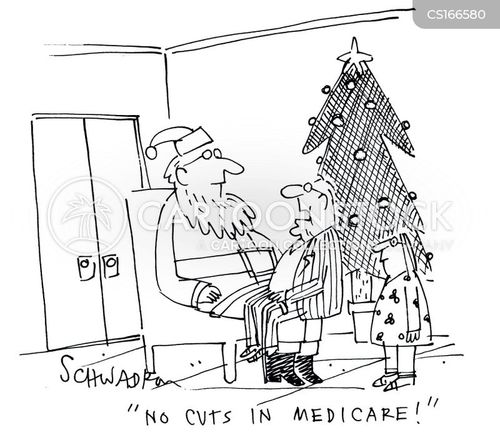
Cartoon – Get Sick Now

A Little-Known Windfall for Some Hospitals, Now Facing Big Cuts

Most hospitals are nonprofit and justify their exemption from taxation with community service and charity care. But the Trump administration could require some of them to do more to help the poor, and the hospitals that are in the cross-hairs are those benefiting from an obscure drug discount program known as 340B.
The 340B program requires pharmaceutical manufactures to sell drugs at steep discounts to certain hospitals serving larger proportions of low-income and vulnerable people, such as children or cancer patients. The participating hospitals may charge insurers and public programs like Medicare and Medicaid more for those drugs than they paid for them and keep the difference.
By one estimate, the program saved hospitals $6 billion in 2015 alone. The original intent of the program, enacted in 1992, was for hospitals to use the revenue to provide more low-income patients a broader range of services.
Many institutions that serve mostly low-income and uninsured populations say they need the program. “Most nonprofit hospitals have very slim profit margins, and they’ve come to rely on this revenue,” said Melinda Buntin, chairwoman of the Department of Health Policy at Vanderbilt School of Medicine. A hospital lobbying group said that for some rural hospitals, the funding cut “could actually be the difference between staying open and closing.”
But there is concern that 340B has come to include hospitals that don’t need the extra help and are not using its windfall as originally intended.
The program has grown considerably, most recently as a result of an expansion included in the Affordable Care Act. As of 2004, about 200 hospitals benefited from the 340B program; by 2015, over 1,000 were participating. The program now encompasses 40 percent of all hospitals and an even larger number of hospital-affiliated clinics and pharmacies.
It might seem odd to give discounts on drugs to help hospitals offer care to low-income patients. How can we be sure they’ll use the money for that?
An increasing number of hospitals are not.
A study published in JAMA Internal Medicine found that the early participating hospitals were more likely to be located in poor communities with higher levels of uninsured people, to spend more of their budget on uncompensated care, and to offer more low-profit services than hospitals that started participating later.
“The 340B program may produce the results intended at some hospitals,” said Sayeh Nikpay, an assistant professor at Vanderbilt University and a co-author on the study. “But as the program grew, it benefited many hospitals with less need for assistance in serving low-income populations.”
Other research corroborates that hospitals aren’t using the 340B program as intended. A study in The New England Journal of Medicine was unable to find any evidence that profits from 340B have led to more access to care for low-income patients, or reductions in mortality rates among them. Another study in Health Affairs found that 340B hospitals have increasingly expanded into more affluent communities with higher rates of insurance.
The 340B program may have also inadvertently raised costs — for example, by encouraging care in 340B-eligible hospitals that could have been provided less expensively elsewhere. A study in Health Services Research found that hospital participation in 340B is associated with a shift of cancer care from lower-cost physician offices to higher-cost hospital settings.
The program may also encourage providers to use more expensive drugs. The more hospitals can charge insurers and public programs for a drug — relative to how much they have to pay for it under the program — the greater the revenue they receive. They also receive more revenue when the drugs are prescribed more often.
In January, Medicare lowered the prices it pays for 340B drugs by 27 percent. Although this move chips away at how much hospitals can benefit financially, it does little to address how much insurers and individuals pay for prescription drugs or the value they obtain from them. In addition, the move does nothing to increase hospital spending that could help the poor.
It may even harm some health care organizations, leading to lower-quality care at those institutions that are helping the poor. Studies have shown that, by and large, when hospitals lose financial resources, they make cuts that could harm some patients.
This can happen if cuts lead to reductions in workers who perform important clinical functions. A study in Health Services Research found that hospitals cut nursing staff in response to Medicare payment cuts in the late 1990s. Heart attack mortality rates improved less at hospitals that had larger cuts.
Another response to reduced revenue is cuts to specific services, which would harm patients who rely on them. A study by economists from Northwestern’s Kellogg School of Management found that some hospitals that endured financial setbacks during the Great Recession cut less profitable services like trauma centers and alcohol- and drug-treatment facilities.
Another study looked at a 1998 California law that required hospitals to comply with seismic safety standards — imposing a large cost on those institutions, without providing additional funding. Hospitals that were hit harder financially by this law were more likely to close; government hospitals responded by reducing charity care.
Hospitals could absorb cuts without harming care if they could become more productive — by doing more with less. Historically, there is very little evidence they have been able to do that.
Two powerful lobbies are now battling each other, with the pharmaceutical industry arguing that 340B has grown well beyond its original intent. Hospital lobbying groups are fighting back and also squaring off against the government, suing over the planned federal cuts.
Those are big clashes over a program that began modestly a quarter of a century ago to help the poor, albeit in a most convoluted way.
https://interimcfo.wordpress.com/2018/08/30/take-off-your-clothes/

Abstract: This article takes a look at the role of culture in organizational performance.
It has been a while since I have written for my blog. I’ve been a little busy on an engagement that has taken a lot of my time. One of the most challenging aspects of working with organizations in transition is dealing with culture. I have written a lot about culture in my blog and it continues to be one of the most vexing aspects of leadership and Interim Executive Consulting. The following story is true and it happened almost spontaneously. I now use this experience to make a point that people will remember about how they allow their cultural limitations to limit their capability.
I was listening to a group of managers debating the hospital’s preparedness for a regulatory survey. Concern was being expressed about the fact that there were multiple known deviations from standards. The longer I listened to this, the more frustrated I became. At the breaking point of my patience, I stood up and said, “OK, that’s enough.” “Everyone in the room, take off your clothes.” The shock and awe were palpable. People sat staring at me as they tried to comprehend what they had just heard. I said, “I’m serious. Everyone. Take off your clothes right now.” My audience was dumbfounded. I suspect some of them were wondering if the psychiatrist was in the building.
I said, “Let me ask you folks a question. If I continue to press this point, my prediction is that at least one of you will take the position that you will not take off your clothes. You will refuse to do this because you have modesty, morals, ethics, decency and or religious convictions upon which you will base your refusal.” My question was, “If you have standards that prevent you from taking your clothes off when all that is involved is a simple violation of modesty, how do you rationalize having knowledge of regulatory deficiencies in your areas of responsibility and not having done enough to resolve them when patient safety may be compromised?” Remember the movie, ‘A Few Good Men?’ Tom Cruise asked, “Can you explain this?”
And so, I had another head-on collision with entrenched dysfunctional culture. Several years ago, I had the privilege of doing work with Northside Hospital in Atlanta. Northside’s culture as it relates to regulatory compliance is very simple: Every department is expected to operate 100% compliant with applicable standards 100% of the time. As a result, a compliance survey is or should be a non-event at Northside. This is dramatically different from the culture in other hospitals I have worked in that go through episodes of horror when they are in the survey window and word comes that surveyors have been spotted in the next town. These hospitals have a culture that says it is OK to have a laissez-fair attitude and approach toward regulatory compliance until they think they might be surveyed. Then there is a mad rush to get into compliance.
I told the leadership team that the Board of Trustees had decided to commit the hospital to applicable accreditation standards. Therefore, the question as to whether or not managers are expected to follow regulations is off the table. Anyone that does not agree with this position of the Board should ‘punch the clock and get over the hill,’ as my dad would say. I went on to tell the group that in deciding to comply with regulatory standards, the Board had a reasonable right to expect that the standards were being followed on a continuous basis and not just when the hospital was in the survey window.
I told the group that I needed a volunteer, someone that could explain to the Board if the survey turned out as bad as they predicted, how the organization had developed a culture of tolerance of areas of non-compliance with so many standards. To my chagrin, I did not get a volunteer. I told the group that this depressed me so much that I was going to go to the store, buy a bottle of wine and drink the whole thing, I was then going to bring the bottle back to the next meeting and use it to play spin the bottle to determine who the spokesman from the group to the Board would be. I then exited the room.
Over the next couple of weeks, the leadership team of the organization responded admirably. There was no need to go back to the meeting to play spin the bottle. Every manager of every department went to work, around the clock in some cases to bring their areas into compliance with regulations. Sure enough, in less than two weeks, the surveyors showed up. The hospital had one of the best if not the best surveys in its history.
Was this result due to me making a speech? I don’t think so. All I did was challenge the hypocrisy of a dysfunctional culture that in some cases could potentially jeopardize patient safety. What changed was that a group of managers decided independently that they were no longer going to be associated with substandard compliance in their areas of responsibility. There is a one-liner that states that “You don’t have to move all of the cattle to change the direction of a herd. All you have to do is to change the direction of the lead steer.” Peer influence in an organization is extremely powerful. This is what led me to redefine my own understanding of the word ‘culture.’ Webster defines culture as the beliefs, customs, arts, etc., of a particular society, group, place, or time: a particular society that has its own beliefs, ways of life, art, etc.: a way of thinking, behaving, or working that exists in a place or organization. I define culture as the lowest level of excellence a group will accept as tolerable and normal. Groups in my experience do a very good job of enforcing the culture of the organization on their peers for better or worse. When a group decides to hold itself to a higher level of performance or rejects the mediocrity that has held it back, its performance improves measurably.
So, I conclude with questions for you. To what degree are you being limited by the culture that is surrounding you in your present situation? What are you doing to change the culture? Do you have the support you need to get the culture from where it is to where it needs to be?
Remember my challenge to take off your clothes. Give some thought to where you will draw the line when it comes to the level of mediocrity you will accept and tolerate.
Please feel free to contact me to discuss any questions or observations you might have about these blogs or interim executive services in general. As the only practicing Interim Executive that has done a dissertation on Interim Executive Services in healthcare in the U.S., I might have an idea or two that might be valuable to you. I can also help with career transitions or career planning.
The easiest way to keep abreast of this blog is to become a follower. You will be notified of all updates as they occur. To become a follower, just click the “Following” link or bubble that usually appears near the bottom of this web page.
There is a comment section at the bottom of each blog page. Please provide input and feedback that will help me to improve the quality of this work.
If you would like to discuss any of this content or ask questions, I may be reached at ras2@me.com. I look forward to engaging in productive discussion with anyone that is a practicing interim executive or a decision maker with experience engaging interim executives in healthcare.


 HENRY KOTULA