


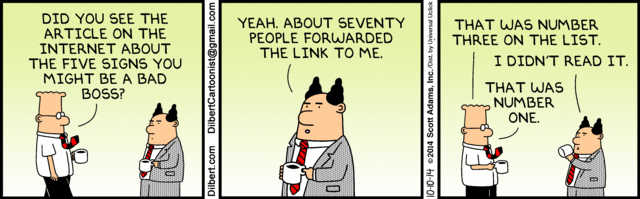
Cartoon – Rewarding Loyalty


The Large Hidden Costs of Medicare’s Prescription Drug Program

At a glance, Medicare’s prescription drug program — also called Medicare Part D — looks like the perfect example of a successful public-private partnership.
Drug benefits are entirely provided by private insurance plans, with generous government subsidies. There are lots of plans to choose from. It’s a wildly popular voluntary program, with 73 percent of Medicare beneficiaries participating. Premiums have exhibited little to no growth since the program’s inception in 2006.
But the stability in the premiums belies much larger growth in the cost for taxpayers. In 2007, Part D cost taxpayers $46 billion. By 2016, the figure reached $79 billion, a 72 percent increase. It’s a surprising statistic for a program that is often praised for establishing a competitive insurance market that keeps costs low, and that is singled out as an example of the good that can come from strong competition in a private market.
Much of this increase is a result of growing enrollment — it has doubled in the past decade to 43 million — and higher drug prices. But there is also a subtle way in which the program’s structure promotes cost growth.
When enrollees’ drug costs are relatively low, plans pay a large share, typically about 75 percent. But when enrollees’ drug spending surpasses a certain catastrophic threshold — set at $5,000 in out-of-pocket spending in 2018 — 80 percent of drug costs shifts to a government program called reinsurance. This gives people in charge of private insurance plans an incentive to find ways to push enrollees into the catastrophic range, shifting the vast majority of drug costs off their books. For example, they could be less motivated to negotiate for lower drug prices for certain types of drugs if doing so would tend to keep more enrollees out of the catastrophic range.
Reinsurance spending, which is not reflected in premiums, has been rising rapidly.
“This harms the very competition that Part D was supposed to establish,” said Roger Feldman, an economist at the University of Minnesota. Consumers are naturally attracted to lower-premium plans, but choosing them increasingly shifts higher costs onto taxpayers if plans achieve those lower premiums in part by shifting more drug expenses onto the government’s books.
Documenting this is a recent study by Mr. Feldman and Jeah Jung of Penn State University that was published in Health Services Research. The study found that the disconnect between premiums and reinsurance costs has increased over time. Additionally, insurance company plans exhibiting less of an effort to manage the use of high-cost drugs had higher reinsurance costs. This is consistent with incentives to encourage enrollees into the catastrophic range of spending.
The Medicare Payment Advisory Commission has been warning about this problem for several years in its annual reports to Congress. According to MedPAC, between 2010 and 2015, the number of enrollees entering the catastrophic drug cost range grew 50 percent, from 2.4 million to 3.6 million, now accounting for 8 percent of enrollees.
“It’s ironic for a program supposedly built on market principles,” said Mark Miller, a former MedPAC director. “You wouldn’t see this kind of thing in the commercial market.” For commercial market insurance products — such as those offered by employers or in the health insurance marketplaces — only about 1 percent of policyholders reach a catastrophic level of expenditures at which reinsurance kicks in. (Mr. Miller and I are co-authors of an editorial about Ms. Jung’s and Mr. Feldman’s study, which also appears in Health Services Research.)
Reinsurance is the fastest-growing component of Medicare’s drug program, expanding at an 18 percent annual rate between 2007 and 2016. In 2007, it accounted for 17 percent of government spending for Part D. In 2016 it was 44 percent.
The Affordable Care Act hastened this growth. The law requires pharmaceutical manufacturers to pay some of the cost of the drug benefit. (The Bipartisan Budget Act of 2018 further increased how much manufacturers must contribute.) For the purposes of reaching the catastrophic threshold and triggering reinsurance, these industry contributions count as out-of-pocket payments for enrollees, even though they are not.
That means enrollees don’t have to spend as much as they otherwise would to trigger the reinsurance program. Although this is of great benefit to enrollees, it also pushes up taxpayer liability for the program.
Changing the extent to which manufacturer’s contributions count as enrollee out-of-pocket spending is one potential reform of the program. Other solutions include increasing the liability of insurance company plans in the catastrophic range and decreasing the liability of taxpayers.
This would have the effect of bringing premiums more in line with program spending. Doing so would “return Part D to the market-based program it was intended to be,” Ms. Jung said. As it stands, there is a substantial divide between what Part D was billed as and what it actually is.
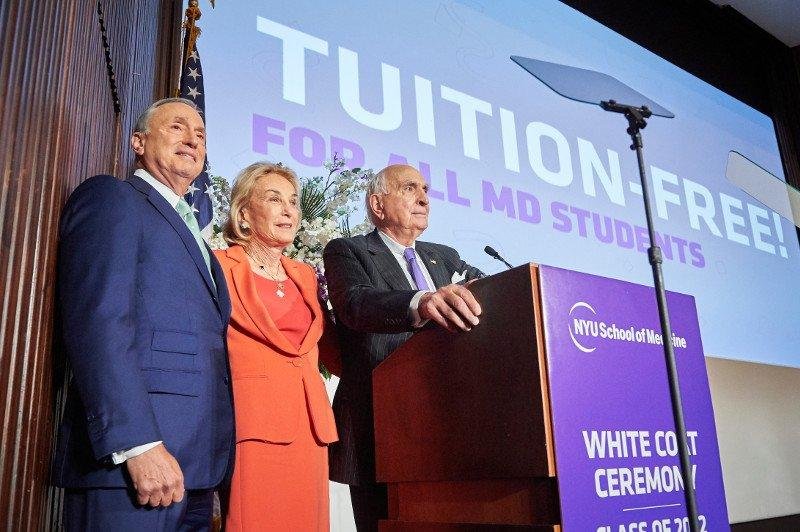
New York University made waves last week when it announced it will cover all tuition expenses for all its medical students in perpetuity.
While the news left some NYU alumni wishing they had waited just a few years longer to enroll, it also reanimated debate over the problems high educational debt levels can cause for doctors and the healthcare delivery system at large.
In an op-ed for Stat News, fourth-year NYU medical student Eli Cahan noted that researchers have identified debt burden as one of the factors propelling doctors into more lucrative specialty areas, leaving a shortage of primary care physicians.
“Eliminating medical school tuition, and thus medical school debt, could help nudge more students to choose much-needed careers in primary care,” Cahan wrote.
But research suggests the burden of educational debt is one factor among several in a complex relationship affecting the likelihood of new doctors to choose primary care.
A study published in 2014 by the Annals of Family Medicine, for example, concluded that reducing debt for medical students could help to enlarge the primary care physician workforce but that the positive effects of such an initiative would vary depending on which types of students benefited from the debt reduction.
“Students from lower-income families, in general, tend to have more interest in primary care careers, and students from disadvantaged backgrounds tend to have more interest in primary care careers,” lead researcher Julie Phillips, MD, MPH, an associate professor of family medicine at Michigan State University College of Human Medicine, tells HealthLeaders.
“Those same students also tend to have more debt because students from lower-income families don’t have the parents’ resources to help them with medical school costs,” Phillips adds.
The study, which analyzed data from more than 136,000 physicians, found that students from higher-income families were significantly less influenced by educational debt in their specialization decisions. What’s more, although the researchers found that educational debt deterred graduates of public medical schools from choosing primary care, the same could not be said of graduates of private medical schools.
This research suggests that the benefits of tuition-free medical school on primary care could be diminished by the fact that NYU is a private institution. That’s not to say, of course, that the decision to go tuition-free comes without benefits.
“I think it will make a difference. It’s hard to know if it will make a big difference,” Phillips says, calling NYU’s announcement “a great step in the right direction.”
“It would be really wonderful if public schools were able to implement this,” she adds, “but I just think they don’t typically have those resources.”
“The income disparity between primary care doctors and specialists in the United States is concerning, and there’s pretty good evidence that if you change that, the whole game changes,” Phillips says.
“As a culture, we tend to look on people who make money as being more valuable,” she adds, “so the income disparity between primary care doctors and specialists sort of creates a culture or contributes to a culture where primary care is not as well-respected, and that’s a really big problem.”

Despite Republican efforts to undermine the Affordable Care Act, insurance premiums will go up only slightly in most states where carriers have submitted proposed prices for next year. And insurance carriers are entering markets rather than fleeing them.
The improvements stem from less political uncertainty over health policy, steeper than necessary increases this year, better understanding of the markets, improvements in care and a host of actions taken by individual states.
Average proposed premiums for all levels of plans in California, Colorado, Delaware, Florida, Indiana, Nevada, Ohio and Pennsylvania will increase less than 9 percent in 2019, according to the Kaiser Family Foundation.
By contrast, this year’s mid-priced plans increased an average of 37 percent nationally compared to 2017.
In some states, 2019 premiums are projected to decrease. Prices also are expected to drop for people in a number of metropolitan areas, including Atlanta, Baltimore, Denver, New York and Washington, D.C.
And unless the Trump administration launches new attacks on the Affordable Care Act in the coming months, analysts believe the average increase across the United States will hold to the single digits.
To be sure, not all areas will fare as well. Some can still expect to see big increases next year, according to the Kaiser Family Foundation. For instance, proposed premium increases in Maryland average 30 percent for 2019.
(In some states, carriers have not yet had to file their rate proposals for 2019, but will in the coming weeks.)
But after a couple years in which carriers fled many markets around the country, insurers are planning to enter exchanges in many states, including Arizona, Florida, Michigan, New Mexico and Wisconsin. In some states, existing insurers are pushing into new areas.
“That they are entering markets is a sign that the insurers are pretty confident about those markets,” said Rabah Kamal, who analyzes health reform and health insurance for Kaiser.
“After several years of big losses, insurers are actually turning a profit,” said Kamal. “They’re doing well, so overall, there’s no justification for big increases.”
To a large extent, premiums in 2019 appear to be moderating because carriers raised rates higher than necessary in 2018 in reaction to the uncertainty over how Congress and the Trump administration might undermine the ACA. “It boils down to the fact that last year’s rates were too high,” said Emily Curran, a research fellow at Georgetown University’s Health Policy Institute.
Carriers also understand the marketplace much better than they did in 2014 when the exchanges were launched across the country, Curran and others say. Carriers have a better sense of who they are covering and how to predict their health risks, Curran said. Insurers and medical providers also have better coordinated care to reduce duplication.
States also have had a major hand in stabilizing their markets, seeking to limit the damage the federal government is doing to the ACA.
Massachusetts had its own individual mandate before the ACA, and now New Jersey does as well. Three states, Massachusetts, New Jersey and New York, have passed outright bans on issuing short-term health insurance policies, while 12 others have adopted standards more restrictive than federal policy. Some states, including Alaska, Minnesota and Oregon, have also created state-funded reinsurance pools, which protect carriers from financially crippling individual medical claims.
Finally, a number of states have done their own outreach to publicize their exchanges and promote enrollment in the absence of federal efforts.
Pennsylvania is one of those states. The insurance market has stabilized there, said Jessica Altman, the state’s insurance commissioner. She projects the average state premium increase in 2019 will amount to 0.7 percent, compared to 30.6 percent this year. She said in 31 of 67 Pennsylvania counties, there will be more carriers selling policies next year compared to 2018. And, she said, many carriers are pushing into new territories.
Her agency estimates that the increase this year would have been only 7.6 percent absent the federal government’s elimination of cost-sharing reductions, which were federal payments to insurance carriers to cushion them from exorbitant individual medical claims.
“We had pretty significant increases last year, and we shouldn’t have,” Altman said.
Julie Mix McPeak, commissioner of the Department of Commerce and Insurance in Tennessee, where premiums are expected to fall and more carriers are intending to operate, said the ACA brought more than 200,000 Tennesseans into health plans — many of whom previously had not sought routine health care — which meant higher claims in the first years.
“We had a pretty negative health score in terms of dollars spent on claims because so many people coming into primary care had health issues that needed to be addressed. Now that they’ve been in care for several years now, we aren’t seeing those claims rising any more. They are leveling off.”
Whether the stability that appears to be settling the markets in 2019 will continue beyond that largely depends on what Washington does. “No one,” said Curran, “wants to see more uncertainty.”
A Brookings Institution study released this month estimated that insurers on the health insurance market this year will enjoy an underwriting profit margin of 10.5 percent, up from 1.2 percent last year.
The study estimated that, absent federal policies disrupting the marketplaces, premiums would have dropped 4.3 percent nationwide in 2019.
Many health care analysts agree. “In cases where we are seeing modest increases, we might have seen decreases,” said Myra Simon, executive director of individual market policy for America’s Health Insurance Plans, a lobbying arm of the health insurance industry.
Steps taken by Republicans in Washington to undermine the exchanges include Congress’ repeal starting next year of the individual mandate, which requires all Americans to obtain health insurance, and the Trump administration’s decision to end the Obama-era cost-sharing reduction payments.
The administration also eliminated most funds for outreach to encourage enrollment in the markets and shortened the periods during which people could sign up for plans. In addition, the administration has moved forward with plans to loosen regulation on association and short-term health plans that don’t have to be as comprehensive as plans sold under the Affordable Care Act.
Health insurance analysts of all stripes had said those actions would draw people away from the insurance exchanges, particularly the young and healthy. Their departure, analysts said, could drive up premiums for all those remaining and set the markets on a “death spiral” that would ultimately drive all carriers from the exchanges.
The president has been clear about his intentions. “Essentially, we are getting rid of Obamacare,” he said in April.
But as carriers file their plans with state insurance offices for next year, it appears that warnings of imminent catastrophe were, at the least, premature.
“The administration has done almost everything on its list to destabilize the market or, in their words, ‘create more choice,’” said Chris Sloan, a director at Avalere Health, a Washington-based health policy research and consulting firm. “They’ve done it all and the market is still standing.”



 HENRY KOTULA