What Barbershops Can Teach About Delivering Health Care

What Barbershops Can Teach About Delivering Health Care

Image result for barbershop poll

Heart disease is the most common killer of men in the United States, and high blood pressure is one of the greatest risk factors for heart disease. Despite knowing this for some time, we have had a hard time getting patients to comply with recommendations and medications.

recent study shows that the means of communication may be as important as the message itself, maybe even more so. Also, it suggests that health care need not take place in a doctor’s office — or be provided by a physician — to be effective.

It might, as in this study, take place in a barbershop, an institution that has long played a significant social, economic and cultural role in African-American life. A setting that fosters both confidentiality and camaraderie seems like a good place to try reaching men to talk about hypertension.

Years ago, researchers ran an experiment in which they trained barbers to check blood pressure and refer people with high levels to physicians. One group received this intervention; a control group received pamphlets handed out by barbers. Blood pressure values were only minimally improved in the intervention group. This was thought to be because even when patients were referred to primary care physicians, those doctors rarely treated their condition appropriately.

The more recent study went further, removing physicians almost entirely from the process. The control group consisted of barbers who encouraged lifestyle modification or referred customers with high blood pressure to physicians. In the intervention group, barbers screened patients, then handed them off to pharmacists who met with customers in the barbershops. They treated patients with medications and lifestyle changes according to set protocols, then updated physicians on what they had done.

The results were impressive. Six months into the trial, systolic blood pressure (the higher of the two blood pressure measures) in the control group had dropped about 9 mm Hg (millimeters of mercury) to 145.4, which is still high.

In the intervention group, though, blood pressure had dropped 27 mm Hg to 125.8, which is close to “normal.” If we define the goal of blood pressure management to be less than 130/80, more than 63 percent of the intervention group achieved it, compared with less than 12 percent of the control group.

It gets better. The rate of cohort retention — measuring how many of the patients remained plugged into the study and care throughout the entire process — was 95 percent.

The barbershop customers were part of a population that is traditionally hard to reach. More than half of participants lived in households earning less than $50,000 a year, and more than 40 percent in households earning less than $25,000. On average, they were overweight or obese, about a third smoked, and more than a fifth had diabetes. Yet the improvement in blood pressure was more than three times that of the average of previous pharmacist-based interventions seeking to improve blood pressure, and many of those had focused on populations easier to reach.

One reason this trial succeeded where others failed is that it adapted its intervention to overcome barriers. When barbers weren’t consistently screening customers by measuring their blood pressure, pharmacists stepped in to do that. When labs slowed things down, pharmacists brought measuring tests to the barbershops.

The larger implications of this study shouldn’t be ignored. Getting barbers involved meant health messages came from trusted members of the community. Locating the intervention in barbershops meant patients could receive care without inconvenience, with peer support. Using pharmacists meant that care could be delivered more efficiently.

Of course, this study is limited by the usual sorts of questions. Who will pay for this in the real world? Who would do the training necessary to scale it up? Who would be responsible?

But those concerns reflect the shortcomings of our current health care system, not those of the study. Health care reimbursement in the United States usually focuses on the clinical encounter, at a physician office or hospital. This reflects a belief that care is best offered there, even when evidence says otherwise. Coverage and payment focus on the individual patient, not on the community, even when research shows that the latter is more effective. Care often requires the participation of a physician, even when studies prove that it can be delivered well in many cases by midlevel practitioners.

It’s important to remember that we have the health care system we do because of history and economics, not because of studies that show it’s optimally designed. Changes are most often made within the current framework; those that buck the system are usually met with more resistance.

Retail clinics may provide better access, but many professional organizations oppose them. Lifestyle changes may do more to improve health than drugs. But getting the system to recognize that diet and exercise might prevent diabetes, for example — and to pay for that intervention — requires huge efforts and decades of time.

If we really want to improve health on a large scale, especially with populations distrustful of the health care system, it seems we need to go to where they are; to use people they trust to deliver messages; and to allow care to occur without much of the infrastructure usually demanded for billing. Such efforts may not be traditional, but they may deliver much better results.


 

Short-Term Plans Could Bring Long-Term Risks to California’s Individual Market

Short-Term Plans Could Bring Long-Term Risks to California’s Individual Market

Image result for short term health insurance risks


The Trump administration is considering changes to federal rules regulating short-term, limited-duration insurance (“short-term plans”) that could result in the expansion of these plans in California.

This report, written by Georgetown University’s Center on Health Insurance Reforms, provides an overview of short-term plans and the current market for these plans in California. It explains how changes to federal policy around short-term plans might affect California’s individual health insurance market and describes policies that various states are pursuing in response to these changes.

Key points include:

  • Short-term plans are exempt from the Affordable Care Act’s consumer protections. Insurers can deny coverage based on preexisting conditions, not cover certain services, and limit what they will pay for services. For example, many short-term plans currently available in California do not cover maternity and newborn care, mental health and substance use services, and outpatient prescription drugs. They also limit the total amount that plans will pay per day in the hospital and for particular services, such as surgeon fees, in addition to imposing a maximum the plan will spend toward claims covered by the policy.
  • Short-term plans are rare right now in California, but that could change. There is only one insurer currently selling approved short-term plans in California, and fewer than 10,000 policies in effect across the state. But if the Trump administration changes federal rules, and there is no change in California law, enrollment in short-term plans is likely to grow. Under these conditions, the Urban Institute projects that over 600,000 Californians would enroll in short-term plans in 2019.
  • Enrollment in short-term plans could contribute to destabilizing Covered California and increasing premiums. Short-term plans are likely to siphon off healthier and younger consumers from Covered California, which would increase premiums for those remaining in the ACA-compliant market.
  • States are taking action. Colorado, Massachusetts, Michigan, New Jersey, New York, and Rhode Island have taken steps to ensure that short-term plans don’t destabilize their individual health insurance markets. A bill is currently pending in the California legislature banning short-term plans altogether.

The full report is available under Related Materials below.


Is it a gag rule after all? A closer look at changes to Title X funding regarding abortion.

https://www.washingtonpost.com/news/to-your-health/wp/2018/05/23/is-it-a-gag-rule-what-changes-to-family-planning-funds-and-abortion-referrals-might-mean/

The Trump administration has released the language of a proposed rule on federal family planning funding, and abortion rights activists are raising alarm about it.

When health officials revealed Friday that they would be filing a change to which clinics would be eligible for funding, they emphasized that it was not a “gag rule.” Instead, they said they were proposing to strip away a current mandate. It requires organizations that receive Title X funding to counsel women about abortion and provide them with referrals to abortion services. Under the new rules, a provider wouldn’t have to talk about abortion at all.

This was part of a plan that would require “a bright line of physical as well as financial separation” between Title X family planning programs and ones in which abortion is “supported or referred for as a method of family planning.”

“Contrary to recent media reports,” the White House said in a statement that day, “HHS’s proposal does not include the so-called ‘gag rule’ on counseling about abortion.” The statement contrasted the new rule with a Reagan administration policy in 1988 that banned any mention of abortion.

The Department of Health and Human Services declined to make the full proposed rule available last week, but it was posted on the HHS website Tuesday. It’s consistent with the message the administration provided Friday but is more explicit about what can and cannot be said.

Page 119 states that “A Title X project may not perform, promote, refer for, or support, abortion as a method of family planning, nor take any other affirmative action to assist a patient to secure such an abortion.”

The one exception is if a woman “clearly states that she has already decided to have an abortion.” In this situation, a doctor or other provider should provide “a list of licensed, qualified comprehensive health service providers (some, but not all, of which also provide abortion, in addition to comprehensive prenatal care.)”

So is it or isn’t it a “gag rule”?

HHS’s view is that there is a difference between counseling and referrals. Counseling — as long as it is not “directive” or expressing an opinion — is allowed. It stated that referrals for abortion are, “by definition, directive” and, therefore, not allowed under its new interpretation of a 2000 regulation that pregnancy counseling be nondirective.

Planned Parenthood, which serves about 41 percent of the patients who receive services through Title X, and other groups that support abortion rights, beg to differ. On Wednesday, Planned Parenthood started a #NoGagRule campaign that will include a rally in front of the U.S. Capitol at 5:30 p.m.

“This is one of the largest-scale and most dangerous attacks we’ve seen on women’s rights and reproductive health care in this country. This policy is straight out of the Handmaid’s Tale — yet, it’s taking effect in America in 2018,” Dawn Laguens, executive vice president for Planned Parenthood Federation of America, said in a statement that referenced Margaret Atwood’s dystopian novel.

Georgeanne Usova, legislative counsel with the American Civil Liberties Union, said the policy is “putting the health and lives of countless people at risk in service of this administration’s extreme antiabortion agenda.”

Likewise Jenn Conti, a fellow with Physicians for Reproductive Health, said the ” ‘gag rule’ is not only unconscionable, but it undermines medical ethics by allowing health-care professionals to withhold accurate and timely medical information from patients.”


It Costs $685 Billion a Year to Subsidize U.S. Health Insurance

https://www.bloomberg.com/news/articles/2018-05-23/it-costs-685-billion-a-year-to-subsidize-u-s-health-insurance


It will cost the U.S. government almost $700 billion in subsidies this year help provide Americans under age 65 with health insurance through their jobs or in government-sponsored health programs, according to a report from the nonpartisan Congressional Budget Office.

The subsidies come from four main categories. About $296 billion is federal spending on programs like Medicaid and the Children’s Health Insurance Program, which help insure low-income people. Almost as big are the tax write-offs that employers take for providing coverage to their workers. Medicare-eligible people, such as the disabled, account for $82 billion. Subsidies for Obamacare and for other individual coverage are the smallest segment, at $55 billion.

In total, the subsidies are equivalent to about 3.4 percent of the U.S. gross domestic product.

Financing Americans’ Insurance

In 2018, subsidizing health coverage will cost taxpayers almost $700 billion.

Also known as the Affordable Care Act, Obamacare reduced the number of uninsured, but 29 million people will likely go without health coverage in an average month this year, the CBO said. Thirty-five million Americans could lack coverage by 2028 as rising premiums and the elimination of the individual mandate drive more people to drop coverage.

The subsidies in the Affordable Care Act are designed to insulate people in the program from premium increases. The CBO projected that monthly premiums for a mid-range plan in the program will increase by 15 percent by 2019, and by about 7 percent annually through 2028.

One reason for the rising premiums is the actions of President Donald Trump. Last year, Trump topped funding for the cost-sharing reduction payments made to insurers under Obamacare to help Americans afford health costs.

The non-payment of those subsidies, less enforcement of a rule requiring people to have insurance and limited competition caused insurers to raise their premiums by about 34 percent in 2018, compared to 2017. That increased the cost of the subsidies to the federal government, according to the CBO.

It’s the Monopolies, Stupid!

http://www.commonwealthfund.org/publications/blog/2018/may/drug-monopolies-pricing?omnicid=EALERT1410094&mid=henrykotula@yahoo.com

Image result for pharmaceutical monopoly

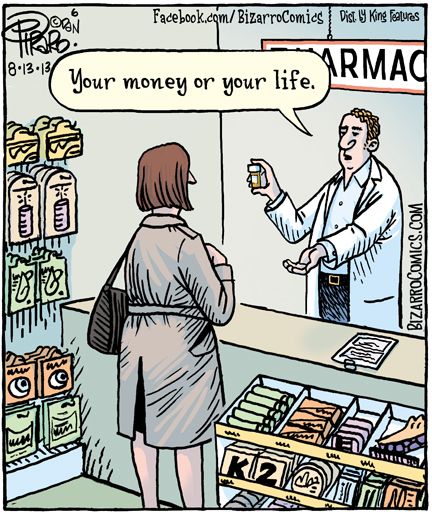
At the core of the nation’s drug pricing problem is one fundamental fact: Drug companies enjoy government-sanctioned and -enforced monopolies over the supply of many drugs.

These monopolies result from patents awarded under federal law for novel molecules. Patents allow manufacturers to prevent competitors from selling the same drug for 20 years from the time the patent is filed. Given that the process of gaining regulatory approval to market their new drug takes time, research suggests new drugs have, on average, 12 to 13 years of market exclusivity.

Once new drugs are approved by the Food and Drug Administration, the monopolies assured by patents enable pharmaceutical companies to charge any price they choose. They generally pick prices that not only cover their development costs, but also generate profits that exceed those of most other industries: for example, the average profit margin for the 25 largest software companies (which are cited as having the same high R&D investment and low production and distribution costs as pharmaceutical companies) was 13.4 percent in 2015, while the average profit margin for the 25 largest drug companies was 20.1 percent in 2015. Drugmakers are also free to raise prices whenever they want at rates they alone determine.

The existence of patents does not totally prevent competition. Often, other companies introduce drugs that are distinct enough to justify their own separate patents and accomplish the same therapeutic goal. This results in competition that lowers drug prices, but often by not enough to make the medications affordable for many patients. In addition, the makers of patented drugs — for example, Mylan’s EpiPen and the weight-loss drug Suprenza — have developed effective mechanisms to extend the lives of their patents beyond 20 years. These approaches include making minor modifications in the formulations or packaging of drugs that have no clinical significance, as well as paying potential generic competitors not to introduce generic drugs.

That said, patents eventually expire, at which point generic drug companies can manufacture the drug and sell it at a much lower price. But even generic drug competition has been weakened recently by generic drug market monopolies, as these manufacturers have bought up their competition. As a result, the prices of old and familiar drugs have risen dramatically. The price of the cardiac drug isuprel has increased more than sixfold between 2013 and 2015, and the price of the antibiotic doxycycline has soared 90-fold over the same period.

As long as drug companies (or a small group) hold monopoly (or oligopoly) power over potent new therapies, there is no free market solution to lowering drug prices. Only a countervailing nonmarket force of equal strength can bring those prices down. Other western industrial countries, recognizing this, authorize their governments to step in and moderate drug prices for the benefit of their citizenry. Some set prices by fiat, while other negotiate with drug companies. In the latter case, the negotiations are sometimes guided by comparative effectiveness analysis that estimates the value of new drugs to patients. Of course, drug companies are free to walk away from such deals, but they generally choose not to, presumably because they still make money from those sales.

Drug companies say their monopoly earnings are necessary to sustain the research and development that produce new drugs. In effect they are saying that they need to be able to charge the very high prices we now see for patented drugs so they can innovate. This raises the questions of how much money society should allocate toward pharmaceutical innovation and who should decide. Setting those questions aside for the moment, we should be very clear about one thing: As long as pharmaceutical companies have uncontested market power to set prices for many patented and generic drugs, those prices will remain a huge problem for Americans and their elected representatives.