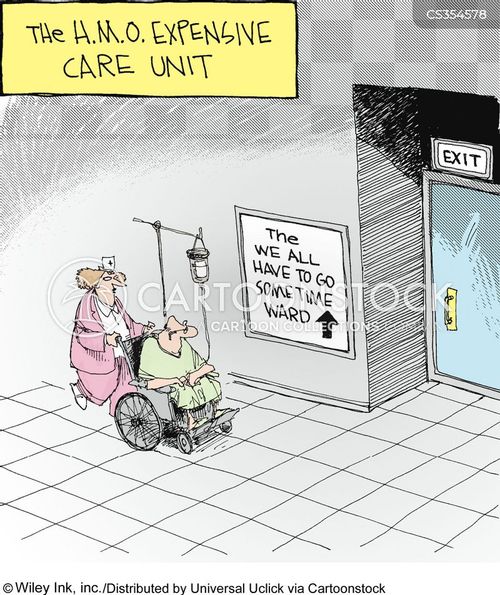
Cartoon – Expensive Care Unit
http://khn.org/news/while-washington-fiddles-calif-leaders-forge-ideas-for-universal-health-care/

As the nation’s Republican leaders huddle to reconsider their plans to “repeal and replace” the nation’s health law, advocates for universal health coverage press on in California, armed with renewed political will and a new set of proposals.
Organized labor and two lawmakers are leading the charge for a single, government-financed program for everyone in the state. Another legislator wants to create a commission that would weigh the best options for a system to cover everyone. And Democratic Lt. Gov. Gavin Newsom, who hopes to become the next governor, has suggested building on employer-based health care to plug holes in existing coverage.
The proposals are fueled both by a fear of losing gains under the Affordable Care Act and a sense that the law doesn’t go far enough toward covering everyone and cutting costs.
But heath policy experts say that creating any type of universal health plan would face enormous political and fiscal challenges — and that if it happens at all, it could take years.
“There are different ways to get there,” says Jonathan Oberlander, professor of social medicine and health policy at the University of North Carolina. “None of them is easy.”
The most specific California proposal comes from state Sens. Ricardo Lara (D-Bell Gardens) and Toni Atkins (D-San Diego), co-authors of legislation that would take steps toward creating one publicly financed “single-payer” program.
The bill, co-sponsored by the California Nurses Association, would aim for something like a system of “Medicare for all” in which the government, not insurers, provides payments and sets coverage rules.
Lara said the approach would get California closer to a system “that covers more and costs less.”
The bill’s authors haven’t announced how the program would be funded. And that’s where the biggest obstacle lies, said Oberlander: It would largely uproot California’s present system, in which roughly half of coverage is sponsored by employers.
If “you’re going to take health insurance largely out of the market, you’re going to disconnect it from employers,” he said. “Then you have to make up all the financing that you’re going to lose.”
There’s no way to make up for those lost employer contributions other than to introduce “very visible taxes,” Oberlander said. And that’s not the only reason why a single payer plan would be controversial. “A lot of people are satisfied with what they have,” he said.

New punches were thrown in the blame game over U.S. drug prices Thursday.
Broadening its efforts to defuse outrage over skyrocketing prices, Pharmaceutical Research and Manufacturers of America, the industry’s lobbying association, started an advertising campaign urging insurers to share with customers more of the benefits of rebates they’ve negotiated. In response, the main health-insurance lobby pushed the blame back on drugmakers: “Enough with the distractions.”
Meanwhile, the head of one of the largest pharmacy benefit managers, who are often criticized by drugmakers for their lack of transparency, said his industry helps save money and manufacturers should stop faulting the middlemen.
Pharmacy benefit managers like Express Scripts Holding Co. — which manage drug benefits for employers and insurers, and privately negotiate prices on their behalf — receive discounts from manufacturers. The rebates lead to lower prices, but it’s up to insurers whether they are ultimately passed down to patients, Express Scripts Chief Executive Officer Tim Wentworth said in an interview on Bloomberg Television on Thursday.
“A hundred percent of the time, payers determine how they pass through,” he said.
Drug companies that raise prices “would blame the middleman,” the CEO said. Yet pharmacy benefit managers, or PBMs, are transparent with how they work within the health-care sector with payers. “For us it’s a real simple challenge: get the net cost as low as possible for our clients.”
The three main groups that are involved in the complex and opaque system of setting drug prices in the U.S. — drugmakers, insurance companies and PBMs — started to strongly fight off criticism months ago. The sector escalated its defense against Washington this year after drug prices became a frequent target for President Donald Trump. He’s threatened to use the government’s buying power to force prices down, which is the industry’s most dreaded option, but so far has not unveiled any specifics about how.
The new ad from PhRMA, which represents more than 50 companies and is one of the most powerful interest groups, is another step in its endeavor to demonstrate that other parts of the health-care industry are responsible for the costs faced by patients. In January, the group started a major initiative, including TV, radio and digital ads. Unlike most developed countries in the world, the U.S. doesn’t directly regulate medicine prices, and drugmakers have strongly resisted it.
The new campaign, “Share the Savings,” will include advertising across various mediums to educate the public about how the rebates for commercially insured patients with high deductibles and coinsurance aren’t passed along to consumers, PhRMA said in a statement. “Robust negotiations” have resulted in major discounts, the group said.
Repeal push complicates state efforts to get ObamaCare waivers

A number of states are readying blueprints for substantial changes under an ObamaCare waiver program, but a renewed push to repeal the law is complicating their plans.
The Affordable Care Act’s 1332 State Innovation Waiver lets states skip some of the law’s regulations if their healthcare plan covers a comparable number of people without increasing the federal deficit. States can apply for the waivers starting this year.
But a revived attempt to repeal the health law is throwing a wrench in those plans, since states don’t know what a new bill will entail. While House Republicans moved forward an amendment in committee to their larger repeal bill on Thursday, the party is far from reaching a consensus.
“The way we are tackling those great uncertainties is that we have to continue to move forward with plans to make the market more stable and proceed along a path that works within the current regulatory framework,” said Oklahoma Health Care Authority Chief Strategy Officer Buffy Heater. “Now we have to of course be mindful of any other proposals that may come up, or any movements that may be made at that time, and be flexible and adapt to whatever changes those might bring.”
Oklahoma is preparing to file a plan with the Centers for Medicare and Medicaid Services later this summer that would implement sweeping changes to the state’s individual insurance market.
If approved, the waiver would establish what Duke University health policy researcher David Anderson calls a “backdoor Medicaid expansion” by shifting subsidies from people between 100 percent to 400 percent of the federal poverty level to those between 0 percent to 300 percent.
The waiver would also allow insurers to charge older members more, restructure subsidies based on age and income, eliminate tiers in favor of two broader categories and require insurers to establish a minimum amount of value-based agreements. Officials also want to regulate outcomes in a number of areas, including mental health, diabetes and obesity.
The stakes are high. Blue Cross Blue Shield of Oklahoma is the only carrier left on the state exchanges, and the state suffers from low enrollment rates. Heater said CMS has promised the state an expedited waiver review but no assurances that things won’t change.

The problem: All they’ve settled on is the addition of a $15 billion risk-sharing fund to help health insurers with high-cost patients. Not only is it similar to an Obamacare reinsurance program — with less money — it doesn’t do anything to solve the basic dispute with the Freedom Caucus. It wants to let states get rid of the Obamacare rules requiring insurers to cover sick people, and banning them from charging higher premiums for those patients. The rest of the GOP doesn’t want to touch that.
The bottom line: Leadership sources say it’s all up to the Freedom Caucus now.
Update: From AshLee Strong, spokeswoman for House Speaker Paul Ryan: “Member discussions will continue and should a path toward 216 votes emerge, the speaker wouldn’t hesitate to bring members back to fulfill our promise to repeal and replace Obamacare.”

A new Kaiser Family Foundation analysis finds that the average premium for a benchmark silver plan in Affordable Care Act (ACA) marketplaces would need to increase by an estimated 19 percent for insurers to compensate for lost funding if they don’t receive federal payment for ACA cost-sharing subsidies.
Established by the health law to reimburse insurers for the cost of reducing out-of-pocket costs for lower-income people buying marketplace plans (with incomes from 100% to 250% of the poverty level), the subsidies have been challenged in a lawsuit from the U.S. House. With a legal appeal pending, the federal government and Congress are in a position to choose whether to continue reimbursing insurers for their cost.
Among 12.2 million people who selected a 2017 ACA marketplace plan, about 58 percent, or 7.1 million, are receiving cost-sharing reductions. An earlier Foundation analysis of 2017 plans found the subsidies lower combined medical and prescription drug deductibles by as much as $3,354 and reduce annual out-of-pocket maximums by up to $5,587.
The Foundation’s new analysis examines the amount insurers would need to increase premiums to make up for the lack of funding, if federal payments cease for the cost-sharing reduction program.
http://khn.org/news/gop-has-no-choice-but-to-keep-pushing-health-care-rock-up-the-hill/

This week’s effort to resurrect the GOP bill to overhaul the Affordable Care Act has apparently met the same end as the first try in March — not even a vote on the floor of the House. Apparently the roadblock was the same, too. Efforts to gain votes from holdout conservatives repelled moderate Republicans in the House, while efforts to placate moderates kept conservatives from signing on.
So what was the purpose of the new effort, which was led mostly from the White House?
Republican health analysts said party officials had little choice but to keep trying to reach consensus — or at least enough consensus to pass a bill out of the House.
GOP House members, particularly those from conservative areas, “are going to go home and get hammered for not repealing Obamacare,” said Thomas Scully, a health policy official in both Bush administrations.
The latest Kaiser Family Foundation monthly tracking pollsuggests that might well be the case. Although three-quarters of the population wants President Donald Trump and his administration to make the health law work, 54 percent of Republicans said it was “a bad thing” that the House GOP bill failed to pass in March, and 58 percent of Republicans said the bill “did not go far enough to end Obamacare.” (Kaiser Health News is an editorially independent project of the foundation.)
Chris Jacobs, a longtime GOP congressional staffer, said there are two imperatives still pushing for some kind of deal. “First, a seven-year commitment by the Republican Party” to repeal and replace the health law, “and second, the administration very clearly wants a win” on some sort of major policy initiative.
But apparently the ideas put forward by the White House to gain more conservative votes without losing moderate ones did not work as the administration hoped.
Conservatives were reportedly pleased early in the week when it appeared states would be allowed to opt out of most of the ACA’s insurance regulations — including rules on what benefits must be covered and whether insurers can charge sicker people higher premiums or deny them coverage.
But moderates complained that would violate promises that the GOP would keep intact protections for people with preexisting health conditions. And the proposal was apparently scaled back.
What remained “was a substantial narrowing in an unproductive way for the proposal,” Michael Needham of the conservative group Heritage Action told reporters on a conference call. Needham called the new version “a nonstarter” for conservatives.
On Thursday, Republicans announced agreement on an amendment to the health bill that would provide $15 billion to help compensate insurers for very high-cost patients.
But at a hastily called meeting of the House Rules Committee, even Chairman Pete Sessions (R-Texas) conceded that the amendment, at least for now, mostly provides a way for members to say they are making progress as they head home to face their constituents.
“What we’re trying to do is lock in ideas so we [Republicans] have an opportunity to go home and amplify,” he said.
Now Congress is poised to leave Washington for a two-week spring recess, from Monday through April 21, without their promised health bill. And what happens when they come back is unclear.
“They put themselves in this box canyon and have no way out of it,” said political scientist Norman Ornstein of the American Enterprise Institute. “I just don’t see a strategy here.”