

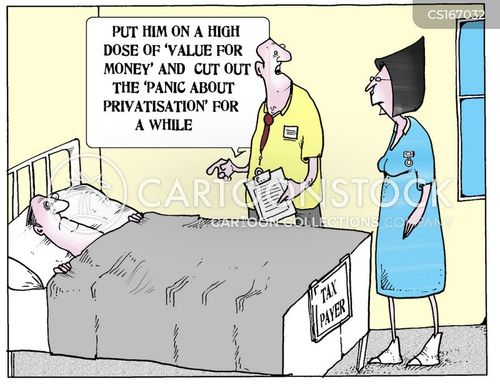
Cartoon – Put him on a High Dose of Value for Money
http://fortune.com/2016/12/19/healthcare-drug-costs-2017-predictions/

At the start of 2016, we made 10 healthcare predictions for the year ahead. Overall, we were 50% right, which is either a failing grade in high school or a great average in baseball.
In the win column, we predicted that the Federal Trade Commission (FTC) would block a major hospital merger, and they did just that with Advocate and NorthShore health systems in Chicago. We predicted that the technology-enabled insurance startup craze would be a bust, and Oscar promptly lost a ton of money. Finally, we were correct that employers would become more engaged in healthcare cost management with many adding “frozen carrots,” or financial incentives to drive usage of services that lower healthcare costs.
Our biggest bust was on the PCSK9’s—we predicted these new cholesterol drugs would be blockbusters. Thus far, they have been a total flop. We were also wrong when we predicted wearables would become medically useful treatments. And, to our surprise, there were more setbacks than breakthroughs in continuous biosensors, devices such as glucose monitors for diabetics.
We’re hoping to bat above .500 this coming year. Here are our 10 healthcare industry predictions for 2017:

As a practicing physician for more than 30 years, I have seen a number of changes occur in the healthcare industry. None of these changes have been as significant as the current transition from fee-for-service to value-based care.
It is no secret that with the price tag and inefficiencies, the current U.S. healthcare system is unsustainable. The traditional fee-for-service model, which focuses on treating acute conditions and rewards providers based on the number of services they provide, no longer works. Fortunately, the industry is shifting toward value-based care, which focuses on prevention and wellness and rewards providers for keeping people well and out of the hospital.
Major health systems like Greenville Health System (GHS), of which I am a part, are slowly but surely making the transition from volume- to value-based care. This type of transition is a huge undertaking and further complicated by the fact that the industry as a whole has not made the transition yet.
It’s as if we have one foot in the canoe and the other on shore. We are preparing for a future that has not fully arrived, but it is one that we are betting on because we believe it will have a tremendous impact on the health of our nation.

The Affordable Care Act (ACA) has allowed states to expand Medicaid. Medicaid pays hospitals prices that are lower than those paid by private insurers, although the price difference varies from state to state. Does this cause hospitals to charge private insurers even more to make up the difference, a cost shift?
Despite a substantial body of evidence to the contrary, many people believe hospitals shift costs in this way. For example, in 2014, Don George, MBA, the president and CEO of Blue Cross Blue Shield of Vermont wrote, “When government reimbursements are insufficient to cover the cost of the services a facility provides to Medicare or Medicaid beneficiaries, hospitals charge patients with private insurance enough to cover not only the cost of their services, but the shortfall created by government reimbursements as well.”
In truth, it’s been nearly 2 decades since any rigorous study has found evidence of substantial cost shifting. Recent work has found the opposite effect—when public programs pay hospitals less, so do private insurers. In a 2013 study published in Health Affairs, Chapin White, PhD, MPP, now a senior policy researcher at Rand Corporation, found that a 10% reduction in Medicare payments to hospitals was associated with a nearly 8% reduction in prices hospitals charge private insurers. Another study by him and Vivian Wu, PhD, now at the University of Southern California, published in Health Services Research in 2013, found that a reduction in hospital inpatient revenue from Medicare was associated with an even larger decline in total revenue, also suggesting hospitals cut prices charged to private payers.
Doctors group warns against loss of coverage from ObamaCare repeal

The country’s leading doctors group is urging Republicans to take steps to ensure that people do not lose their health insurance once ObamaCare is repealed.
The American Medical Association (AMA), wrote a letter to congressional leaders on Tuesday calling for the gains in coverage from ObamaCare, which has expanded insurance to 20 million people, to be preserved.
“In considering opportunities to make coverage more affordable and accessible to all Americans, it is essential that gains in the number of Americans with health insurance coverage be maintained,” AMA CEO Dr. James Madara wrote leaders in both parties.
“Consistent with this core principle, we believe that before any action is taken through reconciliation or other means that would potentially alter coverage, policymakers should lay out for the American people, in reasonable detail, what will replace current policies,” Madara continued.
“Patients and other stakeholders should be able to clearly compare current policy to new proposals so they can make informed decisions about whether it represents a step forward in the ongoing process of health reform.”
The AMA’s position is at odds with Republicans’ current plan. The GOP is moving forward this month with plans to repeal ObamaCare without a replacement, but delay repeal going into effect for a few years to buy time for drafting an alternative.
The American Hospital Association, meanwhile, warned in a report last month of an “unprecedented public health crisis” from people losing coverage under ObamaCare repeal.
The AMA added that ObamaCare is “imperfect” and said it would favor policies if they increased coverage, choices and affordability.
Leading Republicans See A Costly Malpractice Crisis — Experts Don’t

As top Republicans see it, a medical malpractice crisis is threatening U.S. health care: Frivolous lawsuits are driving up malpractice insurance premiums and forcing physicians out of business. Doctors and hospitals live in fear of litigation, ordering excessive tests and treatments that make health care unaffordable for Americans.
That’s why Republican House Speaker Paul Ryan and Rep. Tom Price, tapped to be the nation’s top health official by President-elect Donald Trump, are vowing to make tort reform a key part of their replacement plan for the Affordable Care Act.
But, according to researchers and industry experts, the reality doesn’t match the GOP rhetoric. They say the nation’s medical malpractice insurance industry is running smoothly and the last crisis dates back more than a decade.
“It’s a wonderful time for doctors looking for coverage and it’s never been better for insurers,” said Michael Matray, editor of Medical Liability Monitor, a trade publication.
Doctors are paying less for malpractice insurance than they did in 2001 — without any inflation adjustment, according to the Doctors Company, one of the nation’s largest malpractice insurers. And the rate of claims has dropped by half since 2003.
“It’s a time of relative calm and this hasn’t been a front burner issue or crisis,” said Nicholas Pace, a researcher who studies the civil justice system at the Rand Corp., a nonprofit think tank. “But now Republicans see an opportunity to make changes they have wanted for a long time as they replace Obamacare.”


For the second time, Dr. Toby Cosgrove has opted to remain at the Cleveland Clinic rather than lead the troubled Department of Veterans Affairs. He first declined the position in 2014, when the Obama administration approached him after the Phoenix VA Health Care System scandal that led to the resignation of then-Secretary Eric Shinseki.
The VA System faces continued challenges in the wake of the scandal, with poor patient experiences and slow improvements in key areas such as wait times and access to primary care. Despite the slow pace of change, a number of veterans groups favor keeping the current VA Secretary, Robert McDonald, the Military Times reported.

