The Single Payer Debate

http://www.rollcall.com/news/politics/sanders-displays-political-clout-single-payer-movement?utm_source=rollcallheadlines&utm_medium=email&utm_campaign=newsletters&utm_source=rollcallheadlines&utm_medium=email&utm_campaign=newsletters

Image result for Medicare for All

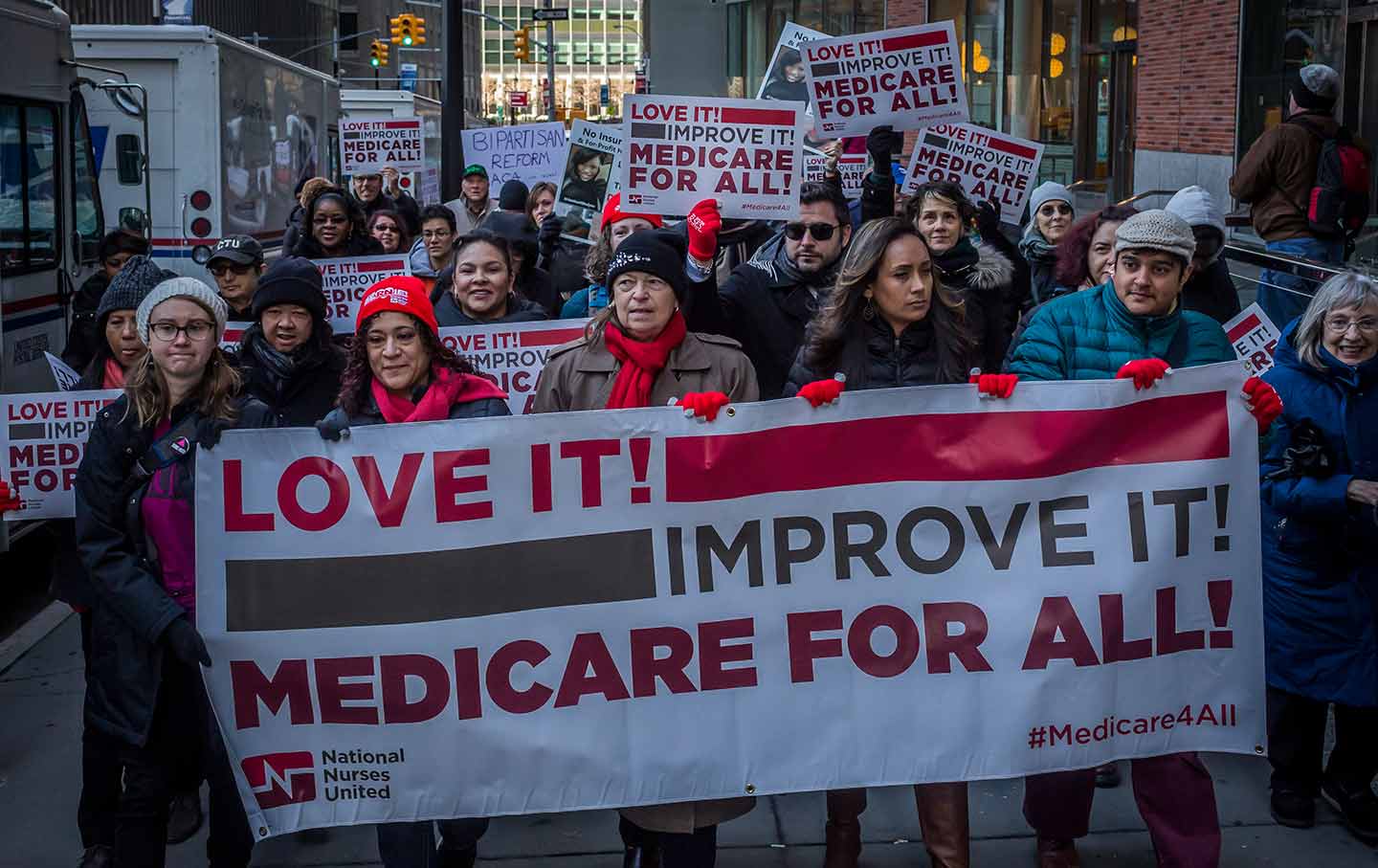
The seismic shift in support for Sen. Bernie Sanders’ plan to transform the U.S. health care system into a single-payer program indicates the reach the Vermont independent has within the Democratic Party.

At the same time that his onetime presidential foe Hillary Clinton is reminding people of the party’s devastating loss last fall, Sanders is trying to define its future. His bill to enroll every American in Medicare drew 16 co-sponsors, 16 more than when he first introduced similar legislation in 2013.

It has garnered support from possible 2020 Democratic presidential hopefuls — Sens. Cory Booker of New Jersey, Kamala Harris of California, Elizabeth Warren of Massachusetts and Kirsten Gillibrand of New York — as well as Sen. Tammy Baldwin of Wisconsin, an incumbent up for re-election next year in a state narrowly won by President Donald Trump.

It also provided a welcome talking point for Republicans who have long railed against government-run health care. Several GOP senators used Sanders’ legislation as a tool to warn voters of what could come if Republicans are unable to overhaul the health care system.

‘A political crisis’

During a bill introduction Wednesday that felt more like a campaign rally than the standard press conference, Sanders — flanked by co-sponsors — stuck to his standard script of bashing Republicans and special interest groups for doing nothing to address rising health care costs.

“The crisis we are discussing is not really about health care,” he told a crowded room of activists and supporters. “The crisis we are discussing today is a political crisis which speaks to the incredible power of the insurance companies, the drug companies and all those who make billions of dollars off of the current system.”

The politics of “Medicare for all” are divisive. And aside from a short comment about raising taxes across the board, Sanders has yet to outline a clear way to pay for such a system.

There is a divide within the Democratic Party on how to define such a system, and many Senate Democrats have yet to voice their support for Sanders’ plan, including vulnerable incumbents up for re-election such as Sen. Joe Manchin III of West Virginia.

Despite those differences, however, the expanding coalition of Democrats who now back such a proposal is a display of just how Sanders, who gave Clinton a serious challenge for the presidential nomination, continues to influence the national party.

“Sen. Sanders’ presidential campaign was a phenomenon that very few people saw coming. It uncovered a groundswell of progressive activation that the party now rightly wants to tap into as we head into 2018 and 2020,” Connecticut Democratic Sen. Christopher S. Murphy said. “I think that Democrats now feel a little freer to imagine some even bigger and bolder ideas.”

Asked whether the growing support for his legislation is indicative of his influence, Sanders hedged.

“Right now, we are focusing on what the bill is about,” he said. “We’ll talk about the politics of it later.”

A national message?

Several other Democratic senators supported the national party embracing more bold ideas — like Medicare for all — in the fallout from the 2016 election and tied that movement directly to the success of Sanders’ campaign.

“It’s an idea whose time has come. There’s a clear recognition that universal coverage has to be the goal,” Democratic Sen. Richard Blumenthal of Connecticut said. “These principles are now in the public mind, front and center, and that is due, in part, to the prominence that Bernie Sanders gave to them during the campaign.”

A Democratic aide echoed those thoughts and said the shift is indicative of a recognition that the party needs to be bolder and sharper in its proposals.

“I think there will be a lot of support for this bill,” the aide said. “It’ll make the clear contrast between the two parties on health care even more clear.”

While the Sanders proposal has gained more support among members of the Democratic conference, skeptics remain.

“The Sanders bill requires people to give up their insurance. It’s not an option that you buy in. It requires people to give up the insurance,” Sen. Claire McCaskill of Missouri said. “I’ve been down the road of requiring people to do things the government says on insurance and it is a road paved with big rocky boulders.”

Asked whether she correlates the growing support for Medicare for all to Sanders’ popularity among liberals, McCaskill — who is up for re-election in 2018 in a state Trump won easily — said she had not analyzed it from that perspective.

“I just think we’ve got to think this through and not make this some kind of political litmus test,” she told Roll Call.

While other Democratic lawmakers also said they hoped support for the Sanders bill would not be a political benchmark for the party, several openly said endorsing the concept would be crucial for any successful candidate.

“I have trouble seeing how a viable Democratic candidate does not support the idea of single-payer,” Blumenthal said. “This bill is going to drive the national message.”

Bernie-Care barrier?

Some Senate Republicans, who this summer failed in their attempt to repeal and replace the 2010 health care law, are making a last-ditch attempt to overhaul it.

Sens. Bill Cassidy of Louisiana, Lindsey Graham of South Carolina, Ron Johnson of Wisconsin and Dean Heller of Nevada are pushing legislation that would transform the health care system to essentially a large federal block grant to the states based on the size of their individual insurance pool.

Their message to the Republican conference was clear: It’s either our plan or Sanders’ proposal.

“If you want a single-payer health care system, this is your worst nightmare,” Graham said. “Bernie, this ends your dream of a single-payer health care system for America.”

Republican leadership echoed that message.

“We see what the alternative is and hopefully that’ll focus the mind,” Senate Majority Whip John Cornyn said. “Their party is clearly lurched to the left even further, and it’s made it hard for otherwise pretty pragmatic people, like Chuck Schumer, to do deals which he ordinarily would do with Republicans.”

But for Sanders, the failed attempt by the GOP to overhaul the current health care law only bolsters his case.

“To my Republican colleagues, please don’t lecture us on health care,” he said. “You, the Republican Party, have no credibility on the issue of health care.”
GOP Sees Offensive Opening on Health Care for 2018

http://www.rollcall.com/news/politics/gop-medicare-for-all-strategy?utm_source=rollcallheadlines&utm_medium=email&utm_campaign=newsletters&utm_source=rollcallheadlines&utm_medium=email&utm_campaign=newsletters

Image result for Medicare for All

Republicans plan to tie all Democrats to “Medicare for all” proposals.

As more and more Democrats come out in favor of some form of “Medicare for all” legislation, Republican campaign strategists are salivating.

In much the same way the GOP has tried to tie all Democrats to House Minority Leader Nancy Pelosi in attack ads, they’re planning to tie all Democratic incumbents and challengers to different proposals from Vermont independent Bernie Sanders in the Senate and Michigan Rep. John Conyers Jr. in the House, regardless of whether they’ve personally embraced those policies.

“I’m thrilled,” said Corry Bliss, executive director of the Congressional Leadership Fund, the leadership-backed super PAC that plans to spend $100 million to help Republicans keep their House majority in 2018.

“I love their new policy so much that I’m thinking about taking the $50 or so million I was planning on spending on attacking Nancy Pelosi and putting a small portion toward explaining how single-payer hurts the American people,” Bliss said Tuesday.

That strategy isn’t much different from the GOP strategy of the past seven years, when the party has gone after Democrats on the 2010 health care law. But after months of their own health care legislative failures, Republicans think they finally have an offensive opening on health care again.

“It’s first time we’ve been in that position in a long time,” said one GOP campaign strategist, who acknowledged that this year’s health care debate revived the 2010 law.

Attacking all Democrats

The National Republican Congressional Committee was especially vocal on Wednesday, with a digital ad and a slew of press releases trying to pin Sanders’ proposal on Democratic incumbents and challengers.

“Studies reveal that single-payer would cost taxpayers a staggering $32 trillion over the next ten years,” the releases say, all pointing to the same study from the Urban Institute from May 2016.

“Sanders and Pelosi are leading their members down a path with nowhere to turn but left,” NRCC communications director Matt Gorman said in a statement.

In reality, Pelosi has shied away from Medicare for all proposals, trying instead to keep her caucus’ focus on improving the 2010 health care law. Her reticence toward the issue is a fact Republicans sometimes highlight to underscore its unpopularity — as in, “This is such a bad idea, Nancy Pelosi doesn’t even support it.”

But when it comes to messaging against the proposals, Republicans are happy to include Pelosi — a perpetual boogeyman — to help tie the issue around the neck of all Democrats.

California Rep. Scott Peters, a member of the moderate New Democrat Coalition and chairman of the group’s PAC, brushed aside the threats of those kinds of attacks.

“That won’t be a very effective campaign technique. People understand where we are,” he said, walking down the House steps Wednesday afternoon. Peters, an NRCC target in 2018, doesn’t support the Conyers legislation.

But with a majority of House Democrats signing onto it, and many 2020 hopefuls embracing the Sanders plan in the Senate, Republicans see it as nationalized party issue they can apply down ballot to all candidates.

“This is going to help frame the choice next year,” Bliss said. “It will be a huge issue in every single district that we spend in next year.“

One Republican admitted, though, it may be harder to message against a Democratic proposal that doesn’t stand a chance of becoming law anytime soon and doesn’t have a Democratic president behind it.

“I don’t think it will get to the same level as Obamacare did in the 2010 cycle,” the GOP strategist said. “You don’t have the same boogeyman in President Obama and Pelosi.”

Still, Republicans hope the issue will help them by pushing Democratic candidates to the left and sinking nominees in red districts or states won by President Donald Trump last fall.

In Wisconsin, where Trump eked out a win, Sen. Tammy Baldwin has come out in support of Sanders’ legislation. She’s the only senator up for re-election in a state the president won to have signed onto the Sanders’ proposal.

Trump has called for “insurance for everybody,” but Republicans say it’d be very easy to message against a Medicare for all plan to his voters.

“Here’s a socialist idea where everyone gets the same thing,” the GOP strategist said. “That doesn’t play.” It doesn’t fit with what she called the “you deserve more” narrative that Trump pushed to working-class voters during the campaign.

Keeping up the heat

Democrats aren’t backing away from their own offensive attacks on health care, trying to make the GOP-controlled Congress own their repeal-and-replace efforts.

That continued on Wednesday, with the introduction of the Senate Republicans’ latest effort at repealing the 2010 health care law.

“The 2018 election will be a referendum on the toxic GOP health care plan that spikes costs and strips coverage,” said David Bergstein, spokesman for the Democratic Senatorial Campaign Committee.

And they’re skeptical that this week’s attention on the Medicare for all legislation will take away from what a GOP-controlled Congress has been able to do — or not do — on health care this year.

“To have that be their golden ticket out of the nightmare they face right now seems just insane,” one Democratic operative said.


Hospital Impact—The only thing clear about healthcare policy is the continued lack of clarity

http://www.fiercehealthcare.com/hospitals/hospital-impact-only-thing-clear-about-healthcare-policy-continuing-lack-clarity?utm_medium=nl&utm_source=internal&mrkid=959610&mkt_tok=eyJpIjoiWldFeE1XUXlPRFE0TlRneCIsInQiOiJ5dzRsZ1IwekxcL2FMZnN3NkJIOHZGbnpNV1RPcmtMNmdPd1MwV0RLUXNBSXl6QzJnK0s0NktPVzBLOUtRRjF1K0puZzZMZG95dERnN2VUcVRpeForakRVZVJsXC9GWllyU1g1Rk9ZY2pERVRQcjVyT1wvQkMycXdobjd5UnNKa2p3NiJ9

Executive looking out window

For healthcare leaders, it’s discouraging that federal policy decisions seem to be made at the last minute without much planning or consideration of unintended consequences.

I spent my Labor Day vacation in Monterrey, California, watching the waves crash into the sand and wondering what the future of healthcare will look like in the coming months and years. Some clarity is emerging that we have not seen in the past, and I feel comfortable making some observations and predictions:

  • Congress will not revisit the repeal and replacement of the Affordable Care Act before the end of the year. It is simply dealing with far too many other issues—passing a budget, raising the debt ceiling, approving disaster aid for Harvey and Irma, not to mention its desire for tax reform—that lawmakers must address.
  • While the Senate HELP committee is attempting a bipartisan effort to shore up the ACA, the issues listed above will make it almost impossible for such a law to be passed during this session.
  • The leadership of the Department of Health and Human Services ideologically opposes the very concept of the ACA and is also responsible for implementing the law. The tension between those two facts will lead to confusion and uncertainty for those of us in healthcare.
  • The passage of the ACA changed the terms of debate around healthcare reform. Granting health insurance to more than 20 million Americans has now shifted public opinion so that a solid majority believes the federal government should ensure that its citizens have insurance.
  • The ACA is not failing, but going forward it can be undermined without congressional action.

As a former anatomic pathologist, I am always interested in postmortem examination of failures, and the failure of Republicans to repeal the ACA ranks high in any list of stunning political disasters. Pundits have identified several possible causes:

  • Republicans never had a clear replacement plan or goal.
  • Taking away benefits from 22 million Americans is politically unpopular.
  • The ACA was not in a “death spiral.”
  • The president did not exert necessary leadership to get GOP senators to support his unpopular position.
  • Republican governors who had expanded Medicaid did not support the effort.
  • Organized opposition to repeal led to most Americans not supporting repeal.

Autopsy results always arrive too late for those of us who are still alive, and it is more important for those of us in healthcare to interpret the mixed messages coming out of HHS and Congress so that our organizations can continue to care for patients under the current system.

HHS seems willing and eager to let states experiment with healthcare reform. Alaska has received approval for $323 million over five years to subsidize insurance carriers and stabilize its individual ACA marketplace. Iowa is likely to receive approval for a radical 1332 waiver approach to healthcare reform in the Hawkeye state, and other states are preparing waiver submissions.

Meanwhile, HHS actions that seem to undermine the ACA include refusing to guarantee cost-sharing reduction subsidies to insurance companies and slashing the budget to support ACA enrollment for 2018. HHS recently announced advertising budget cuts of 90% for 2018 and the navigator program cuts of 40%.

A recent study—detailed in a post on The Incidental Economist blog—compared Kentucky ACA enrollment under a Democratic governor who supported advertising and a Republican governor who cut advertising. It found that lack of TV advertising led to 450,000 fewer page views on the ACA website and 20,000 fewer unique visits to the enrollment website.

ACA supporters, meanwhile, have recently put together a private enrollment campaign for 2018 to fill in the gap created by HHS decisions, Axios reported.

Last week, the Senate HELP Committee heard from state insurance commissioners and governorsabout ideas to stabilize the ACA marketplaces. They include:

  • Funding the cost-sharing reduction subsidies to insurance companies.
  • Facilitating reinsurance programs.
  • Expanding the ACA 1332 waiver programs to let states innovate.
  • Funding enrollment activities such as advertising and navigator programs.

Although health policy experts largely support these recommendations, it is hard to see how such a divided Congress could pass such proposals. Even if such legislation were approved, it would likely come too late to impact health insurance company decisions for 2018.

So, as of early September, we are left with the ACA continuing to be the law of the land, but with those in charge of the federal government not entirely supporting its success. Healthcare organizations have difficulty caring for patients when the rules keep changing and when clarity is hard to come by. It is also discouraging that decisions seem to be made at the last minute without much planning or consideration for unintended consequences.

That said, we still need to keep taking care of patients. My advice is to:

  • Continue to prepare for the transition from fee-for-service to value-based payments, but be aware that the Trump administration might slow down this process.
  • Continue to cut unnecessary costs.
  • Continue to improve the measurable quality of the care you give.
  • Participate in efforts in your individual states to innovate through waiver programs.
  • Collaborate with your physicians who are confused by all the uncertainty.
  • Keep up to date with the frequent changes that nobody can predict.


Healthcare Triage News: Congress is Back, and Healthcare Should Be on the To-do List

Healthcare Triage News: Congress is Back, and Healthcare Should Be on the To-do List

Image result for Healthcare Triage News: Congress is Back, and Healthcare Should Be on the To-do List

Congress is back in session, and it has a full month ahead. They have to deal with hurricanes, raise the debt limit, fund the government, keep us out of war, AND they want to talk about cutting taxes, too. With all this going on, it’s going to be hard to get anything done around healthcare, but there’s lots that needs to be done.

There’s one Obamacare repeal bill left standing. Here’s what’s in it.

https://www.washingtonpost.com/graphics/2017/politics/cassidy-graham-explainer/?utm_term=.c90e0ce41aa2

Image result for cartoon dilbert beating a dead horse

After a dramatic series of failed Senate votes in July, there’s one repeal-and-replace plan for the Affordable Care Act left standing. Trump is pushing for a vote, per Politico, and John McCain has announced his support, but the bill has yet to gain significant traction.

The proposal, crafted by Sens. Bill Cassidy (R-La.), Lindsey O. Graham (R-S.C.) and Dean Heller (R-Nev.), essentially turns control of the health-care markets over to the states. Rather than funding Medicaid and subsidies directly, that money would be put into a block grant that a state could use to develop any health-care system it wants. It also allows states to opt out of many ACA regulations. “If you like Obamacare, you can keep it,” Graham has said, using a common nickname for the health-care law. “If you want to replace it, you can.”

In reality, that may not be true. The Medicaid expansion and subsidy funding would be cut sharply compared to current spending, going to zero in a decade.

 “You can’t actually keep the same program if your federal funding is being cut by a third in 2026,” said Aviva Aron-Dine, a senior fellow at the left-leaning Center on Budget and Policy Priorities. And even putting aside the cuts, she said, the block grant structure would fundamentally change the health-care landscape. “[Funding] is capped, so it wouldn’t  go up and down with the economy,” when fewer or more people become eligible for subsidies.

Republicans contest this. The drop in funding “gives strong incentives for the states to be more efficient with their program,” said Ed Haislmaier, a senior fellow at the conservative Heritage Foundation. That is, states may be able to maintain the ACA structure and regulations as long as they streamline operations.

If the streamlining turns out to be insufficient, the cuts would hit liberal states the hardest, according to a report by the Center for Budget and Policy Priorities. This is largely because they tend to be the biggest spenders on health care: They’ve expanded Medicaid and aggressively signed people up for marketplace coverage. They have the most to lose.

 On the whole, Aron-Dine says, “This is a lot more similar to the [Senate repeal bill] than different. All of them end with devastating cuts to marketplace subsidies, Medicaid, and weakening of consumer protections.”

Haislmaier agreed, pointing out the Cassidy-Graham plan was originally intended as an amendment to the Senate bill.

Here’s the nitty gritty of what would change, compared to the ACA and the Senate plan that failed in July:

Who would need to be covered

Under the Cassidy-Graham plan, the mandates would be eliminated at the federal level. States could choose to keep the measure, replace it or get rid of it completely.

How they would pay for coverage

The federal health insurance subsidies that help most people with ACA marketplace plans afford their coverage would change. This bill would shift those subsidies to the state-level, so people in some states may see their subsidy scaled back or eliminated.

Proposed changes to Medicaid

The bill would restructure Medicaid and decrease its funding. That would make it very difficult for states to maintain the Medicaid expansion.


Trump wants one last Senate push on Obamacare repeal

http://www.politico.com/story/2017/09/05/trump-obamacare-repeal-senate-242346

Image result for beating a dead horse

The odds are slim, but the White House still hopes for action on a bill drafted by Lindsey Graham and Bill Cassidy.

President Donald Trump and some Senate Republicans are refusing to give up on Obamacare repeal, even after this summer’s spectacular failure and with less than a month before a key deadline.

The president and White House staff have continued to work with Republican Sens. Lindsey Graham of South Carolijna and Bill Cassidy of Louisiana over the summer on their proposal to block grant federal health care funding to the states. And though the bill is being rewritten and Congress faces a brutal September agenda, Trump and his allies on health care are making a last-gasp effort.

“He wants to do it, the president does. He loves the block grants. But we’ve got to have political support outside Washington,” Graham said in an interview. He said the bill needs to have a “majority of the Republican governors behind the idea” to gain momentum in the Senate.

But there’s far more work to do even than that. Senate Majority Leader Mitch McConnell would need to find room on the packed calendar this month to hold another uncertain push to repeal Obamacare on party lines. The Senate has only until the end of the month to pass the measure using powerful budget reconciliation procedures, but is also planning to fund the government, raise the debt ceiling, write a new defense policy bill and extend a host of expiring programs.

Cassidy said he hopes to have the bill text finalized by this week and has declined to reveal details about what changed in the bill during August.

“We are still refining the legislative language — just things you got to clear up,” he said. “We think we have good legislation, good policy.”

The Congressional Budget Office would also still need time to analyze the cost of the bill, a process that could take several weeks.

Trump berated McConnell and the Senate GOP over the summer for falling one vote short of sending repeal into conference with the House in July, when Sen. John McCain of Arizona voted down the GOP’s “skinny” repeal bill. So the White House has continued to work on the Graham-Cassidy bill behind the scenes, seeing it as the best option to make progress, according to several administration officials.

The bill would keep most of Obamacare’s taxes and devolve many spending decisions to the states. It was submitted as an amendment to the repeal bill in July but did not receive a vote; aides say it could not pass the Senate in its current form.

Trump has intermittently told aides he wants progress on health care and is still frustrated that the bill failed. The White House’s legislative team has talked with Republican governors in recent weeks and is planning to bring more to the White House, according to one of the officials. Internally, White House officials say they have listened to concerns from governors and tried to tweak the state block grant formulas.

Hill leadership hasn’t played a central role in the effort.

McConnell said in Kentucky last month that the path forward is “somewhat murky” and pointed to efforts by Sen. Lamar Alexander (R-Tenn.) to stabilize insurance markets as one avenue forward, though he doubted Democrats’ resolve on the bipartisan effort.

“We’re going to see what Sen. Alexander and his team can do on a bipartisan basis. The Democrats have been pretty uninterested in any reforms. They’re really interested in sending money to insurance companies but not very interested in reforms,” McConnell said then.

Inside the White House, there is little hope that a health care bill can happen quickly, with a stacked legislative agenda. And some close to the president prefer he would focus on tax reform and other immediate fiscal issues.

The Senate parliamentarian has ruled that the chamber’s reconciliation instructions, which allow the GOP to evade a Democratic filibuster and the chamber’s 60-vote requirement, expire at the end of the month. Republicans are planning to use their next budget measure to pass tax reform via a simple majority. But Graham insisted there’s a short window to fulfill the party’s seven-year promise if the GOP goes into overdrive, starting this week.

“It’s possible, yes. But you’ve got to do it quickly … introduce it this week, have a hearing soon about the bill, then the process is set to actually take it to floor and vote,” Graham said. “Everything has to fall in place.”

Kaiser Health Tracking Poll – August 2017: The Politics of ACA Repeal and Replace Efforts

Kaiser Health Tracking Poll – August 2017: The Politics of ACA Repeal and Replace Efforts


KEY FINDINGS:
  • The August Kaiser Health Tracking Poll finds that the majority of the public (60 percent) say it is a “good thing” that the Senate did not pass the bill that would have repealed and replaced the ACA. Since then, President Trump has suggested Congress not take on other issues, like tax reform, until it passes a replacement plan for the ACA, but six in ten Americans (62 percent) disagree with this approach, while one-third (34 percent) agree with it.
  • A majority of the public (57 percent) want to see Republicans in Congress work with Democrats to make improvements to the 2010 health care law, while smaller shares say they want to see Republicans in Congress continue working on their own plan to repeal and replace the ACA (21 percent) or move on from health care to work on other priorities (21 percent). However, about half of Republicans and Trump supporters would like to see Republicans in Congress keep working on a plan to repeal the ACA.
  • A large share of Americans (78 percent) think President Trump and his administration should do what they can to make the current health care law work while few (17 percent) say they should do what they can to make the law fail so they can replace it later. About half of Republicans and supporters of President Trump say the Trump administration should do what they can to make the law work (52 percent and 51 percent, respectively) while about four in ten say they should do what they can to make the law fail (40 percent and 39 percent, respectively). Moving forward, a majority of the public (60 percent) says President Trump and Republicans in Congress are responsible for any problems with the ACA.
  • Since Congress began debating repeal and replace legislation, there has been news about instability in the ACA marketplaces. The majority of the public are unaware that health insurance companies choosing not to sell insurance plans in certain marketplaces or health insurance companies charging higher premiums in certain marketplaces only affect those who purchase their own insurance on these marketplaces (67 percent and 80 percent, respectively). In fact, the majority of Americans think that health insurance companies charging higher premiums in certain marketplaces will have a negative impact on them and their family, while fewer (31 percent) say it will have no impact.
  • A majority of the public disapprove of stopping outreach efforts for the ACA marketplaces so fewer people sign up for insurance (80 percent) and disapprove of the Trump administration no longer enforcing the individual mandate (65 percent). While most Republicans and Trump supporters disapprove of stopping outreach efforts, a majority of Republicans (66 percent) and Trump supporters (65 percent) approve of the Trump administration no longer enforcing the individual mandate.
  • The majority of Americans (63 percent) do not think President Trump should use negotiating tactics that could disrupt insurance markets and cause people who buy their own insurance to lose health coverage, while three in ten (31 percent) support using whatever tactics necessary to encourage Democrats to start negotiating on a replacement plan. The majority of Republicans (58 percent) and President Trump supporters (59 percent) support these negotiating tactics while most Democrats, independents, and those who disapprove of President Trump do not (81 percent, 65 percent, 81 percent).
  • This month’s survey continues to find that more of the public holds a favorable view of the ACA than an unfavorable one (52 percent vs. 39 percent). This marks an overall increase in favorability of nine percentage points since the 2016 presidential election as well as an increase of favorability among Democrats, independents, and Republicans.

Trump to GOP: Get Obamacare repeal bill done

http://www.politico.com/story/2017/08/10/trump-obamacare-repeal-senate-republicans-241494?utm_campaign=KHN%3A%20First%20Edition&utm_source=hs_email&utm_medium=email&utm_content=55194059&_hsenc=p2ANqtz-8_YOjdjRTjA-xM50_ZT5aTfcjL6fylg2px13PHXBu5kUC3p0UiYmzhnVD8O5O7HqNErxB3FYB_-rCA7s1w-oHuLGYjjA&_hsmi=55194059

Image result for beating a dead horse

President Donald Trump renewed his call for Senate Republicans to take another crack at dismantling Obamacare, saying Thursday it’s a “disgrace” that they failed to pass a repeal bill.

“They lost by one vote,” Trump said from his Bedminster, New Jersey, golf course. “For a thing like that to happen is a disgrace.”

The president has hectored Senate Republicans for days over their collapsed health care effort, most recently singling out Majority Leader Mitch McConnell for criticism.

“I just want him to get repeal and replace done,” Trump told reporters, when asked about his multi-day string of tweets attacking the Kentucky Republican over health care. “It’s almost two years, and all I hear is repeal and replace. And I get there, and I said where’s the bill? I want to sign it.”

McConnell has suggested that the GOP should move on from health care after falling just short of the 50 votes he needed to pass a “skinny” repeal bill, and instead focus on tax reform. And earlier this week, McConnell said Trump has “excessive expectations” about how quickly Congress can pass legislation.

But Trump demanded that Republicans follow through on their agenda, suggesting further failure could cost McConnell his job atop the Senate GOP.

“If he doesn’t get repeal and replace done, and if he doesn’t get taxes done, meaning cuts and reform, and if he doesn’t get a very easy one to get done, infrastructure, he doesn’t get them done, then you can ask me that question,” Trump said.


Taxpayers Will Pay the Price for Uncertainty Over Obamacare in 2018

https://www.thefiscaltimes.com/2017/08/10/Taxpayers-Will-Pay-Price-Uncertainty-Over-Obamacare-2018

The health insurance industry remains in the throes of a largely unnecessary crisis of confidence, according to an analysis released by the Kaiser Family Foundation on Thursday.

With the open enrollment period approaching for Obamacare insurance plans sold through state exchanges, Kaiser Foundation experts were able to analyze the proposals for 2018 submitted by insurance companies to 20 states and the District of Columbia — the only places where enough information is made public to allow an assessment of what health care costs would look like for an average policyholder under the insurers’ requested rate structures.

“Insurers attempting to price their plans and determine which states and counties they will service next year face a great deal of uncertainty,” the authors wrote. “They must soon sign contracts locking in their premiums for the entire year of 2018, yet Congress or the Administration could make significant changes in the coming months to the law – or its implementation – that could lead to significant losses if companies have not appropriately priced for these changes. Insurers vary in the assumptions they make regarding the individual mandate and cost-sharing subsidies and the degree to which they are factoring this uncertainty into their rate requests.”

What that means for consumers is a bit of a mixed bag. Almost all insurers are seeking rate increases, with some approaching a 50 percent jump. But the actual impact on consumers varies depending on where they buy their insurance and how much money they earn. One thing is for sure, though: The federal government, and therefore taxpayers, will be on the hook for larger subsidy payments.

Because the majority of Americans obtain health insurance through an employer-sponsored plan or from federal programs like Medicare and Medicaid, the impact of the premium increases of exchange-based policies will mean little to a large element of the population.

Of those who buy insurance on the exchanges, the overwhelming majority receive tax credits meant to keep their premium payments to a specific fraction of their annual income. The remaining 16 percent, depending on their income, receive either a smaller subsidy or no subsidy at all. It is these people who, if they live in some of the regions facing large premium increases, who will be hurt the most.

The Kaiser study gathered information from the largest city in each of the 20 states plus the District of Columbia. (Benchmark levels for tax credits are based on the second-cheapest Silver Level plan available in the largest city in a state.) They estimated the change in costs for a 40-year-old non-smoker earning $30,000 a year.

In only one state was the annual premium expected to fall in 2018: Rhode Island, which anticipates a 5 percent drop. Vermont’s premiums will remain static in 2018 if the data holds. The other 19 states can all expect increases, from a modest 3 percent in Michigan to a whopping 49 percent in Delaware.

The average increase in the data collected by Kaiser is 17 percent.

However, none of those costs would be passed on to the consumer making $30,000 a year. In fact, because of adjustments to the tax credit, he could expect to see monthly costs fall by 3 percent, to $201, next year, regardless of what premium levels do where he lives.

But somebody has to pay when premiums go up, and if it isn’t the consumer, it’s the Treasury and by extension, the taxpayer.

The change in premium payments required to keep that 40-year-old’s health insurance premium at $201 per month will increase very sharply in many states, depending greatly on how far from the premium cap a silver plan was in 2017.

In Washington State, according to Kaiser, the premium tax credit would increase 239 percent, from $31 per month to $105. In New Mexico, it would jump 183 percent, from $51 to $144. In Rhode Island it would fall 13 percent, while in Vermont it would rise a modest 2 percent. On average, though, the amount of premium payment picked up by the federal government will increase by about 63 percent in the states reviewed by Kaiser.

Perversely, as Kaiser points out, that fiscal wound is largely self-inflicted. While it is impossible to gauge just how much of this year’s rate increases are attributable to insurers being nervous about whether the federal government would slash support payments in the middle of the 2018 policy year, the answer is surely non-trivial, and the dollars are coming out of the pockets of taxpayers.

Carper cast as governors’ lobbyist in health care debate

http://www.delawareonline.com/story/news/politics/2017/08/08/carper-cast-governors-lobbyist-health-care-debate/546377001/

Image result for Carper cast as governors' lobbyist in health care debate

When Sen. Tom Carper was shopping for votes to block GOP health care bills, he didn’t just turn to his fellow senators. He turned to their governors.

A self-described “recovering governor,” himself, the Delaware Democrat carried out a communications blitz – calling, texting, emailing – and made contact with up to half of them. He skipped out on a Democratic campaign retreat to make a case at the National Governors Association summer meeting in Rhode Island.

His message: The legislation will hurt your states. Put your opposition in writing so the Senate can pause, work together to stabilize the insurance exchanges, and return to “regular order,” with hearings, bipartisan amendments — and input from governors, he said.

Delaware’s senators are bullish that debate over health care will turn to fixing the Affordable Care Act after the Senate early Friday morning defeated a proposal to repeal parts of the landmark law. 7/28/17 Damian Giletto/The News Journal

“He came up and spent a morning discussing the ins and outs, the details of health care changes,” Colorado Gov. John Hickenlooper, a Democrat, said on CBS’s “Face the Nation” Sunday.

Ohio Gov. John Kasich, a Republican, speaking on the same show, said, “Tom Carper from Delaware has been unbelievable in terms of his looking at trying to solve this problem.”

Carper believed that governors’ objections would be key to blocking the GOP effort to repeal and replace Obamacare, and it turned out they were. Even Sen. John McCain of Arizona, one of three Republicans who helped sink the GOP’s last-ditch effort, repeatedly highlighted his governor’s concerns.

Senate Minority Leader Charles Schumer of New York tapped Carper to lead outreach efforts to governors in early July when Carper complained that their voices weren’t being heard. In the health care drama, where there were many players, Democrats’ casting of Carper as the lead governors’ lobbyist made sense. He’s a former NGA chairman who loves the organization (and is prone to gushing about it).

“Tom Carper was really our point person with the governors, he kind of managed it,” said Sen. Tim Kaine, a former Democratic governor of Virginia. “He played a very important role in all of this. And the governors themselves, their voices were very important.”

Several days before the NGA summer meeting, Carper learned administration officials would discuss GOP health care proposals with the governors and was alarmed to discover that no one was scheduled to present the opposing view. He wangled an invitation to speak on a closed-door panel on July 15 alongside Seema Verma, administrator of the Centers for Medicare and Medicaid Services, and Secretary of Health and Human Services Tom Price.

“(Carper) was spreading this word that we should do this together, that people shouldn’t be hurt who are not in a position of being able to help themselves,” Kasich, an opponent of the GOP health care bills, said in an interview with USA TODAY. “And it was a message of slow down and let’s get this right. At no time did he ever say we should do nothing.After that, Carper kept contact information for every governor by his side, calling them during free moments between hearings and meetings. They discussed how the legislation would impact states’ Medicaid expansions, for example, or how a straight repeal of Obamacare would impact the states.

When he couldn’t reach Arizona Gov. Doug Ducey, a Republican, he said he talked several times to his Medicaid director and to his chief of staff. He said he spoke with Kasich “a dozen times or more.”

“One night he called me and it was like 10:30 at night,” Kasich said. “He was relentless in terms of what he did. And do I think he made a difference? I have no doubt that he did. Did he switch anybody? You don’t know. Did he have some people that would have not voted for this had McCain not voted ‘no,’ I just can’t tell you. But he deserves a lot of credit for being a really good public servant, keeping in mind the people that he serves.”

Carper said his outreach efforts helped him develop trust with governors “and just to let them know if they are interested in finding a path forward, they have a number of Democratic senators… who want to find common ground.”

Three days after Carper’s pitch at the NGA meeting, Kasich, Hickenlooper and nine other bipartisan governors who had been vocal about their concerns issued a statement opposing efforts to repeal the current system and replace it later. The statement, which Kasich said had been in the works for a while, called for governors to be included in the next steps.

“The best next step is for both parties to come together and do what we can all agree on: fix our unstable insurance markets,” they wrote.

They may be getting their wish, and so may Carper.

After the GOP’s three legislative failures, the Senate Health, Education, Labor and Pensions Committee announced it would begin hearings in September on ways to stabilize the individual health insurance market. The committee will hear from a wide range of stakeholders, including governors.

Moving forward, Carper said “the stage has been set” for better, more affordable health care coverage. Though he isn’t on the HELP Committee, he believes he can play a role in bipartisan discussions on health care.

“The key now is for the Senate to do its job,” Carper said.