The Complex Mess of Health Insurance

The Kaiser Family Foundation is one of the best sources of information on health care, and it recently convened some focus groups in the Midwest and Pennsylvania. These groups included people who received health insurance through an Obamacare exchange and who also voted for Donald Trump.

You can read about the results in an Op-Ed today by Drew Altman, Kaiser’s chief executive. It underscores how messy and uncertain the coming debate over Obamacare’s future will likely be.

I want to point out one theme that keeps popping up in Altman’s piece — and existed long before Obamcare: A lot of Americans are deeply frustrated by the logistical headaches built into our health care system.

As Altman writes: “They were especially upset by surprise bills for services they believed were covered. They said their coverage was hopelessly complex.” If they had their way, Altman says, their insurance would become “much more understandable.”

I share their frustration, and I imagine most of you do, too. Just this week, a member of my family endured the Kafkaesque experience of being told that she needed to show up for an appointment even if she were no longer sick or face a penalty, thanks to insurance rules.

The Health Care Plan Trump Voters Really Want

This week Republicans in Congress began their effort to repeal and potentially replace the Affordable Care Act. But after listening to working-class supporters of Donald J. Trump — people who are enrolled in the very health care marketplaces created by the law — one comes away feeling that the Washington debate is sadly disconnected from the concerns of working people.

Those voters have been disappointed by Obamacare, but they could be even more disappointed by Republican alternatives to replace it. They have no strong ideological views about repealing and replacing the Affordable Care Act, or future directions for health policy. What they want are pragmatic solutions to their insurance problems. The very last thing they want is higher out-of-pocket costs.

The Kaiser Foundation organized six focus groups in the Rust Belt areas — three with Trump voters who are enrolled in the Affordable Care Act marketplaces, and three with Trump voters receiving Medicaid. The sessions, with eight to 10 men and women each, were held in late December in Columbus, Ohio, Grand Rapids, Mich., and New Cumberland, Pa. Though the participants did not agree on everything, they expressed remarkably similar opinions on many health care questions. They were not, by and large, angry about their health care; they were simply afraid they will be unable to afford coverage for themselves and their families. They trusted Mr. Trump to do the right thing but were quick to say that they didn’t really know what he would do, and were worried about what would come next.

They spoke anxiously about rising premiums, deductibles, copays and drug costs. They were especially upset by surprise bills for services they believed were covered. They said their coverage was hopelessly complex. Those with marketplace insurance — for which they were eligible for subsidies — saw Medicaid as a much better deal than their insurance and were resentful that people with incomes lower than theirs could get it. They expressed animosity for drug and insurance companies, and sounded as much like Bernie Sanders supporters as Trump voters. One man in Pennsylvania with Type 1 diabetes reported making frequent trips to Eastern Europe to purchase insulin at one-tenth the cost he paid here.


Poll: Public Divided on Repealing Obamacare, But Few Want It Repealed Without Replacement Details

http://connect.kff.org/poll-public-divided-on-repealing-obamacare-but-few-want-it-repealed-without-replacement-details?ecid=ACsprvtG5kIoCbXzcE3WLgrX01kIXFDaDUgXQ0BUzNGGn2gIr2haSAC8OzTQSp0H3e0Qeujg-Q9Y&utm_campaign=KFF-2017-January-Priorities-Tracking-Poll&utm_source=hs_email&utm_medium=email&utm_content=40166809&_hsenc=p2ANqtz-_zwF7NlvPoFINfG9Nd0OPcBebPHjaaSvuWqkCefkoOcmCo9aOPqJHM0W6_uhOAYH4ucOOIuXrEe40HttSNtSg8udNc1A&_hsmi=40166809

1.6.17 - 2017 tracking email alert - image 2.png

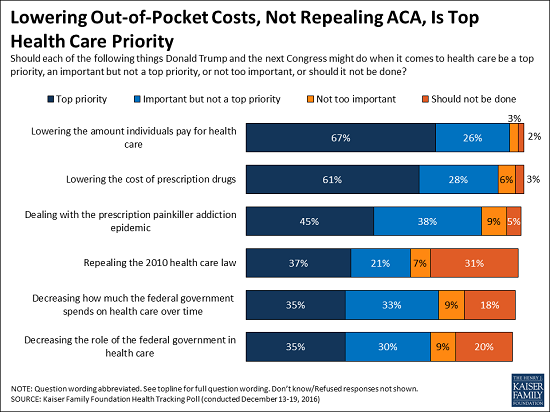
Out-of-Pocket Costs, Not the Affordable Care Act, Top Public’s List of Health Care Priorities for new Administration and Congress

As Congress begins to work on repealing and replacing the Affordable Care Act, the latest Kaiser Health Tracking Poll finds that one in five Americans (20%) support repeal alone, while three quarters either oppose repeal altogether (47%) or want to wait to repeal the law until the replacement plan’s details are known (28%).

Overall, the poll finds that nearly equal shares say that the next Congress should vote to repeal the law (49%) and that it should not vote to repeal it (47%), which mirrors the public’s overall views of the 2010 law (46% view it unfavorably, 43% favorably).

The debate surrounding repeal could influence the public’s views, as the poll finds that some people shift their opinions after hearing counter-arguments.  For example, after hearing pro-repeal arguments about the law’s costs to individuals and the government, the share of the public supporting repeal grows as large as 60 percent, while anti-repeal arguments about people losing coverage and the impact on people with pre-existing conditions decreases support for repeal to as low as 27 percent.

When asked directly about their family’s health care costs, similar shares of the public say repealing the Affordable Care Act would make their situation worse (28%) as say it would make it better (27%). Most say their own ability to get and keep health insurance (55%) and the quality of their own health care (57%) will stay about the same if Congress votes to repeal the law.

Beyond ‘Repeal and Replace,’ Further Health Reforms Loom

http://www.healthleadersmedia.com/leadership/beyond-repeal-and-replace-further-health-reforms-loom?spMailingID=10175220&spUserID=MTY3ODg4NTg1MzQ4S0&spJobID=1080402683&spReportId=MTA4MDQwMjY4MwS2#

Image result for Health Reforms

The old saying, “May you live in interesting times,” may sound like a blessing.

U.S. healthcare leaders know it is a curse.

All they’ve been working toward and preparing for since the Patient Protection and Affordable Care Act was enacted almost seven years ago has been turned upside down in the wake of the Republican election sweep.

Yet, for all their campaign promises to repeal the ACA, most congressional Republicans and President-elect Donald Trump must know that healthcare costs are too much for many Americans, and abolishing Obamacare with no replacement could be politically dangerous.

A report from consulting firm KPMG and an opinion piece published on LinkedIn by a Navigant executive predict that the Republican Congress and the executive branch will change the healthcare reform efforts initiated through the ACA, but the concept of value-based care will stay.

Governors signal support for Medicaid expansion

http://www.fiercehealthcare.com/payer/state-governors-signal-support-for-medicaid-expansion?utm_medium=nl&utm_source=internal&mkt_tok=eyJpIjoiTldOaE1qUm1ZMlV6T0dJNCIsInQiOiJVQWx2aDRmUXpsaGlUeEJcL0xFb1ZzcVFpbWp6ak1sU0VmUVY3Sk5BUHduNEVjeXNUUGw5emdwZVR6ajcrR0x1VnB0WFJaMWdWXC9tbG1SeDlEcVUxa3NPTmR5dEFEZ1dMYVFHdU1VOHJJRE1FSjR2ZGd0aEZxYzRLWUo1ckFTWVZ3In0%3D

Some governors—including two Republicans—are voicing support for Medicaid expansion even as lawmakers on Capitol Hill move toward repealing the Affordable Care Act.

In Michigan, Republican Gov. Rick Snyder wants Congress and President-elect Donald Trump to preserve the state’s unique version of Medicaid expansion even in the event of an ACA repeal, The Detroit News reported. The Healthy Michigan plan, which has seen enrollment surge past initial projections, requires recipients to contribute to health savings accounts and allows them to reduce their co-pays through healthy behaviors.

“I think it’s important that as they look at the Affordable Care Act … I hope they carefully look at the success we’ve had in Michigan, because we didn’t just do Medicaid expansion,” Snyder told the publication.

Repealing Federal Health Reform: Economic and Employment Consequences for States

http://www.commonwealthfund.org/publications/issue-briefs/2017/jan/repealing-federal-health-reform?omnicid=EALERT1150318&mid=henrykotula@yahoo.com

The Commonwealth Fund

Abstract

Issue: The incoming Trump administration and Republicans in Congress are seeking to repeal the Affordable Care Act (ACA), likely beginning with the law’s insurance premium tax credits and expansion of Medicaid eligibility. Research shows that the loss of these two provisions would lead to a doubling of the number of uninsured, higher uncompensated care costs for providers, and higher taxes for low-income Americans.

Goal: To determine the state-by-state effect of repeal on employment and economic activity.

Methods: A multistate economic forecasting model (PI+ from Regional Economic Models, Inc.) was used to quantify for each state the effects of the federal spending cuts.

Findings and Conclusions: Repeal results in a $140 billion loss in federal funding for health care in 2019, leading to the loss of 2.6 million jobs (mostly in the private sector) that year across all states. A third of lost jobs are in health care, with the majority in other industries. If replacement policies are not in place, there will be a cumulative $1.5 trillion loss in gross state products and a $2.6 trillion reduction in business output from 2019 to 2023. States and health care providers will be particularly hard hit by the funding cuts.

http://www.commonwealthfund.org/interactives-and-data/maps-and-data/the-impact-of-aca-repeal-on-employment


GOP won’t promise ObamaCare fix will cover all

GOP won’t promise ObamaCare fix will cover all

Image result for uninsured

Republican leaders are refusing to commit to their ObamaCare replacement plan covering as many people as President Obama’s health law.

Congressional Republicans are quickly moving forward to pass a repeal of ObamaCare and say a replacement plan will come later this year.

But it’s unclear whether that eventual replacement will provide insurance options for at least 20 million people, the number who gained coverage under ObamaCare, amid worries that many could lose their health insurance.


Why Drug Costs Will Keep Rising in 2017

http://fortune.com/2016/12/19/healthcare-drug-costs-2017-predictions/

Exchange Family Pharmacy

At the start of 2016, we made 10 healthcare predictions for the year ahead. Overall, we were 50% right, which is either a failing grade in high school or a great average in baseball.

In the win column, we predicted that the Federal Trade Commission (FTC) would block a major hospital merger, and they did just that with Advocate and NorthShore health systems in Chicago. We predicted that the technology-enabled insurance startup craze would be a bust, and Oscar promptly lost a ton of money. Finally, we were correct that employers would become more engaged in healthcare cost management with many adding “frozen carrots,” or financial incentives to drive usage of services that lower healthcare costs.

Our biggest bust was on the PCSK9’s—we predicted these new cholesterol drugs would be blockbusters. Thus far, they have been a total flop. We were also wrong when we predicted wearables would become medically useful treatments. And, to our surprise, there were more setbacks than breakthroughs in continuous biosensors, devices such as glucose monitors for diabetics.

We’re hoping to bat above .500 this coming year. Here are our 10 healthcare industry predictions for 2017:

Hospital Impact: Trump administration should stay the course on transition to value-based care

http://www.fiercehealthcare.com/hospitals/hospital-impact-it-s-vital-to-stay-course-value-based-care?utm_medium=nl&utm_source=internal&mrkid=959610&mkt_tok=eyJpIjoiTWpVM05HSm1PR0ZoTnpFMiIsInQiOiJUYjRHejhMZWNReUgrWjZDN1N6ZHhzU3NVSXlrZ2UrTk1lQWtiU1g2TFlBSHdXcHhwXC9sdFo4bFMwaklKaFRKSnZqMmNoV0I1dnNoT0czRDA4QWNoekNCeGZiV2JFYUZVdkdvWkY2UVVjYWFGTTRGOXhzSUlcL2xldkgzYzhoTWVOIn0%3D

Signs saying healthcare reform

As a practicing physician for more than 30 years, I have seen a number of changes occur in the healthcare industry. None of these changes have been as significant as the current transition from fee-for-service to value-based care.

It is no secret that with the price tag and inefficiencies, the current U.S. healthcare system is unsustainable. The traditional fee-for-service model, which focuses on treating acute conditions and rewards providers based on the number of services they provide, no longer works. Fortunately, the industry is shifting toward value-based care, which focuses on prevention and wellness and rewards providers for keeping people well and out of the hospital.

Major health systems like Greenville Health System (GHS), of which I am a part, are slowly but surely making the transition from volume- to value-based care. This type of transition is a huge undertaking and further complicated by the fact that the industry as a whole has not made the transition yet.

It’s as if we have one foot in the canoe and the other on shore. We are preparing for a future that has not fully arrived, but it is one that we are betting on because we believe it will have a tremendous impact on the health of our nation.


Hospitals Don’t Shift Costs From Medicare or Medicaid to Private Insurers

https://newsatjama.jama.com/2017/01/04/jama-forum-hospitals-dont-shift-costs-from-medicare-or-medicaid-to-private-insurers/

Image result for cost shifting

The Affordable Care Act (ACA) has allowed states to expand Medicaid. Medicaid pays hospitals prices that are lower than those paid by private insurers, although the price difference varies from state to state. Does this cause hospitals to charge private insurers even more to make up the difference, a cost shift?

Despite a substantial body of evidence to the contrary, many people believe hospitals shift costs in this way. For example, in 2014, Don George, MBA, the president and CEO of Blue Cross Blue Shield of Vermont wrote, “When government reimbursements are insufficient to cover the cost of the services a facility provides to Medicare or Medicaid beneficiaries, hospitals charge patients with private insurance enough to cover not only the cost of their services, but the shortfall created by government reimbursements as well.”

In truth, it’s been nearly 2 decades since any rigorous study has found evidence of substantial cost shifting. Recent work has found the opposite effect—when public programs pay hospitals less, so do private insurers. In a 2013 study published in Health Affairs, Chapin White, PhD, MPP, now a senior policy researcher at Rand Corporation, found that a 10% reduction in Medicare payments to hospitals was associated with a nearly 8% reduction in prices hospitals charge private insurers. Another study by him and Vivian Wu, PhD, now at the University of Southern California, published in Health Services Research in 2013, found that a reduction in hospital inpatient revenue from Medicare was associated with an even larger decline in total revenue, also suggesting hospitals cut prices charged to private payers.