Why Kaiser added tech execs to its med school board

https://www.bizjournals.com/sanfrancisco/news/2017/07/11/kaiser-permanente-medical-school-board-23andme.html?lipi=urn%3Ali%3Apage%3Ad_flagship3_me_share_analytics%3BlvxxuqaBTIiOEUeGO7Ntwg%3D%3D&licu=urn%3Ali%3Acontrol%3Ad_flagship3_me_share_analytics-analytics_suggested_article

Image result for Kaiser Medical School

Kaiser Permanente has selected 13 board members for its new medical school in Pasadena.

The roster includes Kaiser medical executives and Silicon Valley technology leaders, including Anne Wojcicki, CEO of 23andMe, and Mary Hentges, former chief financial officer of PayPal and CBS Interactive. Dr. Holly J. Humphrey, dean for medical education at the University of Chicago, will serve as board chair.

The move shows Kaiser’s continued emphasis and investment in technology integration and innovation: Kaiser was one of the first to use an electronic medical records system, and in 2015 Kaiser reported 52 percent of its primary care encounters were telemedicine visits, completed by email, phone or video.

Medical students at the Pasadena school will apply what they learn immediately within the Kaiser system, said Dr. Edward M. Ellison, board member and executive medical director of Southern California Permanente Medical Group. Many existing medical schools involve two years of basic science and lots of lectures.

“Medical school education hasn’t changed for a hundred years. Engaging physicians from the very beginning … and teaching them to be a part of our system, that’s something that other medical schools can’t do,” Ellison told the Business Times.

“We knew we wanted to create physicians who will lead care and innovations in the country. We’re integrating that with technology because it allows us to see care everywhere.”

Half of residents stay at Kaiser, and half go elsewhere after completing their training, according to Ellison. The school can accommodate 100 students on campus and is discussing plans to start satellites in other locations.

In 2015, Kaiser said it would open a nonprofit “national school of medicine” in Southern California. The Oakland-based nonprofit system, which trains more than 600 physicians in residency every year, plans to start classes in the fall of 2019. It will start accepting applications in 2018 and expects full enrollment of 192 students by 2022.


Recipe for Successful Health System M&A: Ensure Focus on Execution of Transaction Does Not Undermine Key Long-Term Strategic Imperatives

http://www.healthleadersmedia.com/leadership/recipe-successful-health-system-ma-ensure-focus-execution-transaction-does-not-undermine?spMailingID=11083005&spUserID=MTY3ODg4NTg1MzQ4S0&spJobID=1161895525&spReportId=MTE2MTg5NTUyNQS2

Image result for Recipe for Successful Health System M&A

The evolving U.S. healthcare landscape, perhaps more now than ever before, requires that health system executives possess varied and deep skill sets. Not only must executives navigate the changing political and macroeconomic landscape, including the repeal-and-replace uncertainty, but in execution of their well-intentioned strategic transactions, health system leaders must remain focused on the original strategic imperatives and objectives to help ensure long-term, sustainable success. Of 140 surveyed participants, 61% believe their organization’s merger, acquisition or partnership activity will increase within the next three years.

Commonly, a decision is made to move forward on an appropriate strategic transaction and then senior leadership assigns a multidisciplinary deal team to consummate such. The majority (74%) of surveyed participants cite both financial/operational and clinical/care delivery equally as the primary objective when deciding to transact. Prior to commencement, successful healthcare organizations will have gone through a lengthy strategic planning process, developed a list of strategic imperatives and had such approved by their board of trustees. Some of these strategic imperatives may include: the Triple Aim, relevance/attractiveness with employers and payers, alignment of incentives, ability to manage the resulting organization as a system versus a loose federation, and the stickiness and sustainability of the resulting system.

A breakdown in the deal consummation process that results in the strategic imperatives not maintaining primacy but being subordinated or ignored may result in a nice press release or closing ceremony but when measured by the test of time, the transaction may not deliver expected and necessary sustaining strategic benefits. This is exacerbated in complex M&A transactions and strategic partnerships. Such complex transactions cannot be managed in a manner similar to important but more routine operational or capital initiatives (e.g., construction of a new bed tower or implementation of a staff reduction initiative) facing healthcare organizations. Senior leadership must help ensure that the strategic benefits of a transaction do not become deemphasized due to deal fatigue, completion of task bias, arbitrary deadlines, and other pressures that work against the deal team obtaining optimal outcomes.

Healthcare leaders must help ensure that the strategic imperatives are effective guardrails of the deal team’s efforts and not lost in the difficult and dynamic transaction negotiation and consummation process. A successful approach focuses less on arbitrary timelines or goals and embraces an accountability process that monitors the deal progress and documentation to help ensure a true north heading. Effective leaders must remain laser-focused on the strategic imperatives and not allow completion and execution of the deal to subordinate the foundation of the original strategic mandate.

ACHE report: High healthcare CEO turnover rates now the norm

http://www.fiercehealthcare.com/healthcare/ache-reports-continued-high-turnover-among-healthcare-ceos?utm_medium=nl&utm_source=internal&mrkid=959610&mkt_tok=eyJpIjoiT0RGaE9USTFOR1F4T0dGbSIsInQiOiJsMHdQVHhVK1pcL0c4S0JpV21SZXJxaVFNU3M5TWFHWWRJSU1XWnp1Szl0VkJlT29xdkFzNWJqdE9YMURvUTJYVjl4NVB3RHlBcVpZMEJVUEVVMVZNakFnUUVPNWV4SzU5amdCeGNWTURDdllzYzhrQWwxdFJHdHlxMDZidnlYN3MifQ%3D%3D

Boardroom

The high healthcare CEO turnover rates seen over the past several years continued in 2016, according to the American College of Healthcare Executives (ACHE).

The turnover rate was 18% for healthcare CEOs in 2016, down from the record high of 20% in 2013, ACHE announced. Still, this level was approximately equivalent to those seen over the past few years, which the association notes are among the highest in the past 20 years.

Structural changes in the industry appear to be among the main drivers of this trend, according to ACHE President and CEO Deborah J. Bowen. “The ongoing consolidation of healthcare organizations, continuing movement toward new models of care and retiring leaders from the baby boomer era,” she said in the announcement, are likely influences behind the high turnover rates.

These results align with other recent reports of unprecedented turnover throughout hospitals, which are on pace to turn over half their overall staff every five years, according to previous reporting byFierceHealthcare. High turnover rates in the C-suite present organizations with problems beyond recruitment and retention, however, since changes to top leadership can have a ripple effect throughout the leadership pipeline.

RELATED: Hospitals nationwide face unprecedented turnover, report says

With the multiyear trend continuing unabated, Bowen urges healthcare organizations to ensure they have developed succession plans and that they keep them up to date. “Succession planning should include not only naming and preparing immediate successors to C-suite positions, but more broadly an emphasis on developing the pipeline of future leaders,” she said.

ACHE found the highest rate of turnover in the District of Columbia, which came in at a whopping 67%. That result appears to be an outlier, as the second- and third-highest states of New Hampshire and Washington came in at 38% and 30%, respectively. All other states showed adjusted turnover percentages under 30. Alaska, North Dakota and Delaware showed the most stable trends, all three in single digits.

65 financial benchmarks for hospital executives

http://www.beckershospitalreview.com/finance/65-financial-benchmarks-for-hospital-executives-022117.html

Image result for financial benchmarks

Hospitals leaders across the nation use benchmarking as a way to determine the areas of their business that need improvement. The continuous process of benchmarking allows hospital executives to see how their organizations stack up against local and regional competitors as well as national leaders.

Here are 65 benchmarks related to one of the most important day-to-day areas hospital executives oversee — finance.

Key ratios
Source: Moody’s Investors Service, “U.S. Not-for-Profit Hospital 2015 Medians” report, September 2016.

The medians are based on an analysis of audited 2015 financial statements for 340 freestanding hospitals, single-state health systems and multi-state health systems, representing 81 percent of all Moody’s-rated healthcare entities. Children’s hospitals, hospitals for which five years of data are not available and certain specialty hospitals were not eligible for inclusion in the medians.


Broward Health fires another auditor

http://www.beckershospitalreview.com/finance/broward-health-fires-another-auditor.html

Image result for financial statement disclosures

Fort Lauderdale, Fla.-based Broward Health will terminate a contract with its outside CPA at the end of this month after a 29-year working relationship. The fired audit director sees the break-up as the health system’s attempt to curb independent examination of the public system, according to the Sun Sentinel.

Joel Mutnick, audit director for Plantation, Fla.-based Fiske & Co., abstained from a vote to approve a draft of the firm’s audit since the documentation did not disclose several key events, including the suicide of late CEO Nabil El Sanadi, MD, in January 2016, the governor’s suspension of two board members and the lawsuit filed against the board by Pauline Grant, interim CEO who was fired in December 2016.

The audit covered the year ending June 30, 2016. Mr. Mutnick served on the committee of Broward board members and executives that supervised a third-party annual audit of the five-hospital system.

“They didn’t like not having control of me,” Mr. Mutnick told the Sun Sentinel. “Clearly they didn’t like the idea of me turning down the financial statements because of their inadequate disclosure. I don’t think they liked an outside auditor telling them or questioning the financial statement results.”

The chairman of Broward Health’s audit committee, Chris Ure, refused accounts that Mr. Mutnick’s departure involved his voting record or his independence. Mr. Ure said the committee is operating under new bylaws that impose term limits on members to strengthen independence and fresh perspectives, according to the Sun Sentinel. Under those new bylaws, Mr. Ure said outside members will no longer be paid.

Last September, Broward Health cut ties with KPMG after the accounting firm refused a contract addendum that would have extensively restricted its inquiry powers into Broward’s activities. Broward officials said they added the addendum over concerns KPMG would be unable to certify the system’s financial statements by the end of the year, due to the length of KPMG’s possible investigation into corruption allegations against the system.

Are CEOs Less Ethical Than in the Past?

https://www.strategy-business.com/feature/Are-CEOs-Less-Ethical-Than-in-the-Past?gko=50774&utm_source=itw&utm_medium=20170516&utm_campaign=resp

The job of a chief executive officer at a large publicly held company may seem to be quite comfortable — high pay, excellent benefits, elevated social status, and access to private jets. But the comfortable perch is increasingly becoming a hot seat, especially when CEOs and their employees cross red lines.

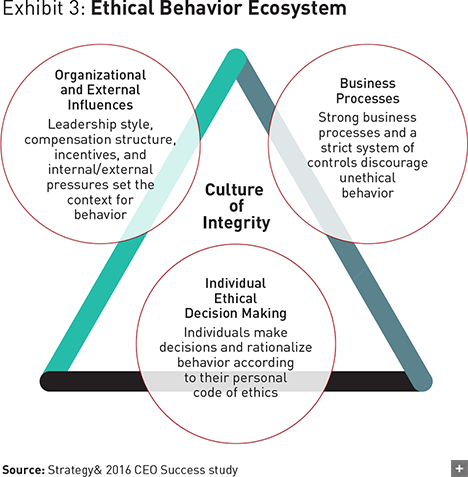
As this year’s CEO Success study shows, boards of directors, institutional investors, governments, and the media are holding chief executives to a far higher level of accountability for corporate fraud and ethical lapses than they did in the past. Over the last several years, CEOs have often garnered headlines for all the wrong reasons: for misleading regulators and investors; for cutting corners; and for failing to detect, correct, or prevent unethical or illegal conduct in their organization. Some high-profile cases, involving some of the world’s largest corporations, have featured oil companies bribing government officials and banks defrauding customers.

To be sure, the number of CEOs who are forced from office for ethical lapses remains quite small: There were only 18 such cases at the world’s 2,500 largest public companies in 2016. But firings for ethical lapses have been rising as a percentage of all CEO successions. (We define dismissals for ethical lapses as the removal of the CEO as the result of a scandal or improper conduct by the CEO or other employees; examples include fraud, bribery, insider trading, environmental disasters, inflated resumes, and sexual indiscretions. See “Methodology,” below.) Globally, dismissals for ethical lapses rose from 3.9 percent of all successions in 2007–11 to 5.3 percent in 2012–16, a 36 percent increase. The increase was more dramatic in North America and Western Europe. In our sample of successions at the largest companies there (those in the top quartile by market capitalization globally), dismissals for ethical lapses rose from 4.6 percent of all successions in 2007–11 to 7.8 percent in 2012–16, a 68 percent increase.

http://www.beckershospitalreview.com/hospital-management-administration/ceo-turnover-for-misbehavior-up-36-worldwide.html


Why do CEOs get fired or leave organizations anyway?

https://interimcfo.wordpress.com/2015/01/09/why-do-ceos-get-fired-or-leave-organizations-anyway/

In my previous post, I made reference to comments written by ‘TiredofTheOverpaidFailures’ in response to a Becker Review article.

Among other things, this writer said, “As a healthcare staffer for 35 years from entry-level employee to Director, I’ve literally never seen any CFO or CEO leave our organizations for any reason other than to “spend more time with my family”.  It’s true, because in every case they collected an inflated golden parachute for the next 2-3 years and indeed manage to take off time to spend with their family or most of the time do part-time consulting at some other organization where they have no idea the horrific failure they were in the previous position. For that matter, what shape they left the organization in.  They usually consider them “the expert” because they are from somewhere else.”

Clearly, he or she  was very bitter about what they had observed in the front office of their organization over a long period of time.

It is true that some of the folks occupying C-suite offices are not that stellar but more often than not, when they leave it is rarely because they are an idiot.  The system does a pretty good job of weeding out idiots before they can reach positions of such power and influence although I have seen a number of suspects among the casts of characters I have dealt with in healthcare administration.  So if the CEO is not an idiot, why let him go?  I will discuss a variety of situations that I have seen that I believe explain in part why CEO turnover in healthcare is so high.

I frequently hear complaints about what a Board is and is not doing with respect to the organization and the CEO.  A healthcare organization is not much different from a professional sports team.  The Board is the owner and the CEO is the coach.  In the end, like a sports team, the Board only has one switch or lever to use to guide the organization; hire the coach or fire the coach.  As long as the Board has not decided to fire the coach (CEO), by default they are supporting or at least tolerating him.  He is still their guy until the notice is delivered which can happen on the same date that an incentive award is given.  If you do not like what you see the CEO doing, it is not necessarily his fault.  Look to the Board for responsibility for the actions and results of their CEO.

Molina Healthcare fires its CEO and CFO

http://www.fiercehealthcare.com/payer/molina-healthcare-fires-its-ceo-and-cfo

Boardroom

Citing “the company’s disappointing financial performance,” Molina Healthcare has cut ties with its CEO, J. Mario Molina, and his brother, CFO John Molina.

The Medicaid managed care company announced Tuesday that Joseph W. White, who was its chief accounting officer, will take over the role of CFO and act as the interim president and CEO while Molina seeks a replacement for that role.

Molina’s board of directors took the step of firing the sons of the company’s founder, C. David Molina, “in order to drive profitability through operational improvements,” Chairman Dale B. Wolf said in the announcement.

“With the industry in dynamic transition, the Board believes that now is the right time to bring in new leadership to capitalize on Molina’s strong franchise and the opportunities we see for sustained growth,” he added.

The leadership change comes in the wake of Molina’s revelation in February that it lost $110 million on its Affordable Care Act exchange business last year. On the company’s fourth-quarter earnings call, J. Mario Molina primarily blamed the ACA’s risk adjustment program, which he said uses a methodology that “penalizes low-cost and low-premium health insurers like Molina.”

That was a sharp turnaround from back in September, when the insurer’s CEO said that it had exceeded its own growth targets for its ACA exchange business.

J. Mario Molina has also been an outspoken critic of Republicans’ bill that aims to repeal and replace the Affordable Care Act—a rarity among his peers. In particular, he was critical of the steep funding cuts for Medicaid proposed by the GOP.

Molina’s now-ex-CEO earned $10 million in total compensation in 2016, a slight decrease from the $10.3 million he made the year prior and only one of two executives at the eight largest publicly traded health insurers to take a pay cut.