

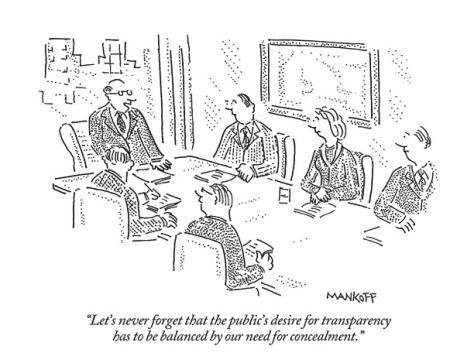
Cartoon – Governance Today

The volume of hospital M&A deals has doubled over the past six years, with fewer and fewer community hospitals still going it alone. For the remaining holdouts, they are at an important juncture: Should they continue fighting for independence or join a larger system?
This heavily-debated question is at the core of many board meetings. While the answer is unique to each institution, in either scenario, the community hospital that proactively controls its own destiny — instead of losing that control to market forces — can come out ahead.
Whether the future holds independence or acquisition, here is what leadership needs to know to position their hospitals for future growth.
What does it take to stay independent?
For efficient facilities with ample cash on hand, there’s an understandable allure to remaining independent. After all, the board of directors at a community hospital is typically made up of individuals from the local area who can continue to focus exclusively on addressing the needs of the local community rather than answer to a distant corporate team.
But a lean and high-volume operation today just isn’t a strong enough indicator to choose independence for the long term. Leadership must consider broader questions that take into account a host of internal and external factors:


The problem was that bank employees were pushed to sell products and services to customers whether they wanted them or not, in violation of the company’s stated values, and often this meant opening up accounts and issuing credit cards without customers knowing about it.
And to add insult to injury, even employees who called the company’s ethics hotline that was set up to report issues just like this one were fired for doing so.
Yes, Wells Fargo’s stated company values are 180 degrees opposite of what employees were actually told to do.
If you look at Wells Fargo’s statement of values, it all sounds pretty good:
Our values should guide every conversation, decision, and interaction. Our values should anchor every product and service we provide and every channel we operate. If we can’t link what we do to one of our values, we should ask ourselves why we’re doing it. It’s that simple.
All team members should know our values so well that if our policy manuals didn’t exist, we would still make decisions based on our common understanding of our culture and what we stand for. Corporate America is littered with the debris of companies that crafted lofty values on paper but, when put to the test, failed to live by them. We believe in values lived, not phrases memorized. If we had to choose, we’d rather have a team member who lives by our values than one who just memorizes them.
We have five primary values that are based on our vision and provide the foundation for everything we do:
- People as a competitive advantage
- Ethics
- What’s right for customers
- Diversity and inclusion
- Leadership
Those values sound good, but in the case of Wells Fargo, they were total BS.

There are two methods for measuring compensation. One appears everywhere. The other is correct.
Through stock buybacks of this magnitude, executives effectively participate in the looting of the corporations they run.
“An increasing number of boards are asking the question: ‘Are we structured in competency, number, and culture to lead a nine- or 10-figure business going forward?’ The time it takes to recalibrate can be fairly significant.”
“You’ve got to get beyond shared governance after a while and move toward unified governance. The right time is when you have a sense the board is struggling to keep up with the agenda and provide oversight.”
Why have 2 Boston hospitals failed to merge — 3 times?
Burlington, Mass.-based Lahey Health and Boston-based Beth Israel Deaconess have attempted to join forces numerous times, but to no avail.
They tried to merge in 2011. They took another stab at it when they teamed up with Newton, Mass.-based Atrius Health in 2012. Merger talks were once again sparked earlier this year, only to fall through in September.
Despite the effort, the health systems can’t seem to pull it together and unite. But their attempts at merging show more than a lack of a solid relationship — they provide a deeper look at the background of healthcare in Massachusetts and the power of market share.

As some of the largest nonprofits in the U.S., hospitals face a major challenge — their board members or executives often have direct ties to organizations with which the hospital does business, The Wall Street Journal reports.
Here are six things to know about nonprofit hospitals and their business associations, according toWSJ.

Interim EXECUTIVE SERVICES is temporary consulting service provided in or to the executive suite of an organization. Executive Services is differentiated from other interim services based on the reporting relationship of the Interim Executive. If the Interim Executive is reporting to the Board of Directors or CEO, they are engaged in Executive Services as opposed to other interims or temps that are working at lower levels in the organization. The differentiating factor about Executive Services is that the work is more strategic and cognitive in focus as opposed to task orientated, supervised activities carried out by most of the interims an organization will typically engage. There is a lot more at risk with an Interim Executive providing Executive Services. Typically, billing rates are higher and the potential of the Interim Executive to have a profound effect on the organization is much higher. An organization engaging Executive Services has the right to expect a lot more from an sophisticated Executive Services Interim than they would from someone picked to just fill a slot temporarily.

 HENRY KOTULA