Stop Hiring for Cultural Fit and Start Hiring For Cultural Fitness

https://www.tlnt.com/stop-hiring-for-cultural-fit-and-start-hiring-for-cultural-fitness/?mkt_tok=eyJpIjoiWmpsbE5HVmpNRFl6WXpabCIsInQiOiI0V1Fvbmcrbk1LMVBWcHpDZ3hCYmc1MVJMTlwvT2g1RUdzMHNBeFY3Vit3b2tiU2dDaDdFWStzYzFnaG9YZ1dzVDgrTUZvR2p1T212MTBKTnFVa0RzNUVyWXdNUXhCUlUrV04wVFBqeGhxWWt0aVBBVzQzbENKUjdkTTlMN00zT2YifQ%3D%3D

Culture is the glue that brings a team or organization together. But if the glue is too sticky it can make them stuck instead of making them stay together. Cultural fit can become a limitation rather than a strength.

Which takes me to the topic of hiring the right talent for your organization:

Do you hire people that are a cultural fit?

Or do you hire to improve your culture fitness?

Culture is something dynamic

The notion that people can or can’t fit into a specific culture is, to at least some extent, at odds with the fluid teams organizational structure. Cultural fit as an operating requirement not only forces new employees to adapt but, also hinders your culture’s ability to be influenced by outsiders. It limits its ability to grow.

When interviewing people, I do care about cultural fit,  but I also look for culture disruption. As I like to tell candidates: “I want you to be influenced by our culture but, most importantly, I want you to challenge and influence our culture too.”

Cultural dynamics involve an ongoing struggle between old and new elements. If you only stick to what fits your existing culture, your organization will get stuck. Yet, if you only care about the new shining object, you might be throwing away core elements of your culture just for the sake of change.

Before practicing any competitive sports, we need to prepare our body. We stretch our muscles and warm up, not just to avoid injuries, but also to make sure we can play to our highest potential.

The same is true when confronting change. Just like with sports, you need to stretch your organizational culture. It needs to prepare, to warm up, to be ready to adapt to an ever-changing world.

Hire for cultural fitness

When evaluating candidates, choose those that will make your team grow. Stretch your culture by hiring people who will make it more adaptive, experimental and resilient.

Here are some considerations when hiring for cultural fitness:

  • Amplify your team’s perspective:Hire people with diverse backgrounds, skills and personalities to avoid biases and so you are drinking something more inspiring and refreshing than your own corporate Kool-Aid.
  • Encourage teams to dissent:Promote differences and tensions, not just affection. Dissent is not comfortable for everyone, but is the only way to avoid group thinking and stretch your team beyond its comfort zone.
  • Continuously challenge your culture: Hire opinionated people, hire outsiders or hire from outside your industry. Bring someone with the right talent, but goes against your culture. Shaking things up from time to time will keep your culture in good shape. As I wrote here, misfits are the best option for energizing a team.
  • Promote diversity of thinking not just demographic diversity: Train your team to embrace difference of opinions. The more heterogeneous the members, the more interesting and productive the team. Being more open to people from different walks of life will provide fresh eyes and make the team smarter. It will help solve for the “demographic” diversity needed too but with a purpose.

Diversity takes training

The real problem behind diversity is that teams are not trained to deal with differences of opinions. Managers and team members alike have been trained to think and behave the same: the corporate way. People are expected to accommodate rather than to challenge the status quo.

One of the key issues of bringing “diverse” people to a team is that they see things differently. They challenge things through their fresh eyes. And not every organization and manager can swallow that.

Here are some points to help embrace diversity to improve cultural fitness.

  • Diverse means different not inferior: Conversations around diversity need to shift from quota to curiosity. Instead of thinking how we can provide a certain demographic with opportunity — a hierarchical approach — we need to ask what we can we learn from people that are different from us. Diversity is about becoming better at interacting with those who can provide fresh eyes and challenge the way we operate.
  • Quotas limit rather than provide opportunities: Establishing percentages to have representation from different sectors might come from a place of good intention. But, in most cases, it misses the point — the need to create a balanced team. I’ve seen many companies that use quotas, simply to check the box and appear to be a good corporate citizen. But they have little commitment to embracing diversity of thinking.
  • People are more than a demographic: Being part of a minority (age, gender, sex preference, etc.) is just one aspect of any person. Our identity is more complex than our religious or sexual preferences. Those do play an important role. But who we are is a composite of multiple factors: our origin, experience and dreams. Organizations need to encourage their teams to see people beyond their demographics.
  • Encourage transparent conversations:Trust is the basis in which all emotional transactions are done. And is one of the most powerful elements to keep culture alive. Conversations around diversity are still too controlled. Organizations need to discuss these things more openly. Help people realize we are all different, not just those who don’t belong to our tribe. Creating experiences where people can share their journey or their personal hobbies and passions can definitely spark curiosity and show how that everyone can learn from each other. Creating a culture of transparency can help reposition diversity as learning.

Why cultural fitness matters to me

Everyone can learn (almost) anything. And anyone can adapt to any corporate culture. It can be hard or tough but smart people always adapt.

What I care the most, is how a new hire can help make our organization smarter. This is my checklist of what I look for:

  • They are smart and talented
  • They possess the ability to adapt to change
  • They are genuine and have a voice of their own
  • They are open to learn
  • They are generous rather than selfish

If they score well in the above, then they will definitely help our culture stretch, regardless if they are – today — the right cultural fit.

One last thing. I always like to ask candidates: “What are you bringing to the table that is unique?” Basically, I want to know not just what that person is good at but how they will help make our organization smarter. I want people who will build and strengthen our cultural fitness.

Culture Is Not the Culprit

https://hbr.org/2016/04/culture-is-not-the-culprit

hen organizations get into big trouble, fixing the culture is usually the prescription. That’s what most everyone said General Motors needed to do after its recall crisis in 2014—and ever since, CEO Mary Barra has been focusing on creating “the right environment” to promote accountability and head off future disasters. Pundits far and wide called for the same remedy when it came to light that the U.S. Department of Veterans Affairs, deemed a corrosive bureaucracy by federal investigators, kept veterans waiting months for critical health care. Cultural reform has likewise been proposed as the solution to excessive use of force by police departments, unethical behavior in banks, and just about any other major organizational problem you can think of. All eyes are on culture as the cause and the cure.

But the corporate leaders we have interviewed—current and former CEOs who have successfully led major transformations—say that culture isn’t something you “fix.” Rather, in their experience, cultural change is what you get after you’ve put new processes or structures in place to tackle tough business challenges like reworking an outdated strategy or business model. The culture evolves as you do that important work.

Though this runs counter to the going wisdom about how to turn things around at GM, the VA, and elsewhere, it makes intuitive sense to look at culture as an outcome—not a cause or a fix. Organizations are complex systems with many ripple effects. Reworking fundamental practices will inevitably lead to some new values and behaviors. Employees may start seeing their contributions to society in a whole new light. This is what happened at Ecolab when CEO Doug Baker pushed decisions down to the front lines to strengthen customer relationships. Or people might become less adversarial toward senior executives—as Northwest employees did after Delta CEO Richard Anderson acquired the airline and got workers on board by meeting their day-to-day needs.

The leaders we spoke with took different approaches for different ends. For example, Alan Mulally worked to break down barriers between units at Ford, whereas Dan Vasella did a fair amount of decentralizing to unleash creative energy at Novartis. But in every case, when the leaders used tools such as decision rights, performance measurement, and reward systems to address their particular business challenges, organizational culture evolved in interesting ways as a result, reinforcing the new direction.

Revisiting their stories provides a richer understanding of corporate transformation and culture’s role in it, so we share highlights from our conversations here. Most of these stories involve some aspect of merger integration, one of the most difficult transitions for companies to manage. And they all show, in a range of settings, that culture isn’t a final destination. It morphs right along with the company’s competitive environment and objectives. It’s really more of a temporary landing place—where the organization should be at that moment, if the right management levers have been pulled.

Leadership Takes Self-Control. Here’s What We Know About It

https://hbr.org/2017/06/leadership-takes-self-control-heres-what-we-know-about-it?utm_campaign=hbr&utm_source=facebook&utm_medium=social

jun17-05-5407890

Philosophers and psychologists have been discussing the importance of self-control for ages. Plato, for example, argued that the human experience is a constant struggle between our desire and rationality, and that self-control is needed to achieve our ideal form. Likewise, Freud suggested that self-control is the essence of a civilized life.

The scientific study of self-control started about 25 years ago in the fields of criminology and psychology. Since then, hundreds of studies have shown the positive effects that come from possessing self-discipline. For instance, people with higher levels of self-control eat healthier, are less likely to engage in substance abuse, perform better at school, and build high-quality friendships. At work, leaders with higher levels of self-control display more effective leadership styles – they are more likely to inspire and intellectually challenge their followers, instead of being abusive or micromanaging. But what happens when people lack self-control at work?

We conducted a comprehensive review of research findings on employee self-control in a forthcoming paper in the Academy of Management Annals. Analyzing more than 120 management papers, we found that there are three main reasons why people occasionally lose self-control: 1) self-control is a finite cognitive resource; 2) different types of self-control tap the same pool of self-control resources; and 3) exerting self-control can negatively affect future self-control if it is not replenished. Think of self-control as analogous to physical strength: Our physical strength is limited, various tasks (e.g., football, basketball, walking, etc.) deplete it, and continued exertion can negatively affect future physical strength if it’s not restored.

For example, our own research has found that service employees in leadership positions who have to force a smile in customer interactions (thereby exercising self-control to suppress their true feelings) are later less able to regulate their interactions with their subordinates – they lie and are more rude to them.

Our review identified a few consequences that are consistently linked to having lower self-control at work:

  1. Increased unethical/deviant behavior: Studies have found that when self-control resources are low, nurses are more likely to be rude to patients, tax accountants are more likely to engage in fraud, and employees in general engage in various forms of unethical behavior, such as lying to their supervisors, stealing office supplies, and so on.
  1. Decreased prosocial behavior: Depleted self-control makes employees less likely to speak up if they see problems at work, less likely to help fellow employees, and less likely to engage in corporate volunteerism.
  1. Reduced job performance: Lower self-control can lead employees to spend less time on difficult tasks, exert less effort at work, be more distracted (e.g., surfing the internet in working time), and generally perform worse than they would had their self-control been normal.
  1. Negative leadership styles: Perhaps what’s most concerning is that leaders with lower self-control often exhibit counter-productive leadership styles. They are more likely to verbally abuse their followers (rather than using positive means to motivate them), more likely to build weak relationships with their followers, and they are less Scholars have estimated that the cost to corporations in the United States for such a negative and abusive behavior is at $23.8 billion annually.

Our review makes clear that helping employees maintain self-control is an important task if organizations want to be more effective and ethical. Fortunately, we identified three key factors that can help leaders foster self-control among employees and mitigate the negative effects of losing self-control.

First, sleep appears to have an amazing restorative effects on self-control. One study found that leaders who slept well at night (defined as having minimal interruptions to sleep) were much more likely to exercise their self-control and refrain from displaying abusive supervision, such as yelling and cursing at low-performing subordinates, compared to their counterparts who did not sleep well. Modern organizations often require employees to work beyond traditional office hours in the name of increased productivity. But this could be counter-productive and lead to negative workplace behaviors due to employees lacking self-control. Instead, organizations should be mindful about how long work hours can impact employees’ behavior and wellbeing. Google, for example, installed sleep pods at the office to allow employees to nap and be reenergized.

Second, “service with a smile” might not always pay. Service-oriented organizations often force employees to smile in front of customers. While this might please customers in the short-term, it can cause other organizational problems. Dropping this practice perhaps is not be a practical option, but companies should consider training employees to tap into the emotions they display. For example, another study showed that physicians who engaged in perspective taking and felt genuine empathy toward their patients did not experience reduced self-control and its associated negative workplace behaviors such as burnout, whereas physicians who were forced to fake empathic behaviors toward patients later reported increased burnout and lower job satisfaction. Service-oriented employees may also benefit from engaging in more perspective-taking rather than faking their emotions.

Third, creating the right environment may help prevent some of the negative behaviors associated with lower self-control. For example, we came across research showing that employees with low self-control were no more likely to engage in deviant behavior when organizations promoted an ethical culture —displaying the company’s code of conduct where employees could see it made them less tempted to behave unethically. This type of intervention tends to be very effective in the short-term.

Ultimately, the keys to avoiding self-control failures are to 1) allow the body to rest and restore self-control, 2) reexamine existing organizational policies that might inadvertently reduce employees’ self-control, and 3) create a culture that deters negative behaviors in moments of reduced self-control.

Leaders can’t write a memo to change culture

http://www.beckershospitalreview.com/hospital-management-administration/scripps-ceo-chris-van-gorder-leaders-can-t-write-a-memo-to-change-culture.html

Related image

When Chris Van Gorder joined San Diego-based Scripps Health as COO in 1999, the health system had 55 days cash on hand, and there was no trust between the administration and clinical staff.

His first day on the job, Mr. Van Gorder attended a meeting at Scripps Memorial Hospital La Jolla (Calif.) with another Scripps executive to resolve a miscommunication surrounding contract renegotiations. Rising tensions between physicians and administrators boiled over at the meeting, which cumulated with the Scripps executive quitting his job on the spot so he could sue the hospital’s chief of staff for slander.

“The physician sitting next to me tapped my shoulder and said, ‘Welcome to Scripps, you’re on,'” says Mr. Van Gorder. “That was the end of my first day.”

Flash forward 18 years and Mr. Van Gorder — promoted to CEO six months after joining Scripps — now runs a $3.1 billion health system that’s been named to Fortune’s top 100 employers in the country 10 years in a row.

Mr. Van Gorder discussed Scripps’ transformation — and the leadership strategies he used to drive these improvements — at the Becker’s Hospital Review 8th Annual Meeting in Chicago.

Earn employees’ trust

Shortly after he took over the CEO role, Mr. Van Gorder met with every board member one-on-one.

“Everyone wanted me to fix everything all at once,” he says. “But I knew I needed to prioritize and first find a way to work with our physicians.”

Mr. Van Gorder says it’s crucial for leaders to ensure proper communication with employees to establish trust and set the groundwork for a culture change. To mend relationships with Scripps’ physicians, he called a meeting with the health system’s elected physician leaders entire to acknowledge the lack of transparency between administrators and staff.

“They had all these demands and expectations they wanted us to meet,” he says. “But they didn’t know we were on the verge of bankruptcy.”

Mr. Van Gorder developed a physician advisory body called the “Physician Leadership Cabinet” to serve as a liaison between the clinical and administrative teams and weigh in on decision-making. Giving physicians more responsibility to manage the health system’s limited resources helped them understand the institution’s financial constraints, thus breaking down the communication wall between them and leadership.

“It’s really easy to say, ‘I want, I want, I want’ when you’re on the outside,” says Mr. Van Gorder. “But when you’re on the inside, you realize how difficult it is to manage scarce resources.”

The Physician Leadership Cabinet has proven successful. Health system leadership has accepted every recommendation from the board in the last 18 years, and every vote except one has been unanimous, according to Mr. Van Gorder.

Drive culture change from the middle up

Once leaders earn staff members’ trust, they should shift their attention to changing the organization’s culture, says Mr. Van Gorder. He believes managers have the most influence on culture, as they manage a majority of the organization’s employees.

“Leaders can’t write a memo to change culture,” he says. “But our frontline employees and middle management can influence culture.”

To develop an umbrella culture for the organization from the middle, Mr. Van Gorder launched the Scripps Leadership Academy — a year-long behind-the-scenes program for managers at the health system. Every program starts with a two-hour Q&A session where Scripps executives talk about how they got to where they are today.

“I was a cop. I worked at Arby’s,” says Mr. Van Gorder. “Most people look at executives and just see the suits. But as soon as you remove the veil of the title away from the individual, they become a human being.”

The leadership academy strives to show managers how the organization operates and how decisions are made. Each graduating class also works on a change project to improve a specific aspect of the organization. After the academy ends, Mr. Van Gorder challenges the managers — his “agents of culture change” — to take what they learned and demand more from the people they work with.

Maintain regular communication

Leaders must maintain a positive relationship with staff members to sustain the improvements in trust and culture, says Mr. Van Gorder.

He sends out a daily newsletter to Scripps managers and employees who request it, highlighting major news in the healthcare industry, along with organization updates and photos.

“Even if they just read the titles, they’ll start to understand the external factors impacting our organization,” Mr. Van Gorder says. “The more they understand this, the more they’ll accept the changes we’re trying to make in our organization. They’ll see it’s not something forced on them from management — it stems from the changes in healthcare.”

As email is the one way he can connect with Scripps’ 15,000 employees, Mr. Van Gorder freely invites employees and physicians to reach out to him directly if they are not getting the support they need to do their jobs, or even if they want to say hello. He responds the same day to every email he receives — a feat he sees as a basic level of respect.

“One of our values is respect,” he says. “If I’m not responsive to them, I’m not being very respectful.”

Are CEOs Less Ethical Than in the Past?

https://www.strategy-business.com/feature/Are-CEOs-Less-Ethical-Than-in-the-Past?gko=50774&utm_source=itw&utm_medium=20170516&utm_campaign=resp

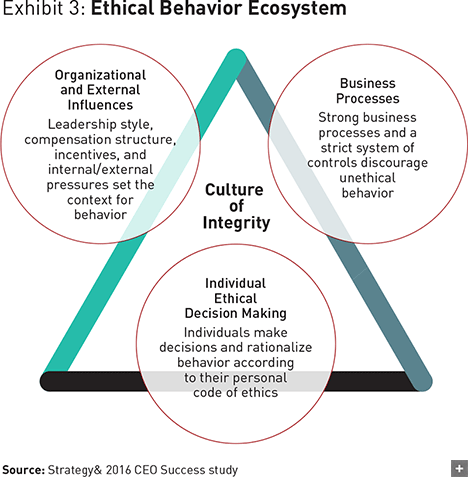
The job of a chief executive officer at a large publicly held company may seem to be quite comfortable — high pay, excellent benefits, elevated social status, and access to private jets. But the comfortable perch is increasingly becoming a hot seat, especially when CEOs and their employees cross red lines.

As this year’s CEO Success study shows, boards of directors, institutional investors, governments, and the media are holding chief executives to a far higher level of accountability for corporate fraud and ethical lapses than they did in the past. Over the last several years, CEOs have often garnered headlines for all the wrong reasons: for misleading regulators and investors; for cutting corners; and for failing to detect, correct, or prevent unethical or illegal conduct in their organization. Some high-profile cases, involving some of the world’s largest corporations, have featured oil companies bribing government officials and banks defrauding customers.

To be sure, the number of CEOs who are forced from office for ethical lapses remains quite small: There were only 18 such cases at the world’s 2,500 largest public companies in 2016. But firings for ethical lapses have been rising as a percentage of all CEO successions. (We define dismissals for ethical lapses as the removal of the CEO as the result of a scandal or improper conduct by the CEO or other employees; examples include fraud, bribery, insider trading, environmental disasters, inflated resumes, and sexual indiscretions. See “Methodology,” below.) Globally, dismissals for ethical lapses rose from 3.9 percent of all successions in 2007–11 to 5.3 percent in 2012–16, a 36 percent increase. The increase was more dramatic in North America and Western Europe. In our sample of successions at the largest companies there (those in the top quartile by market capitalization globally), dismissals for ethical lapses rose from 4.6 percent of all successions in 2007–11 to 7.8 percent in 2012–16, a 68 percent increase.

http://www.beckershospitalreview.com/hospital-management-administration/ceo-turnover-for-misbehavior-up-36-worldwide.html


Let’s Get Real About Culture: What Does Your Organization Truly Value?

https://www.linkedin.com/pulse/what-does-your-organizations-culture-truly-value-ask-leddin-ph-d-?trk=v-feed&lipi=urn%3Ali%3Apage%3Ad_flagship3_feed%3B48kuvwanN9e3kKYMGuvVVQ%3D%3D

Image result for Organizational Value

What does your organization value?

I’m not asking what your strategic plan lists as your top goals. I’m also not referring to what senior leaders say are important initiatives. True, these may all be the same things; however, there is often a gap (sometimes a big one) between what the organization ‘says’ it truly values and what the organization ‘truly’ values.

Let me share a couple of examples…

Imagine that it is 1998 and you are sitting in a conference room holding a meeting with your colleagues. The session has been in full swing for two solid hours and everyone is in need of a much-deserved break. A suggestion is made to adjourn for 15 minutes and all eagerly agree. Some scurry to the restroom and others opt to run back to their workspace to check email.

Why did they go back to their workspace?

Consider your organization:

  • What’s your organization’s currency?
  • What do people in your organization TRULY value?
  • What is being rewarded and reinforced?
  • Think about the things that people count and brag about. Are they important items that drive goals that matter or are they trivial things with little true value?

Explain this story to a few people in your workplace and ask them to tell you what the current organizational currency is in your organization. You might be surprised!

The Devil is in the Culture: It is all about Will!

http://www.mobihealthnews.com/content/value-based-care-patient-engagement-local-attention-and-digital-technology-are-fixes

Image result for cartoon the devil in the culture

As lawmakers on Capitol Hill wrangle over the fate of the Affordable Care Act and its would-be replacement, the American Health Care Act, the National Academy of Medicine said its four main priorities for fixing the country’s healthcare industry include continuing the shift from fee-for-service to value based payment models; empowering people to be fully engaged in their healthcare decisions; tapping communities for local health solutions; and implementing integrated services and seamless digital interfaces.

Writing a blog for the Journal of the American Medical AssociationDonald M. Berwick, MD, acknowledged that these solutions don’t exactly reinvent the wheel.

“The strength of the Vital Directions report is not in its innovativeness; it contains no surprises,” said Berwick. “This report offers a template for change broad and inclusive enough for it to be a charter for coherent and effective system redesign.”

The first step in that redesign, the shift from volume to value, is already underway, and the academy contends that its continuation is vital in terms of reducing waste and improving value.

Berwick agreed that this shift is needed, but wrote that fee-for-service behaviors “and top line-driven revenue growth strategies continue to dominate healthcare economies, and recent political pushback has been strong against expanding effective bundled payment models and value-based pharmaceutical purchasing.”

The report also cites evidence that underinvestment in social services relative to healthcare services may be contributing to the country’s poor health performance. To reduce inequality and increase cost savings, the report recommends integrating clinical care services and non-medical services, such as housing, food, transportation and income assistance.

That solution leads into another of the report’s action plans, activating communities. A person’s health is very much a product of the available social supports within their community, their physical environment and their behavior. The U.S. continues to invest far less in community-based social services, which the report said is vital to combating health threats such as chronic disease and substance abuse. The report recommends investing in local leadership and infrastructure capacity for public health initiatives, and calls for collaboration from leaders in different sectors, such as business, education, housing and transportation. For this approach to be successful, close coordination is needed between medical and social services.

When it comes to empowering and engaging people, the report claims that patients are often insufficiently involved in their own care decisions, sometimes resulting in care that doesn’t take their specific life situations into account. Health regimens and treatments should work within that context, and policymakers should focus on increasing the amount of information that’s available, the authors wrote. Telehealth was identified as an important component of that, as it helps patients in underserved or remote areas and essentially gives them greater ownership of their health information.

Revamping digital interfaces, the fourth action plan, is particularly vital, the authors said, because the extent to which systems can share and make use of data remains severely limited. That causes breaks in care continuity, which not only predisposes the patient to harm but increases stress for the clinician. Creating principals for end-to-end interoperability, strengthening the overall data infrastructure, building public trust around privacy and security, and smoothing over inconsistent state and local policies on data use and sharing are possible solutions.

Berwick wrote that if the country adopted these policy frameworks, healthcare quality and costs would likely improve dramatically within a decade.

“The devil is not in the details here,” wrote Berwick. “Everything the authors recommend can, in principle, be done with remarkably few cycles of trial and learning. The devil is in the culture. It is all about will.”

“Leaders must recruit the courage to make the case and put their own political and organizational futures on the line,” wrote Berwick.


Creating a culture of persistence

Creating a culture of persistence

persistence

We live in a world that makes it increasingly easy to justify failures and abdicate responsibility. Too often the news trumpets the reasons why certain groups don’t get what they want, and they showcase how those in authority are responsible for others’ shortcomings.

While there are certainly injustices in world today, successful individuals don’t let them affect how hard they work or what steps they take to progress. Capable leaders keep doing the right things for their teams and their customers. They persist through difficulties, and in the process, they create a culture of persistence.

The importance of a culture of persistence cannot be overstated. You need people in your organization who will push through hard times. You need a team that will come together and do great things, regardless of what obstacles they face. You need to recruit team members that will roll up their sleeves and do what’s necessary to get the job done.

A culture of persistence needs fuel from many sources, but it starts with leadership. You can become the catalyst for this transformation by taking the following actions: