Florida health administrator charged in $1B fraud case

http://www.fiercehealthcare.com/finance/florida-health-administrator-charged-1b-fraud-case?utm_medium=nl&utm_source=internal&mrkid=959610&mkt_tok=eyJpIjoiTkdWbE16bGlOMlJrWWpKaSIsInQiOiJWYVwvZWxBWjZGWEREN3BuSHBkNGZHN3ZqUVJNcWVzTVEwRDk5TWV6OVBkQ1RoZGhuVmlRbXFWMmpVMFgyb1NhbDNDeEhtYUVaaEdJVXBZXC9MWEpqUlZcLzR6WU9kQkowUk5OS1hcL1BcL21oSnphRXMrOFwvOHRhekVyQ2dlbktSc2pLdiJ9

Dollars

Bribes paid to a state health administrator are central to one of the biggest healthcare fraud cases to date, according to federal authorities.

The Department of Justice has charged Bertha Blanco, a former employee at Florida’s Agency for Health Care Administration (AHCA) with bribery in connection with a $1 billion Miami fraud case. Federal investigators said Blanco received bribes from Philip Esformes, the CEO of a Miami chain of skilled nursing facilities and assisted-living facilities, and his associates.

Blanco received cash bribes from Medicare and Medicaid providers in exchange for confidential AHCA reports, including patient complaints and unannounced AHCA inspection schedules that were then used to make false Medicare and Medicaid claims, according to DOJ. Blanco did not receive payouts directly from Esformes but through a series of intermediaries, the Miami Herald reports.

Esformes, who made FierceHealthcare’s list of notorious healthcare executives last year, has been charged with fraud and bribery in the case. He has been behind bars in federal prison since July 2016 awaiting a trial set for March 2018.

Assistant Attorney General Leslie R. Caldwell called the scheme “ruthlessly efficient,” with conspirators using a network of corrupt providers to shuffle patients between various healthcare facilities while exchanging kickbacks disguised in various sham agreements, as FierceHealthcare has previously reported.

Blanco’s defense attorney Robyn Blake told the Herald that she is reviewing the DOJ’s evidence before deciding to pursue a full trial or take a plea deal. Blanco was arrested earlier this month and was released on $250,000 bond; she will be arraigned on Sept. 1.

Esformes’ attorneys maintain his innocence, according to the Herald. Two of the Esformes’ alleged co-conspirators have pleaded guilty to Medicare fraud charges, and Michael Pasano, Esformes’ lead attorney, said the pair worked independently without Esformes’  involvement.

Another fraud case: Vanderbilt Hospital settles overbilling suit

In other fraud news, Vanderbilt University Medical Center has paid out $6.5 million to settle a federal lawsuit that alleged the hospital overbilled Medicare and Medicaid, the Associated Press reports.

The suit was brought in 2013 by whistleblowers who claimed the hospital overbilled federal healthcare programs for more than a decade. Vanderbilt’s counsel, Michael Regier, said that the settlement aimed to avoid further costs and distractions related to the suit, according to the article, and that the hospital still disputes the claims in the lawsuit.

The hospital and the feds found no evidence of wrongdoing on Vanderbilt’s part, Regier said.

HHS announces ‘largest fraud takedown in history’

http://www.healthcarefinancenews.com/news/hhs-announces-largest-fraud-takedown-history-charging-400-defendants-schemes-involving-13?mkt_tok=eyJpIjoiTTJVNFlXUTBOR0pqTmpJMSIsInQiOiJ3S01TRnZaWE5GT2NZMG13bGNnMENVdEc0OTRaNHVac1RJemUzNlhBRjY1ckY3dDQ5TCtlM1RqcTN5NHN0NktPU3Vud3dvUTJMM2ZHdG12R0RGaXZ1SzRGVjdYbE9KVFwvcTVwVENVWVdMbFwvYzh4RGlkNlRcLzY0SFZhMmpDZlBwUiJ9

The Department of Health and Human Services Office of Inspector General, state and federal law enforcement executed a massive fraud takedown this month that charged more than 400 defendants in connection with healthcare fraud schemes that involved roughly $1.3 billion in fraudulent billings to government payers including Medicare and Medicaid, the OIG announced.

The takedown is being called the largest in history, both for the number of defendants charged and the amount of money lost, OIG said.

Additionally, OIG issued exclusion notices to 295 doctors, nurses, and other providers related to opioid diversion and abuse. The notices ban participation in or claim submissions to, all Federal healthcare programs.Those who got the notices include 57 doctors, 162 nurses, and 36 pharmacists.

“Takedowns protect Medicare and Medicaid and deter fraud — sending a strong signal that theft from these taxpayer-funded programs will not be tolerated. The money taxpayers spend fighting fraud is an excellent investment: For every $1.00 spent on health care-related fraud and abuse investigations in the last three years, more than $5.00 has been recovered,” OIG said in a statement.

The schemes spanned the entire nation, from Washington to Puerto Rico, and 115 of those charged are medical professionals, specifically doctors and nurses. Among the fraud schemes, a Texas provider was charged with overprescribing narcotics to patients who had no medical need for them, and some of whom died from drug overdoses. The doctor allegedly fraudulently billed Medicare, netting more than $1.2 million in reimbursement. Another scheme involved seven Michigan defendants, including five physicians, who allegedly perpetrated illegal kickbacks and billing for medically unnecessary joint injections, drug screenings, and home health services. One of the defendants owned multiple health-related businesses and allegedly billed Medicare $126 million as part of the fraud scheme.

Another notable fraud case recently announced by the Department of Justice involved a landmark settlement with historically unique requirements. Pharmaceutical manufacturer Mallinckrodt, one of the largest manufacturers of generic oxycodone, agreed to pay $35 million to settle allegations that it violated the Controlled Substances Act when it failed to report “suspicious orders” for controlled substances, as well as record-keeping infractions. The DOJ said that from 2008 until 2011, Mallinckrodt supplied distributors an “increasingly excessive quantity” of oxycodone pills but didn’t notify the DEA of these suspicious orders. The distributors then supplied various U.S. pharmacies and pain clinics.

The DOJ called the settlement groundbreaking for a couple reasons. First, it involves requiring a manufacturer to utilize chargeback and similar data to monitor and report suspicious sales of its oxycodone at the next level in the supply chain. This typically means sales from distributors to independent and small chain pharmacy and pain clinic customers. Also, it requires a parallel agreement with the DEA through which the company will analyze data it collects on orders from customers down the supply chain to identify suspicious sales.

It is clear government agencies and law enforcement are increasingly zeroing in on healthcare fraud, with other notable settlements in recent months with well-known providers related to False Claims Act violations. Those systems include Carolinas Healthcare, Freedom Health, Los Angeles hospital Pacific Alliance Medical Center, Genesis Healthcare, and even Walmart.

Broward Health fires another auditor

http://www.beckershospitalreview.com/finance/broward-health-fires-another-auditor.html

Image result for financial statement disclosures

Fort Lauderdale, Fla.-based Broward Health will terminate a contract with its outside CPA at the end of this month after a 29-year working relationship. The fired audit director sees the break-up as the health system’s attempt to curb independent examination of the public system, according to the Sun Sentinel.

Joel Mutnick, audit director for Plantation, Fla.-based Fiske & Co., abstained from a vote to approve a draft of the firm’s audit since the documentation did not disclose several key events, including the suicide of late CEO Nabil El Sanadi, MD, in January 2016, the governor’s suspension of two board members and the lawsuit filed against the board by Pauline Grant, interim CEO who was fired in December 2016.

The audit covered the year ending June 30, 2016. Mr. Mutnick served on the committee of Broward board members and executives that supervised a third-party annual audit of the five-hospital system.

“They didn’t like not having control of me,” Mr. Mutnick told the Sun Sentinel. “Clearly they didn’t like the idea of me turning down the financial statements because of their inadequate disclosure. I don’t think they liked an outside auditor telling them or questioning the financial statement results.”

The chairman of Broward Health’s audit committee, Chris Ure, refused accounts that Mr. Mutnick’s departure involved his voting record or his independence. Mr. Ure said the committee is operating under new bylaws that impose term limits on members to strengthen independence and fresh perspectives, according to the Sun Sentinel. Under those new bylaws, Mr. Ure said outside members will no longer be paid.

Last September, Broward Health cut ties with KPMG after the accounting firm refused a contract addendum that would have extensively restricted its inquiry powers into Broward’s activities. Broward officials said they added the addendum over concerns KPMG would be unable to certify the system’s financial statements by the end of the year, due to the length of KPMG’s possible investigation into corruption allegations against the system.

DOJ sues UnitedHealth over $1B+ in Medicare claims

http://www.beckershospitalreview.com/payer-issues/doj-sues-unitedhealth-over-1-billion-in-medicare-false-claims-again.html

Image result for dept of justice

The Justice Department sued Minnetonka, Minn.-based UnitedHealth Group Tuesday, alleging the payer defrauded Medicare at least $1 billion in false claims.

In the 103-page lawsuit filed in a Los Angeles federal court, the Justice Department alleged the payer knowingly inflated risk adjustment payments by providing the government inaccurate data about the health status of its beneficiaries. Department officials cited UnitedHealth’s “one-sided” chart review process that reportedly didn’t address errors elevating its revenues.

The department also alleges the payer ignored “invalid diagnoses from healthcare providers with financial incentives to furnish such diagnoses.

The move follows the department’s decision to intervene in a whistle-blower suit filed by James Swoben in 2009. That suit alleges UnitedHealth billed Medicare higher payments for patients by “making patients look sicker than they” were. In an earlier statement to Star Tribune, UnitedHealth spokesperson Matt Burns said the payer denied the claims and has “been transparent with [CMS] about our approach under its unclear policies. We reject these claims and will contest them vigorously.”

This is the second lawsuit the department has filed against the insurer this month. The other lawsuit concerns separate but similar allegations filed under seal in 2011 by Benjamin Poehling, former finance director of UnitedHealthcare Medicare and Retirement.

Are CEOs Less Ethical Than in the Past?

https://www.strategy-business.com/feature/Are-CEOs-Less-Ethical-Than-in-the-Past?gko=50774&utm_source=itw&utm_medium=20170516&utm_campaign=resp

The job of a chief executive officer at a large publicly held company may seem to be quite comfortable — high pay, excellent benefits, elevated social status, and access to private jets. But the comfortable perch is increasingly becoming a hot seat, especially when CEOs and their employees cross red lines.

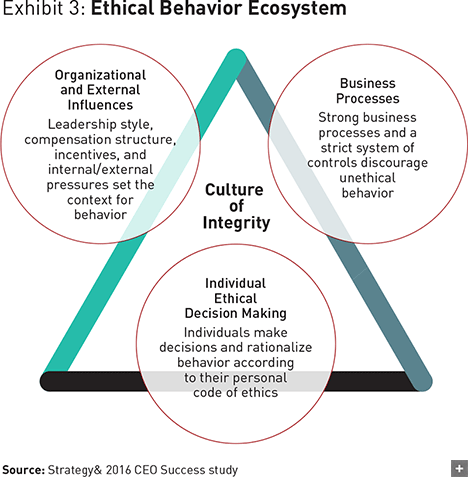
As this year’s CEO Success study shows, boards of directors, institutional investors, governments, and the media are holding chief executives to a far higher level of accountability for corporate fraud and ethical lapses than they did in the past. Over the last several years, CEOs have often garnered headlines for all the wrong reasons: for misleading regulators and investors; for cutting corners; and for failing to detect, correct, or prevent unethical or illegal conduct in their organization. Some high-profile cases, involving some of the world’s largest corporations, have featured oil companies bribing government officials and banks defrauding customers.

To be sure, the number of CEOs who are forced from office for ethical lapses remains quite small: There were only 18 such cases at the world’s 2,500 largest public companies in 2016. But firings for ethical lapses have been rising as a percentage of all CEO successions. (We define dismissals for ethical lapses as the removal of the CEO as the result of a scandal or improper conduct by the CEO or other employees; examples include fraud, bribery, insider trading, environmental disasters, inflated resumes, and sexual indiscretions. See “Methodology,” below.) Globally, dismissals for ethical lapses rose from 3.9 percent of all successions in 2007–11 to 5.3 percent in 2012–16, a 36 percent increase. The increase was more dramatic in North America and Western Europe. In our sample of successions at the largest companies there (those in the top quartile by market capitalization globally), dismissals for ethical lapses rose from 4.6 percent of all successions in 2007–11 to 7.8 percent in 2012–16, a 68 percent increase.

http://www.beckershospitalreview.com/hospital-management-administration/ceo-turnover-for-misbehavior-up-36-worldwide.html


Medicare Advantage aggressive coding or fraud

https://www.balloon-juice.com/category/mayhew-on-insurance/

Image result for medical coding

The New York Times has a good story from the 15th on a False Claims Act lawsuit filed by a former United Healthcare employee.  It alleges UHC systemically defrauded the US government of billions from up-coding its Medicare Advantage claims to get bigger risk adjustment payments.  This is a big deal.  Medicare knows that the incentive in Medicare Advantage is to make the patients look as sick as possible to maximize upcoding. A recent estimate has coding differentials leading to a $20 billion dollar a year payment differential between Medicare Advantage and Fee for Service Medicare for intrinsically similar patients.

At the heart of the dispute: The government pays insurers extra to enroll people with more serious medical problems, to discourage them from cherry-picking healthy people for their Medicare Advantage plans. The higher payments are determined by a complicated risk scoring system, which has nothing to do with the treatments people get from their doctors; rather, it is all about diagnoses.

Diabetes, for example, can raise risk scores by varying amounts, depending on a patient’s complications. So UnitedHealth gave people with diabetes intensive scrutiny, to see if they had any other conditions that the diabetes might have caused.

As Mr. Poehling’s lawyer, Mary Inman, described it, the government would pay UnitedHealth $9,580 a year for enrolling a 76-year-old woman with diabetes and kidney failure, for instance, but if the company claimed that her diabetes had actually caused her kidney failure, the payment rose to $12,902 — an additional $3,322. Ms. Inman is with the law firm of Constantine Cannon in San Francisco.

We need to differentiate between aggressive coding and fraud.  The key question in this example is not whether or not UHC got a doctor to say that the kidney failure was caused by diabetes but whether or not the evidence in the chart supports that assertion.

If it is medically supported from the chart, history and corroborating results, this is not fraud.  It is aggressive coding designed to maximize revenue.  If it is not supportable, then it is either fraud or abuse.  That will be the key area of argument.  Does the evidence show that the diagnosis codes that UHC is chasing are supportable by medical evidence?

Betsy Nicoletti is a coding specialist who shared her coding book with me.  I want to highlight a legitimate example of what happens at every health plan that has risk adjusted plans.  The example is about diabetes:

Collection company president accused of stealing $1.6M from NYC hospital

http://www.beckershospitalreview.com/legal-regulatory-issues/collection-company-president-accused-of-stealing-1-6m-from-nyc-hospital.html

The president of Rockville Centre, N.Y.-based collection firm MBI Associates was arrested March 29 and charged with first-degree grand larceny for allegedly stealing $1.6 million from St. Barnabas Hospital in New York City, according to Rockville Centre Patch.

According to prosecutors, from Nov. 25, 2012, to Feb. 18, 2015, MBI Associates failed to give St. Barnabas Hospital $1.6 million the company had collected for services provided to the hospital’s patients. Norman Alpren, the 71-year-old president of MBI Associates, allegedly used the $1.6 million to cover operating expenses for his company, according to the report.

Mr. Alpren’s lawyer Robert Abiuso told Rock Centre Patch he expects his client to be “vindicated at trial.” If convicted, Mr. Alpren faces up to 25 years in prison.

Mylan Sued by Consumers claiming PBM Rebates Are Just Kickbacks

http://www.realclearhealth.com/articles/2017/04/03/mylan_sued_by_consumers_claiming_pbm_rebates_are_just_kickbacks_110528.html?utm_source=RealClearHealth+Morning+Scan&utm_campaign=2ee066e433-EMAIL_CAMPAIGN_2017_04_04&utm_medium=email&utm_term=0_b4baf6b587-2ee066e433-84752421

Image result for Mylan Sued by Consumers claiming PBM Rebates Are Just Kickbacks

Three consumers filed a lawsuit accusing Mylan Pharmaceuticals of paying kickbacks to pharmacy benefits managers in order to boost EpiPen sales, which caused them to unfairly overpay for the allergy-reaction device that has been at the center of the national debate over the high cost of medicines.

Their allegations take aim at the convoluted interplay between drug makers and pharmacy benefit managers, which are middlemen that negotiate favorable insurance coverage for medicines on behalf of insurers. The PBMs attempt to extract the best prices from drug makers and, for their trouble receive rebates, some of which are held back as fees.

The lawsuit, which charges Mylan engaged in racketeering, seeks class action status and claims that Mylan “gamed the system” and pretended to blame PBMs for demanding ever-higher rebates for its decisions to regularly raise the price for EpiPen.

The consumers maintain that Mylan paid continually higher rebates in order to book larger sales and ensure favorable insurance coverage, especially as competition to EpiPen arrived. The lawsuit, however, argued that the rising rebates “saddled” consumers who either did not have insurance or have high-deductible plans with “crushing out-of-pocket expenses.”

One of the women who brought the suit, Lisa Vogel of Takoma Park, Md., purchased EpiPen Jr. two-packs several time for her son, who is allergic to peanuts and amoxicillin, according to the lawsuit. Her family has a high-deductible plan from Aetna and, on June 13, 2014, her out-of-pocket cost was $351.73. A year later, on June 22, 2015, her share of the cost $453.49, the lawsuit stated.

The lawsuit also pointed to recent research in the Journal of the American Medical Association that found between January 2007 and December 2014, out-of-pocket spending for each EpiPen patient rose nearly 124 percent, to $75.50 from $33.80. “Mylan’s list price has become an artificial and phony price established and driven up as part of a kickback scheme from Mylan to the PBMs,” the lawsuit argued.

“Mylan is no victim,” the lawsuit continued. “Instead, Mylan participated in and benefited from the high list price scheme and from paying high rebates or kickbacks to PBMs to ensure EpiPen’s market dominance. In fact, from at least 2008 until 2011, when Mylan stopped reporting this information, EpiPen had a 95 percent market share” for auto-injector allergy devices.

There are no PBMs named as defendants. A Mylan spokeswoman declined to comment.


House Proposal to Promote Association Health Plans Poses Risks for Insurance Markets, Consumers

http://www.commonwealthfund.org/publications/blog/2017/mar/house-proposal-to-promote-association-health-plans-poses-risks-for-insurance-markets-consumers?omnicid=EALERT1182419&mid=henrykotula@yahoo.com

While the nation is focusing on the American Health Care Act, the most recent proposal to repeal and replace the Affordable Care Act (ACA), another Republican proposal is quickly advancing through Congress. The Small Business Health Fairness Act, H.R. 1101, allows small employers to band together and buy health insurance though federally certified associations. Despite its name, the bill would have a considerable and likely detrimental impact on the private health insurance market and undermine the ability of states to protect small employers and their employees.

The concept of federally certified Association Health Plans (AHPs) is not new. AHP proposals similar to H.R. 1101 are prominently featured in many of the legislative proposals to replace the ACA. Similar versions of this legislation were defeated in the early 2000s with opposition from a broad spectrum of stakeholders. One important critic, the National Association of Insurance Commissioners (NAIC), strongly opposes federal AHP legislation, including H.R. 1101, because the approach would “strip states of the ability to protect consumers and create competitive markets.”

H.R. 1101 would encourage professional and trade associations to offer health insurance coverage to their members nationwide. Proponents suggest that AHPs will offer lower premiums to members, primarily through increased bargaining power and fewer regulatory requirements. Under the bill, AHPs would be certified by the federal government and regulated under minimal federal standards for premiums, benefits, and financial solvency.1  In general, these federal standards would be less stringent than those required of insurers under state insurance law.

While some members of AHPs may benefit, this proposal would undermine states’ ability to regulate health coverage sold to their residents and to implement local standards and protections. Ultimately, federally certified AHPs under H.R. 1101 have the potential to negatively impact consumers and health insurance markets in the following ways: