Despite jitters, some health insurers start to prosper

http://www.tampabay.com/news/business/1-inch-1-inch-of-body-type-1-inch-1-inch-of/2335280

Image result for health insurance company profits


It has not been a market for the faint of heart.

Supporters of the Affordable Care Act achieved a major victory this past week when, thanks to cajoling and arm-twisting by state regulators, the last “bare” county in the United States — in rural Ohio — found an insurer willing to sell health coverage through the law’s marketplace there. So despite earlier indications that insurance companies would stop offering coverage under the law in large parts of the country, insurers have now agreed to sell policies everywhere.

But a moment of truth still looms for the industry in the coming weeks under the law known as Obamacare. Companies must set their final plans and premiums by late September, even as the Trump administration continues to threaten to cut off billions of dollars in government subsidies promised by the legislation. Insurers are also awaiting Senate hearings set to start Sept. 6 for a hint of what steps, if any, lawmakers may take to stabilize the market.

With congressional Republicans’ yearslong quest to dismantle the Affordable Care Act dead for now, the fate of the landmark law depends in large part on the health of the insurance marketplaces and the ability of insurers to make a viable business out of selling coverage to individuals. When the law passed seven years ago, insurers saw a potential bonanza: tens of millions of brand-new paying customers, many backed by generous government subsidies and required by the new law to have health coverage. Now, about four years after the law’s marketplaces opened for business, most of the industry’s biggest players have pulled out.

Yet the continuing churn among insurers and the anxiety pervading the industry have obscured an encouraging fact: Many of the remaining companies have sharply narrowed their losses, analysts say, and some are even beginning to prosper.

“Outside of the noise,” the surviving companies “are seeing a path forward in this marketplace,” said Deep Banerjee, an analyst with Standard & Poor’s who has examined the financial results of more than two dozen Blue Cross insurers.

“It is still a new market,” he added, “and everyone is adjusting to it.”

The healthier business outlook has been achieved at a big cost to consumers. To stanch their losses, many companies raised their prices substantially for this year while narrowing their networks of providers to hold down costs.

In some cases, companies will seek even higher rates for 2018; the lone insurer left in Iowa is asking for a nearly 60 percent increase, on average.

Among the insurers now making money in the individual market and expanding is Centene, a for-profit company. Some of the Blue Cross insurers, including Health Care Service Corp., which operates plans in multiple states, including Texas and Illinois, and Independence Blue Cross, which has 300,000 customers in Pennsylvania and New Jersey, began to turn a profit in the market this year.

Oscar Health, a venture capital-backed insurance startup, lost roughly $200 million last year but, sensing a more promising future, plans to enter three more states and expand in California and Texas.

Centene made use of its experience, including setting up networks of hospitals and doctors that care for Medicaid patients, to sell coverage. The company now insures about 1.1 million people in the individual market.

“For 2018, we intend to grow this profitable segment of our business,” Michael Neidorff, the company’s chief executive, told investors last month.

HHS cuts ACA advertising budget by 90%

https://www.axios.com/hhs-cuts-aca-advertising-budget-by-90-percent-2480029656.html?stream=health-care&utm_source=alert&utm_medium=email&utm_term=alerts_healthcare

Image result for HHS cuts ACA advertising budget by 90%


The Department of Health and Human Services announced today it’s slashing the advertising and promotional budget for the Affordable Care Act for next year. It’s planning to spend $10 million to promote the law in the open enrollment period that starts in November — compared to the $100 million the Obama administration spent last year.

Why they’re doing it: On a conference call with reporters, HHS officials argued that last year’s promotional spending — which was doubled from the year before — was ineffective because signups for new customers actually went down. They also said the $10 million budget is more in line with what Medicare Advantage and Medicare Part D spend to promote their open enrollments.

Why it matters: The Trump administration is making cost-effectiveness a major theme this year, but it’s sure to be accused of undermining ACA enrollment, given all of the Trump administration’s battles to repeal the law — and given that it also cancelled advertising for the final days of last year’s open enrollment.

One more thing: HHS is also planning to cut spending on “navigators,” who are supposed to help people enroll, by tying their funding to their effectiveness in reaching their enrollment goals last year.

After repeal scare, Obamacare has never been more popular

https://www.cbsnews.com/news/obamacare-repeal-has-never-been-more-popular/

obamacare-sentiment.png

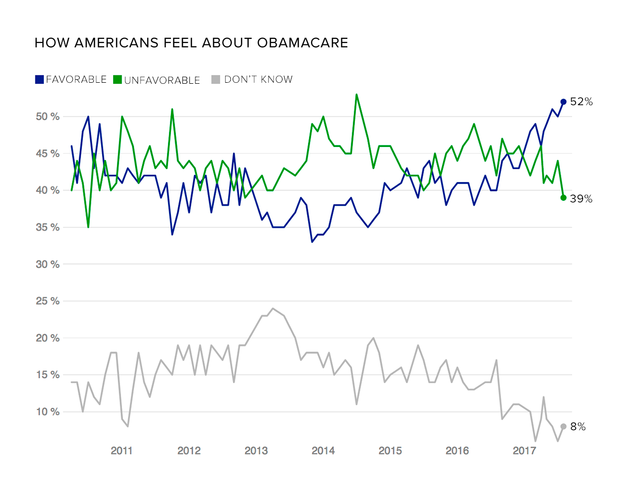
Underscoring the adage that you don’t know what you’ve got until it’s (almost) gone, the popularity of Obamacare is surging.

Only weeks after Republicans in Congress failed to repeal the landmark health reform law, 52 percent of respondents hold a favorable view of the Affordable Care Act (ACA), according to a recent Kaiser Family Foundation August poll. That’s up 10 percentage points since June of last year and nearly 20 points since November 2013, when public support for the ACA was at its nadir.

A July poll by CBS News after the repeal effort collapsed found that a plurality of Americans favor a bipartisan push in Congress to improve Obamacare.

The shift in sentiment coincides with other positive developments for Obamacare following its close call in Washington. With several large, and some smaller, insurers pulling out of the program over the past year or so, until recently it looked as if more than 92,000 participants spread out over 82 counties would have no insurer in their local health care exchanges, Cynthia Cox, associate director of Kaiser Family Foundation, said. But state insurance commissioners and other officials in states in jeopardy of losing Obamacare coverage have worked closely with insurers to negotiate continued coverage.

In Ohio, for instance, there were 20 counties without insurers, but officials ultimately convinced five health plans to cover all but one. Then, on August 24, the Ohio Department of Insurance announced that Paulding County, the last “bare county” in the country, would be covered by insurer CareSource.

In addition, the exchange marketplace overall has shown signs of stabilizing. After big financial losses in 2014 and 2015, individual market insurers saw improved performance in 2016, a trend that has continued this year, according to a different Kaiser Family Foundation study.

If Obamacare’s popularity is up, the program’s shortcomings remain clear. At last count, more than 2.6 million enrollees across 1,300 counties were expected to have only one insurer in their exchanges. More insurers also could pull out or move to sharply increase their premiums. The deadline for insurance companies to commit to participate in an exchange is September 27.

Until then, many insurers are watching closely to see if the Trump Administration will continue funding the federal cost-sharing subsidies that help low-income members pay for deductibles, co-pays and other out-of-pocket costs. Industry players are also waiting or Senate hearings to start after Labor Day in which which insurance commissioners, lawmakers and state governors are expected to testify about what can be done to stabilize the individual marketplace.

Meanwhile, some states are beginning to take matters into their own hands, moving to rewrite the ACA rules by applying for what’s known as a “Section 1332” waiver. Oklahoma is asking for a waiver to establish its own reinsurance program using some federal funds, which would cover the highest-cost individual marketplace cases. Alaska recently received approval for a similar reinsurance waiver. Oklahoma, however, is also looking ahead to more major structural changes that may spur debate.

Iowa, which is undergoing huge premium increases in its individual marketplace, has submitted a waiver that would overhaul the state’s insurance marketplace by redistributing federal tax credit money. The plan would create a single standard health plan and offer a flat tax credit based on age and income.

Critics argue this would increase health care costs significantly for Iowa’s low-income population, putting coverage out of reach for many. Proponents argue that increasing Iowa’s pool of healthy insured people is the best way to stabilize Iowa’s individual market and lower premiums for everyone.

When athletes share their battles with mental illness

https://www.usatoday.com/story/sports/2017/08/30/michael-phelps-brandon-marshall-mental-health-battles-royce-white-jerry-west/596857001/

Image result for When athletes share their battles with mental illness

How to keep ACA stabilization narrow

https://www.axios.com/aca-markets-narrow-problem-2479649219.html

When Congress returns next week, the health debate will shift from trying to pass sweeping legislation to stabilizing the non-group insurance market. This will be a different debate about a thorny but smaller problem. The weaknesses that need to be fixed are fairly specific, and they don’t affect the majority of Americans.

Data: Kaiser Family Foundation; Chart: Andrew Witherspoon / Axios

The bottom line: If Congress can keep the focus on market stabilization and doesn’t get mired in another divisive debate about health reform, and the news media can keep this relatively manageable problem in perspective for the public, there is at least a decent chance for bipartisan cooperation and a successful outcome.

The problem: Premiums in the Affordable Care Act marketplaces have been rising sharply, with the average increase for the benchmark “silver plan” up 21% this year. Proposed rates for next year will range from a 49% increase in Wilmington, Delaware to a 5% decrease in Providence, Rhode Island.

But the non-group market is actually fairly small, covering about 18 million people, with about 10 million of them in the ACA marketplaces which have received so much attention.

The perception: Kaiser Family Foundation poll this month found that when people read headlines or hear about “premiums soaring” in the ACA marketplaces, most Americans — 76% — they think they are hearing about their own premiums, even though the vast majority of Americans are not in the individual insurance market and are not affected. (A smaller but sizeable percentage believe they are affected when they hear about counties with no or limited insurance options in the ACA marketplaces.)

There are several reasons for this, and the media bears some of the responsibility. Health journalists have generally done an outstanding job covering the issue, but sloppy cable headlines, commentary from pundits, and spin from politicians have too often implied that everyone in America is affected when they are not.

For context: In fact, the rest of the health system where most Americans get their coverage looks very different from the non-group market. As the chart shows:

  • Average premiums in the employer insurance market, where 151 million Americans get their health coverage, rose by an average of just 3% last year. And we’re expecting continued moderation this year.
  • Likewise, per capita spending for Medicaid is projected to grow a modest 3% in 2017, with per capita Medicare spending growing by just 2 percent.

The back story: Insurers and regulators have been struggling with a unique set of issues in the non-group market, most especially a sicker than expected risk pool and the uncertainty surrounding Trump administration policies. The most important areas of uncertainty have been whether the administration will continue to pay out the $7 billion in cost sharing subsidies and enforce the individual mandate.

But even before the ACA, the non-group market was also the weak link of the insurance system, with sick people priced out or excluded from coverage altogether.

What to watch: Some think a deal on stabilizing the non-group market could be as narrow as an agreement to appropriate the $7 billion in federal cost sharing subsidies in exchange for greater flexibility for states under the ACA. That might not be a slam dunk if that flexibility trips over third rail issues, such as endangering coverage for people with pre-existing conditions.

But whether the formula for a bipartisan deal is that one or another one, policymakers will have a better chance of addressing the problems in the marketplaces if they forge a narrow agreement. And the debate stands a better chance of not spinning out of control if the news media works overtime to help the public understand who is affected and who is not.


Terminating Cost-Sharing Reduction Payments

http://www.healthaffairs.org/podcasts/terminating-cost-sharing-reduction-payments

Image result for the blame game

In a WTOP-FM interview, Alan Weil assesses the CBO’s report on the impact on premiums and the deficit if CSR payments were eliminated.


What Exactly Is a ‘High-Performing’ Health System?

http://www.healthleadersmedia.com/quality/what-exactly-%E2%80%98high-performing%E2%80%99-health-system?spMailingID=11802162&spUserID=MTY3ODg4NTg1MzQ4S0&spJobID=1222637521&spReportId=MTIyMjYzNzUyMQS2#

Image result for High-Performing

A review by The Joint Commission finds broad and inconsistent uses for the term and definitions that are all over the map, hindering effective measures for the concept.

Despite all the time, money, and energy spent on improving healthcare quality and value, there is no “overarching concept” or consistent definition of what constitutes a “high-performing health system,” a review by The Joint Commission has found.

“The absence of a consistent definition of what constitutes high performance and how to measure it hinders our ability to compare and reward health care delivery systems on performance, underscoring the need to develop a consistent definition of high performance,” the review found.

In their search for a consistent definition of the term, The Joint Commission researchers sifted through English-language articles defining high performance with respect to a healthcare system or organization in PubMed and WorldCat databases from 2005 to 2015 and the New York Academy of Medicine Grey Literature Report from 1999 to 2016. The entity/condition to which the definition was applied was extracted from included articles.

The number and type of dimensions used to define high performance within and across articles was tabulated and the number and type of metrics used by performance dimension and by article was calculated.

Instead of a consistent definition, the researchers found that high performance was variably defined across different dimensions, including quality (93% of articles), cost (67%), access (35%), equity (26%), patient experience (21%), and patient safety (18%).

Most articles used more than one dimension to define high performance (75%), but only five used five or more dimensions. The most commonly paired dimensions were quality and cost (63%).

The Joint Commission researchers said in their review that measuring performance in the nation’s healthcare delivery system “has gained significant traction” over the years with policy makers, even though they apparently do not have a consistent definition of the term.

To support delivery system improvement nationally, the Agency for Healthcare Research and Quality recently funded three Centers of Excellence to study high-performing systems, particularly their ability to quickly move new evidence-based care practices into practice, The Joint Commission review noted.

“Research to understand what enables healthcare delivery systems to perform highly, and policy efforts to measure and recognize high-performing health care delivery systems, is predicated on an agreed-on definition of what it means to be high-performing,” the researchers said.

“Achieving consensus on what it means to be high-performing is essential to facilitate comparisons across delivery systems and in applied measurement activities, such as programs that designate and publicly recognize high performers.”

Network adequacy standards

Network adequacy standards

Image result for Network adequacy standards

Like everything in health care, network adequacy is complicated, with numerous measures and differing regulations by program. This post offers a flavor and a bit of organization of that complexity, based on some of our recent reading.

Medicare Advantage

When is network adequacy assessed? CMS is only certain to assess a plan’s network upon application for a new contract or expansion of a contract’s service area. At its discretion, CMS may review networks at other times, for instance when a plan terminates a contract with a provider, when it changes ownership, or when there are network access complaints or plan-identified network deficiencies.

What types of entities are assessed for adequacy? There are different network adequacy standards for each of 27 practitioner specialty types (e.g., primary care, cardiology, urology) and 23 facility types (e.g., acute inpatient hospitals, outpatient dialysis, mammography).

Are all markets treated equivalently? No. CMS places each county into one of five categories: Large Metro, Metro, Micro, Rural, or CEAC (Counties with Extreme Access Considerations). Within each practitioner and facility type, there are different network adequacy standards by county type. These can change from year-to-year as well.

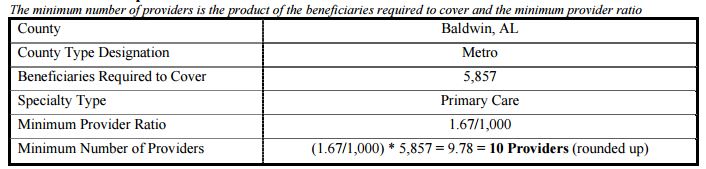
How is network adequacy measured? The gist is that each plan must contract with a specified number of providers of each type. Moreover, 90% of beneficiaries in the county must live within specified travel distance and travel time from at least one provider of each type. To calculate the minimum number of providers, each county receives a population of beneficiaries (termed “beneficiaries required to cover” in the table below) that is equal to the 95th percentile of penetration in all plans in its county type, multiplied by the total number of beneficiaries in the county. That’s a mouthful, but roughly speaking it means that CMS makes sure that each plan can serve a number of beneficiaries larger than it is ever likely to enroll.

This is rather abstract. How about a concrete example? Sure! The following tables should help. The first illustrates the calculation of the number of primary care providers a plan in Baldwin, AL must contract with (10) for 5,857 beneficiaries.

The next table shows that in Baldwin, AL, at least one primary care provider must be within 10 miles and 15 minutes of travel time for 90% of beneficiaries in the county. Additionally, a PCP who is not within the time and distance requirements of at least one beneficiary, will not count towards the minimum number of providers required. Moreover, because at least 90% of beneficiaries must be within the time and distance requirements, a plan may have to contract with more than the minimum number of providers required to meet these requirements.

Where can I learn more? Here are some potentially helpful links:

  • Most of the foregoing can be found in this CMS guidance document.
  • Additional details on how time and distance to providers are calculated can be found in this memo.
  • Here is the most recent file that specifies year-specialty-county type network adequacy regulations.

Marketplaces

The following is for federally facilitated marketplaces, but concludes with a comment about state facilitated ones.

When is network adequacy assessed? As best we can tell, network adequacy is assessed for each plan every year.

What types of entities are assessed for adequacy? CMS focuses on a subset of specialist areas and facility types that have been associated with network adequacy problems in the past: hospital systems, dental providers (if applicable), endocrinology, infectious disease, mental health, oncology, outpatient dialysis, primary care, and rheumatology. That other specialists and facility types are not necessarily scrutinized is one limitation of the approach.

Are all markets treated equivalently? No. CMS places each county into the same categories used for MA plans’ network adequacy: Large Metro, Metro, Micro, Rural, or CEAC (Counties with Extreme Access Considerations). Within each practitioner and facility type, there are different network adequacy standards by county type. Presumably, these can change from year-to-year as well.

How is network adequacy measured? The approach is similar to that for MA plans: 90% of enrollees must have access to at least one provider/facility type within specified travel distances and travel times. A key difference is that there does not appear to be a minimum number of each provider type every plan must contract with. It’s reasonable to hypothesize, therefore, that marketplace plans would have much more narrow networks than MA plans, but no direct comparison exists, to our knowledge.

Public Health Care Programs: Lower Cost but Not Lower Quality

Public Health Care Programs: Lower Cost but Not Lower Quality

Image result for What kind of insurance you have does affect your access to health care


In recent days, Democrats have stepped into the health policy vacuum created by the Republicans’ failure to repeal and replace the Affordable Care Act. Proposals making the rounds include allowing Americans to buy into Medicare at age 55 or to buy into Medicaid.

Both Medicare and Medicaid pay lower prices to health care providers compared with private market plans offered by employers and in the Affordable Care Act marketplaces. On that basis, you might think these public programs are more cost-efficient. Are they?

Imagine that I take my car to the cheapest mechanic in town, while you take yours to the most expensive. My repairs, though costing less, don’t always fix the problem or last as long. You get what you pay for.

Let’s take a look at whether something similar is happening with public health programs. One study examined claims data for 26 low-value services and found that as much as 2.7 percent of Medicare’s spending is on these services alone, which include ineffective cancer screening, diagnostic testing, imaging and surgery. That sounds pretty bad.

But a paper that appeared in Health Services Research this year suggests that private plans do not perform better. Looking at the years 2009 to 2011, the authors compared the rates at which Medicare and private health plans provided seven low-value services. The services compared were among those identified as unnecessary by national organizations of medical specialists as part of the Choosing Wisely campaign.

The researchers found that four of the seven services they examined were provided at similar rates by Medicare and commercial market plans: cervical cancer screening over age 65; prescription opioid use for migraines; cardiac testing in asymptomatic patients; and frequent bone density scans. Medicare was less likely to pay for unnecessary imaging for back pain, but more likely to pay for vitamin D screening.

This finding might seem counterintuitive. Commercial market plans pay higher rates and confer higher profit margins, meaning there is more financial incentive for physicians to provide privately insured patients more of all types of care, whether low or high value.

But other results from the study suggest a more likely explanation: Doctors tend to treat all their patients similarly, regardless of who is paying the bill.

“What kind of insurance you have does affect your access to health care,” said Carrie Colla, associate professor of the Dartmouth Institute for Health Policy & Clinical Practice and the lead author of the study. “But once you’re in front of the doctor, by and large you’re treated the same way as any other patient.”

One apparent exception found in the study involved the seventh service it examined: cardiac testing before low-risk, noncardiac surgery. This service was provided to 46 percent of Medicare beneficiaries and 26 percent of privately insured patients. The large difference could reflect the fact that cardiac problems are more prevalent among older people. So a doctor with equal concern for all her patients might test Medicare patients at a higher rate for that reason. Nonetheless, such testing is considered low value even for the Medicare population.

Another recent study, published in JAMA Internal Medicine, also found little relationship between insurance status and low-value care. The study found no difference in the rates at which seven of nine low-value services were provided to patients on Medicaid versus those with private coverage. Six were also provided at the same rates for uninsured and privately insured patients.

Moreover, the study found that physicians who see a higher proportion of patients on Medicaid provide the same rate of low- and high-value services for all their patients as other physicians do. This is an important finding because Medicaid pays doctors less than private plans do, raising concerns that higher-quality doctors would tend not to participate in the program.

“Despite concerns to the contrary, Medicaid patients don’t appear to be seeing lower-quality doctors,” said Dr. Michael Barnett, lead author of the study, a physician with the Brigham and Women’s Hospital and an assistant professor at the Harvard T.H. Chan School of Public Health. “Though raising the prices Medicaid pays doctors may increase physician participation, enhancing enrollees’ access to care, it isn’t likely to change the quality of care patients receive once they are in the doctor’s office.”

If insurance status doesn’t influence how much low-value care patients are being offered, what does? In part, it seems related to the history and organization of local health care markets. A big culprit, according to Ms. Colla’s study, is a market’s ratio of specialists, like cardiologists and orthopedists, to primary care physicians. In areas where there are relatively more specialists, there is also more low-value care. That’s not to say that specialists don’t provide valuable services — but it suggests that they tend to provide more low-value care as well.

In a way, this is good news — the medical system doesn’t seem to discriminate by insurance status. It also means that public programs appear to be relatively cost-efficient, spending less than private payers for care of similar quality. That bodes well for Democrats’ proposals to expand Medicare or Medicaid.

But the bad news is that the study results imply that the value of care is hard to influence by adjusting prices. In a normal market, paying less for something would send a message of its low value, prompting people to provide less of it. The fact that price apparently does not influence doctors’ decisions is just another way in which health care does not seem to function like other markets.

Facebook Live: The Prescription Drug Pricing Pipeline

http://khn.org/news/facebook-live-the-prescription-drug-pricing-pipeline/?utm_campaign=KHN%3A%20First%20Edition&utm_source=hs_email&utm_medium=email&utm_content=55788948&_hsenc=p2ANqtz–od0NkOnZ3JW63AcEvWasisokdBxSkvpXO26Fjun675RM0hdMqrzrJFyv1mPagID4A6YaGGliyY42elFVZt4M1Cbax7A&_hsmi=55788948

Related image


Who contributes to what you pay at the pharmacy? Why are prescription drugs so expensive in the United States? In this Facebook Live, KHN’s Julie Appleby talks with Stephanie Stapleton and answers readers’ questions about the prescription drug pricing pipeline and the industry stakeholders who have a role in what you pay.

For more in-depth conversations with KHN reporters, check out our Facebook video archive.

Here are videos and a chart to help make sense of drug pricing. And remember you can republish KHN content for free:

Pharmacy benefit managers — companies that are often unnoticed and even less understood by most consumers — hold an important place in the prescription drug-pricing pipeline. In this video, Kaiser Health News details the emergence of these multimillion-dollar corporations and the impact they have on medication costs and patients’ access to these treatments.