Nursing strikes can cause harm well beyond labor relations

http://www.healthcaredive.com/news/nursing-strikes-can-cause-harm-well-beyond-labor-relations/447627/

Image result for hospital labor strike

hen officials at Tufts Medical Center in Boston refused to allow nurses just off of a one-day strike return to their jobs, the footage spread across TV news programs and social media. Boston Mayor Martin Walsh, a former labor leader, spoke in favor of the striking nurses and the hospital found itself in an uncomfortable spotlight.

About 1,200 nurses went on a one-day strike after their union, the Massachusetts Nurses Association, and Tufts couldn’t come to a new contract agreement after more than a year of negotiations. Tufts, in turn, locked out the nurses when they attempted to return to work the next day.

Officials said the lockout was required because they needed to give at least five-day contracts to 320 temporary nurses brought in to fill the gap. The nurses are back on the job now without a new contract, but the strike and subsequent lockout got the public’s attention.

Hospital strikes aren’t that common — usually, the sides agree to a new contract. Strikes or threatened strikes in recent years have typically involved conflicts over pay, benefits and staff workloads.

When strikes do happen, however, they can hurt a hospital’s reputation, finances and patient care.

Strike’s effect on patient safety

study on nurses’ strikes in New York found that labor actions have a temporary negative effect on a hospital’s patient safety.

Study authors Jonathan Gruber and Samuel A. Kleiner found that nurses’ strikes increased in-patient mortality by 18.3% and 30-day readmission by 5.7% for patients admitted during the strike. Patients admitted during a strike got a lower quality of care, they wrote.

“We show that this deterioration in outcomes occurs only for those patients admitted during a strike, and not for those admitted to the same hospitals before or after a strike. And we find that these changes in outcomes are not associated with any meaningful change in the composition of, or the treatment intensity for, patients admitted during a strike,” they said.

They said a possible reason for the lower quality is fewer major procedures performed during a strike, which could lead partially to diminished outcomes. The study authors found that patients that need the most nursing care are the ones who make out worst during strikes.

“We find that patients with particularly nursing-intensive conditions are more susceptible to these strike effects, and that hospitals hiring replacement workers perform no better during these strikes than those that do not hire substitute employees,” they wrote.

Allina Health’s Abbott Northwestern Hospital in Minneapolis faced a patient safety issue during a strike last year that resulted in the CMS placing the hospital in “immediate jeopardy” status after a medication error. A replacement nurse administered adrenaline to an asthmatic patient through an IV rather than into the patient’s muscle. The patient, who was in the emergency room (ER), wound up in intensive care for three days because of the error. Allina said the error was not the nurse’s fault, but was the result of a communication problem.

The CMS accepted the hospital plan of correction, which included having a nurse observer when needed and retraining ER staff to repeat back verbal orders.

A strike’s financial impact

Hospitals also take a financial hit during strikes. Even the threat of a one- or two-day nurse strike can cost a hospital millions.

Bringing in hundreds or thousands of temporary nurses from across the country is costly for hospitals. They need to advertise the positions, pay for travel and often give bonuses to lure temporary nurses.

The most expensive recent nurse strike was when about 4,800 nurses went on strike at Allina Health in Minnesota two times last year. The two strikes of seven days and 41 days cost the health system $104 million. The hospital also saw a $67.74 million operating loss during the quarter of those strikes.

To find temporary replacements, Allina needed to include enticing offers, such as free travel and a $400 bonus to temporary nurses.

Even the threat of a strike can cost millions. Brigham and Women’s Hospital in Boston spent more than $8 million and lost $16 million in revenuepreparing for a strike in 2016. The 3,300-nurse union threatened to walk out for a day and much like Tufts Medical Center, Brigham & Women’s said the hospital would lock out nurses for four additional days if nurses took action.

At that time, Dr. Ron Walls, executive vice president and chief operating officer at Brigham and Women’s Hospital, said the hospital spent more than $5 million on contracting with the U.S. Nursing Corp. to bring on 700 temporary nurses licensed in Massachusetts. The hospital also planned to cut capacity to 60% during the possible strike and moved hundreds of patients to other hospitals. They also canceled procedures and appointments in preparation of a strike.

The Massachusetts Nurses Association and Brigham & Women’s were able to reach a three-year agreement before a strike, but the damage was already done to the hospital’s finances.

Richard L. Gundling, senior vice president of healthcare financial practices at Healthcare Financial Management Association, told Healthcare Dive that healthcare organizations need to plan for business continuity in case of an event, such as a labor strike, natural disaster or cyberattack.

“Business continuity is directly related to the CFO’s responsibility for maintaining business functions. The plan should include having business continuity insurance in place to replace the loss associated with diminished revenue and increased expenses during the event,” Gundling said.

These plans should provide adequate staffing, training, materials, supplies, equipment and communications in case of a strike. Hospitals should also keep payers, financial agencies and other important stakeholders informed of potential issues.

“It’s also key to keep financial stakeholders well informed; this includes insurance companies, bond rating agencies, banks, other investors, suppliers and Medicare/Medicaid contractors,” he said.


“Business continuity is directly related to the CFO’s responsibility for maintaining business functions. The plan should include having business continuity insurance in place to replace the loss associated with diminished revenue and increased expenses during the event.”

Richard Gundling

Senior vice president of healthcare financial practices, Healthcare Financial Management Association


Impact to a hospital’s reputation

Hospital strikes, particularly nurses’ strikes, can also wreak havoc on a hospital’s reputation. Nurses are a beloved profession. They work hard, often long hours and don’t make a fortune doing it. The median registered nurses’ salary is about $70,000, according to the Bureau of Labor Statistics.

Nurses’ contract disputes involving staffing levels are a sticky situation for hospitals. Nurses will almost always win the PR battle against hospital executives.

If a hospital can’t avoid a strike, Seitel said two keys for the organization are telling the truth and not being passive about untrue statements from the other side. They don’t want to be adversarial and escalate the situation, but go with a more measured approach.

Fraser Seitel, president of Emerald Partners, a communications management consulting company, told Healthcare Dive there are two ways that hospital leadership can avoid a strike.

“The best way to prevent a strike is by the management of the hospital having a robust communications program with the staff of the hospital as well as keeping competitive in terms of salaries and benefits,” said Seitel, who has helped hospitals during times of labor strife.

Seitel said labor issues often crop up when management isn’t communicative. Communication, transparency and competitive compensation are the best preventative medicine for a strike, he said.

UPMC moves ahead on purchase of PinnacleHealth

http://www.healthcaredive.com/news/upmc-moves-ahead-on-purchase-of-pinnaclehealth/449305/

Image result for upmc

Dive Brief:

  • UPMC have reached a definitive agreement to with Harrisburg-based PinnacleHealth to be acquired, Philly.com reports.
  • The deal paves the way for UPMC to expand its market share in central Pennsylvania and compete directly with the University of Pennsylvania Health System, which owns Lancaster General Health.
  • Last month, Pinnacle bought four central Pennsylvania hospitals from Community Health Systems, a Tennessee-based hospital chain. The purchase included Lancaster Regional Medical Center and Heart of Lancaster Regional Medical Center.

Dive Insight:

The deal, first announced in March, is UPMC’s largest ever and the first to involve an entire health system. Previous purchases have involved single hospitals, the most recent being Sunbury Community Hospital and Lock Haven Hospital from Quorum Health. Those hospitals will become part of Williamsport, Pa.-based UPMC Susquehanna, which was added to the UPMC system last fall.

With Pinnacle’s acquisition now on track, UPMC also stands to boost its health insurance product line, which accounted for close to half of its 2016 operating revenue. The move will pit UPMC Health Plan against Capital BlueCross and Highmark, which together have 75% of the central Pennsylvania market. Aetna holds the rest.

Gaining a foothold in the Harrisburg region could help to compete with Highmark, which four years ago bought Pittsburgh-based Allegheny Health Network, putting it in direct competition with UPMC’s medical and coverage operations.

Merger and acquisition activity has kept up a steady pace this year, with no signs of abating. Reasons for deals include declining admissions, rising costs and a desire to expand into new regions or service lines.

In May, Cleveland Clinic and Dover, Ohio-based Union Hospital signed a letter of intent to merge Union into Cleveland Clinic. The move will expand Cleveland Clinic’s footprint into southern Ohio, while bringing new services and resources to Union, officials said at the time.

Cleveland Clinic CEO Toby Cosgrove, who is stepping down later this year, said in April that consolidation and a greater focus on telemedicine would help providers transition from volume to value payment as healthcare reform continues to evolve.

UPMC expects to complete the acquisition September 1, pending regulatory approvals. For the fiscal year ended June 30, 2016, Pinnacle reported revenue of $1.05 billion.

47 Hospitals Slashed Their Use Of 2 Key Heart Drugs After Huge Price Hikes

http://www.npr.org/sections/health-shots/2017/08/09/542485307/47-hospitals-slashed-their-use-of-two-key-heart-drugs-after-huge-price-hikes?utm_source=Sailthru&utm_medium=email&utm_campaign=Newsletter%20Weekly%20Roundup:%20Healthcare%20Dive%2008-12-2017&utm_term=Healthcare%20Dive%20Weekender

Even before media reports and a congressional hearing vilified Valeant Pharmaceuticals International for raising prices on a pair of lifesaving heart drugs, Dr. Umesh Khot knew something was very wrong.

Khot is a cardiologist at the Cleveland Clinic, which prides itself on its outstanding heart care. The health system’s internal monitoring system had alerted doctors about the skyrocketing cost of the drugs, nitroprusside and isoproterenol. But these two older drugs, frequently used in emergency and intensive care situations, have no direct alternatives.

“If we are having concerns, what is happening nationally?” Khot wondered.

As it turned out, a lot was happening.

Following major price increases, use of the two cardiac medicines has dramatically decreased at 47 hospitals, according to a research letter Khot and two others published Wednesday in the New England Journal of Medicine.

The number of patients in these hospitals getting nitroprusside, which is given intravenously when a patient’s blood pressure is dangerously high, decreased 53 percent from 2012 to 2015, the researchers found. At the same time, the drug’s price per 50 milligrams jumped more than 30-fold — from $27.46 in 2012 to $880.88 in 2015.

The use of isoproterenol, key to monitoring and treating heart-rhythm problems during surgery, decreased 35 percent as the price per milligram rose from $26.20 to $1,790.11.

The two drugs, which are off patent, have long been go-to medicines for doctors.

“This isn’t like a cholesterol medicine; these are really, very specialized drugs,” says Khot, who is lead author on the peer-reviewed research letter. When patients get the drugs, he says, “they are either sick beyond sick in intensive care or they’re under anesthesia [during] a procedure.”

Valeant bought the drugs in early 2015 from Marathon Pharmaceuticals. Last year, Valeant announced a rebate program to lower the price hospitals paid for the drugs.

And Valeant’s Lainie Keller, a vice president of communications, says the company is committed to limiting price increases.

“The current management team is committed to ensuring that past decisions with respect to product pricing are not repeated,” Keller says.

Pharmacist Erin Fox, the director of drug information at University of Utah Health Care, said the findings by Khot and his colleagues reveal “exactly what a lot of pharmacists have been talking about. When prices are unsustainable, you have to stop using the drug whenever you can. You just can’t afford it.”

Fox says her Utah health system has removed isoproterenol from its bright-red crash carts, which are stocked for emergencies like heart attacks. But Nitroprusside is more difficult to replace.

“If you need it, you need it,” Fox says. “That’s exactly why the usage has not gone down to zero, even with the huge price increases.”

Cleveland Clinic leaders spent months investigating each drug’s use and potential alternatives, Khot says.

“We’re not going to ration or restrict this drug in any way that would negatively impact these patients,” Khot says, adding that he hopes to do more research on how the decreased use of both drugs has affected patients.

Dr. Richard Fogel is a cardiologist and electrophysiologist at St. Vincent, an Indiana hospital that’s part of Ascension, a large nonprofit chain with facilities in 22 states and the District of Columbia. He told a Senate committee last year that the cost of the two drugs alone drove a nearly $12 million increase in Ascension’s spending over one year.

“While we understand a steady, rational increase in prices, it is the sudden, unfounded price explosions in select older drugs that hinder us in caring for patients,” Fogel told the committee.

The NEJM letter also analyzed the use of two drugs that remained stable in price over that time period, as a control group — nitroglycerin and dobutamine. The number of patients treated with nitroglycerin, a drug used for chest pain and heart failure, increased by 89 percent. Khot warns that the drugs can’t always be used as substitutes.

Study: No link between offering price transparency tool and lower healthcare spending

http://www.beckershospitalreview.com/finance/study-no-link-between-offering-price-transparency-tool-and-lower-healthcare-spending.html

Image result for Study: No link between offering price transparency tool and lower healthcare spending


Offering a price transparency tool to a large insured population in California did not result in decreased healthcare spending, according to a study published in Health Affairs.

For the study, researchers analyzed the experience of beneficiaries of the self-insured California Public Employees’ Retirement System, a benefit manager for the state’s public employees, their dependents and retirees. CalPERS offered beneficiaries enrolled in an Anthem Blue Cross preferred provider organization a commercial price transparency tool called Castlight. Castlight was introduced to beneficiaries on July 1, 2014, and researchers conducted the study from July 1, 2012, to Sept. 30, 2015. Researchers said they specifically focused on “shoppable” services such as lab tests, office visits and advanced imaging services.

The study found no link between shoppable services spending and Castlight. Researchers said only 12.3 percent of beneficiaries offered the price transparency tool used it to conduct a price search at least once in the 15 months after it was introduced. Only 2.4 percent of beneficiaries used it at least three times during the 15 months, and 3.9 percent used it at least twice for searches with at least 30 days between searches.

The study found beneficiaries that did a price search prior to receiving imaging services on average paid 14 percent less than those who did not do a price search prior to those services. Researchers said only 1 percent of beneficiaries who received advanced imaging conducted a price search.

“We did not find evidence that offering a price transparency tool was associated with a reduction in spending on shoppable services. Patients’ use of the tool was associated with lower-price imaging services, but because use of the tool was so limited, this result did not translate into meaningful spending reductions among the population offered the tool,” the study’s authors concluded.

Former healthcare CFO sentenced to more than 3 years in prison for fraud

http://www.beckershospitalreview.com/legal-regulatory-issues/former-healthcare-cfo-sentenced-to-more-than-3-years-in-prison-for-fraud.html

Related image

U.S. District Judge Malcolm J. Howard sentenced William Canupp, former CFO of Beulaville, N.C.-based Eastpointe Human Services, to 3 1/2 years for wire fraud, tax fraud and conspiracy to commit federal program fraud, according to The Wilson Times.

Mr. Canupp served as Eastpointe’s CFO from March 2010 to April 2013. Eastpointe manages the public sector behavioral health system for several counties in eastern North Carolina.

On May 24, 2016, a federal grand jury returned a 47-count indictment against Mr. Canupp, charging him with conspiracy, bribery, organization fraud, wire fraud and money laundering. The indictment was issued nearly one year after a state audit found Mr. Canupp had facilitated kickbacks from two Eastpointe contractors. The audit revealed Eastpointe paid two contractors more than $1 million for renovations from 2010 to 2013. Each time a check was received from Eastpointe, the contractor wrote a personal check to Mr. Canupp. The contractors paid the former CFO a total of $547,595.

Mr. Canupp pleaded guilty in March to conspiracy to commit federal program fraud, wire fraud and tax fraud, according to The Wilson Times.


Auditor: 15-bed Missouri hospital at heart of $90M billing fraud scheme

http://www.beckershospitalreview.com/finance/auditor-15-bed-missouri-hospital-at-heart-of-90m-billing-fraud-scheme.html

Image result for fraud and abuse

Putnam County Memorial Hospital, a 15-bed hospital in Unionville, Mo., received $90 million in insurance payments in less than a year for lab services that were performed at other facilities across the country, according to The St. Louis Post-Dispatch, which cited a report released Wednesday by Missouri State Auditor Nicole Galloway.

According to Ms. Galloway’s report, Putnam County Memorial Hospital contracted with Hospital Laboratory Partners in September 2016 to operate a clinical laboratory on behalf of the hospital.

“Immediately upon signing the management contract with the hospital, the CEO and his associates began billing significant amounts of out-of-state lab activity through the hospital,” according to the auditor’s report.

Putnam County Hospital allegedly acted as a shell company by submitting claims for other labs and funneling the insurance payments through the hospital.

“Based on our review of hospital accounts, the vast majority of laboratory billings are for out-of-state lab activity for individuals who are not patients of hospital physicians,” states the auditor’s report.

Ms. Galloway has turned her findings over to the Missouri attorney general, the FBI and the Putnam County prosecuting attorney, according to KCUR.

On Thursday, Hospital Laboratory Partners said the auditor’s report mischaracterizes the payments. The company said Putnam County Hospital, a critical access hospital, is authorized to bill for off-site lab work.

“The assignment of non-patient lab specimens has been standard practice for rural and critical access hospitals for many years,” Hospital Laboratory Partners attorney Mark Thomas said in a statement to The Kansas City Star“The purpose of the rural/critical access exceptions is to give rural healthcare facilities a fighting chance to survive and serve their local communities.”


Bon Secours Richmond CEO orders managers, others to take paid leave to reduce expenses

http://www.beckershospitalreview.com/finance/bon-secours-richmond-ceo-orders-managers-others-to-take-paid-leave-to-reduce-expenses.html

Image result for Bon Secours RichmondPer


Bon Secours Richmond (Va.) Health System CEO Toni Ardabell, BSN, issued an order July 19 mandating select salaried workers at the health system take five paid days off to reduce the health system’s expenses by the end of its fiscal year Aug. 31, according to the Richmond Times-Dispatch.

A health system spokesperson said in a written statement to the Times-Dispatch Aug. 10 the order applies only to salaried management and professional personnel who accrued a large number of paid vacation days but had not used them during the first 10 and a half months of the fiscal year. The rule does not apply to employees who “have little or no accrued PTO … [or] those who have just returned from a leave of absence or those who may be getting ready to take one,” the spokesperson said.

Ms. Ardabell’s memorandum, obtained by the Times-Dispatch, called for “full compliance with these instructions,” provided the stipulation does not affect patient care or reduce patient volume. She also wrote management should not attempt to replace employees on leave with “other workers in a way that adds incremental expense.”

“Replacing a salaried employee with an hourly employee you have to pay doesn’t help,” Ms. Ardabell wrote. “However, if another salaried employee who is being paid anyway simply stretches to cover the work of two people for a few days, then we realize the savings.”

The spokesperson said the order does not reflect any financial distress at the health system. Bon Secours is “a financially strong and fiscally sound organization with consistently high bond ratings and financial performance,” she told the Times-Dispatch.

Editor’s Corner—Why the Biden-Faulkner exchange over EHR access touched a nerve

http://www.fiercehealthcare.com/ehr/editor-s-corner-why-biden-faulkner-exchange-over-ehr-access-touched-a-nerve?mkt_tok=eyJpIjoiTWpnMFlUY3dNREExTUdReSIsInQiOiJ4WGdTalwvWk9ZTVFSaXQ0Y2R4OEVqUHFBWFE5NllQc2xHVEl2Z2VYc1d0aTJwUnZwczE5Y1pNVGcxSGFIa2lhZFZaaVRHc0FhSGhwaVRiR3NuNWJRZDhFNW5COTAyRXpQODdJR2VIcDlHTHBcL0RDZ2ZFU2lCSWxyRWNKRTdEdXE3In0%3D&mrkid=959610&utm_medium=nl&utm_source=internal

Joe Biden

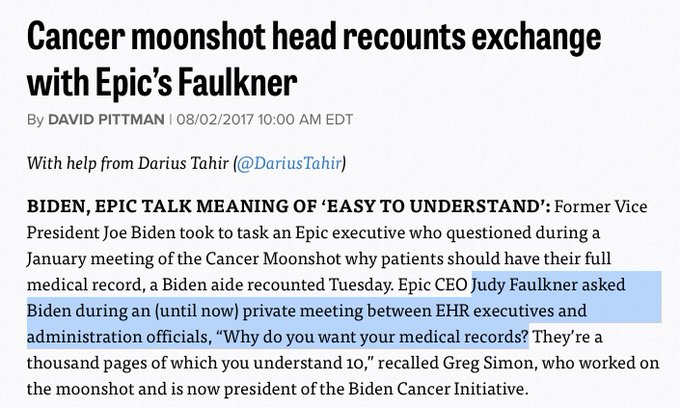
It’s hard to say exactly what transpired at that January meeting between then-Vice President Joe Biden and Epic CEO Judy Faulkner.

What we do know is that it triggered a visceral online reaction over the importance of interoperability and access to health data—and even some Twitter threads on the nuances of HIPAA. But that might be more telling about where the industry currently stands and the direction it’s quickly heading.

It began last week when Politico recounted the exchange between Biden and Faulkner as told by the vice president’s aide Greg Simon, who now serves as president of the Biden Cancer Initiative. The short version: Faulkner reportedly asked Biden why he wanted 1,000 pages of medical records to which Biden retorted, “None of your business.”

“It went downhill from there,” Simon said.

The story developed more on Monday, when former White House Chief Technology Officer Aneesh Chopra told CNBC the meeting was cordial and there “was a motivation and desire to work together to improve data access.” An Epic spokesperson told Health IT News that the company “supports patients’ rights to access their entire record,” adding that Biden was “consistently polite and positive” during the meeting.

By then, Twitter had worked itself into a full lather. Many were particularly incensed at Faulkner’s insinuation that that length and complexity of a medical record somehow rendered it useless to patients.

The reactions to Biden’s exchange with Faulkner may say more about the state of health IT than the interaction itself that was either contentious or cordial, depending on who you ask. There’s still a lot of frustration over the amount of money invested in EHR adoption and the fact that interoperability is still a challenging task.

At the same time, the vast majority of the industry is embracing the concept of replacing medical paternalism with patient-centered care, and more healthcare consumers are recognizing the benefits of having all of your health information at your fingertips.

In other words, demand is growing, but healthcare is still short on supply. That might explain the visceral reactions.

This week, Chilmark Research analyst Brian Eastwood argued that the debate over patient access to data revolves more around culture than software, and that’s probably true. Embracing the idea that patients should be able to access their medical record is a basic hurdle before anyone can tackle the technology that can make that happen.

But the heated debate that followed shows how much people across the healthcare industry see this as a core priority. It may not have infiltrated every corner of the ecosystem, but it touched a nerve that was far more basic than the technical minutia of interoperability or data standardization. It’s clear that the broader notion that patient records aren’t just the property of the health system—or even the software vendor—is carving out a substantial role in healthcare’s ongoing transformation. Any insinuation to the contrary is seen as shortsighted.

Clearly, it’s not ubiquitous yet, but there’s a strong undercurrent pushing the industry beyond the question of why patients might want their data and into the how. Perhaps that’s a small measure of progress. – Evan | @DB_Sweeney@FierceHealthIT

Dynamics of Decline: The Truth About HMOs

http://www.chcf.org/articles/2016/11/dynamics-decline-truth-hmos

California Commercial HMO Enrollment, Kaiser Foundation Health Plan ("Kaiser") vs. Non-Kaiser, 2004-2015

California’s commercial health maintenance organization population shrank from 11.9 million to 9.8 million enrollees between 2004 and 2015 (see figure below), a 17.5% decline. But the decline has not been consistent across all HMOs — Kaiser’s commercial enrollment has actually grown during this period.

Two new publications from CHCF take a closer look at how commercial managed care enrollment (including individual enrollment) and the public sector’s embrace of managed care are shifting the way physician organizations are paid — important trends that could affect California’s delivery system.

The first report, As Commercial Capitation Sinks, Can California’s Physician Organizations Stay Afloat?, by Laura Tollen uses quantitative data and findings from stakeholder interviews to shed light on the extent to which commercial capitation is losing ground in California.

A companion set of charts and graphics compiled by Katherine Wilson provides additional detail on health plan enrollment and changes in HMO participation over the past decade.

It is important to look separately at Kaiser and non-Kaiser enrollment. Kaiser is characterized by a mutually exclusive relationship between the health plan (Kaiser Foundation Health Plan) and its two associated Permanente Medical Groups in Northern and Southern California. While Kaiser is by far the largest HMO in California, the health plan offers capitated contracts only to these two medical groups.

Kaiser HMO enrollment increased from 5.6 million to 6.1 million in the last decade, while commercial HMO enrollment for all non-Kaiser plans plummeted, from 6.3 million in 2004 to the current 3.6 million — a loss of more than 40%.

Uncertain Future

The impact of these trends on the state’s non-Permanente physician organizations is uncertain. While declining commercial capitation has not yet had a big effect on their operations, medical group leaders suspect it will soon, according to interviews. The change in commercial payment methods has been slow enough that their organizations have been able to adapt, repurposing some of their HMO-based infrastructure (utilization management tools, for example) for value-oriented payment programs that are FFS-based, such as private accountable care organizations (ACOs).

Among the other findings from the interviews were:

  • Declining capitation and rising fee-for-service will not influence individual physicians’ clinical decisions. All interviewees noted that their organizations’ strong culture of providing high-value care would prevent them from fundamentally changing the way they practice, regardless of payment type.
  • Despite commercial trends, capitation from Medicare Advantage and Medi-Cal managed care plans is on the rise. However, neither of these types of capitation is seen as a substitute for commercial capitation in terms of supporting infrastructure. While the perception is that Medicare Advantage capitation rates are generous, there is also recognition that these patients are costly. Interviewees said Medi-Cal capitation rates are inadequate.
  • Along with the decline in commercial capitation, interviewees expressed alarm at the large increases they observed in patient cost-sharing requirements. All said they fear that patients will not obtain the care recommended by their providers because of high out-of-pocket costs, and some said they already see this happen frequently.

Why This Matters

As more employers shift coverage from HMOs to preferred provider organizations (PPOs) and other non-capitated plans to achieve lower premium rates, they are sacrificing quality and financial protection for employees in exchange for short-term premium savings.

A recent CHCF blog post by Jeff Rideout of the Integrated Healthcare Association highlights the patterns of higher quality / lower cost that distinguish HMO plans in the state (compared to PPOs and other plan types). Large multispecialty physician organizations, which have flourished in California, have a long history and significant expertise in managing risk and coordinating care. These are the very skills that health care purchasers demand from value-based payment programs. Without sufficient infrastructure — which is supported by capitation/prepayment — the foundation of high-value care could crumble.

Given these trends, are employers being penny-wise but pound-foolish in pursuing short-term savings at the expense of longer-term value?


In California, What’s Driving the Variation in Total Cost of Care — Volume or Price?

http://www.chcf.org/articles/2017/02/variation-total-cost-care

Linking Hospital Utilization and Total Cost of Care for Commercially Insured Californians, by Product Type, 2013

As the “repeal and replace” debate continues in Washington over the future of the Affordable Care Act, policymakers considering new legislation should not lose sight of the key concept of the ACA — affordability. High and rising costs are among the most intractable health care issues facing consumers across California and the nation, and any discussion must keep underlying cost drivers at the forefront.

But where should the focus be? At the most elementary level, total health care spending boils down to two main factors: how much care we use (volume, or utilization) and what we pay for that care (price). Teasing out how each factor — utilization or price — contributes to costs is important because cost-control solutions vary depending on the answer.

Across 19 regions in California, the annual risk-adjusted, per capita total cost of care for commercially insured people varies dramatically — from an average high of $5,400 in San Francisco to a low of $3,600 in Kern County, according to 2013 data in the California Regional Health Care Cost & Quality Atlas, a web-based interactive tool produced by the Integrated Healthcare Association (IHA) to monitor cost and quality trends across the state.

Adjusted to reflect differences in population health status, the atlas shows a clear geographic cost pattern. All Northern California regions have higher costs than the statewide average of $4,300, all Southern California regions have lower costs than the state average, and Central California regions have mixed costs.

Three Key Measures

What is driving these differences? Is it variation in per capita utilization, or is it price? While the atlas does not have unit price information, it does include three important hospital utilization measures: emergency department (ED) visits, all-cause readmissions, and inpatient bed days. This allows for basic comparisons of total cost per enrollee vs. three critical measures of utilization. If hospital utilization were driving the overall cost of care, there would be a positive correlation between the cost and utilization measures. However, an analysis of atlas information actually shows the opposite. When considering all commercial health maintenance organization (HMO) and preferred provider organization (PPO) products and regions, cost and volume tend to move moderately in opposite directions.

The quadrant chart below illustrates the relationship between total cost of care and hospital utilization, based on a composite score representing the three utilization metrics. Each orange circle represents a region’s PPO products, and each blue triangle represents a region’s HMO products. With the exception of one outlier region, the data show a moderate negative correlation between hospital utilization and cost. In other words, lower hospital utilization is associated with higher total costs of care.

In the atlas data, total cost of care includes both what the enrollee pays — for example, deductibles and coinsurance — as well as the insurance payments that go to providers. That means cost variation can’t be explained by differences in benefit design among commercial products. Because higher total costs are not driven by greater hospital utilization, and not accounted for by benefit design differences, price seems to be playing a strong role.

There is also an alternative but less likely explanation. Because the atlas only looks at hospital utilization, it’s possible that the total cost of care could be driven by nonhospital utilization as much as the price of care. But because hospital utilization accounts for almost one-third of overall spending on average, it is unlikely that utilization of other services, such as physician and other ambulatory care, has as great an impact on cost variation.

Much of the focus to date on making health care more affordable has involved transferring more financial responsibility to individual patients, the idea being that if consumers have “skin in the game” they will be more discriminating in their care purchases. But if the cost problem is primarily driven by price, which is related to market forces prevalent in a geographic region, is shopping really the solution?

The next version of the atlas, scheduled for release in 2017, will include additional utilization measures and cost information. These will offer a clearer picture of the roles of utilization and price in determining health care costs for commercially insured Californians. Until then the atlas findings stress the need for a better understanding of how pricing differences contribute to total cost variation and encourage us to search for more effective strategies to influence prices as well as utilization.