Trump needs to stop sabotaging Obamacare — before it’s too late

https://www.washingtonpost.com/opinions/trump-needs-to-stop-sabotaging-obamacare–before-its-too-late/2017/08/17/1c1404ba-8133-11e7-902a-2a9f2d808496_story.html?utm_term=.40564141606c

THE CONGRESSIONAL Budget Office released on Tuesday yet another damning report on health care, this time highlighting the damage President Trump will do if he continues his Obamacare sabotage campaign. Over the next few weeks, during which the government and insurers must sort out what will happen to Obamacare insurance markets next year, everyone in the administration and every member of Congress must recognize that they have no more time to entertain repeal-and-replace fantasies. The fate of the health-insurance markets on which millions of people rely hangs on their willingness to accept reality.

The Trump administration has shown some flexibility. The Department of Health and Human Services last week offered insurers an extra few weeks to file rates for next year. Earlier, Alaska got $323 million in federal money to backstop its individual insurance market in a reinsurance arrangement that could drive down premiums and serve as a model for stabilizing insurance markets across the nation. Though Mr. Trump has repeatedly vowed to let Obamacare collapse, these moves show willingness to bolster, not undermine, the insurance markets that Obamacare created.

Yet the administration has stoked more uncertainty than it has allayed, leaving the health system in peril. The White House has been deciding month-to-month whether to keep important subsidy payments flowing to insurance companies — payments that were simply assumed during the Obama administration. Without these payments, insurers would have to jack up premiums or leave Obamacare markets next year. The CBO estimated Tuesday that average premiums would jump by 20 percent next year if the Trump administration pulled them. Moreover, because of how the payments interact with other elements of the health-care system, the government would end up losing money — $194 billion over a decade.

Though it would be irrational to subvert the health-care system and the budget, Mr. Trump has repeatedly threatened to do so. His officials also have taken steps in that direction, pulling advertisements meant to encourage people to enroll in health insurance, cutting programs that helped people sign up, railing about Obamacare’s “victims” and generally insisting, against the facts, that the law is a disaster. The administration’s moves to weaken the individual mandate, which requires all Americans to carry health coverage and underpins the Obamacare system, have led insurers to contemplate increasing premiums or leaving the system.

The president wanted and failed to overhaul Obamacare. That does not excuse him from faithfully executing the law. Unless Mr. Trump wants to be blamed for health-care chaos, the administration’s mixed messages must stop. Mr. Trump should commit to keeping the subsidies going permanently, to enforcing the individual mandate and to working with Congress on a bipartisan bill that would bolster insurance markets.

The broad strokes are clear: Democrats would ensure that subsidy payments are made permanent and Republicans would get more flexibility for states in administering Obamacare. More money should also go into reinsurance programs like Alaska’s. Though such a bill might come too late to hold down 2018 premiums, serious legislative activity could persuade insurers to stay in the market, riding out next year with the promise of a more stable situation in 2019.

All of this would be easier if the administration would commit to a strategy of stewardship, not sabotage.

What’s the Near-Term Outlook for the Affordable Care Act?

http://www.kff.org/health-reform/issue-brief/whats-the-near-term-outlook-for-the-affordable-care-act/?utm_campaign=KFF-2017-August-Health-Reform-Outlook-ACA&utm_medium=email&_hsenc=p2ANqtz-_EbLjzmzMtjCe5gWysdKFOYAKOhLUxytBE9QiRYkFON8iXqISeYScKKovbN72gQpEReUlNwoqtEivO7NiGu6poWGxL1A&utm_content=54950542&utm_source=hs_email&hsCtaTracking=b35f36e5-60c0-4e14-ba27-3e14c4025b79%7Cf0a0cb87-2715-4168-b499-2000076067bf

If Congress abandons efforts to repeal and replace the Affordable Care Act (ACA), President Trump has said he would “let Obamacare fail.” This Q&A examines what could happen if the Affordable Care Act, also called “Obamacare,” remains the law and what it might mean to let Obamacare fail.

Is Obamacare failing?

The Affordable Care Act was a major piece of legislation that affects virtually all payers in the U.S. health system, including Medicaid, Medicare, employer-sponsored insurance, and coverage people buy on their own. One of the biggest changes under the health reform law was the expansion of the Medicaid program, which now covers nearly 75 million people, about 14 million of whom are signed up under the expansion. Most Americans, including most Republicans, believe the Medicaid program is working well.

When people talk about the idea of the ACA failing, they are usually referring to the exchange markets, also called Marketplaces. These markets, which first opened in 2014, are part of the broader individual insurance market where just 5-7% of the U.S. population gets their insurance. People who get insurance from other sources like their work or Medicaid are not directly affected by what happens in the individual insurance market.

The exchange markets have not been without problems: There have been some notable exits by insurance companies and premium increases going into 2017, and in the early years of the exchanges, insurers were losing money. The structure of the ACA’s premium subsidies – which rise along with premiums and cap what consumers have to pay for a benchmark plans a percentage of their income – prevents the market from deteriorating into a “death spiral.” However, premiums could become unaffordable in some parts of the country for people with incomes in excess of 400% of the poverty level, who are ineligible for premium assistance.

Insurer participation in this market has received a great deal of attention, as about 1 in 3 counties – primarily rural areas – have only one insurer on exchange. Rural counties have historically had limited competition even before the ACA, but data now available because of the Affordable Care Act brings the urban/rural divide into sharper focus. On average at the state level, competition in the individual market has been relatively stable – neither improving nor worsening.

Premiums in the reformed individual market started out relatively low and remained low in the first few years – about 12% lower than the Congressional Budget Office had projected as of 2016 –before increasing more rapidly in 2017. Most (83%) of the 12 million people buying their own coverage on the exchange receive subsidies and therefore are not as affected by the premium increases, but many of the approximately 9 million people buying off-exchange may have difficulty affording coverage, despite having higher incomes. As might be expected, after taking into account financial assistance and protections for people with pre-existing conditions, some people ended up paying more and others paying less than they did before the ACA. Our early polling in this market found that people in this market were nearly evenly split between paying more and paying less. About 3 millionpeople who remain uninsured are not eligible for assistance or employer coverage and many of them may be going without coverage due to costs.

Our recent analysis of first quarter 2017 insurer financial results finds that the market is not showing signs of collapse. Rather, insurers are on track to be profitable and the market appears to be stabilizing in the country overall. In other words, those premium increases going into 2017 may have been enough to make the market stable without discouraging too many healthy people from signing up. However, there are still markets – particularly rural ones – that are fragile.

How would administrative actions affect market stability?

Despite signs that the individual insurance market is generally stabilizing on its own, certain administrative actions could cause the market to destabilize again. Actions the Administration might take that would weaken the market include:

STOP ENFORCING OR WEAKEN THE INDIVIDUAL MANDATE

The individual mandate is the Obamacare requirement that most people either have insurance or pay a penalty. The purpose of it is to get young and healthy people into the market to bring down average costs. If there are not enough young and healthy people signing up, insurers have to raise premiums. If the administration signals it will either stop enforcement of the individual mandate or give broad exemptions, insurers will respond by raising premiums or exiting the market. The Congressional Budget Office (CBO) estimates that without the individual mandate, premiums in the individual insurance market could rise by 20%.

SCALE BACK OUTREACH AND CONSUMER ASSISTANCE

The individual market is often a transitional source of insurance when life circumstances change. People who are temporality unemployed, in school, or early retirees make up a substantial share of the individual market. Additionally, people in this market often experience income volatility and may cycle between Medicaid and subsidized exchange coverage. Those who are sick will be most likely to seek insurance coverage on their own when they go through a change in life circumstances, but outreach and consumer assistance programs – particularly those targeted at young and healthy individuals – can help balance out the risk pool and bring down average costs.

This coming open enrollment period (November 1 – December 15, 2017) is shorter than previous periods and may require more outreach to get people signed up before the deadline. This will also be the first enrollment period run from start to finish by the Trump administration and it is not yet clear how much outreach the administration will take on. Toward the end of the last open enrollment period, the Trump administration cut marketing and more recently has used outreach funds for messages critical of the health care law.

STOP MAKING COST-SHARING SUBSIDY PAYMENTS

Under the Affordable Care Act, insurers are required to offer low-deductible plans to low-income people (58% of marketplace enrollees benefit from these cost-sharing subsidies). For the lowest-income enrollees, these subsidies can bring down the deductible from a few thousand dollars to a couple hundred dollars (Figure 2 below). Providing these higher-value plans to low-income enrollees costs insurers more money (an estimated $10 billion dollars in 2018), so under the ACA the federal government reimburses insurers in the form of a cost-sharing subsidy payment. However, these payments are the subject of a lawsuit and the Administration has signaled they might stop making payments.

If these payments stop, we estimate that insurers would need to raise rates on silver-level plans – which are the only plans where consumers can access cost-sharing reductions – by 19 percent, with states that did not expand Medicaid (primarily red states) facing higher premium increases (Figure 3 below). Lower-income marketplace enrollees receiving premium subsidies would be protected from premium increases because subsidies would rise as well. However, higher-income enrollees not receiving premium subsidies would face higher premiums if insurers expect cost-sharing subsidy payments to end.

The combined effect of these policy changes (not enforcing the individual mandate and defunding cost-sharing subsidies) could cause some insurers to raise premiums on some plans by as much as 40 percentage points higher than they otherwise would. Because premium subsidies increase as premiums rise, administrative actions that cause premiums to rise can also cause taxpayer costs to increase. For example, we estimate that ending cost-sharing subsidy payments could increase net federal costs by about $2.3 billion per year.

Insurers have already submitted their preliminary premiums for the upcoming calendar year to state regulators. Since there has not been clarity on these issues, some insurers are already assuming that the Trump Administration or Congress may take an action that would destabilize the market. Some companies have either significantly raised premiums for next year, scaled back their footprints, or made plans to exit the exchange or individual market all together. Insurers are still negotiating rates for 2018, so if they do not get clarity soon, premiums could go up even more or more insurers could leave.

Again, these premium increases would only affect people who buy their own insurance (particularly middle-income or upper-middle-income people who buy their own insurance without a subsidy to offset the costs), and this group does not make up a large share of the American public. Nonetheless, more insurer exits or large premium increases on the exchange markets could be seen as Obamacare failing. It is worth noting, though, that a majority (64 percent) of the public – including 53 percent of Republicans – say that because President Trump and Republicans in Congress are now in control of the government, they are responsible for any problems with the ACA moving forward.

What happens if the market fails?

Following some announcements of 2018 exits by major insurers, there are some counties at risk of having no insurer on the exchange next year. This would be a first; thus far, all counties have had at least one insurer on the exchange. As negotiations between insurers and state regulators are still underway, there is still time for other insurers to come in and fill these gaps. Thus far, in most cases, a new or expanding insurer has already moved in to cover counties once thought to be “bare.” However, administrative actions that destabilize the market could encourage more insurers to exit.

If no exchange insurer ultimately moves in to some of these counties, people buying their own insurance will not be able to get subsidies and would have to pay full price for insurance. Paying for unsubsidized insurance would be particularly difficult for low-income and older adults living in high-cost areas like many rural parts of the country. Our subsidy calculator can show the difference in cost. For example, in Knox County Ohio, a low-income 60-year-old could get a silver plan for $83 per month but would have to pay $775 per month if he bought that plan without a subsidy, plus he would have a higher deductible because he would no longer benefit from cost sharing subsidies that are only available on the exchange. That same person would also qualify for a free ($0 premium) bronze plan if he buys on exchange, but off-exchange without a subsidy he would have to pay more than $600 per month for a similar plan. People shopping for coverage off-exchange in a county left without an exchange insurer – particularly lower income or older exchange shoppers – may not be able to afford any option and may drop their coverage.

If the market becomes destabilized, and particularly if the individual mandate is not enforced, insurers may decide to exit the off-exchange market as well. This would mean that people in these counties who would otherwise buy their own insurance may not have any option even if they could afford to pay full price.

What might be done to strengthen the Marketplaces?

Although the individual health insurance market is stabilizing on average, insurer financial performance varies and some companies in some states are still struggling. Additionally, some insurers have already decided to increase premiums significantly or exit the market in 2018 on the assumption that the Trump Administration or Congress will take actions that destabilize the market. Although there are many ideas on both the left and the right for how to improve these markets, there are not many options that have bipartisan support.

One possible policy response that could receive bipartisan support would be to reestablish a reinsuranceprogram. Reinsurance programs provide funds to insurers that enroll high-cost (sicker) individuals and can work to lower premiums. The Affordable Care Act included a reinsurance program but it was temporary and phased out in 2016. Republicans in Congress and the Administration have also signaled a willingness to establish reinsurance programs: Both the House and Senate repeal bills included stability funds for reinsurance and Health and Human Services Secretary Price has supported Alaska’s request for a waiver to support its reinsurance program. Though such a program could receive bipartisan support, it would require additional funds (for example, taxing insurers in other markets).

Additional state flexibility to address local challenges in implementing the health care law may also receive some bipartisan support. The challenge of attracting insurers to rural areas or certain states, for example, may warrant state-specific solutions – either as part of the ACA’s waiver program or by Congress giving states additional flexibility.

CBO: ObamaCare premiums could rise 20 percent if Trump ends payments

CBO: ObamaCare premiums could rise 20 percent if Trump ends payments

Image result for congressional budget office

Insurance companies would raise premium prices about 20 percent for ObamaCare plans if President Trump ends key payments to insurers, according to the Congressional Budget Office (CBO).

At the request of House Democratic leadership, CBO estimated what would happen if the payments to insurers ended after December. It found that halting payments would increase the federal deficit by $194 billion through 2026.

Many people would be cushioned from the impact of the increases because federal tax credits rise automatically when premiums do.

If the payments ended, some carriers would withdraw from ObamaCare and about 5 percent of people would live in an area without any options on the exchanges in 2018, according to CBO. But by 2020, CBO estimates more insurers would participate again, so that most areas would be covered.

The number of people without insurance would be slightly higher next year but a little lower in 2020, according to the analysis.

Cost-sharing reduction payments are made to insurers, compensating them for discounting out-of-pocket costs for certain enrollees.

Insurers have been pleading for certainty from the administration on whether they’ll continue to receive the payments, which total about $7 billion for fiscal 2017.

The administration has been making these payments on a monthly basis. But Trump has threatened to halt the funds, calling the money “bailouts” for insurance companies.

The issue has also been caught up in court, and if Trump decides to stop appealing a court ruling against the administration, CSR payments could stop. The deadline for another update is coming up quick — Aug. 20. The case has been on hold for months and could be delayed again.

Additionally, the Senate Health Committee will hold hearings on a bipartisan, short-term stabilization measure the first week of September. The goal, according to Chairman Lamar Alexander (R-Tenn.), is to craft a bill by mid-September that includes funding the payments to insurers.

But insurers are bumping up against major deadlines.

Last week, the administration extended the deadline for carriers to finalize how much their premiums will cost on HealthCare.gov. That date is now Sept. 5, and insurers sign contracts locking them into selling plans Sept. 27.

If insurers don’t know if CSRs will be funded, they could exit the marketplaces, health experts warn. That could possibly lead to some areas have no insurers selling plans on their exchanges.


Why ACA market upheaval still looms large despite failure to repeal the law

http://www.healthcaredive.com/news/why-aca-market-upheaval-still-looms-large-despite-failure-to-repeal-the-law/449117/

Whether lawmakers are done with efforts to repeal the ACA or not, some important changes for healthcare could be on the horizon.

Facing Trump Subsidy Cuts, Health Insurance Officials Seek a Backup Plan

Image result for Facing Trump Subsidy Cuts, Health Insurance Officials Seek a Backup Plan

Congress is on vacation, but state insurance commissioners have no time off. They have spent the past three days debating what to do if President Trump stops subsidies paid to insurance companies on behalf of millions of low-income people.

For administration officials and many in Congress, the subsidies are a political and legal issue in a fight over the future of the Affordable Care Act. But for state officials, gathered here at the summer meeting of the National Association of Insurance Commissioners, the subsidies are a more immediate, practical concern.

The insurance commissioners are frustrated with the gridlock in Washington, which they say threatens coverage for consumers and the solvency of some insurers. Without the payments, they say, consumers will face higher premiums in 2018, and more insurers will pull back from the individual insurance market.

Mr. Trump has repeatedly threatened to cut off the payments, which reimburse insurers for reducing the deductibles, co-payments and other out-of-pocket costs for low-income people.

If the government continues providing funds for the subsidies, insurers will have “a small profit,” said Craig Wright, the chief actuary at the Florida Office of Insurance Regulation. “If the subsidies are not funded, carriers would face the prospect of large financial losses, which could increase the risk to their solvency.”

“It could be very damaging,” Mr. Wright said. “Our market wouldn’t recover.”

With no guidance or clarity from the Trump administration, state officials are agonizing over what to do. Many expressed a sense of urgency, saying they needed to make decisions soon on rates to be charged in 2018.

Trump administration officials were invited to speak to state insurance regulators and were listed in the program for at least one public session, but they did not show up at that event to provide the promised update on federal policy.

“Most of us are hoping and praying that this gets resolved,” said David Shea, a health actuary at the Virginia Bureau of Insurance. “But that’s not the case right now.”

Without the federal subsidies, insurers would need to get the money — estimated at $7 billion to $10 billion next year — from another source. And that means higher premiums, state officials said.

The officials here are wrestling with several questions: How much should premiums be increased? Who should pay the higher premiums? Is there any way to minimize the effect on low-income people? Is it better to assume that the cost-sharing subsidy payments will or will not be made in 2018? What happens if state officials guess wrong?

State officials said they would allow insurers to impose a surcharge on premiums if the federal government cuts off funds for the cost-sharing subsidies.

Paul Lombardo, a health actuary at the Connecticut Insurance Department, said officials there might direct insurers to spread the cost across all of their health plans, both on and off the insurance exchange created under the Affordable Care Act.

By contrast, Florida has asked insurers to load all of the extra cost into the prices charged for midlevel “silver plans” sold on the exchange. The federal government would then absorb almost all of the cost through another subsidy program, which provides tax credits to help low-income people pay premiums, Mr. Wright said. The tax credits generally increase when premiums rise.

J. P. Wieske, the deputy insurance commissioner in Wisconsin, said that two companies, Anthem and Molina Healthcare, were leaving the state’s marketplace in 2018 and that two others, Humana and UnitedHealth, exited in previous years. As a result, he said, more people will be enrolled in smaller local health plans that could be more affected by a termination of federal subsidy payments.

“Carriers left in the Wisconsin market are smaller, local plans,” Mr. Wieske said. “Particular carriers could have huge surges in population, going from 7 or 8 percent of their business in the individual market to 30 or 40 percent. If that’s the case, if it’s 30 or 40 percent of their business in the individual market, that’s obviously a gargantuan risk.”

The risks for consumers are also high, Mr. Wieske said. “Consumers,” he said, “could be stuck in a zombie plan, an insurer that is essentially no longer able to do business in the worst-case scenario, or consumers may have to move to another insurer with different health care providers.”

Officials in many states must decide this month on insurance rates for next year.

“We are holding off making those decisions until the very last possible minute,” said Julie Mix McPeak, the Tennessee insurance commissioner. “In doing so, we are really making it difficult for consumers who need information about open enrollment — who’s participating in the market and what the rates might be. We don’t know the answers to any of those questions.”

The uncertainty stems not only from the White House and Congress, but also from federal courts.

House Republicans challenged the cost-sharing payments in a lawsuit in 2014. A federal judge ruled last year that the Obama administration had been illegally making the payments, in the absence of a law explicitly providing money for the purpose. The case is pending before the United States Court of Appeals for the District of Columbia Circuit, which has held it “in abeyance” at the request of House Republicans and the Trump administration.

The administration has been providing funds for cost-sharing subsidies month to month, with no commitment to pay for the remainder of this year, much less for 2018.

“I am very fearful that we’ll have insurers make a decision to leave markets as a result of the uncertainty,” said Ms. McPeak, who is the president-elect of the National Association of Insurance Commissioners. “It’s somewhat inequitable to ask insurers to sign a contract that binds them but may not bind the federal government.”

The Affordable Care Act requires an annual review of health insurance rate increases, and states are taking different approaches.

Nebraska initially told insurers to file 2018 rates on the assumption that the cost-sharing subsidies would continue. But “because of the confusion in Washington,” said Martin W. Swanson of the Nebraska Insurance Department, the state later told insurers to assume that they would not receive the subsidy payments.

Mike Chaney, the Mississippi insurance commissioner, and Allen W. Kerr, the Arkansas insurance commissioner, said they had instructed companies to assume that they would receive the cost-sharing subsidies next year. Michigan has told insurers to submit two sets of rates, one with the subsidies and one without.

Michael F. Consedine, the chief executive of the National Association of Insurance Commissioners, said that without a firm commitment of federal funds for the cost-sharing subsidies, “we have grave concerns about the long-term viability of the individual health insurance market in a number of states.”

“We need some step right away,” Mr. Consedine said, “either by action of Congress or by direction of the administration, to ensure that Americans continue to have access to coverage.”

Taxpayers Will Pay the Price for Uncertainty Over Obamacare in 2018

https://www.thefiscaltimes.com/2017/08/10/Taxpayers-Will-Pay-Price-Uncertainty-Over-Obamacare-2018

The health insurance industry remains in the throes of a largely unnecessary crisis of confidence, according to an analysis released by the Kaiser Family Foundation on Thursday.

With the open enrollment period approaching for Obamacare insurance plans sold through state exchanges, Kaiser Foundation experts were able to analyze the proposals for 2018 submitted by insurance companies to 20 states and the District of Columbia — the only places where enough information is made public to allow an assessment of what health care costs would look like for an average policyholder under the insurers’ requested rate structures.

“Insurers attempting to price their plans and determine which states and counties they will service next year face a great deal of uncertainty,” the authors wrote. “They must soon sign contracts locking in their premiums for the entire year of 2018, yet Congress or the Administration could make significant changes in the coming months to the law – or its implementation – that could lead to significant losses if companies have not appropriately priced for these changes. Insurers vary in the assumptions they make regarding the individual mandate and cost-sharing subsidies and the degree to which they are factoring this uncertainty into their rate requests.”

What that means for consumers is a bit of a mixed bag. Almost all insurers are seeking rate increases, with some approaching a 50 percent jump. But the actual impact on consumers varies depending on where they buy their insurance and how much money they earn. One thing is for sure, though: The federal government, and therefore taxpayers, will be on the hook for larger subsidy payments.

Because the majority of Americans obtain health insurance through an employer-sponsored plan or from federal programs like Medicare and Medicaid, the impact of the premium increases of exchange-based policies will mean little to a large element of the population.

Of those who buy insurance on the exchanges, the overwhelming majority receive tax credits meant to keep their premium payments to a specific fraction of their annual income. The remaining 16 percent, depending on their income, receive either a smaller subsidy or no subsidy at all. It is these people who, if they live in some of the regions facing large premium increases, who will be hurt the most.

The Kaiser study gathered information from the largest city in each of the 20 states plus the District of Columbia. (Benchmark levels for tax credits are based on the second-cheapest Silver Level plan available in the largest city in a state.) They estimated the change in costs for a 40-year-old non-smoker earning $30,000 a year.

In only one state was the annual premium expected to fall in 2018: Rhode Island, which anticipates a 5 percent drop. Vermont’s premiums will remain static in 2018 if the data holds. The other 19 states can all expect increases, from a modest 3 percent in Michigan to a whopping 49 percent in Delaware.

The average increase in the data collected by Kaiser is 17 percent.

However, none of those costs would be passed on to the consumer making $30,000 a year. In fact, because of adjustments to the tax credit, he could expect to see monthly costs fall by 3 percent, to $201, next year, regardless of what premium levels do where he lives.

But somebody has to pay when premiums go up, and if it isn’t the consumer, it’s the Treasury and by extension, the taxpayer.

The change in premium payments required to keep that 40-year-old’s health insurance premium at $201 per month will increase very sharply in many states, depending greatly on how far from the premium cap a silver plan was in 2017.

In Washington State, according to Kaiser, the premium tax credit would increase 239 percent, from $31 per month to $105. In New Mexico, it would jump 183 percent, from $51 to $144. In Rhode Island it would fall 13 percent, while in Vermont it would rise a modest 2 percent. On average, though, the amount of premium payment picked up by the federal government will increase by about 63 percent in the states reviewed by Kaiser.

Perversely, as Kaiser points out, that fiscal wound is largely self-inflicted. While it is impossible to gauge just how much of this year’s rate increases are attributable to insurers being nervous about whether the federal government would slash support payments in the middle of the 2018 policy year, the answer is surely non-trivial, and the dollars are coming out of the pockets of taxpayers.

The different ways your health care costs are going up

https://www.axios.com/the-different-ways-your-health-care-costs-are-going-up-2471186113.html

Image result for The different ways your health care costs are going up


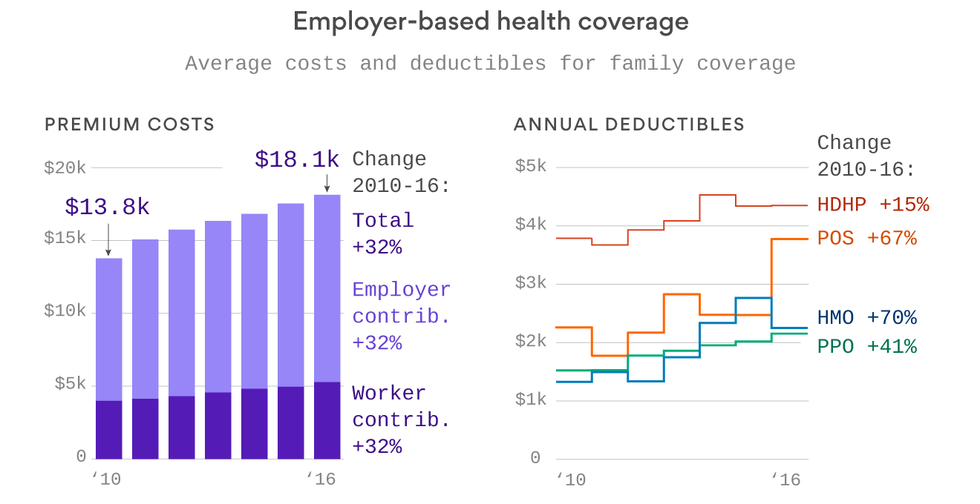
We’ve spent so much time talking about Affordable Care Act costs this year that it’s easy to forget what most people are actually paying for health care — the 156 million Americans who get their health coverage through the workplace. Turns out, most of us aren’t seeing sky-high premium increases. But it’s also worth remembering that deductibles matter too — because that’s what we pay out of pocket before insurance kicks in.

Take a look at these two graphics from Axios datavisuals genius Chris Canipe. The premium increases between 2010 and 2016 weren’t that bad — they’re single digits each year, and just add up over time. But you can see some big increases in deductibles, especially in point-of-service plans and HMOs.

Why it matters: That’s a big reason why people feel their health care costs going up, because it means they’re paying more out of pocket. And when prescription drug prices rise, they’re more likely to feel it directly.

Outside Of Washington, There Is A New Vital Center In Health Care Reform

http://healthaffairs.org/blog/2017/07/31/outside-of-washington-there-is-a-new-vital-center-in-health-care-reform/

Larissa Pisney of Denver joins others during a protest outside the office of U.S. Rep. Mike Coffman, R-Colo., over the health care overhaul bill up for a vote in the U.S. House Thursday, May 4, 2017, in Aurora, Colo. (AP Photo/David Zalubowski)

Republicans in Congress are mired in political quicksand. Following passage of the Affordable Care Act (ACA) in 2010, they locked themselves into a promise to repeal and replace it at the behest of ultra-conservative donors and party activists who control the GOP’s nomination process. Since 2010, however, Americans and rank-and-file Republicans increasingly came to expect help meeting the rising costs of medical care and insurance and to accept the ACA’s tangible programs to address these concrete challenges.

The Democrats created their own political trap. They passed the ACA on the promise of making health care affordable but deductibles and rising premiums continued to present a burden to many Americans.

Both parties are missing, however, the vital center on health reform that has formed since 2010. Americans are frustrated with Democrats for not delivering on their promise of affordability, and they are now alarmed with Republican efforts to repeal—instead of improve—the ACA’s coverage of costs.

Tracking Changes In Public Opinion

Most public opinion polls are unable to track these changes in opinion about health care because they are only snapshots, drawn from a moment in time. To remedy this, we have been gathering panel data, tracking the views of the same group of Americans every two years since the ACA’s passage in 2010. This equips us to study how individuals respond to the ACA as they experience or learn more about the law’s provisions over time. Specifically, we conducted four waves of interviews in the two-month period leading up to national elections from 2010 to 2016 when health reform received heightened attention; this avoided the risk of choosing an arbitrary month when health reform might have arbitrarily lost or gained salience.

The first wave was conducted by the Survey Research Institute (SRI) at Cornell University and consisted of a national sample of 1,200 adults. Abt SRBI (now part of Abt Associates) conducted the last three waves, returning to the same individuals. All waves asked identical questions and were administered by telephone, using only landlines in 2010 and adding mobile phones in 2012, 2014, and 2016. Forty-nine percent of the original 2010 survey (587 individuals) responded to all four waves. Survey weights were applied to each survey to match representative demographic targets and allow us to generalize from our panel to the adult population in the United States.

Why Americans Dislike Health Reform

Republicans have been eager to highlight the unpopularity of the Affordable Care Act, also known as “Obamacare.” Exhibit 1 shows that unfavorable assessments of the ACA have steadily increased since its passage. Unfavorability rose from 44 percent in 2010 to 58 percent in 2016.

Exhibit 1: Increasingly Unfavorable Views Of The Affordable Care Act (Percent)

Question: “As you may know, a major health care bill was signed into law in 2010. Given what you know about this law, do you have a generally favorable or generally unfavorable opinion of it, or do you have a neutral opinion, neither favorable nor unfavorable?” Exhibit 1 presents the “unfavorable” responses.

Why are Americans increasingly disenchanted with the ACA? The public’s displeasure emanates to a large extent from frustrations with health care costs. Democrats promised to lower the costs of medical care and insurance with the enactment of the ACA. They did succeed to slow the rate of increase in national health care spending and insulate most subsidized enrollees in its insurance Marketplace from premium increases, as the Congressional Budget Office reports (Note 1). Yet, the costs of medical care remain high, and premiums and deductibles are out of the reach of some Americans.

The source of the public’s rising frustration with health care costs is picked up in Exhibit 2. The first grouping of bars on the left shows increasing frustration with costs for medical treatments that are not covered by insurers. By 2016, 14 percent expressed dissatisfaction with the amount and number of treatments that their insurance covered, a 6-point increase from 2014. One-third of Americans also expressed dissatisfaction in 2016 with the out-of-pocket costs that they were forced to pay because of gaps in their insurance coverage, as shown in the middle cluster. This is an 8-point increase from 2014.

Exhibit 2: Rising Concerns About Affordability (Percent)

Question: Several questions asked respondents to indicate their satisfaction or dissatisfaction with individual features of the health care system—“The number and kind of treatments your health insurance will cover” and “The amount you spend out of pocket on health care costs your insurance doesn’t cover.” A separate item asked respondents to indicate their agreement or disagreement with the statement: “Public officials care about making health care more affordable for people like me.” (Exhibit 2 shows “disagreement” with the statement.)

The public’s disappointment with the persistent burden of health care costs leads it to blame lawmakers for a lack of responsiveness. The bars on the right in Exhibit 2 indicate that a growing majority of Americans disagree with the statement that, “Public officials care about making health care more affordable for people like me.” Fifty-eight percent of Americans disagreed with this statement in 2016, a 10-point increase since 2012.

In addition, the sense that the ACA has not delivered the affordability that Democrats promised may help account for the sharply stronger conclusion in recent years that the ACA’s taxes present a heavier burden. Exhibit 3 shows that the proportion of Americans who believe that their taxes have increased a lot or a little has risen from 43 percent in 2012 to 56 percent in 2016. This growing perception that the ACA has increased taxes rests on inaccurate assumptions. The ACA’s financing primarily relies on two taxes on individuals whose yearly income exceeds $200,000 or for married couples earning more than $250,000—an increase in Medicare’s tax on earnings by 0.9 percent and a new 3.8 percent tax on capital gains from investments. These taxes fall on less than 2 percent of tax filers, according to the non-partisan Tax Policy Center (Note 2).

Exhibit 3: Growing Perception That The Affordable Care Act Increased Taxes (Percent)

Question: “Do you think that the new health care law enacted in 2010 has increased the taxes that you pay, decreased the taxes that you pay, or has it had no impact on the taxes that you pay?”

Americans Oppose Repeal Because They Appreciate The Effects Of Health Reform

Considering the strong public disapproval of repeal, President Donald Trump and congressional Republicans are discovering that it is a mistake to equate the public’s frustrations with the ACA with support for repealing its programs. When respondents reported “unfavorable” views of the law, we followed up with a question asking them whether they would prefer either “repeal[ing] [the ACA] as soon as possible,” or “giving the law more time to have a chance to work, with lawmakers making necessary changes along the way.” In Exhibit 4, we combined those who favored giving it “a chance to work” with those who expressed “favorable” overall views of the law. This shows that since 2010 more Americans favored the law or wanted to give it time to be improved than backed repeal. Although support for repeal inched up since 2010, a greater percentage of Americans consistently favored the ACA and improving it over repeal by a 41-to-37 margin in 2010 and by 49-to-43 in 2016.

Exhibit 4: More Americans Prefer To Keep And Improve The Affordable Care Act Than Repeal It (Percent)

Question: This figure is based on two survey questions. The first is the following: “As you may know, a major health care bill was signed into law in 2010. Given what you know about this law, do you have a generally favorable or generally unfavorable opinion of it, or do you have a neutral opinion, neither favorable nor unfavorable?” Respondents who had an unfavorable view were asked a second question about their view about the law’s future: “The law should be given more time to have a chance to work, with lawmakers making necessary changes along the way, OR the law should be repealed as soon as possible?” The repeal bar reports responses from the second question; the other bar adds together favorable responses in the first question with the “law should be given more time” responses.

Support for keeping and improving the ACA stems from a growing appreciation for its concrete effects. Exhibit 5 shows that rising percentages pinpoint the ACA’s tangible programs as having either “a great deal” or “quite a bit” of an impact on themselves and their family (other options included “some,” “a little,” and “none”). There is greater recognition in 2016 compared to 2010 or 2012 of the impact of allowing parents with insurance to continue to cover their children until they are 26 years old. More than one in five Americans now report that the ACA expanded their access to health insurance. In addition, nearly one in four Americans, 24 percent, voiced appreciation for the impact of the ACA’s assistance to seniors to pay for prescription medications. Moreover, recognition of a personal impact resulting from the ACA’s tax credits and other subsidies to help people purchase health insurance has remained stable since 2014 and is higher than in earlier years.

Exhibit 5: Rising Appreciation Of The Impact Of The Affordable Care Act (Percent)

Question: “I’m going to read to you a list of some of the features of the health care law that was enacted in 2010. For each one, please answer this question: “How much of an impact has this feature had on you and your family: a great deal, quite a bit, some, a little, none?” Respondents are asked about the following features of health reform: coverage of adult children on their parents’ insurance plans until they are 26 years old; access to health insurance or medical care supported or provided by government; help for seniors to pay for prescription drugs; and tax credits and other subsidies to help people pay for health insurance. Exhibit 5 combines “a great deal” and “quite a bit.”

The New Vital Center On Health Reform

Overall evaluations of the ACA follow the partisan pattern that is familiar today: 68 percent of Democrats have favorable views versus 9 percent of Republicans. What stands out, however, is that the ACA’s tangible effects are starting to loosen rigid partisan dividing lines. Exhibit 6 shows the percentage of Americans reporting a personal impact from at least one of the four provisions presented in Exhibit 5. Democratic elected officials enacted the ACA, and, not surprisingly, majorities of rank-and-file Democrats have generally singled out the law’s effects from early on: 51 percent of Democrats reported an impact from at least one of the law’s features in 2010; by 2016, this recognition remained largely stable, inching up to 54 percent. Strikingly, however, the percentage of Republicans perceiving an impact on themselves or their families has increased by 8 percentage points, from 26 percent in 2010 to 34 percent in 2016 despite vociferous GOP attacks on the ACA. Among independents, the proportion soared by 23 points, from 28 percent to 51 percent. These findings indicate that appreciation for the ACA has expanded beyond the ranks of Democratic partisans who were predisposed to favor it; growing numbers of Americans across the political spectrum increasingly value the impacts of health reform in their own lives.

Exhibit 6. Widening Appreciation Of The Affordable Care Act’s Impact (Percent Reporting Impact Of A New Benefit)

Exhibit 6 presents the percentage of respondents who reported that at least one of the four provisions presented in Exhibit 5 had a “great deal” or “quite a bit” of impact on themselves or their family.

The crux of the public discontent with the ACA—and the repeal proposals by Republicans—is the amount paid for insurance coverage. Respondents to the survey appear to share the complaint of ACA critics that insurance costs are too high. After high expectations following the ACA’s enactment, satisfaction with the cost of health coverage has dropped by 10 points—from 73 percent satisfied in 2010 to 63 percent in 2016. This general assessment misses, however, a crucial condition—whether or not individuals are covered by government programs such as Medicare, Medicaid, or a subsidy financed by the ACA. We found a striking pattern among Republicans, Democrats, and independents: By a margin of 20 points or more, individuals with government coverage were consistently more satisfied with the cost of insurance than those who rely on private health plans. For instance, 79 percent of Republicans with government coverage were content with insurance costs as compared to 56 percent without this coverage. Independents outside the sway of either major party expressed the highest satisfaction when experiencing government coverage (100 percent) and exhibit the largest gap between those covered and those without coverage (41 points).

In short, Republican public officials continue to spotlight what they perceive as the disappointment of Americans with ACA coverage, but the reality is that the most dissatisfied are those who lack government insurance. In fact, most Americans (including Republicans) who benefit from government insurance are content with their coverage.

Health Reform’s New Vital Center

Public opinion toward the ACA has been poorly understood because of an apparent contradiction. On the one hand, a growing share of the public harbor unfavorable views of the ACA as a whole, and proponents of repeal have seized on this dissatisfaction to claim a popular mandate. On the other hand, the discontent of Americans stemmed from disappointment with the ACA for not satisfying their expectations of genuine protection from the burden of costs. Far from wanting to be rid of the ACA, Americans are looking to it to deliver more effective protection.

In the immediate aftermath of World War II, the historian Arthur Schlesinger, Jr., wrote of the “vital center” about the direction of America that was supported by both major political parties and most Americans. Despite today’s fractiousness in Washington over health reform, everyday Americans are converging toward a new vital center of support for health care reform.

Awareness of the ACA’s tangible impacts fits into a robust notion of collective responsibility instead of the individualist approach advocated by conservatives. Since the ACA’s passage, nearly nine out of 10 Americans have consistently embraced access to health care as a “basic right.” Not surprisingly, nearly all Democrats embrace the principle of health care as a right. What stands out is that rank-and-file Republicans overwhelming and increasingly hold the same view—rising from 64 percent in 2010 to 72 percent in 2016. Contrary to the position of Washington Republicans, establishing health care as a birthright owed to Americans is now widely shared. Republican proposals, such as those that would allow states to opt out of some of the ACA’s core consumer protections (including those guaranteeing coverage for individuals with preexisting medical conditions), may well tap into this strain of public opinion and provoke broad opposition.

Elected officials in Washington and, particularly, steadfast opponents of health reform are sliding to the margins of public opinion. The daily problems that Americans face in paying for medical care and insurance mean that pragmatism is trumping ideology. In the past, federal lawmakers responded to broad public agreement and worked across the aisle to improve the flaws in the original legislation that produced Social Security in 1935 and Medicare in 1965. The question today is whether Washington can return to that pragmatic tradition and catch up to the emerging vital center in Americans’ attitudes toward health reform.

Note 1

Congressional Budget Office. American Health Care Act: cost estimate. Washington (DC): CBO; 2017 Mar 13.

Note 2

Tax Policy Center. Tax units above and below the $250,000/$200,000 threshold, 2013–2022. Washington (DC): TPC; 2012 Nov 26

U.S. governors urge Trump to make insurance payments

https://www.reuters.com/article/us-usa-healthcare-idUSKBN1AI28L

Image result for U.S. governors urge Trump to make insurance payments

Democratic and Republican U.S. governors on Wednesday urged the Trump administration, as well as Congress, to continue funding payments to health insurance companies that make Obamacare plans affordable, calling it critical to stabilizing the insurance marketplace.

Republican President Donald Trump, frustrated that Obamacare survived attempts to repeal it, has threatened to cut off about $8 billion in subsidies that help control costs for low-income Americans under the Affordable Care Act, Democratic former President Barack Obama’s signature domestic initiative.

“The Administration has the opportunity to stabilize the health insurance market across our nation and ensure that our residents can continue to access affordable health care coverage,” said a statement by the Health and Human Services Committee of the National Governors Association.

“A first critical step … is to fully fund CSRs (cost-sharing reduction payments) for the remainder of calendar year 2017 through 2018,” the statement said, adding this was needed as Congress and the administration address long-term reform efforts.

The committee is led by Virginia Governor Terry McAuliffe, a Democrat, and Massachusetts Governor Charlie Baker, a Republican. Earlier this year, the governors sent a letter calling on Congress to fully fund the cost-sharing payments.

Some Congressional Republicans have joined Democrats in urging Trump to continue the payments. Republican Senator Lamar Alexander, chairman of the health committee, said Tuesday the president should pay the subsidies through September while lawmakers work on bipartisan legislation to fund the outlays for another year.

But the Senate’s No. 2 Republican John Cornyn hesitated when asked Wednesday if he would support such legislation.

“I’ve said before that I’m not in favor of throwing money at insurance companies without reform, so that’s going to be the nature of the conversation,” Cornyn told reporters outside his office.

Asked what reforms he’d like to see, Cornyn mentioned the “skinny” Obamacare repeal bill the Senate voted down last week. Among other things, it would have repealed the requirement that every American have health insurance or pay a penalty.

Insurers say that the cost-sharing payments are passed onto customers in the form of lower deductibles and co-pays that make care more affordable for low income Americans.

Insurers are finalizing 2018 premium rates for the individual Obamacare market, with many saying their decision hinges on government guarantees for cost-sharing subsidies.

Molina Healthcare Inc said on Wednesday it would stop selling Obamacare plans in Utah and Wisconsin, joining a slew of health insurers that have exited Obamacare markets amid uncertainty over the healthcare law.

Anthem Inc, one of the largest sellers of these plans in 2017, has pared back offerings or mostly exited five states including California and may exit more.

White House budget director Mick Mulvaney told CNN the administration was still considering whether to end cost-sharing subsidies.


Bipartisan drive to pay health insurers faces Senate hurdles

http://abcnews.go.com/Health/wireStory/bipartisan-drive-pay-health-insurers-faces-senate-hurdles-48995691

Image result for political hurdles

A bipartisan Senate effort to continue federal payments to insurers and avert a costly rattling of health insurance markets faces a dicey future. The uncertainty shows that last week’s wreck of the Republican drive to repeal the Affordable Care Act hasn’t blunted the issue’s sharp-edged politics.

President Donald Trump is threatening to halt the payments in hopes of forcing Democrats to negotiate an end to the Obama-era law. The insurance industry and lawmakers from both parties say blocking the money would lead insurers to raise premiums for people buying individual policies and might induce companies to abandon some markets.

Into the fray has stepped Sen. Lamar Alexander, R-Tenn., chairman of the Senate Health, Education, Labor and Pensions Committee.

He said he will work with the committee’s top Democrat, Sen. Patty Murray of Washington state, on a bill next month that would pay insurers through 2018. In exchange, he wants Democrats to agree to make it easier for states to choose their own health coverage standards that insurers must provide, and not heed consumer-friendly requirements of former President Barack Obama’s law.

While that is an idea Democrats say they will discuss, it’s unclear whether the two parties can reach a deal.

For the GOP’s failed effort to repeal and replace Obama’s overhaul, Senate Republicans used special rules allowing passage by a simple majority. But this developing bill would need 60 votes to succeed. Republicans hold a 52-48 advantage in the Senate, which means Democratic backing will be crucial.

Democrats will be reluctant to strike an agreement that would pull back far on Obama’s protections, which include a set of services insurers must cover and guarantees that premiums for healthy and seriously ill people are equal.

“It’s going to be hard to get common ground,” said Sen. Chris Murphy, D-Conn., a committee member. “Republicans are going to want some initial flexibility” for coverage requirements, “and that’s not an easy thing to achieve.”

Republicans are divided, too.

Many, including Trump, have called the payments an insurers’ bailout. Conservatives are reluctant to continue payments to help sustain a law the GOP has pledged for years to toss out.

“I was a total repeal guy,” said Sen. Richard Shelby, R-Ala. “I don’t know if I want to prop it up.”

Added GOP Sen. Ted Cruz of Texas: “I think it’s a mistake to bail out insurance companies.”

Obama’s law requires insurers to reduce out-of-pocket costs such as deductibles and copayments for millions of low- and middle-income customers. It also requires the government to reimburse insurers for those costs.

But a federal court found that Congress hasn’t properly approved money to do that. Both Obama and Trump have continued making the payments as the case has dragged on.

Besides the outright opponents, some Republicans say they would be reluctant to support an Alexander bill unless whatever eased regulations Democrats agree to are worthwhile. It’s unclear what Alexander or other Republicans are willing to accept.

“We certainly should get some structural change to bring down premiums in exchange for that,” said Sen. Ron Johnson, R-Wis. “We can’t just throw money at the problem.”

That echoes what Senate Majority Leader Mitch McConnell, R-Ky., said last Friday after the Senate rejected the third health proposal he advanced, effectively sinking the repeal effort.

“Bailing out insurance companies with no thought of any kind of reform is not something I want to be part of,” McConnell said.

Alexander said Wednesday that he has kept McConnell apprised of his effort. Asked if he had received a commitment that McConnell would bring such legislation to the full Senate, Alexander said, “Well, he doesn’t know what bill we’re going to have.”

But Alexander does have allies.

“We’ll eventually repeal Obamacare and put something in its place,” said Sen. John Kennedy, R-La. “In the meantime, I think it’s very important not to see any Americans get hurt.”

If the GOP divisions persist, McConnell and House Speaker Paul Ryan, R-Wis., might have to decide whether to have votes on legislation opposed by substantial numbers of Republicans. That’s always an uncomfortable proposition for party leaders.

“That’s a question for McConnell,” said the second-ranking Democratic senator, Illinois’ Dick Durbin, said asked whether he thought the GOP leader would allow a vote on a bill opposed by many Republicans.

Durbin said if Republicans are truly concerned about keeping insurance markets stable, “they have to do something.”

Would Ryan support a measure like Alexander’s?

The speaker “believes repeal and replace is the best course of action and that the Senate needs to act,” spokeswoman AshLee Strong said.