12 health systems with strong finances

https://www.beckershospitalreview.com/finance/12-health-systems-with-strong-finances-031219.html


Here are 12 health systems with strong operational metrics and solid financial positions, according to recent reports from Moody’s Investors Service, Fitch Ratings and S&P Global Ratings.

1. Dallas-based Baylor Scott & White Health has an “Aa3” rating and stable outlook with Moody’s. The health system has strong cash flow margins, and its favorable demographics will contribute to volume and revenue growth, according to Moody’s.

2. Newark, Del.-based Christiana Care has an “Aa2” rating and stable outlook with Moody’s. The health system has solid margins and a robust balance sheet, according to Moody’s.

3. Durham, N.C.-based Duke University Health System has an “Aa2” rating and stable outlook with Moody’s. The health system is a leading provider of tertiary and quaternary services and has solid margins and cash levels, according to Moody’s.

4. Chicago-based Northwestern Memorial HealthCarehas an “Aa2” rating and stable outlook with Moody’s. Moody’s expects that the health system’s operating model and comprehensive IT systems will enable it to execute growth strategies while maintaining strong margins.

5. Winston-Salem, N.C.-based Novant Health has an “Aa3” rating and stable outlook with Moody’s. The credit rating agency expects Novant to continue generating strong cash flow margins in favorable markets.

6. Boston-based Partners HealthCare has an “Aa3” rating and stable outlook with Moody’s and an “AA-” rating and stable outlook with S&P. The health system has an excellent reputation in the clinical and research spaces, a long track record of fundraising, and adequate balance sheet measures, according to Moody’s.

7. St. Louis-based SSM Health Care has an “AA-” rating and stable outlook with Fitch. SSM has a strong financial profile, and Fitch expects the system to continue growing unrestricted liquidity and to maintain improved operational performance.

8. Appleton, Wis.-based ThedaCare has an “AA-” rating and stable outlook with Fitch. The health system has a leading market share in a stable service area and strong operating performance, according to Fitch.

9. Cincinnati-based TriHealth has an “AA-” rating and stable outlook with Fitch. Fitch expects the health system to maintain good operating ratios, leading to liquidity growth.

10. Iowa City-based University of Iowa Hospitals & Clinics has an “Aa2” rating and stable outlook with Moody’s. The system’s strong brand and position as the only academic medical center in Iowa will continue to translate into strong market share and high patient demand, according to Moody’s.

11. York, Pa.-based WellSpan Health has an “AA-” rating and stable outlook with Fitch. The health system has a leading market position in south-central Pennsylvania and a strong financial profile, according to Fitch.

12. Yale New Haven (Conn.) Health has an “Aa3” rating and stable outlook with Moody’s. The health system has a leading market position in Connecticut, with a broad reach for tertiary and quaternary patients from throughout the state, and strong brand recognition, according to Moody’s.


IBM Watson names 100 top hospitals

https://www.prnewswire.com/news-releases/ibm-watson-health-announces-100-top-hospitals-300805633.html

https://www.beckershospitalreview.com/rankings-and-ratings/ibm-watson-names-100-top-hospitals.html

Image result for ibm watson top 100 hospitals

2019 Study Finds Top-Performing U.S. Hospitals Provide Better Care at Lower Cost and Higher Profit Margins than Peers Evaluated in the Study

ARMONK, N.Y.March 4, 2019 /PRNewswire/ — IBM Watson Health™ (NYSE: IBM) today published its 100 Top Hospitals® annual study identifying top–performing hospitals in the U.S. This study spotlights the best–performing hospitals in the U.S. based on a balanced scorecard using publicly available data for clinical, operational, and patient satisfaction metrics. The study is part of IBM Watson Health’s commitment to leveraging science and data to advance health and it has been conducted annually since 1993.

Overall, the Watson Health 100 Top Hospitals® study found that the top-performing hospitals in the country achieved better risk-adjusted outcomes while maintaining both a lower average cost per patient and higher profit margin than peer group hospitals that were part of the study.

“At a time when research shows that the U.S. spends nearly twice as much on healthcare as other high-income countries, yet has less effective population health outcomes1, the 100 Top Hospitals are setting a different example by delivering consistently better care at a lower cost,” said Ekta Punwani, 100 Top Hospitals® program leader at IBM Watson Health.

Kyu Rhee, M.D., M.P.P., vice president and chief health officer at IBM Watson Health, added: “From small community hospitals to major teaching hospitals, these diverse hospitals have demonstrated that quality care, higher patient satisfaction, and operational efficiency can be achieved together. In this era of big data, analytics, transparency, and patient empowerment, it is essential that we learn from these leading hospitals and work to spread their best practices to our entire health system which could translate into over 100K more lives saved, nearly 40K less complications, over 150K fewer readmissions, and over $8 billion in savings.”

Following were the key performance measurements on which 100 Top Hospitals showed the most significant average outperformance versus non-winning peer group hospitals (full study results available here):

  • Higher Survival Rates: The 100 Top Hospitals winners achieved survival rates that were 24.9 percent higher than those of peer hospitals.
  • Fewer Complications and Infections: Patients at winning hospitals experienced 18.7 percent fewer complications and 19.3 percent fewer healthcare-associated infections than peer group hospitals.
  • Shorter Length of Stay: Winning hospitals had a median severity-adjusted length of stay that was one half-day shorter (0.5) than peers.
  • Shorter Emergency Department Wait Times: Overall, winning hospitals delivered median emergency department wait times that were 17.3 minutes shorter than those of peer group hospitals.
  • Lower Inpatient Expenses: Average inpatient costs per discharge were 11.9 percent lower (a difference of $830 per discharge) at 100 Top Hospitals versus peer group hospitals.
  • Higher Profit Overall Margins: Winning hospitals maintained a median operating profit margin that was 11.9 percentage points higher than peer group hospitals.
  • Higher Patient Satisfaction: Overall hospital experience, as measured by the Hospital Consumer Assessment of Healthcare Providers and Systems (HCAHPS), was rated 3 percent higher for winning hospitals than peer group hospitals.

The IBM Watson Health 100 Top Hospitals winners outperformed peer group hospitals within all 10 clinical and operational performance benchmarks evaluated in the study: risk-adjusted inpatient mortality index, risk-adjusted complications index, mean healthcare-associated infection index, mean 30-day risk-adjusted mortality rate, mean 30-day risk-adjusted readmission rate, severity-adjusted length of stay, mean emergency department throughput, case mix- and wage-adjusted inpatient expense per discharge, adjusted operating profit margin, and HCAHPS score.

Extrapolating the results of this year’s study, if all Medicare inpatients received the same level of care as those treated in the award-winning facilities:

  • More than 103,000 additional lives could be saved;
  • More than 38,000 additional patients could be complication-free;
  • More than $8.2 billion in inpatient costs could be saved; and
  • Approximately 155,000 fewer discharged patients would be readmitted within 30 days.

In addition to the 100 Top Hospitals, the IBM Watson Health study also recognizes the 100 Top Hospitals Everest Award winners. These are hospitals that earned the 100 Top Hospitals designation and also are among the 100 top for rate of improvement during a five-year period. This year, there are 15 Everest Award winners.

To conduct the 100 Top Hospitals study, IBM Watson Health researchers evaluated 3,156 short-term, acute care, non-federal U.S. hospitals. All research was based on the following public data sets: Medicare cost reports, Medicare Provider Analysis and Review (MEDPAR) data, and core measures and patient satisfaction data from the Centers for Medicare & Medicaid Services (CMS) Hospital Compare website. Hospitals do not apply for awards, and winners do not pay to market this honor.

For more information, visit www.100tophospitals.com.

Here are the winning hospitals, by category, with asterisks indicating the Everest Award winners:

Major Teaching Hospitals

Advocate Illinois Masonic Medical Center – Chicago, IL
Ascension Providence Hospital  – Southfield, MI
Banner – University Medical Center Phoenix – Phoenix, AZ
Cedars-Sinai Medical Center – Los Angeles, CA
Garden City Hospital – Garden City, MI*
Mayo Clinic Hospital – Jacksonville, FL
Mount Sinai Medical Center – Miami Beach, FL
NorthShore University HealthSystem – Evanston, IL
Saint Francis Hospital and Medical Center – Hartford, CT
Spectrum Health Hospitals – Grand Rapids, MI
St. Joseph Mercy Hospital – Ann Arbor, MI*
St. Luke’s University Hospital – Bethlehem – Bethlehem, PA
The Miriam Hospital – Providence, RI
UCHealth University of Colorado Hospital – Aurora, CO*
University of Utah Hospital – Salt Lake City, UT

Teaching Hospitals

Abbott Northwestern Hospital – Minneapolis, MN
Aspirus Wausau Hospital – Wausau, WI
Brandon Regional Hospital – Brandon, FL
BSA Health System – Amarillo, TX
CHRISTUS St. Michael Health System – Texarkana, TX*
Good Samaritan Hospital – Cincinnati, OH
Lakeland Medical Center – St. Joseph, MI
Mercy Hospital St. Louis – St. Louis, MO
Monmouth Medical Center – Long Branch, NJ
Morton Plant Hospital – Clearwater, FL
Mount Carmel St. Ann’s – Westerville, OH
Park Nicollet Methodist Hospital – St. Louis Park, MN
Parkview Regional Medical Center – Fort Wayne, IN*
PIH Health Hospital – Whittier – Whittier, CA
Riverside Medical Center – Kankakee, IL
Rose Medical Center – Denver, CO*
Sentara Leigh Hospital – Norfolk, VA*
Sky Ridge Medical Center – Lone Tree, CO
SSM Health St. Mary’s Hospital – Madison – Madison, WI
St. Luke’s Hospital – Cedar Rapids, IA
St. Mark’s Hospital – Salt Lake City, UT*
Sycamore Medical Center – Miamisburg, OH
UCHealth Poudre Valley Hospital – Fort Collins, CO
Utah Valley Hospital – Provo, UT*
West Penn Hospital – Pittsburgh, PA

Large Community Hospitals

Advocate Sherman Hospital – Elgin, IL*
Banner Del E. Webb Medical Center – Sun City West, AZ
Baylor Scott & White Medical Center – Grapevine – Grapevine, TX
Hoag Hospital Newport Beach – Newport Beach, CA
IU Health Bloomington Hospital – Bloomington, IN*
Mease Countryside Hospital – Safety Harbor, FL
Memorial Hermann Memorial City Medical Center – Houston, TX
Mercy Health – Anderson Hospital – Cincinnati, OH
Mercy Health – St. Rita’s Medical Center – Lima, OH
Mercy Hospital  – Coon Rapids, MN
Mercy Hospital Oklahoma City – Oklahoma City, OK
Northwestern Medicine Central DuPage Hospital – Winfield, IL
Sarasota Memorial Hospital – Sarasota, FL
Scripps Memorial Hospital La Jolla – La Jolla, CA
St. Clair Hospital – Pittsburgh, PA
St. David’s Medical Center – Austin, TX
St. Joseph’s Hospital – Tampa, FL*
Texas Health Harris Methodist Hospital Southwest Fort Worth – Fort Worth, TX
University of Maryland St. Joseph Medical Center – Towson, MD
WellStar West Georgia Medical Center – LaGrange, GA

Medium Community Hospitals

AdventHealth Wesley Chapel – Wesley Chapel, FL
Dupont Hospital – Fort Wayne, IN
East Cooper Medical Center – Mt. Pleasant, SC
East Liverpool City Hospital – East Liverpool, OH*
Garden Grove Hospital Medical Center  – Garden Grove, CA
IU Health North Hospital – Carmel, IN
IU Health West Hospital – Avon, IN
Logan Regional Hospital – Logan, UT
Memorial Hermann Katy Hospital – Katy, TX
Mercy Health – Clermont Hospital – Batavia, OH
Mercy Hospital Northwest Arkansas – Rogers, AR
Mercy Medical Center – Cedar Rapids, IA
Montclair Hospital Medical Center – Montclair, CA
Mountain View Hospital – Payson, UT
Northwest Medicine Delnor Hospital – Geneva, IL
St. Luke’s Anderson Campus – Easton, PA
St. Vincent’s Medical Center Clay County – Middleburg, FL
UCHealth Medical Center of the Rockies – Loveland, CO
West Valley Medical Center – Caldwell, ID
Wooster Community Hospital – Wooster, OH

Small Community Hospitals

Alta View Hospital – Sandy, UT
Aurora Medical Center – Two Rivers, WI
Brigham City Community Hospital – Brigham City, UT
Buffalo Hospital – Buffalo, MN
Cedar City Hospital – Cedar City, UT
Hill Country Memorial Hospital – Fredericksburg, TX
Lakeview Hospital – Bountiful, UT
Lone Peak Hospital – Draper, UT
Marshfield Medical Center – Rice Lake, WI
Nanticoke Memorial Hospital – Seaford, DE
Parkview Noble Hospital – Kendallville, IN
Parkview Whitley Hospital – Columbia City, IN*
Piedmont Mountainside Hospital – Jasper, GA
San Dimas Community Hospital – San Dimas, CA
Seton Medical Center Harker Heights – Harker Heights, TX
Southern Tennessee Regional Health System – Lawrenceburg, TN
Spectrum Health Zeeland Community Hospital – Zeeland, MI
St. John Owasso Hospital – Owasso, OK
St. Luke’s Hospital – Quakertown – Quakertown, PA
Stillwater Medical Center – Stillwater, OK*


Healthcare Triage: Hospital Competition Can Impact Your Health

Healthcare Triage: Hospital Competition Can Impact Your Health

Image result for Healthcare Triage: Hospital Competition Can Impact Your Health

It turns out, hospital and health system consolidations can result in worse outcomes for patients. These mergers reduce competition, and it turns out that hospitals compete more often on quality than they do on prices. The result is that quality suffers in markets with less competition.


CEOs shouldn’t pick their replacements

https://www.beckershospitalreview.com/hospital-management-administration/viewpoint-ceos-shouldn-t-pick-their-replacements.html?origin=ceo&utm_source=ceoe

Image result for ceo succession

While CEOs may be intimately familiar with their companies, their opinion should take a backseat to the organization’s board of directors, according to Stanford (Calif.) University business school professor David Larcker, PhD, and researcher Brian Tayan.

In an op-ed for The Wall Street Journal, the authors note that while it was once general practice for CEOs to pick their successors, changes to corporate governance in recent years have shifted the balance of power to a company’s “independent, professional, outside directors.”

The authors claim that allowing a company’s CEO outsize influence on the hiring of their successor is a mistake because the CEO may not have the right perspective on evaluating candidates and may intentionally or unintentionally control the information presented to the board about candidates, shaping the board’s decision about those individuals.

“At the end of a long career, many CEOs are concerned about their legacy. This can bias them toward favoring candidates who will guide the company in the same direction — and in the same manner — that they themselves led it,” they write.

Instead, the authors argue that a company’s board should be responsible for the final hiring decision and use the CEO’s input to help come to that conclusion.

“Hiring the CEO is a fiduciary duty. The board owes it to the shareholders … to get it right. A subcommittee of independent directors with previous experience in succession at other companies should manage the process, with an open invitation to all board members to participate. If the board doesn’t have depth of experience in place, it can bring in an outside adviser to help,” they write.

To access the full report, click here.


Tenet’s patient volumes face sustained pressure

https://www.healthcaredive.com/news/tenets-patient-volumes-face-sustained-pressure/549171/

Image result for headwinds

Dive Brief:

  • Tenet Health reported Monday patient volumes continue to slide for both inpatient and outpatient units for the fourth quarter and full-year. Looking at volumes on a same facility basis, which accounts for the sale of facilities, total admissions declined nearly 3% in the fourth quarter compared to 2017 and fell nearly 2% in 2018 compared to 2017. Still, the hospital operator beat analyst expectations for its fourth quarter revenue and earnings per share.
  • Hospital segment fourth quarter revenue fell nearly 8% to $3.8 billion from 2017 due to hospital sales last year and the California Provider Fee program. The ambulatory segment reported a modest increase in revenue to $554 million. And client losses in the Conifer RCM segment, which Tenet is looking to sell, caused revenue to dip nearly 6% compared with the fourth quarter in 2017.
  • Overall, for the full year, revenue declined nearly 5% from 2017, while net income improved to $111 million compared to a net loss of $704 million in 2017

Dive Insight:

Hospitals throughout the country continue to face a number of headwinds affecting patient volumes, particularly inpatient admissions. But Tenet reported volume declines for nearly every patient measure, including outpatient visits. 

Tenet’s competitor CHS also reported a drop in total admissions for the year, although CHS’ was much steeper.

While analysts with Jefferies said the softening of patient volumes for Tenet was of concern, the company also delivered strong payer-mix growth and increased hospital profit margins, which underscores “(management’s) progress in delivering cost efficiencies,” the investment bank’s analysts wrote in a note.

CEO Ronald Rittenmeyer told investors Tuesday the company is entering 2019 with a renewed sense of urgency around volume growth. Tenet’s chief operating officer will be tasked with improving organic growth at the system’s hospitals, he said.

Rittenmeyer also outlined the priorities for 2019, which include expanding its ambulatory business, adding new physicians and improving operations to win over patient loyalty. He added the company will look to develop its brand image by delivering the “same unified message” in advertising in its markets around the country.

Tenet disclosed it may have found a buyer or partner for its Conifer business, though executives could not offer any specifics. “We have recently entered into exclusivity with one of the parties that has been engaging with us. While there can be no assurance that this negotiation will result in a transaction we are very pleased with this progress,” Rittenmeyer said.

Tenet also released its guidance for 2019. It expects to generate revenue between $18 billion and $18.4 billion while its window for net income is expected to be between $15 million and $115 million.

Rittenmeyer called 2018 “a year of significant change for the company,” and pledged “additional progress in each of our business segments in 2019 in line with our plan to deliver long-term sustainable growth.”


DOCS GENERATE AN AVERAGE $2.4M A YEAR PER HOSPITAL

https://www.healthleadersmedia.com/finance/docs-generate-average-24m-year-hospital

Family physicians provide an excellent ROI, earning an average $241,000 as a starting salary but generating nine times that amount in hospital revenues.


KEY TAKEAWAYS

Invasive cardiologists were No. 2 on the list of money makers for hospitals, generating an average of $3.5 million, followed by neurosurgeons at $3.4 million, and orthopedic surgeons at $3.3 million.

The average net revenue generated by all physicians in the survey, $2,378,727, is up 52% from 2016.

The increase in net revenues was attributed to more outpatient visits, higher costs per hospital stay, and sicker patients as the population ages.

Physicians each generate an average of nearly $2.4 million in revenues annually for their hospitals, a new survey finds.

Cardiovascular surgeons, on average, generated $3.7 million for their hospitals, topping the list of money makers among the 18 specialties examined in the survey of hospital chief financial officers, which was conducted by Dallas-based physician recruiters Merritt Hawkins.

The money includes net inpatient and outpatient revenue derived from patient hospital admissions, tests, treatments, prescriptions, and procedures performed or ordered by physicians.

“The value of physician care is not only related to the quality of patient outcomes,” said Travis Singleton, Merritt Hawkins’ executive vice president.

“Physicians continue to drive the financial health and viability of hospitals, even in a healthcare system that is evolving towards value-based payments,” Singleton said.

Invasive cardiologists were No. 2 on the list of money makers for hospitals, generating an average of $3.5 million, followed by neurosurgeons at $3.4 million, and orthopedic surgeons at $3.3 million.

Primary care physicians pulled their weight too, according to the survey.  Family physicians generate an average of $2.1 million in net revenue, while general internists generate an average of almost $2.7 million.

The average net revenue generated by all physicians in the survey, $2,378,727, is up 52% from 2016, the last year Merritt Hawkins conducted the survey.

Average revenue generated by each of the 18 medical specialties included in the survey increased compared to 2016, in most cases significantly.

Even though inpatient stays declined or flat-lined in recent years, Singleton attributed the increase in net revenues to more outpatient visits, which have more than tripled since 1975,   higher costs per hospital stay, and sicker patients as the population ages.

“Demographics are our destiny,” Singleton said. “New delivery models that promote prevention, population health and fee-for-value are laudable innovations but they don’t change the basic facts.  People get older and require more medical care, with much of it ordered by or directly provided by physicians.”

While primary care physicians are not the top revenue generators for their hospitals, Singleton says they represent an excellent return on investment.

Family physicians average $241,000 as a starting salary, according to Merritt Hawkins’ data, but they generate nine times that amount in hospital revenues. Orthopedic surgeons, with an average starting salary of $533,000, generate six times that amount for their hospitals.

“PHYSICIANS CONTINUE TO DRIVE THE FINANCIAL HEALTH AND VIABILITY OF HOSPITALS, EVEN IN A HEALTHCARE SYSTEM THAT IS EVOLVING TOWARDS VALUE-BASED PAYMENTS.”


Narrowing choice to curb rising employer spend

https://gisthealthcare.com/weekly-gist/

When Presbyterian Health System struck a deal with Intel to manage care for the firm’s Albuquerque employees, followed by Providence Health & Service’s ACO-like contract to provide care to Boeing employees in Seattle, we became optimistic about the potential of direct contracting between health systems and large employers.

But five years after those landmark deals, we were still just talking about Boeing and Intel. Few other employers followed suit, instead preferring to control spend by shifting more of the cost of coverage onto their employees in the form of higher deductibles, larger co-pays, and greater co-insurance.

In 2018 the average family deductible in employer-sponsored insurance hit $3,000, and in most markets deductibles of $5,000 or higher are not uncommon. Our recent conversations with employers suggest that they are now questioning the utility of shifting more costs onto employees. As deductibles rise, employers see diminishing returns. In contrast to instituting the first $1,000 deductible, moving an already high deductible from $3,000 to $4,000 does little to change employee behavior. And employers are genuinely worried about the impact of rising cost sharing on their employee’s financial and physical health.

Given the historically strong labor market, employers have been reticent to change benefit design in any way that could be perceived as narrowing choice. But the reluctance to push cost sharing further creates an opening for providers and innovators that offer alternative solutions to encourage employees to choose a “high-performance network”—the new term of art for a narrow network.

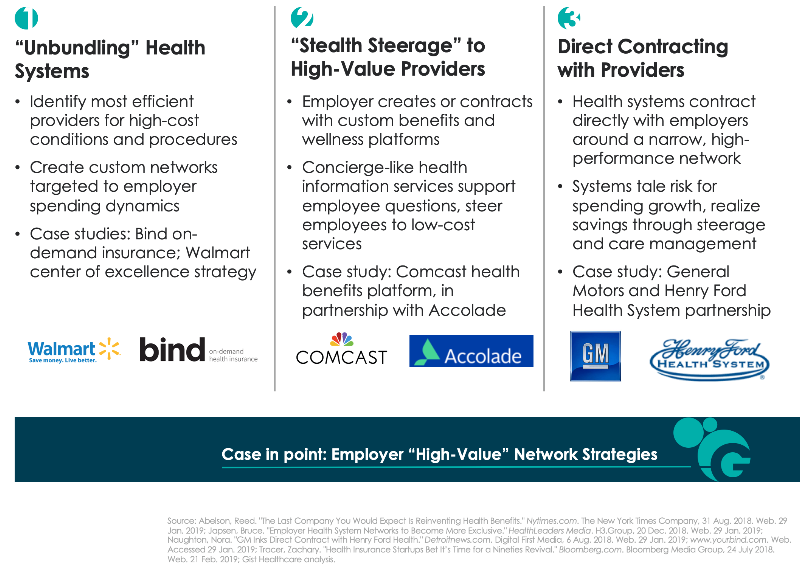
Across the past year we’ve seen a range of strategies to create high-performance networks, described in the graphic below. The pace of direct contracting between health systems and employers has quickened. But other solutions challenge the premise that a single health system provides the best solution for every high-cost condition or procedure. Start-up insurer Bind aims to create bespoke networks for high-cost procedures by identifying the best doctors and hospitals regardless of affiliation, essentially “unbundling” the health system. Others, like health benefits solution provider Accolade, create a concierge-like service to support employee decision-making—while preferentially steering them to lower-cost providers.

It remains to be seen which of these solutions will produce the greatest returns, and whether the gains can be sustained over time. However, we wonder whether companies will really have the fortitude to engage employees in conversations about narrower networks. Many will likely prefer to shift the task of narrowing networks onto employees themselves; we still believe that defined contribution health benefits will be the ultimate solution for employers to manage spend. It’s likely employers will require the cover of a recession to make this dramatic switch in benefit design. In the interim, there seems to be a window of opportunity for high-performance network assemblers to demonstrate that they can be an attractive and effective solution to rising costs.


Moving beyond the “best practice” mindset

https://gisthealthcare.com/weekly-gist/

Image result for best practice

Here’s a question we get all the time, and one that I heard again this week from one of our partner health systems: “We’re working on [initiative X]. What have other health systems like us done about that?” We hear it in any number of situations, from hospitals developing clinical protocols to strategic planners putting together business plans for service line growth. Sometimes the question comes in different forms: “Do you have a white paper on [topic X]?”; or “What research do you have on [issue X]?”; or our favorite, “What’s the best practice for [activity X]?”

It’s not surprising, given our past history, that we’d frequently be asked to provide research or best practice information. But as we’ve grown our own business at Gist Healthcare and developed our own independent perspective on where our industry needs to go, we’ve become less and less impressed by “best practice” as a concept. In fact, I’d go so far as to say that “best practice” has become at best a crutch, and in many cases a hindrance, to real progress in healthcare. As we sometimes tell our clients now, healthcare has outgrown “best practice”, at least as we used to understand it.

Don’t get me wrong. Medicine should absolutely be evidence-driven, and clinical care should always be firmly grounded in proven practice. If anything, the actual clinical practice of medicine is one area where our industry must become more, not less, best-practice based.

But as to system strategy, payment innovation, service improvement, and a host of other business and operational issues, simply imitating what other “successful” organizations are doing leads inevitably to reversion to the mean, groupthink, and (most troubling) fad-driven “bubbles” of activity. It’s no surprise, given the pervasive culture of “best practice”, when suddenly every health system’s top priority turns to creating a patient portal, or hiring a chief experience officer, or starting a proton beam center, or opening freestanding EDs.

Healthcare delivery is a highly fragmented, insular business, with little visibility across markets and across institutions. That makes it very susceptible to white paper-driven trend chasing, which tends to outsource innovation to the “wisdom of the crowd”.

It’s pretty rare to find mavericks, following their own innovation instincts without getting caught up in trying to mimic what other “leaders” are doing. That’s why when a delivery organization takes a risk on a truly new strategic innovationGeisinger’s money-back guarantee, Cleveland Clinic’s promise of same-day access, Presbyterian’s direct contract to manage Intel employees’ health—it immediately sends shock waves across the industry.

Those ideas didn’t come from a white paper. We’re often asked whether we’re building a “best-practice research” capability in our new company. While we’re not quite ready to talk about our upcoming service offerings, the answer to that question is a definitive “no”.