Analysis: Nurse force to grow 36% by 2030, thanks to millennials

http://www.healthcaredive.com/news/analysis-nurse-force-to-grow-36-by-2030-thanks-to-millennials/506539/

Dive Brief:

  • Millennials are becoming registered nurses at nearly twice the rate of baby boomers, but that still won’t necessarily prevent a nursing shortage as boomers retire, a new analysis in Health Affairs concludes.
  • The number of younger RNs nearly doubled to 834,000 in 2015, after dropping to 440,000 in 2000 when Generation Xers were joining the workforce.
  • The number of millennials entering the space has leveled off recently, however, suggesting only modest growth over the next decade. Still, millennials will dominate the nurse workforce in the 2020s, the article says.

Dive Insight:

The average age of the nursing workforce in 2005 was 44, spurring widespread predictions of a nursing shortage as baby boomers retired from the field, according to the authors.

They attribute millennials’ embrace of nursing to several factors. The profession offers stable lifetime earnings and low unemployment as well as opportunities for advancement and relocation. And it can be parlayed in myriad ways across the healthcare industry.

“Considering the acceleration in retirement of the baby boomers and the stabilization of the entering cohort sizes among millennials, we expect the nurse workforce to grow 36%, to just over four million RNs, between 2015 and 2030, a rate of 1.3% annual per capita growth,” the authors write. “This is a rate of per capita growth similar to that observed from 1979 to 2000, but half the rate observed in the rapid-growth years of 2000-15.”

Whether that growth rate is enough to meet demand as baby boomer nurses retire is hard to gauge.

While nursing may be enjoying a surge in popularity, as professions go, retention is a growing problem. In a recent Medscape poll, about one in five nurses said they would not make the same career choice again. Nurses with more than 21 years in the profession were more likely to be dissatisfied than those who were new to the practice.

To retain nurses, hospitals need to provide opportunities for upward mobility and changing roles. They also need to address clinician burnout associated with increasing regulatory and administrative tasks. Allowing nurses to practice at the top of their licenses can also increase workplace satisfaction — not to mention helping address the problem of physician burnout.

New York City public hospitals take measures to conserve cash

http://www.healthleadersmedia.com/leadership/new-york-city-public-hospitals-take-measures-conserve-cash?spMailingID=12087951&spUserID=MTY3ODg4NTg1MzQ4S0&spJobID=1260507154&spReportId=MTI2MDUwNzE1NAS2

Related image


The head of New York City’s public hospital system says he will leave more jobs unfilled at the 11 hospitals he oversees to cope with a cash-flow crisis that emerged after the state withheld millions in aid. City and state officials have sparred over the funding in recent days as healthcare dollars from Washington become scarce. Stanley Brezenoff, interim president of NYC Health + Hospitals, said in a letter to staff on Thursday that he would fill just 25% of the 250 to 300 positions that become available each month at the hospitals the system oversees.

PeaceHealth’s operating performance improves as Epic EHR costs fall

https://www.beckershospitalreview.com/finance/peacehealth-s-operating-performance-improves-as-epic-ehr-costs-fall.html

Image result for peacehealth


Vancouver, Wash.-based PeaceHealth reported operating income before interest, taxes, depreciation and amortization of $229.4 million in fiscal year 2017, up 43.4 percent compared to $160 million the year prior.

The 10-hospital system attributed the improved results to a year-over-year $47.1 million decrease in nonrecurring costs associated with its implementation of Epic’s EHR software. PeaceHealth’s acute and ambulatory facilities completed the CareConnect EHR project as of the fiscal year ended June 30, according to recent financial filings.

While PeaceHealth saw expenses rise to $2.4 billion in fiscal year 2017, up from $2.37 billion the year prior, revenues also increased. The nonprofit health system saw revenues grow to $2.5 billion in fiscal year 2017, up from $2.4 billion in fiscal year 2016. The increase reflected a year-over-year increase in patient service revenues and admissions.

PeaceHealth ended fiscal year 2017 with net income of $315.1 million compared to a net loss of $68.3 million the year prior.

Judge rules against Berkshire Medical Center in court battle over planned nurse strike

https://www.beckershospitalreview.com/human-capital-and-risk/judge-denies-berkshire-medical-center-s-request-to-halt-nurse-strike.html

Image result for nurse strike

Pittsfield, Mass.-based Berkshire Medical Center lost its court battle to avert a planned Oct. 3 nurse strike, according to a report on iBerkshires.com.

The 298-bed community hospital filed a legal request for an injunction to avert the planned strike last month. However, U.S. District Judge Mark Mastroianni in Springfield, Mass., denied Berkshire Medical Center’s request Friday, meaning the 24-hour walkout is still scheduled, according to the report.

In response to the judge’s ruling, the Massachusetts Nurses Association, which represents nearly 800 Berkshire Medical Center nurses, told Becker’s via email: “If the hospital was really serious about doing anything to stop the strike, they would negotiate in good faith over the patient care conditions nurses are seeking. As [the] federal judge’s ruling shows, nurses have a legally protected right to advocate for themselves and their patients. BMC nurses are prepared to strike for 24 hours, but still hope that management does this right thing, returns to the bargaining table and seeks a fair agreement.”

Berkshire Medical Center expressed disappointment in the judge’s ruling.

“This strike does not serve anyone’s best interests — not the nurses, not the hospital’s and not the community’s, and can only serve to harm all three,” the hospital said in an emailed statement to Becker’s. “We are fully prepared to provide uninterrupted care throughout the five-day period and have been preparing for this eventuality for several months. The fact that this is the third such strike by the MNA since June makes it evident that this is a tactic the union is using to promote its statewide political agenda.”

Both sides have been negotiating for about a year, with key sticking points including staffing and health insurance. The 24-hour strike is scheduled to begin at 7 a.m. Oct. 3 and last until 7 a.m. Oct. 4. At that point, hospital officials have said nurses won’t be able to return to work for another four days because Berkshire Medical Center hired replacement workers for a minimum five-day contract. The MNA has also scheduled a “patient safety vigil” Oct. 2 prior to the planned strike.


With 18 days cash on hand, NYC Health + Hospitals calls on state to release $380M in DSH funding

https://www.beckershospitalreview.com/finance/with-18-days-cash-on-hand-nyc-health-hospitals-calls-on-state-to-release-380m-in-dsh-funding.html

Image result for New York City DSH hospitals

NYC Health + Hospitals is in a dire financial situation, and the system’s outgoing CEO Stan Brezenoff is accusing Gov. Andrew Cuomo of withholding hundreds of millions in disproportionate share hospital payments, according to Politico.

“It is mystifying that approximately $380 million of DSH funds — the majority of which we expected to receive months ago — is languishing, awaiting action by the State Department of Health and the Division of Budget,” Mr. Brezenoff wrote in a letter to New York Health Commissioner Howard Zucker. Mr. Brezenoff said the $380 million is for services provided to about 1.2 million patients.

In a statement issued Friday, the governor said New York City should provide assistance to the struggling hospital system, which only has 18 days cash on hand.

“New York City with a $4 billion surplus needs to help H + H,” Mr. Cuomo said, according to The New York Times. “The first source of financial assistance for these hospitals must be their associated local governments and [State University of New York].”

A spokeswoman for New York City Mayor Bill de Blasio told The New York Times the city has already given $1.8 billion to the public hospital system this fiscal year. “We have always said our reserves are for a rainy day,” the spokeswoman said, “not for when Governor Cuomo refuses to give our public hospitals what they’re owed for caring for New Yorkers.”

Adding further stress to New York City’s public hospitals, federal cuts to DSH payments kicked in on Sunday.

The ACA calls for aggregate reductions to DSH payments annually from fiscal year 2014 through fiscal year 2020. Subsequent legislation delayed the start of the reductions until fiscal year 2018, which began Oct. 1, and pushed the end date back to fiscal year 2025. DSH payments would be gradually reduced by a total of $43 billion over the eight-year period.

Lawmakers are working on a solution to the funding issue. On Monday, Sen. Chuck Schumer, D-N.Y., told The New York Times he was “cautiously optimistic that we can forge a common-sense, bipartisan agreement to preserve DSH”

Steward Health completes acquisition, officially becoming the nation’s largest private hospital operator

http://www.fiercehealthcare.com/finance/steward-health-completes-acquisition-and-officially-becomes-nation-s-largest-private?utm_medium=nl&utm_source=internal&mrkid=959610&mkt_tok=eyJpIjoiTURSbU5qazJZbU5sWlRKayIsInQiOiJJTnUxcUsyUm42Y3FjKzBZZXkzQytVR09NYzB0TzNZXC9rXC9YNnBFNXowa0duZGM1SU4yRGJYM2EraXk2TitOa3lwODlWVFNEXC9rc001WUJvcXNjc1U5ZDlYb3FWclNEUjBwbnNlNHc4RVwvc3dGWDVQclJtMDYyZXU4ZmJBNU1lcVkifQ%3D%3D

Steward Health now owns and operates 36 hospitals across the United States, making it the country’s largest private hospital operator.

The Boston-based physician-led organization’s merger with IASIS Healthcare was completed late last week.

Steward Health did not disclose the cost of the deal, but Boston Business Journal reported that Medical Properties Trust contributed $1.4 billion of the $1.9 billion purchase of the acquired hospital’s real estate that was part of the agreement. The organization projected the deal will lead to revenues of almost $8 billion in 2018.

Steward will now oversee 36 individual hospitals across 10 states, managed care operations in Arizona, Utah and Massachusetts, and employ 37,000 people, including 1,400 physicians and 4,700 integrated network physicians.

“This merger enables Steward to expand our successful, physician-led, integrated care model. We look forward to providing the highest quality of care through keeping patients healthy and being available with advanced care in their community, should they need it,” said Ralph de la Torre, M.D., chairman and CEO of Steward Health Care, in an announcement. “Steward will be introducing patients, physicians, and employees in six new states to our innovative programs and community commitment model.”

Iasis Healthcare CEO W. Carl Whitmer stepped down from his position on Friday after the deal closed. “I’m leaving proud of what we together have accomplished and excited about the possibilities that lie ahead for all of us,” Whitmer said in a written statement to the hospital chain’s employees, according to The Tennessean. Whitmer served as CEO for 17 years.

The acquisition includes four hospitals in Arizona, one hospital in Arkansas, one hospital in Colorado, one in Louisiana, six hospitals in Texas and five in Utah.

Moody’s: Proposed changes to 340B program will hurt the finances of nonprofit hospitals

http://www.fiercehealthcare.com/finance/moody-s-proposed-changes-to-340b-program-will-hurt-finances-nonprofit-hospitals?utm_medium=nl&utm_source=internal&mrkid=959610&mkt_tok=eyJpIjoiTURSbU5qazJZbU5sWlRKayIsInQiOiJJTnUxcUsyUm42Y3FjKzBZZXkzQytVR09NYzB0TzNZXC9rXC9YNnBFNXowa0duZGM1SU4yRGJYM2EraXk2TitOa3lwODlWVFNEXC9rc001WUJvcXNjc1U5ZDlYb3FWclNEUjBwbnNlNHc4RVwvc3dGWDVQclJtMDYyZXU4ZmJBNU1lcVkifQ%3D%3D

drugs

Inpatient drug costs will continue to rise for nonprofit and public U.S. hospitals, but the pace of drug price increases will likely slow down amid growing scrutiny of drug manufacturers’ pricing practices.

But even with the slowing rate of price increases, the rising drug costs and potential changes to Medicare 340B payments for outpatient drugs would further reduce hospital margins, according to a new report from Moody’s Investors Service.

Pharmaceutical costs have outpaced hospital revenue growth in recent years, contributing to weaker operating margins, Moody’s finds. “Price increases in recent years were extraordinarily high for certain branded hospital inpatient drugs, but drug manufacturers are pulling back on these increases,” said Diana Lee, a Moody’s vice president. “On the generic drug side, we expect that some of the pressure will ease as the U.S. Food and Drug Administration approves more generic drugs for the first time.”

However, the government’s proposed reduction of Medicare Part B outpatient drug reimbursement to 340B hospitals by roughly 30% would hurt hospital margins.

“Hospitals and health systems of varying size and across the rating spectrum have noted anecdotally that they have benefited from cost savings from this discount drug program,” Lee says. “In some instances, the savings and income gained from this program can be meaningful relative to total operating cash flow. While about half of hospitals in the nation are 340B providers, those that have limited financial flexibility would be most exposed to possible changes to the 340B program.”

Hospitals and industry trade groups have urged the Centers for Medicare & Medicaid Services to withdraw its proposal to cut the drug payments to hospitals in the federal drug discount program. Hospitals use the savings to waive copays and provide drugs and other services for free or reduced costs to low-income patients.

Last week a bipartisan group of more than 220 members of the House of Representatives also told CMS in a letter (PDF) they oppose the proposal.

“This program is a lifeline for the hospitals that serve our most vulnerable patients. These arbitrary cuts will do nothing to improve patient care, or address rising costs in the Medicare program. Instead they simply jeopardize access to the treatments and services that 340B hospitals provide,” said Rep. Mike Thompson (D-Calif.) in an announcement. “There is robust bipartisan agreement that CMS should go back to the drawing board to prevent harm to patients across the country.”

Rep. David P. McKinley (R-W.Va.) said CMS’ proposal was “misguided.” “Our letter shows strong bipartisan opposition to this proposed rule, and hopefully will convince CMS to change course. We must address the high costs of drugs, but this is not the way to do it,” he said.

Meanwhile, the Health Resources and Services Administration has once again delayed (PDF) the effective date of a different 340B final rule that would set drug price ceilings and penalties for drug manufacturers that knowingly overcharge hospitals for drugs purchased under the program. The Department of Health and Human Services said it has delayed the effective date to July 1, 2018, to give more time to make changes to facilitate compliance. “After reviewing the comments received from stakeholders regarding objections on the timing of the effective date and challenges associated with the complying with the final rule, HHS has determined that delaying the effective date to July 1, 2018, is necessary to consider some of the issues raised.”

Guns send thousands to the E.R. every year

https://www.axios.com/vitals-2492155989.html

Image result for Guns send thousands to the E.R. every year


Good morning … Our thoughts are with the victims of the horrific mass shooting in Las Vegas, and their families. If you haven’t yet, spend a minute with this graphic, from the Axios visuals team. Whatever your opinions about gun control, mental health interventions, or any other questions of public policy, it’s a stark look at the human toll of mass shootings.

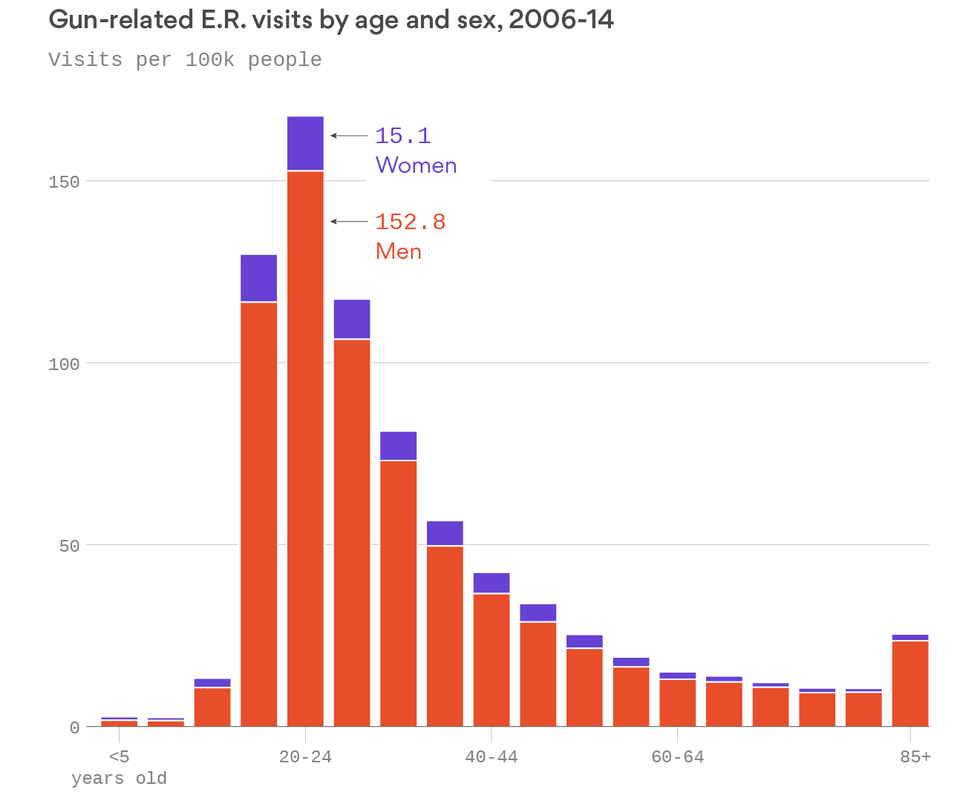
Gun-related injuries send thousands of people to emergency rooms every year, even aside from mass shootings like the tragedy in Las Vegas. In 2015 alone, almost 35,000 people died from gun-related homicides and suicides, and the “clinical burden” from non-fatal gun injuries was three times higher, according to new research published in Health Affairs.

  • Men make up the vast majority of firearm-related E.R. admissions, and young men — ages 15-30 — are especially likely to end up in the hospital because of a gun.
  • A plurality of gun-related E.R. admissions resulted from an assault, followed by accidents, which accounted for about 35% of admissions.
  • Most patients admitted to emergency rooms with firearm-related injuries were discharged, either to home or other facilities. Roughly 37% were admitted for inpatient care, and about 5% died in the emergency room.

Go deeper: Health Affairs is providing free access to this study. You can read the whole thing here.

The fuzzy math around Community Health Systems’ hospital sales

https://www.axios.com/the-fuzzy-math-around-community-health-systems-hospital-sales-2491001792.html

Image result for Fuzzy math on hospital sales

Community Health Systems, the struggling for-profit hospital company, recently conducted a 30-hospital fire sale to reduce its massive debt load. Top executives routinely said in earnings calls with investors they were selling “unproductive” hospitals for “outstanding prices.”

What we found: An Axios analysis finds that, for at least some of those facilities, the numbers don’t really match what executives said. CHS appears to have sold several profitable hospitals for below-average prices.

Why it matters: The discrepancy between CHS’ words and actions raises questions. If CHS sold profitable hospitals for low prices, the company could continue to struggle paying down its mountain of debt because it will have fewer facilities to generate cash. Some investors already believe CHS could default on its debt.

The background: Hospitals are often sold based on a measure of profitability called earnings before interest, tax, depreciation and amortization, or EBITDA. Prices vary based on location, profit, insurance contracts and other factors, but the average hospital today could be sold at 8.5 times its EBITDA, according to one industry estimate.

CHS CEO Wayne Smith and former CFO Larry Cash both have frequently said during earnings calls over the past 18 months the company was getting rid of low-performing and low-margin hospitals. Smith also declared CHS was getting “attractive prices” and “very good value for the facilities that we’re selling, and we’re getting about 10 times (EBITDA) in a market for single-digit (margin) hospitals.” Smith later said “the multiple from our 30-hospital divestiture plan is approximately 12 times EBITDA.”

The gritty details: Eight of the 30 hospitals in CHS’ fire sale are in two states, Pennsylvania and Washington, that have reported financial statements to the public. And the numbers don’t line up with what Smith and Cash said. Here’s the quick synopsis of our analysis, which focused on deals that had publicly announced financial terms:

  • CHS sold four hospitals in Pennsylvania to PinnacleHealth for $231 million, or 3.4 times operating earnings. That multiple would have been even lower if the Pennsylvania data excluded interest and depreciation.
  • CHS sold two hospitals in Washington to Sunnyside Community Hospital for $45 million, or 5.3 times EBITDA.
  • CHS sold two hospitals in Washington to MultiCare Health System for $424 million, or 7.2 times EBITDA.
  • None of those deals are close to the prices that CHS executives discussed publicly.

CHS had a few gripes with the analysis:

  • The Pennsylvania data is based on a July 1 to June 30 fiscal year instead of the typical calendar year that CHS reports.
  • Neither state includes the financial impact of physician practices and other ancillary services.
  • Smith said the multiple from the entire 30-hospital divestiture plan, including working capital, was 12 times EBITDA. That means “some of the transactions were above 12 times, and some were below.”
“The Community Health Systems management team has made accurate and appropriate disclosures about our divestitures,” spokeswoman Tomi Galin said several times during a three-week email exchange. CHS declined to provide the audited data it used for the hospital transactions, and executives were not made available for interviews.
Yes, but: The analysis was shared with a few industry experts who have experience with hospital transactions and spoke on background. They didn’t believe CHS’ points made a material difference. “You’re not going to get a 12-times multiple for something that’s debt-laden,” one hospital finance expert said.
Another industry source said it’s “a little fuzzy sometimes to figure out exactly what the EBITDA is and what the multiples are.” But the numbers CHS executives were citing “just aren’t seen often,” the source said. Getting anything above 12 times EBITDA is almost unheard of for most hospitals right now and highly unlikely in these cases, the experts said.

Underlying concern: Although CHS defended the statements and numbers from earnings calls, some people who follow the company believe the discrepenacies are representative of a long pattern. “There’s a history of deceptive communication practices,” said one CHS investor, who asked not to be named given the sensitivity of the issue.

What to watch for: How much debt CHS still has at the end of the third quarter, and what executives tell investors about the status of the company.