The Justice Department now wants the courts to strike down the entire Affordable Care Act — not just its protections for people with pre-existing conditions.
This is a stunning escalation, raising both the real-world and political stakes in a lawsuit where both the real-world and political stakes were already very high.
Where it stands: Judge Reed O’Connor ruled in December that the ACA’s individual mandate has become unconstitutional, and that the whole law must fall along with it.
At the time, the Trump administration argued that the courts should only throw out the mandate and protections for pre-existing conditions — not the whole law.
But in a one-page filing last night, DOJ said the 5th Circuit Court of Appeals should affirm O’Connor’s entire ruling.
Why it matters: If DOJ ultimately gets its way here, the ripple effects would be cataclysmic. The ACA’s insurance exchanges would go away. So would its Medicaid expansion. Millions would lose their coverage.
The FDA would lose have the authority to approve an entire class of drugs.
The federal government would lose a lot of its power to test new payment models — in fact, the administration is relying on some of those ACA powers as it explores conservative changes to Medicaid.
Politically, this makes no sense. Chuck Schumer and Nancy Pelosi must be dancing in the streets.
Health care — specifically pre-existing conditions — was overwhelmingly a winning issue for Democrats in 2018.
Now the administration is doubling down, putting even more people’s coverage on the chopping block.
What they’re saying:
“The bad faith on display here is jaw-dropping,” pro-ACA legal expert Nick Bagley writes.
“I was among those who cheered the selection of William Barr as Attorney General and hoped his confirmation would herald the elevation of law over politics within the Justice Department. I am still hopeful, but this latest filing is not a good sign,” said Jonathan Adler, a conservative law professor who helped spearhead the last big ACA lawsuit.
In a stunning, two-sentence letter submitted to the Fifth Circuit today, the Justice Department announced that it now thinks the entire Affordable Care Act should be enjoined. That’s an even more extreme position than the one it advanced at the district court in Texas v. Azar, when it argued that the court should “only” zero out the protections for people with preexisting conditions.
The bad faith on display here is jaw-dropping. Does the administration really think that the very position it advanced just month ago is so untenable that it must now adopt an even crazier view?
Much as it may dislike the fact, the Trump administration has an obligation to defend acts of Congress. Absent that obligation, the sitting administration could pick and choose which laws it wants to defend, and which it wants to throw under the bus. Indeed, the decision not to defend is close cousin to a decision not to enforce the law. If the ACA really is unconstitutional, wouldn’t continuing to apply the law would violate the very Constitution that empowers the President to act?
Even apart from that, the sheer reckless irresponsibility is hard to overstate. The notion that you could gut the entire ACA and not wreak havoc on the lives of millions of people is insane. The Act is now part of the plumbing of the health-care system. Which means the Trump administration has now committed itself to a legal position that would inflict untold damage on the American public.
And for what? Every reputable commentator — on both the left and the right — thinks that Judge O’Connor’s decision invalidating the entire ACA is a joke. To my knowledge, not one has defended it. This is not a “reasonable minds can differ” sort of case. It is insanity in print.
Yet here we are. An administration that claims to support protections for people with preexisting conditions has now called for undoing not only the parts of the ACA that protect such conditions, but also the entire Medicaid expansion and parts of the law that shield those with employer-sponsored insurance from punitive annual or lifetime caps. Not to mention hundreds of rules having nothing to do with health insurance, including a raft of new taxes, mandatory labeling of calorie counts at chain restaurants, and rules governing biosimilars.
Maybe you think this level of disdain for an Act of Congress is to be expected from the Trump administration. Maybe it’s too much to process because of Russia and immigration and North Korea. But this is not business as usual. This is far beyond the pale. And it is a serious threat to the rule of law.
It’s March Madness! As always, we’re so excited for the annual ritual of hastily filling out brackets based on our (limited) knowledge of the teams, buying into office pools and “friendly” family competitions, keeping one eye firmly glued to the steady drip of results from the games, and ultimately losing to That Guy in Human Resources who picked winners based on the ferocity of the schools’ mascots.
If you’ve waited till the last minute to fill out your bracket, or if your top-seeded Championship pick and beloved alma mater happens to go out in the first round to a 16-seed (take it from us, it ain’t pretty), then we have just the thing for you!
Presenting…Healthcare March Madness!
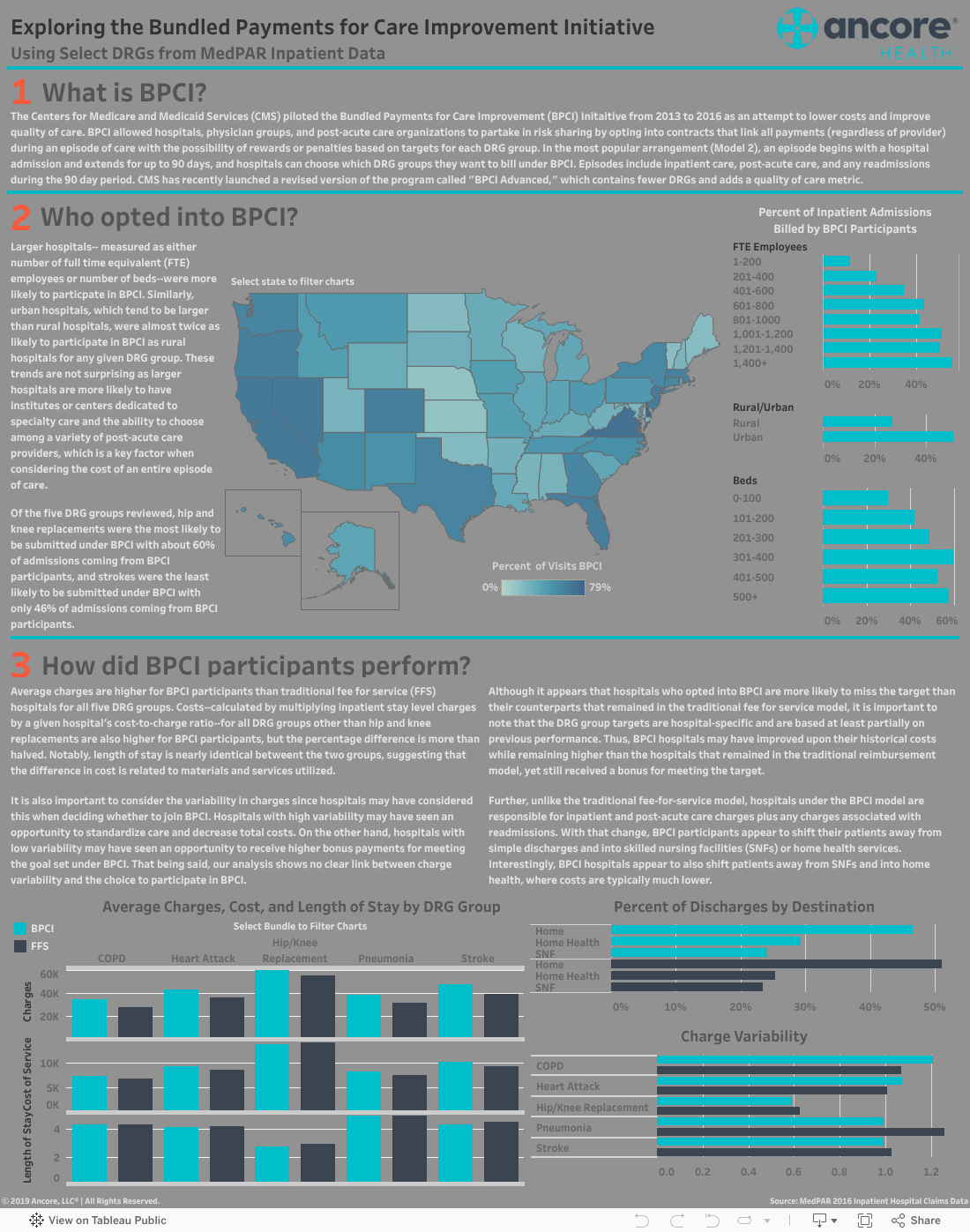
To keep the next two weeks interesting, and to make ourselves feel better for stealing time from work to watch the games, we’ve constructed our own methodology for filling out our bracket, using a metric we call the Health Value Index (HVI). Working with our friends at Ancore Health, a data consulting firm, we assigned each team a score based on the level of “healthcare value” delivered in the county where their school is located, and then compared that metric for each matchup, picking the team with a higher score to advance to the next round.
Here’s how we calculated the HVI: we used county- and state-level data to assess four aspects of healthcare value important to individual consumers: access to care, cost of care, payment environment, and health of the population. (Specific metrics and data sources are listed in the chart below.) Twelve metrics across those categories were normalized and equally weighted to create county-level composite scores. These normalized scores comprise the county’s HVI, allowing us to compare healthcare consumer value across markets.
In the tables below, you can see how each of the 64 teams in this year’s NCAA tournament stacked up in terms of HVI.
And just in case your favorite team didn’t make it to the Big Dance this year, or you’d like to see how your own county performed on HVI, here’s a map of the US with every county’s score. Click on the map to go to an interactive version, where you can scroll over each county and see its score. (Cool, right? Thanks to the wizards at Ancore Health for making that magic possible!)
When we first looked at this map, it occurred to us that we might just be seeing the impact of higher income levels in the Northeast and on the West Coast. But as it turns out, income level is only moderately correlated with HVI score—wealth only accounts for some of the variability in outcomes. The top four teams according to HVI include University of North Carolina, University of Vermont, University of Wisconsin and University of Washington. Wisconsin and Washington are strong performers across the four HVI dimensions, while UNC and Vermont’s strong scores are driven by high access scores.
At the other end of the spectrum we find Abilene Christian, Wofford, Gardner-Webb and Mississippi State among the bottom four teams. Mississippi State’s score is pulled down by a payment environment that is unfriendly to consumers (low commercial insurance competition and Medicare Advantage participation), but Oktibbeha County’s relatively low cost of care saves them from being even further behind. Gardner-Webb, located in Cleveland County, NC, just west of Charlotte, is weighed down by poor performance on all three health outcomes measures. Abilene Christian’s market, Taylor County in West Texas, is weighed down by a high cost of care and high per-capita rate of emergency department visits. Located in Spartanburg County, SC, Wofford’s performance is brought down by poor health outcomes and a non-competitive insurance market.
Using our HVI methodology, let’s take a look at how we’ve filled out our bracket for this year’s tournament. The scores in parentheses next to the school’s name in each round show the margin of victory that earned the school a win in the previous round. (So, for example, Virginia walloped Gardner-Webb in its opener by having an HVI that was 1.35 higher than its opponent.) While there are some big first- and second-round upsets thanks to the variability in scores, and one very surprising debutant in this year’s Championship Game, we’re picking the top-seeded North Carolina Tar Heels to be national champions this year—thanks to the bracket-leading level of healthcare value delivered in Orange County, NC, where UNC is located.
Surprised? We were. Only two of our top four HVI teams—North Carolina and Vermont—made it to the Final Four in our bracket, as it turned out that the South and Midwest regions were particularly stacked with high-ranking teams. Washington got rolled over in the second round by an unbeatable Tar Heel squad, despite the outstanding level of healthcare value in King County, WA. Wisconsin, another top-four team thanks to being based in downtown Madison, in Dane County, WI, made it all the way to the Final Four only to get edged out by UNC as well. Other top-rated teams that didn’t get nearly as far as their high HVIs would have predicted: Northeastern (Suffolk County, MA); UC Irvine (Orange County, CA) and Iona (Westchester County, NY). None of those schools could match the dominance of North Carolina.
Meanwhile, on the other side of the bracket, Vermont easily bests Florida State (Leon County, FL) and Marquette University (Milwaukee County, WI), and barely edges out Michigan (Washtenaw County, MI) in the Elite Eight to face powerhouse Minnesota in the Final Four. The Golden Gophers sailed through the East—easily the least competitive quadrant of our healthcare bracket—only to get crushed by the Catamounts. For those of you who also hail from outside the Green Mountain State and might not know this, Vermont’s mascot is a large cougar-like cat. Scary!
In the Championship Game, Vermont falls to UNC. What gives the home county of UNC, Orange County, the edge in terms of healthcare value? While both lead the bracket in access to care, UNC brings higher access to primary care and mental health providers. And Vermont suffers from lower payer competition and Medicare Advantage participation.
Of course, we wouldn’t actually advise picking 13-seed Vermont to play in the Final—in fact, the lowest-seeded teams ever to make it to the Final Four were all 11-seeds: LSU (1986); George Mason (2006); VCU (2011); and Loyola-Chicago (2018). But given how many people are likely to pick Duke to go all the way this year, with their incredible freshmen leading the way, you could do worse than to follow our methodology, and base your picks on healthcare value. Better still might be picking your next home based on that metric!
We’ll return next week with a deeper look at the healthcare value statistics for the teams that make the (real) Sweet Sixteen, and then when Final Four time comes we’ll profile each of the markets involved to give some sense of what really drives healthcare value at a local level. Until then…enjoy the games!
We live in a time when acrimony and resentment seem to be at an all-time high. These days, individuals feel comfortable hiding behind screens to voice their opinions without giving much thought to the repercussions or the feelings of others.
I freely acknowledge that there have always been mean-spirited people in our lives, workplaces, schools and communities. However lately, it seems as if there is carte blanche to act like a jerk. Maybe this is why kindness seems a bit harder to come by, and why I find myself mentoring young people on how to deal with difficult colleagues more than usual.
I am certainly not immune to jerks. We’ve all dealt with them — the mean-spirited colleague who thought they knew everything. The person who did not like to share their toys in the proverbial sandbox. The team member who jumped at every opportunity to claim credit for success, plow over others or immediately blame others for failure. Simply put, we’ve all worked with jerks.
While jerks can be highly effective at delivering results, don’t confuse value with productivity. By this, I mean that the toxicity jerks infuse into a team and their work environment can significantly outweigh their contributions. These folks tend to be mean-spirited, manipulative, and can often undermine both the organization’s work and their colleagues’ productivity. They cause strife and, in some cases, drive excellent colleagues away from an organization. At the end of the day, they do far more harm than good, and they make the work environment an unpleasant place to spend the day.
Throughout my career, I have managed a few so-called jerks. While it has not always been easy, and I have certainly made my share of mistakes, I’ve learned to effectively deal with these personalities along the way. Beyond that, I’ve developed some management techniques for how to handle them.
As far as I’m concerned, jerks need not apply to positions within my organization. I have adopted a strict “jerk-free” policy for every organization I lead. From the moment I walk in the door on the first day, I articulate that jerks are not welcome. Personally, I would much rather work with a less experienced person who is kind-hearted and receptive to training than an arrogant jerk, any day of the week.
So, how do you move from simply putting up a “jerks aren’t welcome sign” to creating a jerk-free culture? How can you cultivate anti-jerk behavior across your team and coach others to do the same?
1. Communicate. Talk it out from the outset. You need to communicate, communicate and communicate again. Let your teammates and colleagues know what you need and what you expect. You want to set expectations from the outset, so everyone is on the same page, and there is no room for confusion or deniability. You should also be open, transparent and honest. While there are times it is not the easiest thing to do, the payoff is huge and will keep things running smoothly.
2. Lead by example. Jerks gravitate to jerks. Do your best to be kind, helpful, open and honest. It will do more to inspire others and generate positivity than anything else.
3. Build trust. You build trust and inspire loyalty when you foster an environment where differences of opinion are welcomed and encouraged. Where there is trust and good feeling, it makes it harder for jerks to thrive.
4. Let them know. If someone is a jerk and you feel uncomfortable, let them know. Don’t let behavior that bothers you fester. You want to nip it in the bud. In a positive non-judgmental language explain to them how their behavior is not working for you and reflect on how things can change. I always say the first approach to any situation should be: acknowledge, reflect, move forward.
5. Value differences. It’s important to celebrate differences and the wide variety of skills team members bring to the table. If folks feel they have a unique niche to fill and special skills to contribute, they are less likely to be passive aggressive and will feel confident in their contributions.
6. Celebrate. Having a good time is essential. Work is hard, and it’s important to let off a little steam sometimes. I can’t encourage enough the opportunity to have fun and facilitate opportunities where colleagues can get together outside of the office.
7. Coach it out. I have found that all is not lost when it comes to jerks. There is hope. Some jerks can be rehabilitated. They just need effective coaching to turn their attitude around. Of course, there are rare cases when a jerk is, and always will be, a jerk. Unfortunately, there are times when you will have to make the tough call and leave them behind.
A jerk-free workplace certainly has numerous benefits. Not only is your space more enjoyable and pleasant, but a no-jerk policy also attracts and contributes to retaining the best possible team members — those who are incredibly productive, highly effective and extremely positive.
What team member wants to sign up to work with jerks? A positive environment drives productivity as time is not wasted battling destructive behavior or playing pointless games. It also enhances quality and helps delivers excellent customer service, because team members are happy in their work. The ripple effect of that is that they pass it along to anyone with whom they interact.
Think about it: Your team is like a family, and frankly, we often spend more time with them than anyone else in our lives. While we all enjoy a wacky cousin or a wisecracking uncle, no one likes to engage with the family member who is always complaining or rude to others. So, do you and your fellow team members a favor and say goodbye to the jerks. Make more room at the table for positive and enjoyable folks. Everyone will be glad that you did.
The following 11 health systems recently released financial updates:
1. Naples, Fla.-based NCH Healthcare Systemsaw its revenue and net income improve in the 2018 fiscal year. The health system ended fiscal 2018 with net income of $37.3 million, up 45.3 percent from $20.4 million reported in the year prior.
2. Salt Lake City-basedIntermountain Healthcare saw its revenues and operating income improve in fiscal year 2018. After incorporating nonoperating income, which was $240.2 million lower than the year before, Intermountain ended fiscal 2018 with net income of $598.5 million. That’s down 8.6 percent from $655.1 million reported in fiscal 2017.
3. Boston-based Dana-Farber Cancer Institute‘s revenue climbed 11.5 percent year over year to $487.2 million in the first quarter of fiscal year 2019. After factoring in a $31.6 million investment loss, Dana-Farber recorded a net loss of $1.2 million in the first three months of fiscal 2019. That’s compared to the first quarter of fiscal 2018, when the hospital recorded net income of $46.1 million.
4. Bronx, N.Y.-based Montefiore Medical Center saw operating revenue increase in 2018 but ended the period with a lower overall operating margin. After factoring in nonoperating gains and losses, the medical center recorded net income of $26.6 million for 2018, down 52.9 percent year over year from net income of $56.5 million.
5. Renton, Wash.-based Providence St. Joseph Healthsaw operating revenue increase in fiscal year 2018 but ended the period with a net loss. After factoring in investment losses, Providence St. Joseph ended 2018 with a net loss of $445 million compared to net income of $780 million the year prior.
6.Cleveland Clinic‘s revenue increased in 2018, but the system’s operating income and net income declined year over year. After factoring in nonoperating losses, Cleveland Clinic ended 2018 with net income of $103.9 million, down 91 percent from $1.2 billion in the year prior.
7. Trinity Healthrecorded higher revenue in the first half of fiscal year 2019 than in the same period of the year prior, but the Livonia, Mich.-based health system ended the first two quarters of the current fiscal year with a net loss. After factoring in nonoperating losses of $419.6 million, including investment losses due to turbulent financial markets, Trinity reported a net loss of $301.5 million in the first half of fiscal 2019. That’s compared to the first six months of fiscal 2018, when the system posted net income of $806.4 million.
8. Quorum Health‘s revenue declined year over year in the fourth quarter of 2018, and the Brentwood, Tenn.-based company ended last year with a net loss. After factoring in expenses and one-time charges, Quorum ended the fourth quarter of 2018 with a net loss of $20.7 million, compared to a loss of $26.8 million in the same period of the year prior. Looking at full-year results, Quorum’s net loss widened from $114.2 million in 2017 to $200.2 million in 2018.
9. Sacramento, Calif.-basedSutter Health reported its first annual loss in 23 years due to investment losses caused by turbulent financial markets in the fourth quarter of 2018 and recognizing less revenue from the California Hospital Fee Program. Sutter reported a net loss of $198 million in 2018, compared to net income of $893 million in the year prior.
10. Columbia, Md.-based MedStar Health saw its revenue increase in the first half of fiscal year 2019, but ended the six-month period with a net loss due to the investment markets’ unfavorable performance. After including nonoperating results, MedStar ended the first half of fiscal 2019 with an $87.5 million net loss, compared to net income of $171.5 million in the first half of the prior year.
11. Philadelphia-based Temple University Health Systemsaw its financial position improve in the six months ended Dec. 31. TUHS ended the six-month period with an operating loss of $26.2 million, compared to an operating loss of $39.1 million in the six months ended Dec. 31, 2017.
Stephen Klasko, MD, president of Thomas Jefferson University and CEO of Jefferson Health, signed another five-year contract with the Philadelphia-based health system, a spokesperson told Becker’s Hospital Review March 20.
Five things to know about the contract and Dr. Klasko’s first five years with Jefferson:
1. Dr. Klasko, who began leading the health system in 2013, will serve as president of Thomas Jefferson University and CEO of Jefferson Health through 2024.
2. Under Dr. Klasko, Jefferson has grown from three to 14 hospitals. Jefferson’s growth has largely taken place by merging boards across regions. The system has pending deals with Philadelphia-based Einstein Healthcare Network and Temple University’s Fox Chase Cancer Center, also in Philadelphia.
3. At the same time, Jefferson Health has gone from a $1.5 billion system to a more than $5 billion system, generating more than $100 million in savings and efficiencies.
4. New philanthropic initiatives led to the Sidney Kimmel Foundation in Philadelphia donating $110 million to Jefferson Medical College in 2014, representing the largest gift in its history. The college was renamed the Sidney Kimmel Medical College that same year.
5. Under Dr. Klasko’s leadership, Thomas Jefferson University now hosts design curriculum for medical students and operates the No. 3 fashion school in the country.
The president and CEO of Baltimore-based University of Maryland Medical System agreed to take a leave of absence, effective March 25, amid a scandal involving business deals between the system and several of its board members, according to The Washington Post.
Six things to know:
1. UMMS Board Chairman Stephen Burch announced the board’s unanimous decision March 21 to have President and CEO Robert Chrencik take a leave of absence. The system will also hire an independent accounting and legal firm to audit the board’s contracts, and the search for an independent third party will begin immediately.
“Over the past week, I’ve had the proper time to listen to concerns and reflect. The board and I am firmly committed to evolving our governance principles and operating with even more transparency,” Mr. Burch said.
2. John Ashworth, senior vice president of network development at UMMS and associate dean at the Baltimore-based University of Maryland School of Medicine, will serve as interim president and CEO of the 13-hospital system.
3. The leadership changes follow the resignations of three UMMS board members, including Baltimore Mayor Catherine Pugh. At least four other board members have taken a leave of absence. The deals have been sharply criticized by state lawmakers, including Gov. Larry Hogan.
4. Ms. Pugh resigned from the board after facing criticism for a $500,000 book deal she made with UMMS. A spokesperson for the mayor’s office said March 20 Ms. Pugh has returned $100,000 in profit to the health system because production on the books was delayed and they were not actually delivered to UMMS, which had planned to distribute the books to city schools.
5. Hours before Mr. Burch notified the public of Mr. Chrencik’s leave of absence, the Maryland House of Delegates unanimously fast-tracked a bill to overhaul UMMS’ 27-member board of directors, The Washington Post reports.
6. Amid the scandal at UMMS,The Baltimore Sun reviewed state disclosure and tax forms for several other health systems in the state and found at least five other systems have engaged in business deals with members of their board. The American Hospital Association’s guidance on the issue does not prevent such deals from taking place, but asks that leadership ensure “certain preconditions … to make sure that the organization’s interests prevail in the board’s decision-making.”
Potential Medicare expansion plans would drastically impact the financial standing of health systems, though some may be more pragmatic solutions than others.
KEY TAKEAWAYS
Implementing Medicare for All as a single payer healthcare system is estimated to create a 22.1% negative impact on a mid-size regional provider’s net margin.
However, a voluntary buy-in plan, also known as ‘Medicare for more,’ might result in only a slight dip to the net margin compared to the status quo.
Regardless, some amount of legislative action regarding Medicare expansion will be necessary in the next five years, according to the study’s authors.
Fresh off the 2018 midterm elections where healthcare played a critical role in the electoral shift that saw Democrats retake the House of Representatives, 2020 presidential candidates are heralding sweeping policy proposals to expand coverage through Medicare.
While several versions of Medicare for All legislation exist, other policy proposals such as ‘Medicare for more’ or the public option have drawn consideration from lawmakers as potentially more viable or pragmatic solutions to America’s healthcare problems.
In its analysis, Navigant found a medium-sized, nonprofit, multi-hospital system with revenues of more than $1 billion and a current operating margin of 2.3% would endure vastly different financial implications under several proposed federal healthcare policy changes.
Medicare for All would reduce revenues by around $330 million, a margin drop of just over 22%, the public option proposal would cause revenue declines in the neighborhood of $153 million, a margin impact of -6.3%, and the ‘Medicare for more’ expansion plan is estimated to have a neutral impact compared to the status quo.
Still, Navigant’s study points out that if Congress does not act on Medicare expansion until after the next presidential election, hospitals could face a scenario with a financial impact comparable to the public option proposal.
Using the model health system as an example, status quo projections without any cost reduction initiatives would see the organization’s net margin decline from 2.3% to negative 6.2% from 2018 to 2023, with operating costs rising between 4.5% to 5% per year and revenues growing at 2.5% to 3% per year.
“There’s going to be a need to control hospital cost structures going forward, regardless of whether it’s in the status quo with baby boomers aging into Medicare and payer mix shifts occurring, or in a scenario that has limited expansion, moderate expansion, or robust Medicare for All,” Jeff Leibach, director at Navigant, told HealthLeaders in an interview. “There are obviously varying degrees of impact on hospitals, but all of them are going to require a level of attention and and management of revenue strategy and cost structure that I think hospital CFOs are struggling with today and will benefit from through continued focus on performance improvement and revenue strategy.”
PLANS, DETAILS, AND IMPACT:
‘Medicare for more’
Voluntary buy-in at age 50 and over
In one scenario, choice between employer coverage and Medicare
No Medicare payment relief
No reduction in revenue cycle management operations compared to the status quo
15% reduction in current disproportionate share hospital payments
Public option
All lives covered regardless of age
Choice between employer coverage and Medicare
Range from no Medicare payment relief to payments at 110% of Medicare rate
1.5% reduction in revenue cycle management operations compared to the status quo
70% reduction in current disproportionate share hospital payments
Medicare for All
All lives covered regardless of age
Single payer healthcare coverage
Range from no Medicare payment relief to payments at 120% of Medicare rate
2.5% reduction in revenue cycle management operations compared to the status quo
100% reduction in current disproportionate share hospital payments
Leibach said that the analysis arrives at the early part of the conversation surrounding widespread Medicare expansion at the federal level, which makes it difficult to gauge how health system leaders will react to Navigant’s findings.
Some may be hesistant to support plans that are projected to create such a negative material impact on their respective bottom lines, but others may be willing to consider a policy proposal that significant decreases or even eliminates bad debt costs associated with a large uninsured population.
Even before the report was released, however, the American Hospital Association declined to voice support for Medicare for All late last month.
Leibach added that he was surprised by the “nominal impact” of the voluntary buy-in plan, arguing that could hospital leaders may rally around that proposal as a compromise to expanding Medicare without fully deteriorating their financial standing.
This approach would also be the least disruptive to the commercial insurance market, according to Leibach, assuming that the Medicare for All proposal would be a true single-payer platform that eliminates private insurers.






 HENRY KOTULA