

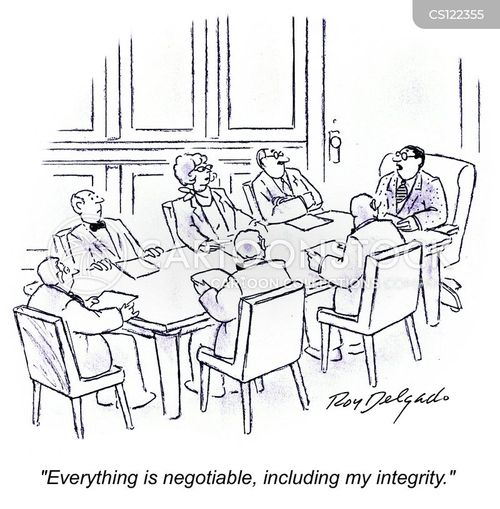
Cartoon – Everything is Negotiable

By now you’ve probably heard the story of the fraudulent business practices at Wells Fargo – the bank that pressured employees to create false credit card and deposit accounts. Have you asked yourself what you would do if you were an employee facing that kind of pressure? In other words, how do you handle a situation in which the incentives seem to be telling you to do something you believe is bad for your customers and clients, or maybe even illegal? And what if it’s clear your boss wants you to get with the program – and your bonus, a promotion, or even your job are on the line?
It’s easy to think that these situations are black and white. Either you go along or suffer the consequences. But sometimes these situations are gray, which I write about in Managing in the Gray. My central guidance is this: When you face a really tough problem, work through it as a manager and resolve it as a human being. This approach can help you avoid stark choices between getting ahead and doing something you believe is wrong.
Here’s how that advice applies to dealing with a situation where you think you are potentially being incentivized to do the wrong thing:


The problem was that bank employees were pushed to sell products and services to customers whether they wanted them or not, in violation of the company’s stated values, and often this meant opening up accounts and issuing credit cards without customers knowing about it.
And to add insult to injury, even employees who called the company’s ethics hotline that was set up to report issues just like this one were fired for doing so.
Yes, Wells Fargo’s stated company values are 180 degrees opposite of what employees were actually told to do.
If you look at Wells Fargo’s statement of values, it all sounds pretty good:
Our values should guide every conversation, decision, and interaction. Our values should anchor every product and service we provide and every channel we operate. If we can’t link what we do to one of our values, we should ask ourselves why we’re doing it. It’s that simple.
All team members should know our values so well that if our policy manuals didn’t exist, we would still make decisions based on our common understanding of our culture and what we stand for. Corporate America is littered with the debris of companies that crafted lofty values on paper but, when put to the test, failed to live by them. We believe in values lived, not phrases memorized. If we had to choose, we’d rather have a team member who lives by our values than one who just memorizes them.
We have five primary values that are based on our vision and provide the foundation for everything we do:
- People as a competitive advantage
- Ethics
- What’s right for customers
- Diversity and inclusion
- Leadership
Those values sound good, but in the case of Wells Fargo, they were total BS.


Habit [hab-it], noun — an acquired behavior pattern regularly followed until it has become almost involuntary
Habits…we all have them, don’t we? Some are good for us and help us live healthier and happier lives. Others aren’t so good and they cause us pain, guilt, and turmoil. Hopefully the good outweigh the bad.
As the definition above illustrates, habits are something that can be learned, and that’s important when it comes to being a trustworthy leader. Most people assume trust “just happens,” but that’s false. Trust is built through the use of very specific behaviors that anyone can learn and master over time. Trustworthiness can, and should, become a habit.
First we make our habits, and then our habits make us.


 HENRY KOTULA