7 latest healthcare industry lawsuits, settlements

https://www.beckershospitalreview.com/legal-regulatory-issues/7-latest-healthcare-industry-lawsuits-settlements-100518.html?origin=cfoe&utm_source=cfoe

Related image

From the U.S. Equal Employment Opportunity Commission suing a Tennessee health system over its flu shot policy to a Montana health system paying $24 million to settle a whistle-blower lawsuit, here are the latest healthcare industry lawsuits and settlements making headlines.

1. EEOC sues Saint Thomas Health over mandatory flu shot policy
The U.S. Equal Employment Opportunity Commission filed a lawsuit against Nashville, Tenn.-based Saint Thomas Health Sept. 28, alleging Murfreesboro, Tenn.-based Saint Thomas Rutherford Hospital violated federal law by ordering an employee to receive a flu shot despite his religious belief

2. Montana hospital pays $24M to settle ex-CFO’s whistle-blower suit
Kalispell (Mont.) Regional Healthcare System and six subsidiaries and related entities agreed to pay the federal government $24 million to resolve allegations they violated the False Claims Act, Stark Law and the Anti-Kickback Statute.

3. DaVita resolves false claims, whistle-blower allegations for $270M
HealthCare Partners Holdings, which does business as DaVita Medical Holdings, will pay $270 million to settle False Claims Act violations and a whistle-blower lawsuit.

4. AmerisourceBergen to pay $625M to settle civil fraud charges linked to repackaging scandal
Drug wholesaler AmerisourceBergen will pay $625 million to resolve allegations that the company improperly distributed tampered and repackaged drugs.

5. Kansas physician awarded $29M in wrongful termination suit
A jury awarded a Kansas emergency physician $29 million for his lawsuit claiming he was wrongfully terminated by the emergency room staffing company he worked for after voicing concerns about the organization’s business practic

6. Disability advocacy firm sues Arizona hospital over access to patients
The Arizona Center for Disability Law filed a lawsuit Sept. 12 against Phoenix-based Arizona State Hospital, claiming hospital officials violated federal law by refusing to provide the center with access to the facility, patients and their records.

7. Louisiana health system stuck in antitrust suit brought by ex-hospital operator, health plan
BRF, a hospital operator in Shreveport, La., and the regional Vantage Health Plan are surging forward with an antitrust lawsuit against Shreveport-based Willis-Knighton Health System, even though BRF left the hospital business Oct. 1.


6 latest healthcare industry lawsuits

https://www.beckershospitalreview.com/legal-regulatory-issues/6-latest-healthcare-industry-lawsuits-091018.html

Related image

From national healthcare organizations refiling a lawsuit over 340B drug pricing program cuts to a Georgia physician accused of submitting thousands of false claims to Medicare, here are the latest healthcare industry lawsuits making headlines.  

1. CHS, Quorum say investors weren’t duped into buying stock at inflated prices
Franklin, Tenn.-based Community Health Systems and Brentwood, Tenn.-based Quorum Health urged a federal judge not to grant class certification in a shareholder lawsuit alleging Quorum’s stock was trading at an inflated price after its spinoff from CHS.

2. Georgia physician allegedly submitted 4,500 false claims for unnecessary lead poisoning treatments
Federal investigators allege Charles Adams, MD, a physician in Fort Oglethorpe, Ga., injected thousands of patients with a lead poisoning treatment they didn’t need, and billed the government $1.5 million for medically unnecessary treatments.

3. Premera Blue Cross accused of destroying evidence in data breach case
The plaintiffs in a class-action lawsuit against Premera Blue Cross, which involves a 2014 data security incident, claim the payer “willfully” destroyed evidence that would have provided details of the breach.

4. Hospitals refile lawsuit against CMS over $1.6B in 340B cuts
The American Hospital Association, along with several other national healthcare organizations and hospitals, refiled their lawsuit against HHS to reverse Medicare payment cuts for drugs purchased through CMS’ 340B drug pricing program, the AHA announced Sept. 5.

5. Medical center owners allegedly double billed insurers, altered patient records as part of $80M scheme
Four people were charged in an $80 million Medicare fraud scheme that involved providing unnecessary medical treatment to patients.

6. Physician imposter allegedly diagnosed patient at California hospital
A 23-year-old man is accused of impersonating a physician at California hospitals.


Trump healthcare order could run afoul of retirement plan law

http://www.reuters.com/article/us-usa-healthcare-lawsuits-analysis/trump-healthcare-order-could-run-afoul-of-retirement-plan-law-idUSKBN1CH0DR

Image result for Retirement Savings

President Donald Trump’s plan to make it easier for small businesses to band together and buy stripped-down health insurance plans could violate a federal law governing employee benefit plans and will almost certainly be challenged in court, legal experts said.

U.S. President Donald Trump speaks about tax reform in Harrisburg, Pennsylvania, U.S., October 11, 2017. REUTERS/Joshua Roberts

Trump signed an executive order on Thursday aimed at letting small businesses join nationwide associations for the purpose of buying large-group health plans that are not subject to coverage requirements of the Affordable Care Act, commonly known as Obamacare.

Industry experts said Trump’s order could ultimately enable such associations to purchase insurance from states with the fewest regulations. That would undermine Obamacare, former Democratic President Barack Obama’s signature healthcare law, which Republicans have failed to repeal.

Several healthcare and employment law experts said if Trump’s plan moves forward, states could argue the federal government had overstepped its authority in violation of the U.S. Employee Retirement Income Security Act (ERISA), a law that governs large-group plans.

In Thursday’s order, Trump asked the Department of Labor to propose rules that would allow more employers to participate in association health plans. Legal experts said lawsuits might not be brought until such regulations are issued.

Dania Palanker, an assistant research professor at Georgetown University’s Center on Health Insurance Reforms, said ERISA granted states the right to regulate association health plans.

Attorneys general could argue the federal government had overreached if the Trump administration winds up allowing associations to buy health coverage across borders that only complies with a single state’s regulations.

”Any attempt to allow the sale of association plans to small groups across state lines will be open to legal scrutiny as to whether it is violating ERISA and undermining state authority,” said Palanker.

‘PREPARED TO FIGHT’

A White House official said that “departments will be drafting rules in a way that minimizes litigation risk.”

The Department of Labor “will be reviewing ERISA in the course of following the President’s direction” in the order, the official said.

A number of state attorneys general from Democratic-leaning states said on Thursday they would fight any efforts to weaken Obamacare, which extended health insurance to 20 million Americans, but which Republicans call intrusive and ineffective.

“It should come as no surprise that California is prepared to fight in court to protect affordable healthcare for its people,” said Xavier Becerra, the state’s Democratic attorney general.

Legal experts said states may argue the associations formed for the purpose of buying insurance are not employers under ERISA.

Although ERISA allows associations to qualify as employers and manage large-group plans, federal regulators have generally required that members of such associations have a high degree of common interest beyond buying insurance, said Allison Hoffman, a professor at the University of Pennsylvania School of Law.

Trump’s order asks the secretary of labor, who enforces ERISA, to consider expanding the common-interest requirements to permit broader participation in association health plans.

SHORT-TERM PLANS

The idea of expanding association health plans across state lines has long been championed by Republican U.S. Senator Rand Paul, who made it a key plank of his own proposal to repeal and replace Obamacare. The Kentucky Republican was at Trump’s side when the president signed the executive order.

Paul’s proposal said ERISA was too restrictive in its definition of associations and that the law needed to be amended.

Thursday’s order also asked the Labor, Treasury and Health and Human Services Departments to look into expanding participation in cheaper, bare-bones, short-term limited-duration insurance plans, which are not subject to the ACA.

Timothy Jost, a professor at the Washington and Lee University School of Law, said such a move would face fewer legal hurdles than the expansion of association health plans.

The current three-month limitation on the use of such plans was a rule adopted by the Obama administration last year, so the Trump administration could roll it back through the normal rulemaking process.

Such plans are typically marketed to individuals who are between jobs or have a gap in coverage. They are much cheaper than ACA plans, but cover less and can exclude those with pre-existing conditions.

Who will pay more without CSR subsidies

https://www.axios.com/vitals-2497054515.html

Good morning … Last week gave us an executive order and an end to cost-sharing payments. Can’t wait to find out what the health policy universe has in store for us this week.

Who will pay more without CSR subsidies

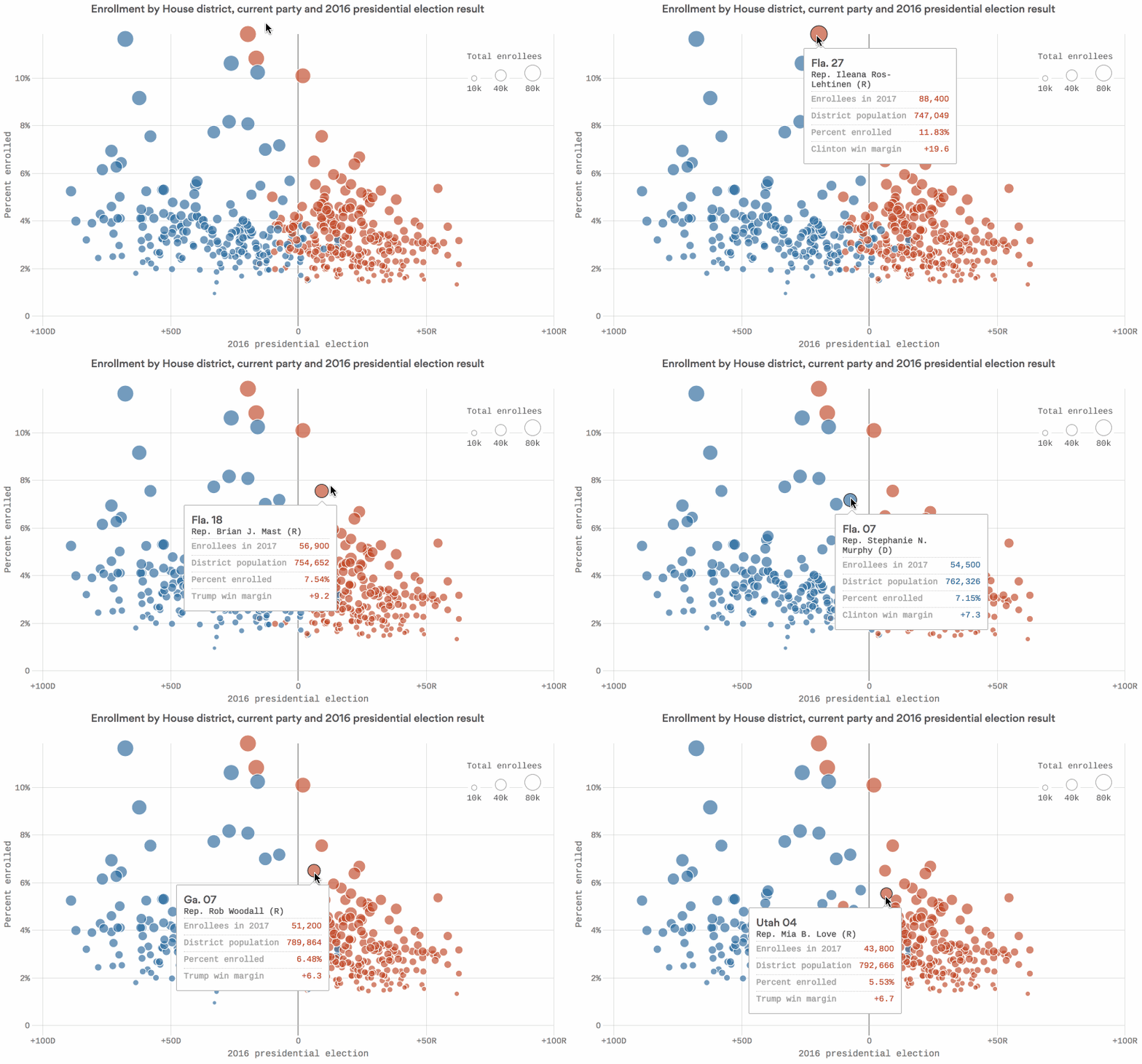
Data: Kaiser Family Foundation; Daily Kos Elections; Census Bureau; Chart: Chris Canipe / Axios

The Trump administration’s decision to stop paying the Affordable Care Act’s cost-sharing reduction subsidies will affect ACA customers in Republican-leaning congressional districts as well as Democratic ones. Here’s a look at how many people could feel the impact in districts that voted for President Trump, compared with those in districts that voted for Hillary Clinton.

The details: This year, 11.1 million people were enrolled in ACA marketplace plans or in a Basic Health Plan created by the law. Of those, 5.9 million live in Republican-held congressional districts and 5.2 million live in districts held by Democrats, per the Kaiser Family Foundation.

The impact: The CSR subsidies are going to 58% of the people who are enrolled in ACA marketplace plans. In all, about 7 million people don’t receive any financial assistance with their premiums, so they’d pay the full cost when health insurance companies raise their rates. But others could be affected if health insurers decided to pull out of the markets rather than deal with the instability.

The flaws in Trump’s legal rationale

There are broader implications of the Trump administration’s decision to lean so heavily on a legal rationale for cutting off the CSR subsidies: institutional divisions between the executive and legislative branches.

Between the lines: The White House said it was ending the payments in part because of a ruling last spring that said it was unconstitutional to make the payments without an explicit appropriation from Congress. As part of that process, Attorney General Jeff Sessions wrote a memo saying, in effect, there was no point appealing that ruling.

  • “Opening the door to lawsuits initiated by Congress over the specifics of how the executive branch spends tax dollars would be a marked change and a potential threat to the White House,” the New York Times’ Carl Hulse noted over the weekend.
  • Trump might particularly wish he hadn’t conceded that point if Democrats retake control of the House and/or Senate while he’s still president. Divided government is how this lawsuit started, after all.

Real talk: Former White House strategist Steve Bannon, speaking at the Values Voters Summit over the weekend, cut to the heart of Trump’s decision: “Not going to make the CSR payments, going to blow that thing up; going to blow those exchanges up, right?”

Administration’s Ending Of Cost-Sharing Reduction Payments Likely To Roil Individual Markets

http://healthaffairs.org/blog/2017/10/13/administrations-ending-of-cost-sharing-reduction-payments-likely-to-roil-individual-markets/

Yesterday, October 12, 2017, the White House press office announced that the administration will no longer be reimbursing insurers for the cost-sharing reductions they are legally required to make for low-income individuals. The Affordable Care Act requires insurers to reduce cost sharing for individuals who enroll in silver plans and have household incomes not exceeding 250 percent of the federal poverty level. These provisions reduce the out-of-pocket limit for these enrollees—particularly for those with incomes below 200 percent of poverty—and sharply reduce deductibles, coinsurance, and copayments. The reductions cost insurers around $7 billion a year currently.

The press secretary’s statement said:

Based on guidance from the Department of Justice, the Department of Health and Human Services has concluded that there is no appropriation for cost-sharing reduction payments to insurance companies under Obamacare. In light of this analysis, the Government cannot lawfully make the cost-sharing reduction payments. The United States House of Representatives sued the previous administration in Federal court for making these payments without such an appropriation, and the court agreed that the payments were not lawful. The bailout of insurance companies through these unlawful payments is yet another example of how the previous administration abused taxpayer dollars and skirted the law to prop up a broken system. Congress needs to repeal and replace the disastrous Obamacare law and provide real relief to the American people.

Acting HHS Secretary Hargan and CMS Administrator Verma issued a similar statement:

It has been clear for many years that Obamacare is bad policy. It is also bad law. The Obama Administration unfortunately went ahead and made CSR payments to insurance companies after requesting—but never ultimately receiving—an appropriation from Congress as required by law. In 2014, the House of Representatives was forced to sue the previous Administration to stop this unconstitutional executive action. In 2016, a federal court ruled that the Administration had circumvented the appropriations process, and was unlawfully using unappropriated money to fund reimbursements due to insurers. After a thorough legal review by HHS, Treasury, OMB, and an opinion from the Attorney General, we believe that the last Administration overstepped the legal boundaries drawn by our Constitution. Congress has not appropriated money for CSRs, and we will discontinue these payments immediately.

The Legal Background

In fact, the ACA requires the federal government to reimburse insurers for these reductions. This is not a bailout. It is rather a statutory obligation of the federal government to pay insurers for services they have provided as required by law. In 2014, the House of Representatives sued the Obama administration in House v. Burwell (now House v. Price) claiming that the cost-sharing reduction (CSR) payments to insurers had never been appropriated by Congress and were thus illegal. A district court judge accepted this argument in the spring of 2016 and enjoined their payment, as President Trump’s statement says, but stayed her order pending appeal. The Obama administration appealed, arguing that there was in fact an appropriation. Until yesterday, the Trump administration had not taken a position on whether there was an appropriation or not.

The appeal is still pending, with the House and the Trump administration having agreed to stay the appeal several times. At the end of August, the D.C. Circuit Court of Appeals allowed 19 state attorneys general to intervene to protect their citizens. For more on the CSR backstory see here and here; for more on the intervention, see here; and for Health Affairs Blog posts on cost-sharing reduction payments, see here.

The Consequences Of Ending The CSR Payments

The effect of terminating the payments has been well analyzed, including a report from the Congressional Budget Office. It will drive up premiums as insurers attempt to cover the cost of the reductions. As premiums go up, so will premium tax credits. Indeed, the government will probably pay more in premium tax credits than it saves in cost-sharing reduction payments. Individuals who earn too much to receive tax credits will be particularly hard hit by the premium increases. Some of these could decide to pursue new forms of coverage that might be made available under the measures announced in President Trump’s October 12 executive order.

Ending the CSR payments could also drive some insurers out of the exchanges. Under their contract with the federal exchange, insurers may terminate participation if cost sharing reduction payments are terminated, but they are still subject to state laws on market withdrawal, which limit their ability to do so. They may not terminate their exchange enrollees unless they fail to pay their premiums, which many likely would do once an insurer left the exchange and premium tax credits were no longer available.

The effect of CSR payment termination, however, will depend heavily on how insurers deal with the change. In several states, including California, insurers have anticipated the termination and have already loaded the lost payments into their on-exchange silver plansIn other states, however, insurers have to date been instructed to assume that the payments will be made, or have been given no instructions whatsoever. In these states, the change is likely to cause considerable confusion. Insurers will have to refile their rates and will likely not be able to do so before open enrollment begins in three weeks. For more on the different responses insurers may have take, see here.

What Might Happen Now

It is possible that the states that have intervened in the House v. Price appeal will seek to block the withdrawal of the funds. It is also very possible that the state attorneys general or a consumer or insurer will sue to block the CSR withdrawal. New York Attorney General Eric Schneiderman issued a press release yesterday threatening legal action if President Trump withdraws the payments, and the California Attorney General has also threatened suit.

It is also possible that Congress will adopt a specific appropriation to fund the CSRs, putting to rest the question of whether such an appropriation exists. The Senate Health, Education, Labor, and Pension Committee held hearings on bipartisan solutions to health reform problems in September and virtually every witness, including insurance commissioners and governors supported removing the uncertainty around the payments and making it clear that they would continue. Support for continuing CSR funding has come from insurers, consumers, the National Association of Insurance Commissioners, and virtually all other stakeholders. The President’s statement, and the likely consequent chaos in the individual marketplaces, may be enough to finally prompt action.

In any event, ending the CSR payments is another sign that President Trump is doing what he can to undermine the stability of the individual market under the ACA. This action will have a much more immediate impact than the measures Trump announced in yesterday’s executive order.

18 states sue over Trump-halted ObamaCare payments

http://thehill.com/policy/healthcare/355360-15-states-sue-over-trump-halted-obamacare-payments

Image result for lawsuits

A new multi-state lawsuit has been announced to stop President Trump from halting key ObamaCare payments to insurers.

Eighteen states and Washington, D.C., signed onto the lawsuit filed Friday in federal court in California, according to Sarah Lovenheim, a spokeswoman for California Attorney General Xavier Becerra (D).

On Thursday night, Trump announced he would stop making the payments, which led to an outcry from critics saying he was sabotaging the health-care law.

The complaint will seek a temporary restraining order, preliminary injunction and permanent injunction requiring the cost-sharing reduction payments be made.

The administration, on a monthly basis, had been funding cost-sharing reduction subsidies, which compensate insurers for lowering the out-of-pocket costs of certain ObamaCare enrollees.

Trump has repeatedly signaled he might cut them off, while insurers have been pleading for long-term certainty that they would continue.

“Without the Affordable Care Act [ACA] and its subsidies for these families, millions more would be left in the cold without coverage. California isn’t about to turn its back on hardworking families who are fighting to hold onto their ACA health insurance. We’ve taken the Trump administration to court before and won, and we’re ready to do it again if necessary,” Becerra said in a statement Thursday night, before the lawsuit was officially announced.

Additionally, New York Attorney General Eric Schneiderman (D) said he anticipates proceeding with litigation on a case that’s currently been on hold.

The House sued the Obama administration, arguing the White House was illegally funding cost-sharing reduction subsidies payments to insurers.

Earlier this summer, the U.S. Court of Appeals for the District of Columbia Circuit ruled that a coalition of attorneys general — including Schneiderman and Becerra — can defend the payments.

“The fast track for initial relief will be in the case we’re filing in California,” Schneiderman said, referring to the new lawsuit.


Pharmaceutical Product Hopping: A Proposed Framework For Antitrust Analysis

http://healthaffairs.org/blog/2017/06/01/pharmaceutical-product-hopping-a-proposed-framework-for-antitrust-analysis/

Skyrocketing drug prices are in the news. Overnight price increases have riveted the attention of the public, media, and politicians of all stripes. But one reason for high prices has flown under the radar. When drug companies reformulate their product, switching from one version of a drug to another, the price doesn’t dramatically increase. Instead, it stays at a high level for longer than it otherwise would have without the switch. Although more difficult to discern than a price spike, this practice, when undertaken to prevent generic market entry, can result in the unjustified continuation of monopoly pricing, burdening patients, the government, and the health care system as a whole.

Not all reformulations pose competitive concerns. Empirical studies have shown that more than 80 percent can be explained by improvements that are not temporally connected to impending generic entry. But a dangerous subset of such reformulations is undertaken for one, and only one, reason: to delay generic entry. In such cases, reformulation is called “product hopping.”

When generics enter the market, the price can fall dramatically overnight, by as much as 85 percent. For that reason, brand firms have every incentive to delay this moment of reckoning as long as possible. Sure enough, making trivial changes to their drugs has that effect. Every state has a substitution law that requires or allows pharmacists to offer a generic drug when the patient presents a prescription for a brand drug. But such substitution is thwarted if the drug is not the same—in particular, if it is not bioequivalent (able to be absorbed into the body at the same rate) and therapeutically equivalent (having the same active ingredient, form, dosage, strength, and safety and efficacy profile). A minor change to a drug’s formulation can prevent the pharmacist from substituting the generic.

Product hopping raises nuanced issues arising at the intersection of patent law, antitrust law, the federal Hatch-Waxman Act, and state drug product substitution laws. It is even more complex given the uniquely complicated pharmaceutical market, in which the buyer (patient, insurance company) is different from the decision maker (doctor).

Courts applying US antitrust law have struggled to create a robust and defensible legal framework for separating anticompetitive product hops from competitively benign, legitimate product development. In this post, we propose a framework that would help courts defer to legitimate reformulations while targeting anticompetitive switches.

What Could President Trump Do Through Executive Order to Dismantle the ACA?

http://www.commonwealthfund.org/publications/blog/2017/jan/what-could-president-trump-do-through-executive-order

Image result for executive orders

The Republican House and Senate have begun the process of repealing the Affordable Care Act (ACA) through the budget reconciliation process. Enacting a budget reconciliation bill is likely to take weeks, however, and at this point it seems likely that such a bill will delay repeal of some of the most important provisions of the ACA for much longer.

In a meeting with Republican lawmakers on January 4, 2017, Vice-President-elect Mike Pence stated that the Trump administration may move much more quickly against the ACA through executive action. He told reporters that the Trump administration would begin on the first day of the administration an orderly transition process to unwind the ACA: “We’re working now on a series of executive orders that will enable that orderly transition to take place even as Congress appropriately debates alternatives to and replacements for Obamacare.”

The President and the executive departments and agencies clearly do have a great deal of power. They can exercise their authority through issuing executive orders, rules, and guidance. The executive branch of government operates programs, decides whether and how to defend or settle litigation, and exercises discretion in enforcing the law. But within our constitutional system the president and executive departments and agencies must comply with the laws and operate according to the processes laid down by law.

What can the executive do to “unwind” a law without congressional action and within the law?

9 latest healthcare industry lawsuits, settlements

http://www.beckershospitalreview.com/legal-regulatory-issues/9-latest-healthcare-industry-lawsuits-settlements-december12.html

Image result for healthcare industry lawsuitsImage result for healthcare industry lawsuits

From a Florida hospital settling a whistle-blower lawsuit for $12 million to six pharmaceutical executives being charged in an alleged fentanyl racketeering scheme, here are the latest healthcare industry lawsuits and settlements making headlines.

Editor’s Corner: A fraud scheme in a league of its own

http://www.fiercehealthcare.com/antifraud/editor-s-corner-a-fraud-scheme-a-league-its-own?utm_medium=nl&utm_source=internal&mkt_tok=eyJpIjoiT1RWa01EQmxZV1l6WkdGbSIsInQiOiJnVitHTEdcL0c4M1JSOENxdGk2V0Q5U0ZQc3V6TFFDdEg4Y1VUWllWbVE3aVNwU2Y3QUpZdmE5aEE3ZEVRWGMyVk14V0YyUHR5MEZvMDByck9wVmFqXC9ib3pRZnNyb0lmM05sZXl1eVZJRjhBPSJ9

opioid

Earlier this month, authorities arrested Christopher Bathum, the self-described “rehab mogul” and founder of more than two dozen sober homes and outpatient drug treatment facilities in California and Colorado. Bathum was charged with fraudulently billing four different insurance companies more than $176 million.

According to a release by California Insurance Commissioner Dave Jones, Bathum, the CEO of Community Recovery of Los Angeles (CRLA), and Kirsten Wallace, the company’s CFO, lured drug addicts to CRLA facilities, stole patient information in order to purchase health insurance policies without their consent, and then billed insurers for drug treatment services beyond what was provided.

Anthem Blue Cross Blue Shield, Cigna, Health Net and Humana paid the company $44 million before discovering the scheme. Bathum profited handsomely.

But the 50-count fraud complaint (PDF) against Bathum paled in comparison to the allegations contained in a separate lawsuit filed by the Los Angeles County District Attorney’s Office. In that suit, Bathum was charged with sexually assaulting and raping female patients between 2013 and 2016, even going as far as to coerce recovering addicts with drugs.

The allegations against Bathum—who has pleaded not guilty to all charges—are a culmination of nearly a year’s worth of negative press for the rehab mogul. In December, LA Weekly wrote a lengthy feature on Bathum that included allegations from one former patient claiming Bathum sexually assaulted her. At that point, Bathum was also being investigated by city and state law enforcement agencies, along with “nearly every large insurance company in California,” according to LA Weekly.

Three more women have come forward since then, filing civil lawsuits accusing Bathum of sexual assault. In June, Bathum was the target of an hourlong 20/20 investigation that focused primarily on his relationship with several female patients. One woman described how Bathum sexually assaulted her in a cramped sweat lodge at a Malibu sober home. Another said Bathum took her to a seedy Malibu hotel where he overdosed on meth and heroin.

In both the LA Weekly story and the 20/20 special, Bathum repeatedly and categorically denied all of the allegations against him, including any insinuation that he had sexually assaulted female patients or used drugs. He blamed identity theft for the ambulance records linking him to an overdose. At one point he filed a libel lawsuit against LA Weekly’s parent company, which he later withdrew.