

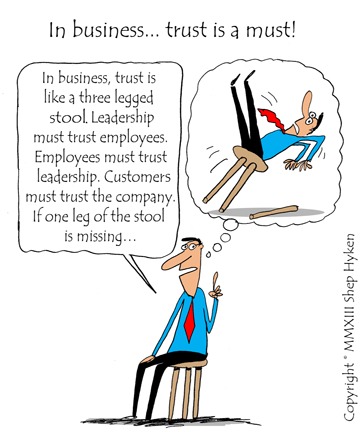
Cartoon – Trust is a Must!

A Better Boss or a Pay Raise? What Would YOUR Employees Choose?

Ask yourself this question: If I gave my employees a choice between receiving a pay raise or me becoming a better boss, which would they choose?
Chances are you’d probably say your employees would choose a pay raise, right? I mean, after all, who wouldn’t want more money? Taking a few liberties with the classic song Money by Barrett Strong, your employees are probably saying “Your leadership gives me such a thrill, but your leadership don’t pay my bills, I need money!”
Getting a pay raise would be an immediately tangible reward that everyone could literally take to the bank. Besides, it’s not like you need any dramatic improvement as a boss, right? Sure, you may not be the greatest leader in the world, but there’s a whole lot of bosses plenty worse than you. Your people would definitely choose a pay raise, you say.
Well, you’d be wrong. One study showed that 65% of Americans would choose a better boss over a pay raise. How do you like them apples?
In many of our training courses we do a “best boss” exercise. We ask participants to share the characteristics of the person who was their best boss, and as you can see from the list below, many of these traits are ones you can develop and master with just a bit of effort and focus.
My best boss…
Unfortunately, too many leaders are unwilling to admit they could use a bit of improvement, and too many organizations tolerate poor managerial performance (free whitepaper: 7 Ways Poor Managers Are Costing Your Company Money). But as you can see from this list, becoming a best boss isn’t rocket science. It’s within the grasp of any leader who is willing to put in a bit of work to improve his/her craft.
Three Basic Truths About People That Busy Leaders Should Not Ignore
Lately, I’ve been working with a company that’s about to make a big leap. They have a potentially world-changing product and are on the cusp of scaling up in a big way. It’s very exciting stuff.
Everyone from the CEO on down is super busy. There is a lot of work to do both internally and externally. With all the demands, time and attention is a scarcer resource than money.
That’s true for many of the leaders I work with. It can be really exciting when you’re running at a hundred miles per hour to get big things done. The challenge is that, in that kind of situation, it’s easy to lose sight of some basic truths about people that you just intuitively get when you’re not so absorbed by everything else you have to do.
Here, then, are three basic truths about people that busy leaders should not ignore:
People care about where you are and what you’re doing. – When you’re running hard, you’re likely to be in a lot of meetings and, possibly, on a lot of airplanes. You’re getting stuff done but it can feel to your team like you’re missing in action. Keep doing what you need to do but let them know what you’re doing and why you’re doing it. Set the context and tell the story. Nature abhors a vacuum. In the absence of solid information, people make stuff up. That’s hardly ever helpful. Avoid that by letting your people know where you are, what you’re doing and why you’re doing it.
People want predictability. – To do their best work, most people need some amount of predictability. They need to know what’s expected of them, what others are working on and how it all hangs together. This is especially true for leadership teams. They need an operating rhythm that ensures that they can stay well informed and in sync with each other. That requires regular and consistent communications. It can be hard to stick with the rhythm of that when you’re running flat out, but it needs to be a priority. Without the predictability of that kind of communication, your team will likely lose their way.
People will hardly ever speak up if you ask, “Are there any questions?” – How many times have you been in a town hall meeting (or, worse, leading one) when, after all the presentations, someone asks, “Are there any questions?” and the response is crickets. That’s because most people are never going to step up and ask the first question in front of a room. Again, that’s especially true when there is a lot going on and a lot of change. If you really want to know what people think (and you should), don’t ask, “Are there any questions?” Instead, ask “What are we missing?” or “What’s going on that we need to pay more attention to?” If you really want to grease the skids, pose one of those questions and then give people ten minutes to talk about it in small groups and then ask for some spokespeople from each group. You’ll almost certainly get better information that way.
So, be busy and get big stuff done. Just don’t ignore the basic truths about what people need while you’re doing it. Your team will be a lot more engaged and productive if you tend to what they need.

Sometimes, when you’re responsible for others, it’s your job to let them be unfair to you

When I was an intern, in one of the first months of my residency, I walked into a patient room to see a child who was being admitted to the hospital. I had barely closed the door before the child’s mother started yelling at me. She was angry that they’d been waiting so long. She was angry because she felt like her child had been mishandled before admission. She was angry that he was in pain, and that no one had given him anything for it.
I was stunned. I had literally only learned about this patient five minutes before I had walked in the room. It had taken me only that amount of time to cross the hospital to see them. I started to defend myself, saying that it was unfair that she was angry at me. None of this was my fault.
This… did not defuse the situation. She lost it on me, screaming that we’d screwed up, that she was tired of being jerked around, and she wasn’t going to listen to excuses. I, being an idiot, tried to argue further. After all, she was blaming me for things I couldn’t control. Meanwhile, her child was in pain and crying in the bed.
I took a patient history as best I could, did a cursory exam, and left to place orders. Then I went to talk to my senior resident. I relayed to him about how ridiculous I thought it was that this mother treated me this way. I went on and on about how unfair it was. I said, “I try so hard to be a good doctor. I don’t understand why she was so unhappy with me.”
He said something which stuck with me, many years later. “She’s got a kid in the hospital, and you’re worried that she doesn’t like you?”
This poor woman was probably panicked out of her mind. She didn’t know what was wrong with her son. She felt like doctors had been screwing up left and right. Her child was crying, in pain, and she couldn’t make it go away. Of course she was angry; of course, she had to take it out on someone.
It was my job to be the receptacle for that anger. Over the course of my (limited) clinical practice, I have let countless parents yell at me. Almost every single time, I thought they were wrong on the facts, but I didn’t care. The only way I could help them was to let them get out their frustration. I’m a big boy. I’m a doctor. I can handle it.
This lesson has served me well as a parent, too. Many times, my children have been frustrated by school, by friends, or even by me or my wife. They snap. I could choose to fight with them, to prove to them that they’re wrong and I’m right. I could “win”. But I know I’ll lose in the end. Because sometimes people are just angry or upset, and they need to vent. I’m their dad. It’s my job. We’ll settle the facts at a later time. The world won’t end in the meantime because I “lost” an argument.
I’ve been watching a lot of news recently where people feel the need to fight. To respond. To be “right”. I don’t know who coined the phrase, “Do you want to be right, or do you want to be happy?” but it’s a mantra in our house. I try very, very hard in my personal life to make it the latter.
When you hold the power, sometimes you have to let others unload on you. It’s the only way to help some people; it’s all they have left. If you can’t handle that, don’t ever put yourself in the position of being responsible for other people’s lives. This applies to more than just medicine, of course.


