Are CEOs Less Ethical Than in the Past?

https://www.strategy-business.com/feature/Are-CEOs-Less-Ethical-Than-in-the-Past?gko=50774&utm_source=itw&utm_medium=20170516&utm_campaign=resp

The job of a chief executive officer at a large publicly held company may seem to be quite comfortable — high pay, excellent benefits, elevated social status, and access to private jets. But the comfortable perch is increasingly becoming a hot seat, especially when CEOs and their employees cross red lines.

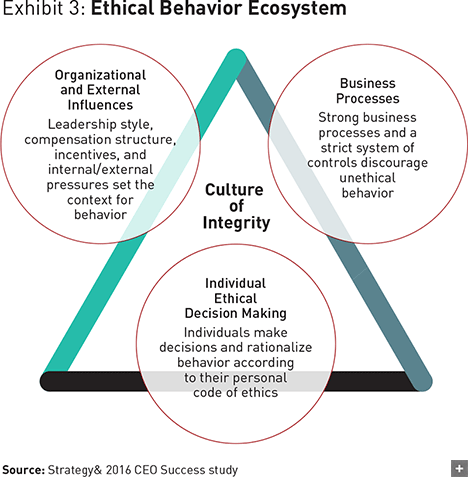
As this year’s CEO Success study shows, boards of directors, institutional investors, governments, and the media are holding chief executives to a far higher level of accountability for corporate fraud and ethical lapses than they did in the past. Over the last several years, CEOs have often garnered headlines for all the wrong reasons: for misleading regulators and investors; for cutting corners; and for failing to detect, correct, or prevent unethical or illegal conduct in their organization. Some high-profile cases, involving some of the world’s largest corporations, have featured oil companies bribing government officials and banks defrauding customers.

To be sure, the number of CEOs who are forced from office for ethical lapses remains quite small: There were only 18 such cases at the world’s 2,500 largest public companies in 2016. But firings for ethical lapses have been rising as a percentage of all CEO successions. (We define dismissals for ethical lapses as the removal of the CEO as the result of a scandal or improper conduct by the CEO or other employees; examples include fraud, bribery, insider trading, environmental disasters, inflated resumes, and sexual indiscretions. See “Methodology,” below.) Globally, dismissals for ethical lapses rose from 3.9 percent of all successions in 2007–11 to 5.3 percent in 2012–16, a 36 percent increase. The increase was more dramatic in North America and Western Europe. In our sample of successions at the largest companies there (those in the top quartile by market capitalization globally), dismissals for ethical lapses rose from 4.6 percent of all successions in 2007–11 to 7.8 percent in 2012–16, a 68 percent increase.

http://www.beckershospitalreview.com/hospital-management-administration/ceo-turnover-for-misbehavior-up-36-worldwide.html


6 Ways Leaders Should Be Like Mothers

6 Ways Leaders Should Be Like Mothers

6 Ways Leaders Should Be Like Mothers

rosie the riveterMother’s Day 2017

Dear Leaders,

Today is a time we set aside to celebrate our mothers. Motherhood is often a thankless and tiring endeavor. It’s easy to take for granted the hard work, sacrifice, and love that moms contribute to our lives. So today we pause to appreciate the countless ways our mothers have positively influenced us and shaped us into the people we are today.

In many ways, moms are the ultimate picture of servant leadership in action. They always have the best interests of their children in mind and will go to great lengths to help them grow, develop, and succeed in life. They are able to harmonize the polarities of unconditional love and tough love, and do so in such a way that their children always know that mom has their back. Mothers are simply amazing leaders.

Using the acronym MOTHER, here are six ways leaders can improve their effectiveness by embodying the characteristics and behaviors of great mothers:


5 WAYS TO SUCCEED WITH AN INFLEXIBLE PIGHEADED BOSS

5 Ways to Succeed with an Inflexible Pigheaded Boss

If you’re flexible, rigid people seem pigheaded, narrow minded, and self-centered. Why can’t everyone be flexible like you?

Rigid people drive the train:

If you have an inflexible boss or team member, they always drive the train.

  1. Fear of offending them controls interactions.
  2. Tough conversations always go one way. Everything is about winning or losing.
  3. Violating the “rules” is a capital offense. Throwing people under the bus may become a means of control.

Change, innovation, and progress slow to a snail’s pace when rigid people drive the train.

Stability:

Stability is the advantage of rigidity.

Organizations need rigid people even if some think they’re evil. You don’t need the dark-side of their strength. But without them, inconsistency escalates into instability.

Sure, they stress themselves and others. They complain about missed commons. But, they’re great at following procedures and delivering consistent results.

Inflexible people love systems that prevent failure.

Navigation tips:

What if your boss is inflexible?

  1. Adapt to them. They won’t adapt to you. No one likes to be changed – especially an inflexible boss. They’ll lash out like caged animals if you pressure them.
  2. Admire their strengths and say so. Say, “Your personal consistency brings stability and consistency to our organization.”
  3. Accept, embrace, and answer their discomforts or fears. Telling them that things will work out drives rigid people crazy.
  4. Prepare them for change.  Don’t surprise them. Discuss problems before solutions.
  5. Establish rituals and routines. Don’t addd stress to their stressful lives.

What suggestions do you have for navigating an inflexible boss or teammate?

Why do CEOs get fired or leave organizations anyway?

https://interimcfo.wordpress.com/2015/01/09/why-do-ceos-get-fired-or-leave-organizations-anyway/

In my previous post, I made reference to comments written by ‘TiredofTheOverpaidFailures’ in response to a Becker Review article.

Among other things, this writer said, “As a healthcare staffer for 35 years from entry-level employee to Director, I’ve literally never seen any CFO or CEO leave our organizations for any reason other than to “spend more time with my family”.  It’s true, because in every case they collected an inflated golden parachute for the next 2-3 years and indeed manage to take off time to spend with their family or most of the time do part-time consulting at some other organization where they have no idea the horrific failure they were in the previous position. For that matter, what shape they left the organization in.  They usually consider them “the expert” because they are from somewhere else.”

Clearly, he or she  was very bitter about what they had observed in the front office of their organization over a long period of time.

It is true that some of the folks occupying C-suite offices are not that stellar but more often than not, when they leave it is rarely because they are an idiot.  The system does a pretty good job of weeding out idiots before they can reach positions of such power and influence although I have seen a number of suspects among the casts of characters I have dealt with in healthcare administration.  So if the CEO is not an idiot, why let him go?  I will discuss a variety of situations that I have seen that I believe explain in part why CEO turnover in healthcare is so high.

I frequently hear complaints about what a Board is and is not doing with respect to the organization and the CEO.  A healthcare organization is not much different from a professional sports team.  The Board is the owner and the CEO is the coach.  In the end, like a sports team, the Board only has one switch or lever to use to guide the organization; hire the coach or fire the coach.  As long as the Board has not decided to fire the coach (CEO), by default they are supporting or at least tolerating him.  He is still their guy until the notice is delivered which can happen on the same date that an incentive award is given.  If you do not like what you see the CEO doing, it is not necessarily his fault.  Look to the Board for responsibility for the actions and results of their CEO.

7 Enemies of Organizational Health

http://www.leadershipdigital.com/edition/daily-leadership-management-2017-05-10?open-article-id=6560474&article-title=leading-with-control-versus-leading-with-influence&blog-domain=ronedmondson.com&blog-title=ron-edmondson

I love organizational leadership. I especially love attempting to lead healthy organizations. I have been in both environments – healthy and non-healthy. I prefer healthy.

If truth be told, I’ve probably been the leader in both extremes. And, there are seasons when every organization is healthier than others.

Over the years of leading I’ve observed a few things which can be the enemy of organizational health. They keep health from happening and – if not dealt with – can eventually destroy an organization – even a local church.

Here are 7 enemies of organizational health:

Shortcuts – There are no shortcuts to creating a healthy organization. I’ve known leaders who think they can read a book, attend a conference, or say something persuasive enough so everything turns out wonderful. Organizational health is much more complicated. Success is not earned through a simple, easy-to-follow formula. It takes hard work, diligence and longevity. Leaders must be committed to the process through good times and bad.

Satisfaction – Resting on past success is a disruption to future growth, which ultimately impacts organizational health. When an organization gets too comfortable – boredom, complacency and indifference are common results. The overall vision must be attainable in short wins, but stretching enough to always have something new to achieve.

Selfishness – Organizational health requires a team environment. There’s no place for selfishness in this equation. When everyone is looking out for themselves instead of the interest of the entire organization – and this starts with the leader – the health is quickly in jeopardy.

Sinfulness – This one is added for those who feel every one of my posts must be spiritual. (Just kidding.) Seriously, healthy organizations are not perfect (and we all sin), but it doesn’t matter if it is gossip or adultery – sin ravages through the integrity of the organization. When moral corruption enters the mix, and is not addressed, the health of an organization will soon suffer. This is why it is so important a leader stays healthy spiritually, relationally and physically.

Sluggishness – Change is an important part of organizational health. In a rapidly changing world, organizations must act quickly to adapt when needed. Some things never change, such as vision and values, but the activities to reach them must be fluid enough to adjust with swiftness and efficiency.

Stubbornness – Let me be clear. There are some things to be stubborn about, again, such as vision and values. When the organization or it’s leaders are stubborn about having things “their way”, however, or resistant to adopt new ways of accomplishing the same vision, the health of the organization will suffer. Most people struggle to follow stubborn leadership, especially when it’s protecting self-interest rather than organizational interests.

Structure – As much as we need structure, and even though we should always be working to add better structure, bad structure can be damaging to organizational health. When people feel they are being controlled by rules, more than empowered by their individuality and passions, progress is minimized and growth stalls. People become frustrated under needless or burdensome structure.

What enemies of organizational health would you add to my list?

Leading with Control Versus Leading with Influence

http://www.leadershipdigital.com/edition/daily-leadership-management-2017-05-10?open-article-id=6560474&article-title=leading-with-control-versus-leading-with-influence&blog-domain=ronedmondson.com&blog-title=ron-edmondson

Let me be honest. I can be a controlling person. It’s part of my character. I know that. I test that way with StrengthsFinders. If no one is taking charge, I’ll take over the room. (And, not because I’m extroverted. I’m not.) If we both come to a four-way stop at the same time – as nice as I try to be and as much as I love others – I won’t stall long for you to decide if you’re going. It’s just how I’m wired. If the leader isn’t in the room, I’ll lead.

I think my team, however – or at least I hope – would tell you I don’t perform as a controlling leader. Some may even wish I controlled more. It’s been a long process to discipline myself not to respond how I am naturally inclined to do.

Leaders, if you want to to have a healthy team environment, you must learn to control less and influence more. The differences are measured in the results of creating a healthy team.

I have learned thought that successful leaders understands the difference in leading with influence and leading with control.

Here’s what I mean by the results of controlling versus influence:

In an organization where control is dominant:

  • The leader’s ideas win over the team’s ideas – every time.
  • The team follows, but only out of necessity (for a paycheck) – not willingly.
  • Change happens through fear and intimidation – not motivation.
  • People are managed closely – rather than led.
  • Team members feel unappreciated and often under-utilized – rather than empowered.
  • The organization is limited to the skills and ability of the controlling leader – not the strength of a team.
  • Passion is weak – burnout is common.

But,

In an organization where influence is dominant:

  • The ultimate goal is what’s best for the organization, not an individual.
  • Team spirit develops as relationships and trust grow.
  • Willing followers, and other leaders, are attracted to the team.
  • Leadership recruitment and development is a continued endeavor.
  • Change is promoted through desire and motivation, not obligation.
  • The organization has the expanded resources of a team of unique individuals.
  • People feel empowered and appreciated.

Leaders, take your pick – control or influence. You can’t have it both ways. One will always be more dominant. Granted, I could write a whole blog post (and, I have) on the messiness of leading by influence. There will often be confusion, lack of clarity, and misunderstandings. It comes when all the rules aren’t clearly defined. This, however, is a tension to be managed not a problem to be solved. (I think Andy Stanley said that first.)

When it comes to creating organizational health – influence will always trump control. Every time.

Have you ever been or worked for a controlling leader?

Have you been in an environment where influence is dominant?

Which did you prefer?

Why an Interim Leader Might Be Right for Your Hospital Now

http://go.healthtechs3.com/webmail/65212/301376317/512fd82f27c1c374fcb87b63770e819d

Upcoming Webinar

Hospitals face difficult transitions every time a leader departs; maintaining momentum, restoring trust with the board, physicians and staff, financial turnarounds, and more.  The right interim leader – at the right time – can provide the expertise and guidance to steer the hospital through difficult straits, often providing the right combination of new strength and leadership for rapid financial or operational turnarounds (or even just a cultural change) when it would be tough for an incumbent to make the necessary changes.  While transitions can be somewhat scary, the right interim can ease the fears of the hospital and the community just by having a “seasoned” pro ready to step in when you need expert help.

Upon completion of the webinar, participants will understand:

  • What the right interim can mean for your organization
  • How s/he can provide unbiased continuity and stability for the institution and its staff and do the sometimes necessary “heavy lifting”
  • How to define what the right interim leader looks like – traits, skills, and fit

Please click here to view details and register.
Register

Cleveland Clinic’s Toby Cosgrove to step down, search begins for new president and CEO

http://www.fiercehealthcare.com/healthcare/cleveland-clinic-s-toby-cosgrove-to-step-down-search-begins-for-new-president-and-ceo?utm_medium=nl&utm_source=internal&mrkid=959610&mkt_tok=eyJpIjoiTm1Oak9EZzNZMkZoTVdKaSIsInQiOiJZY0d6WGVEUmR2S3dTaW5uMFBUWTZWXC9YekZySGpibUJNUWR0Mks3cVZORVZ2ZUZxQVdlcGRseCtiR0JhYUZoVXo0c0RsRHZ0eUVrZzJqRVNDZEdTcVU3S0JTNGEycktPOFNyYkFCeTdRNFpPK3pTNE1wRE1jWHZYbzJKbHp2dVkifQ%3D%3D

Cosgrove_At_State_Of_The_Clinic(Credit:Stephen_Travarca/Cleveland_Clinic)

One of the country’s most influential healthcare leaders plans to hang up his hat later this year.

Toby Cosgrove, M.D., who has served as president and CEO of the Cleveland Clinic for nearly 13 years, announced this morning he intends to step down. He will continue serving as an adviser for the multispecialty academic hospital.

The organization will begin the search for his successor immediately. In keeping with its model as a physician-led institution, the new president and CEO will also be a practicing physician.

Cosgrove was a cardiac surgeon for nearly 30 years before becoming CEO of Cleveland Clinic in 2004. Since then, he has led initiatives that have gained international and national recognition, particularly his focus on improving the patient experience and reorganizing clinical services into a patient-centered care model.

Cosgrove coined the phrase “Patients First” at the institution and was the first to hire a chief patient experience officer, a position that is now a fixture in many hospitals across the country. He also has implemented same-day medical appointments for patients who request them.

“It is an honor and a privilege to be a part of an extraordinary and forward-thinking organization that puts patients at the center of everything we do,” Cosgrove said in an announcement. “Cleveland Clinic’s world-class reputation of clinical excellence, innovation, medical education and research was created and will be maintained by the truly dedicated caregivers who work tirelessly to provide the best care to our patients.”

Under his direction, the Cleveland Clinic has grown into an $8 billion health system with locations in Ohio, Florida, Nevada, Canada and Abu Dhabi. It also will open a facility in London in 2020. The organization is Ohio’s largest employer with more than 50,000 caregivers.

Cleveland Clinic is also a leader in patient care. It was ranked No. 2 in the nation last year by U.S. News & World Report, which also ranked its heart program as No. 1 in America for 10 years in a row.

“The goal of any leader is to leave an institution better than you found it. Without a doubt, Toby has done that,” Cleveland Clinic Board of Directors Chairman Bob Rich said in the announcement. “Our world-class reputation has only grown over the past 13 years, as he has led Cleveland Clinic through a period of dramatic growth and worldwide expansion.”

In recent years, Fortune has also named Cleveland Clinic one of the best workplaces in healthcare. During his tenure, Cosgrove has led major wellness initiatives for both patients and employees, banning smoking on all campuses, adopting a policy not to hire smokers, offering employees free memberships to Weight Watchers and gyms, eliminating fried foods from the hospital cafeteria, opening weekly farmer’s markets in the summer and fall and creating an employee health insurance program that offers discounts for physical activity or for enrollment in a disease management program.

He was a frontrunner twice to serve as the secretary of the Department of Veteran Affairs, most recently as President Trump’s pick to oversee the embattled agency. But he had to turn down the position because he couldn’t get out of his commitment to the Cleveland Clinic.