Antitrust in the Labor Market: Protectionist, or Pro-Competitive?

https://promarket.org/antitrust-labor-market-protectionist-pro-competitive/

Image result for Antitrust in the Labor Market: Protectionist, or Pro-Competitive?

Redirecting antitrust enforcement to confront monopsony power would be a substantial departure from the way it has been conducted in recent decades, but just because a policy has been in place for a long time does not mean it is a success, and recent evidence implies a significant policy change is necessary and justified.

The very first sentence of the United States submission to the OECD’s “Global Forum on Competition” in 2015 reads “The U.S. Federal Trade Commission and the Antitrust Division of the Department of Justice do not consider employment or other non-competition factors in their antitrust analysis.”

Employment isn’t a “competition factor?” A growing body of evidence, drawn from both micro and macro sources, implies that the labor market has been slack since the Great Recession thanks to an aggregate demand shortfall. The employment-to-population ratio, labor force participation, job-to-job and geographic mobility, and the job ladder as a whole have all stagnated for almost a decade, and even before 2008 these indicators had barely made up ground since the recession of the early 2000s. Wages have been stagnant, and thus the labor share of national income has been in decline.

Over an even longer period, worker compensation has failed to keep pace with productivity gains per capita. The broadening literature on the rise of earnings inequality between firms, controlling for worker characteristics, implies that workers do not receive sufficient job offers to equalize the earnings they receive across firms. All of these phenomena are explained by rising monopsony power in the labor market.

The recent paper by De Loecker and Eeckhout makes this point explicit: the ability of employers to extract rents in the labor market causes a reduction in the market demand for labor, and this in turn motivates all of the manifestations of a slack labor market just described, as well as the rising markups that are the central finding of that paper. Profits have risen, reflecting rising market power in both labor and product markets—a finding that is consistent with the aggregate analysis done by Barkai.

So if monopsony power constrains employment, why not consider it a factor in antitrust analysis? After all, the premise of economic analysis in antitrust is that market power threatens welfare by restricting output and raising prices. Why doesn’t market power threaten welfare by reducing demand for labor and lowering wages?

Existing antitrust policy treats maximizing consumer welfare as the ultimate end goal of antitrust policy, and that policy aim makes sense in a world of little market power, where profits are low and the economy is assumed to be on its production possibility frontier. In that world, maximizing consumer welfare is a suitable summary statistic for overall wellbeing.

Moreover, since the revolution in antitrust policy associated with Robert Bork put such an emphasis on sustaining an “economies” defense—meaning that potentially efficiency-enhancing aspects of corporate mergers and conduct must be weighed against inefficiencies arising from market power—the potential for monopsony power has been considered a plus. After all, enforcers and courts generally assumed that any gains at the expense of workers would be passed to consumers in the form of lower prices, since product markets would be competitive (and if not, the potential for entry would exert a disciplining influence). In that world, caring about employment, wages, or other labor market outcomes looks like protectionism, impeding the competitive pressure that yields the best outcomes for consumers, and favoring certain privileged “insider” workers at the expense of others.

We know now that we don’t live in that world, and that revelation calls for a wholesale re-think of the proper goals of antitrust policy, very much including whether the sole focus on consumer welfare makes sense when powerful corporations squeeze workers and then pocket the gains for themselves and their shareholders.

What would it actually look like to bring antitrust into the labor market?

As with any enforcement regime, antitrust often starts with the lowest-hanging fruit: out-and-out written evidence of anti-competitive practices, such as the Justice Department’s 2010 lawsuit against Silicon Valley employers for colluding not to hire one another’s programmers. This is partly why the recent increase in the use of non-compete clauses has drawn attention in antitrust circles. As a would-be vertical restraint, non-compete clauses aren’t as easy to target under antitrust as horizontal collusion, but they are there, in writing—prohibitions on competition in the labor market, to the benefit of employers. And they should be banned, or at the very least subjected to a high burden of proof requiring a substantive defense on the part of employers who impose them, plus an affirmative finding that they do not act to reduce wages or restrict job offers.

The same dynamic is at play in prohibitions on poaching in franchising agreements, which Alan Krueger and Orley Ashenfelter recently found to be prevalent in franchising contracts and which, to my knowledge, the federal competition regulators have never touched—even though they do regulate other provisions of those contracts. Franchising networks are a hybrid beast, somewhere between horizontal and vertical, but a blanket prohibition on poaching throughout a franchisor’s network certainly starts to look like a horizontal agreement not to compete.

It’s important to understand, though, that these written restraints of trade are symptoms of the broader decline in worker power, and meaningful antitrust enforcement should go after the causes. Reclassification of workers as independent contractors is a broader concern—not only anti-competitive in itself, but as a means to engage in other coercive conduct and corporate structures. Studies show that reclassifications result in immediate wage reductions and no other changes in terms of employment, suggesting that they amount to employer’s exploiting their wage-setting power by changing the legal structure of their business.

And beyond the act itself, classifying workers as independent contractors allows employers to avoid liability for minimum wage, maximum hours, workplace safety, and a host of other entitlements associated with statutory employment. The idea was that employment inherently signifies control, and with control ought to come responsibility—and by extension, if employers do not bear responsibility, then they should not be able to exercise control. What employers have realized now, as enforcement regimes in both labor and antitrust have weakened, is that they can have the control without the responsibility. For example, contracting terms often prevent workers from simultaneously working for others—an exercise of control if ever there was one, and an anti-competitive vertical restraint in the context of an independent contractor.

Employers can have that control without first establishing themselves as a monopoly—in fact, reclassification is increasingly standard operating procedure in many industries, which means that treating it as a violation of Section 2 of the Sherman Act should not require that outright monopolization must first be shown.

This is the fundamental issue behind the litigation over whether Uber’s drivers ought to be considered employees, and if not, whether the business amounts to a price-fixing conspiracy between the company and hundreds of thousands of independent businesses who drive for it. I’ve written before about the antitrust lawsuit against Uber on these grounds. The case was recently dealt a severe blow in the form of an appellate ruling that upheld the company’s mandatory arbitration clause—meaning that if the lower court decides Uber did not itself void the arbitration clause by hastening the case with a move to summary judgment, then the case will likely be thrown out of court.

That brings us to yet another way in which employers exercise monopsony power: mandatory arbitration and class action waivers for employment claims, about which the Supreme Court is set to hear a case this term. The issue there is that expansive readings of the Federal Arbitration Act have essentially said that individual rights protected by both the constitution and federal statute can be voided by bilateral waivers—as though the parties are equally situated and at liberty to reject such provisions in employment agreements and elsewhere. Of course, the whole point of monopsony is that jobs are scarce, and hence employers have leverage with which to extract concessions, be they out-and-out wage reductions or agreements not to litigate disputes. Thus, another aim of antitrust enforcement in labor markets ought to be bans on litigation waivers between parties that are not similarly situated economically as restraints of trade—and the competition authorities ought to make their views known to the Supreme Court on this issue. After all, private action is a pillar of federal antitrust policy, and so arbitration clauses are not just themselves restraints of trade, but they also inhibit enforcement against other restraints, as the fate of the Uber antitrust case shows.

Finally, there’s the elephant in the room when it comes to antitrust: merger review, the bulk of what the agencies do about enforcing the laws they’re entrusted to carry out. Claims that mergers reduce employment are not entertained as arguments against them—in fact, they are likely to be considered arguments in favor, as they show some motivation for the transaction beyond raising prices for consumers. And yet we know anecdotally that recently-consummated mergers have in fact had adverse employment impacts. A systematic study of the labor market impact of past mergers has yet to be conducted, to my knowledge—such an exercise would be a valuable component of assessing the impact and success of the current competition policy regime, including whether these job losses do actually end up benefiting consumers in the form of lower prices, as merging parties invariably claim, versus their shareholders and executives.

In conclusion, the view that the competition authorities expressed to the OECD in 2015 looks increasingly out of touch with the labor market and the broader macroeconomic conditions that currently exist. It is true that redirecting antitrust enforcement to confront monopsony power would be a substantial departure from the way it has been conducted in recent decades, and as such there are both court decisions and agency policies that go against it. But just because a policy has been in place for a long time does not mean it is a success, and recent evidence implies a significant policy change is necessary and justified—much as an intellectual movement in academia once shifted antitrust policy substantially, it’s time for new evidence to change it once again.
Debt Sickened a Hospital Giant. Now the Doctors Are Revolting

https://www.bloomberg.com/news/articles/2017-09-21/debt-sickened-a-hospital-giant-now-the-doctors-are-revolting?


The standoff over Lutheran shows how for-profit chain CHS, once the nation’s largest, allowed its facilities to decay, compromising care and destroying investor value.

Four doctors from Lutheran Hospital in Fort Wayne, Ind., showed up at parent company Community Health Systems Inc. in May with a message for Chief Executive Officer Wayne Smith and his board. Physicians were in widespread revolt, they said. Facilities were cash-strapped and crumbling. Powerful locals wanted CHS to reinvest or leave.

The doctors urged Smith to sell the eight-hospital Lutheran Health Network to their physician group, which already owned a 20 percent stake, and an investor partner, for $2.4 billion—triple CHS’s current market value. The combative 71-year-old CEO denied authorizing cost cuts in Fort Wayne and demanded the names of those who did, say people in the meeting. The board refused the offer, and rather than pursue the budget-cutters, Smith fired Lutheran’s CEO, who’d sided with the doctors.

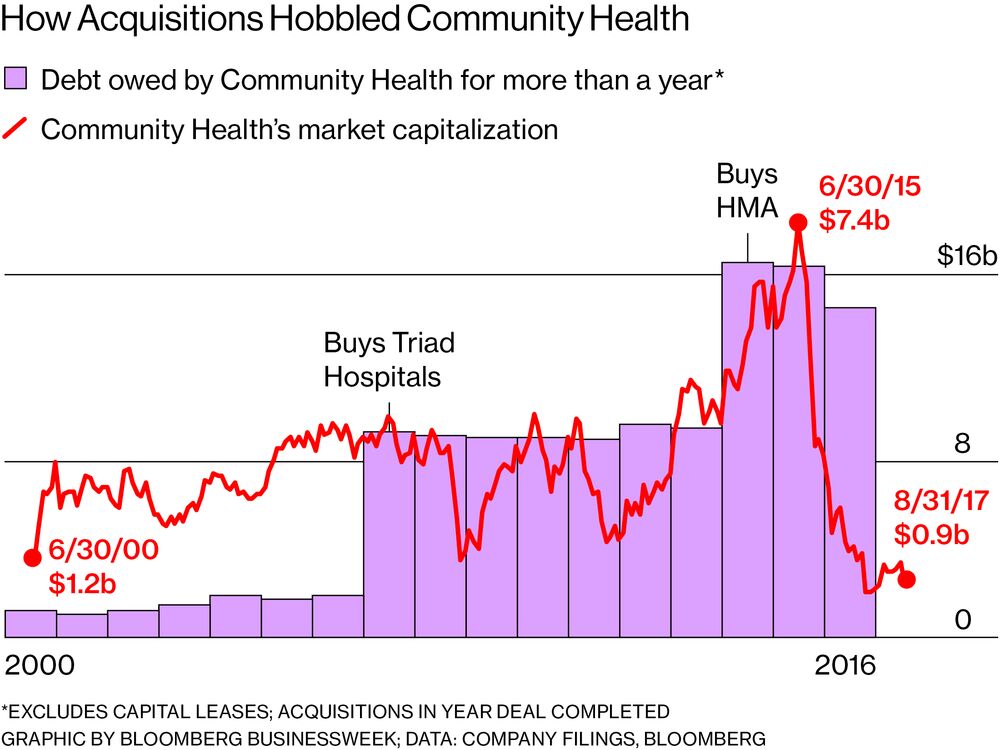
The standoff over Lutheran provides a window into how CHS, once the largest for-profit hospital chain in the U.S., has allowed facilities to languish, possibly compromising care and destroying investor value in the process. Smith presided over a decade-long acquisition binge that saddled CHS with total debt of almost eight times its earnings and a network of underperforming facilities. The company lost $2 billion in the past six quarters, during which doctors from Key West to Spokane have accused the chain of pinching pennies and regulators have fined it for overcharging Medicare. Says Indiana Republican Representative Jim Banks, who’s sided with the Fort Wayne doctors: “It’s buy, squeeze, and repeat.”

“At some point you reach a dead end, and you can’t cut the expenses anymore”

Smith took CHS public in 2001, just four years after coming to the company from Humana Inc., where he’d been head of hospital operations. The big acquisitions began in 2007, when the chain bought Texas-based Triad Hospitals Inc. for $6.4 billion, more than quadrupling its debt. Smaller deals followed. By the end of 2014, CHS had nearly doubled its debt again to finance its buyout of Health Management Associates LLC (HMA), a Florida-based group of mostly rural facilities that required costly upgrades.

Smith’s plan was to try to increase doctor productivity and slash costs, often replacing experienced doctors with loyal patients for younger ones who were willing to work longer hours. Like most for-profit operators, “they focused on cost control,” says Joshua Nemzoff of Nemzoff & Co., who advises hospitals on sale transactions. “At some point you reach a dead end, and you can’t cut the expenses anymore.”

Along with the rest of the hospital industry, CHS expected the Affordable Care Act to provide a windfall of insurance money from the newly covered. Investor enthusiasm soured when 19 states—including Florida and Texas, two key CHS markets—declined to expand Medicaid eligibility, leaving many low-income people without coverage. At the same time, insurers and other government programs began working to divert patients from hospitals into doctors’ offices, outpatient clinics, and other less expensive venues. The combined effect was particularly hard on rural hospitals, a large share of CHS’s network.

Raising prices while slashing costs has been a hallmark of CHS under Smith. In Fort Wayne, Lutheran charges more than rival Parkview Medical Center Inc. for 8 of 10 common medical procedures. During the first half of this year, patients were placed in beds in Lutheran’s emergency room hallways because the wards they should have been moved to were understaffed, and a leaking air conditioner in the neonatal care unit was dripping water on infants’ beds, according to people familiar with the conditions. While Parkview invested in its cancer and cardiac units, Lutheran doctors said at the board meeting that the CHS hospital was using lower-priced monitors they feared would miss potentially fatal heart rhythms.

Company spokeswoman Tomi Galin said in an email that many other hospitals use the same monitors. Nevertheless, CHS plans to spend $500 million on improvements and will recruit new doctors at Lutheran, she wrote, adding that employee retention there is rising.

Other critics of Smith have taken their complaints to court. After Gregg Becker quit his job as chief financial officer of CHS’s Rockwood Clinic in Spokane, Wash., in 2012, he filed a whistleblower claim with the U.S. Department of Labor, saying his superiors told him to reduce the facility’s forecast loss from $12.8 million to $4 million and threatened to fire him if he didn’t. Becker was awarded a settlement of almost $1.9 million by an administrative law judge, according to court documents. CHS has appealed the case to the Washington Supreme Court and the federal Arbitration and Review Board. (CHS sold Rockwood earlier this year.)

In 2014, CHS agreed to pay $98.15 million to the Department of Justice to settle lawsuits in five different districts accusing the company of charging for higher-cost inpatient services at hospitals, including Lutheran, when less expensive outpatient services would have been sufficient. CHS didn’t admit wrongdoing. But the DOJ in a statement said the company had “engaged in a deliberate corporate-driven scheme to increase inpatient admissions of Medicare, Medicaid, and the Department of Defense’s Tricare program.”

With losses mounting and the stock down more than 80 percent from its peak in June 2015, Smith has resorted to selling hospitals to pay off debt. One result: CHS will soon be about the same size it was before it attempted to digest HMA. Hedge fund ASL Strategic Value, a CHS shareholder, sent a letter to the board on Aug. 8 asking directors to replace Smith. Tom Kelley, a Fort Wayne car dealer whose employees rely on Lutheran for care, quit the Lutheran board in July and says he’s reviewing his employee medical plan. He tried and failed to broker a peace deal between the doctors and Smith.

“He’s a street fighter,” Kelley says of Smith. “He has survived government actions against him. He has survived lawsuits. He has survived all of this by being a tough SOB.”

BOTTOM LINE – Community Health Systems used acquisitions to become a major for-profit hospital operator. But the added heft wasn’t matched by profitability gains.


CHI posts $585M operating loss in FY17

http://www.healthcaredive.com/news/chi-posts-585m-operating-loss-in-fy17/505184/?utm_source=Sailthru&utm_medium=email&utm_campaign=Issue:%202017-09-19%20Healthcare%20Dive%20%5Bissue:12065%5D&utm_term=Healthcare%20Dive

Click to access CHI%20Annual%20Report%20Period%20Ending%20June%2030%202017.pdf

Image result for catholic health initiatives annual report 2017

Dive Brief:

  • Catholic Health Initiatives reported a $585.2 million operating loss for fiscal year 2017, ended June 30, up from $371.4 million in 2016.
  • Non-operating income was strong, however, reaching $713.6 million, versus a $204.2 million loss the previous year. The performance benefited from investments of nearly $640 million, according to CHI’s 2017 annual report.
  • Overall, CHI saw a net surplus of $128.4 million — a welcome result after last year’s net loss of $575.7 million. Total operating revenue for 2017 totaled $15.5 billion.

Dive Insight:

CHI has made strides toward getting back on sound financial ground, officials said in a statement, but challenges remain, particularly in some markets.

During the year, CHI divested its KentuckyOne facilities, a move expected to bring in $534.9 million. The system also transitioned operations, management and control of University of Louisville Medical Center back to the university and sold nearly all of its Louisville area acute care operations.

The company said it has also found a buyer for Medicare Advantage plans, but added that uncertainty around the future of the Affordable Care Act has delayed the sale of its QualChoice Health commercial insurance segment.

The Denver-based system is in talks with Dignity Health about a possible merger of their organizations. The non-for-profit hospital systems signed a nonbinding letter of intent to explore an affiliation in September 2016. San Francisco Business Times reported in June that the two organizations were in “final stages” of merger discussions.

Study: Hospitals on doctor-buying spree raise legal questions

http://www.healthcarefinancenews.com/news/study-hospitals-doctor-buying-spree-and-raises-legal-questions?mkt_tok=eyJpIjoiTkRWa1ptVTJNMlUyWldVeCIsInQiOiJGaXFrTXRvUlM4YjFhbHpsVUtRSEh2ZmlCaElBOXh0cVwvejFndVg1WnhTNjEzYmZnTjVIZVMrNjdPeEREOXc4R0I4V0pFN1VZSW5VQVNCYWEycjFIejlmSEZcL1V6VnJ2ZkpUd3k1ekhkY1BidzAyNWdDZGhwRlZacHNudExqclpwIn0%3D

Image result for M&A

Bigger and fewer doctor practices drive up prices for patients, employers and taxpayers, several studies confirm.

Hospitals have gone on a doctor-buying spree in recent years, in many areas acquiring so many independent practices they’ve created near-monopolies on physicians.

Research published Tuesday throws new light on the trend, showing that large doctor practices, many owned by hospitals, exceed federal guidelines for market concentration in more than a fifth of the areas studied.

But it goes further, helping answer some of health policy’s frequently asked questions: How could this happen? Where are the regulators charged with blocking mergers that have been repeatedly shown to drive up the price of health care?

The answer, in many cases, is that they’re out of the game.

Doctor deals are typically far too small to trigger official notice to federal antitrust authorities or even attract public attention, finds a paper published in the journal Health Affairs.

When it comes to most hospital-doctor mergers, antitrust cops operate blind.

“You have a local hospital system and they’re going in and buying one doctor at a time. It’s onesies and twosies,” said Christopher Ody, a Northwestern University economist and one of the study’s authors. “Occasionally they’re buying a group of five. But it’s this really small scale” that adds up to big results, he said.

The paper, drawing from insurance data in states covering about an eighth of the population, found that 22 percent of markets for primary care doctors, surgeons, cardiologists and other specialties were “highly concentrated” in 2013. That means that, under Federal Trade Commission guidelines, a lack of competitors substantially increased those doctors’ ability to raise prices without losing customers.

The research didn’t sort physician groups by ownership. But other studies show that large, predominant practices are increasingly owned by hospitals, which see control of doctors as a way to both coordinate care and ensure patient referralsand revenue.

According to one study, hospitals owned 26 percent of physician practices in 2015, nearly double the portion from 2012. They employed 38 percent of all physicians in 2015, up from 26 percent three years earlier.

In the study by Ody and colleagues, only 15 percent of the growth by the largest physician groups from 2007 to 2013 came from acquisitions of 11 doctors or more.

About half the growth of the big practices involved acquisitions of 10 or fewer doctors at a time. About a third of the growth came not from mergers but from hiring doctors out of medical school or other sources.

Federal regulations require notification to anti-monopoly authorities only for mergers worth some $80 million or more — far larger than any acquisition involving a handful of doctors.

Very few of the mergers that drove concentration over the market-power red line — or even further — in the studied areas would have surpassed that mark or a second standard that identifies “presumably anti-competitive” combinations.

But the little deals add up. In 2013, 43 percent of the physician markets examined by the researchers were highly or moderately concentrated according to federal guidelines that gauge monopoly power by market share and number of competitors.

(A market with three practices in a particular specialty, each with a third of the business, would be at the lower end of what’s considered highly concentrated. A market with one doctor group doing at least 50 percent of the business would be highly concentrated no matter how many rivals it had.)

Bigger and fewer doctor practices, fueled largely by hospital acquisitions, do drive up prices for patients, employers and taxpayers, several studies confirm.

Part of the increase results from a reimbursement quirk. Medicare and other insurers pay hospital-based doctors more than independent ones. But another part comes from the lock on business held by large practices with few rivals, Ody said.

“It’s a problem,” said Martin Gaynor, a health care economist at Carnegie Mellon University and former head of the FTC’s Bureau of Economics. “All the evidence that we have so far … indicates that these acquisitions tend to drive up prices, and there’s other evidence that seems to indicate it doesn’t do anything in terms of enhancing quality.”

The American Hospital Association, a trade association, declined to comment on the study since officials hadn’t seen it. But the AHA often argues that “hospital deals are different” and that doctor acquisitions keep patients from falling through the cracks between inpatient and outpatient care.

The FTC has moved to block or undo a few sizable doctor mergers, including an orthopedics deal in Pennsylvania and an attempt by an Idaho hospital system to buy a medical practice with dozens of doctors.

But the agency largely lacks the tools to challenge numerous smaller transactions that add up to the same result, said Ody.

An FTC spokeswoman declined to comment on the study’s findings.

Ody urged state attorneys general and insurance commissioners to look more closely at doctor combos. Sometimes state officials can question mergers overlooked by federal authorities. Or they can block anti-competitive practices, such as when hospitals seek to exclude competitor physicians from insurance networks.

Beyond that, “I hope that people notice this [research], and I hope people think creatively about what kinds of solutions might be appropriate for this,” he said. “I don’t know what they are.”

Moody’s downgrades UPMC to ‘A1’

http://www.beckershospitalreview.com/finance/moody-s-downgrades-upmc-to-a1.html

Image result for university of pittsburgh medical center


Moody’s Investors Service downgraded Pittsburgh-based UPMC from “Aa3” to “A1,” affecting $2.9 billion of debt.

In addition, Moody’s downgraded UPMC-Hamot’s bonds, which are parity obligations for UMPC, from “Aa3” to “A1.”

The downgrade is a result of several factors including UPMC’s rapid expansion project, high execution risk following the acquisition of Harrisburg, Pa.-based PinnacleHealth and a new service area with high competition. Moody’s also acknowledged UPMC’s increased debt burden, below average financial performance and suppressed margins. Offsetting an additional notch downgrade is UPMC’s strong market position, integration of various hospital acquisitions and core competency in acute care management.

The outlook is negative, reflecting Moody’s expectation that UPMC’s rapid expansion may pose financial and cultural stress.

Paladin to buy 2 Tenet hospitals for $170M

http://www.beckershospitalreview.com/hospital-transactions-and-valuation/paladin-to-buy-2-tenet-hospitals-for-170m.html

Image result for paladin healthcare

Dallas-based Tenet Healthcare will sell its two Philadelphia hospitals to El Segundo, Calif.-based Paladin Healthcare for $170 million, to help lighten its debt burden of $15 billion.

The sale will transfer ownership of Hahnemann University Hospital, St. Christopher’s Hospital for Children and other related operations in Philadelphia to American Academic Health System, a new company formed by Paladin Healthcare.

“Paladin shares [Tenet’s] commitment to providing compassionate, exemplary care and service, and we believe that entrusting the stewardship of these institutions to its affiliate AAHS will benefit the patients, employees, physicians and community for years to come,” said Mike Halter, CEO for Tenet’s Philadelphia division and CEO of Hahnemann University Hospital.

The transaction is expected to be completed in early 2018. It will need regulatory approval.

The decision to sell the two hospitals comes a day after Tenet announced it would replace longtime CEO Trevor Fetter and “refresh” the composition of its board of directors.

Carolinas HealthCare, UNC Health Care reveal intent to merge

http://www.healthcarefinancenews.com/news/carolinas-healthcare-unc-health-care-reveal-intent-merge?mkt_tok=eyJpIjoiWkRabU1tTmxOek13Wm1FMyIsInQiOiJQYzBXSkh1OU5ZZmpSdndteUpUUEtiZHBHOE5RekdPYVoyOXBWaE80aHBRMCtJZjNHM01xaU1lWW9PeThMdzNlWWZ6ZHFlUHJmcmVXRFBRXC83WllsV1hudzFZR241U1J4WE15ODBmTFwvUVZSZCs3TDdzSHdKSGFaaWR5bUlSQUFiIn0%3D

Image result for carolinas health system headquartersImage result for unc health system


Health systems say they are entering negotiations to combine clinical, medical education and research units.

rolinas HealthCare System and UNC Health Care announced on Thursday that they are negotiating a merger that would transform them into a health system earning an estimated $14 billion in annual revenue.

Both organizations have signed a letter of intent to join their clinical, medical education and research resources and the letter kicks off a period of exclusive negotiations, with the goal of entering into final agreements by year’s end.

Together, the health systems would be focused on four strategic areas: increasing access and affordability, advancing clinical care expertise, growing their renowned academic enterprise and contributing to the region’s economic vibrancy.

“The opportunities to be a national model and to elevate health in North Carolina are nearly limitless,” Carolinas CEO Gene Woods said in a statement.

Woods would serve as chief executive officer of the new entity and UNC Health CEO William Roper, MD, would take on the role of executive director.

Woods noted that since the two organizations already serve almost 50 percent of all patients who visit rural hospitals in the state, they are well positioned to participate in the reinvention of rural healthcare and to transform cancer treatment.

Levine Cancer Institute, which is part of Carolinas, cares for more than 10,000 new patients a year, and more than a thousand participate in clinical trials through a ‘care-close-to-home’ model at some 25 locations throughout the Carolinas.

“Combined with UNC Health Care’s National Cancer Institute designation, with more than $70 million in joint cancer research grants for clinical trials, we will create a cancer network that is second to none in the country,” Woods said.

Roper added that merging would enable the combined organization to provide a wider range of care services, build clinical destination centers, advance care in pediatrics, transplants and other services and expand their medical education offerings.

Executives of the two health systems also said the partnership would give them the leverage to negotiate better deals with insurance companies and vendors, potentially saving millions of dollars.

The plans for consolidation would be submitted to the Federal Trade Commission for ruling on whether the size of the new entity might inflate the cost of healthcare in the state or limit the choice of doctors and hospitals.

Presence Health to join Ascension

http://www.beckershospitalreview.com/hospital-transactions-and-valuation/presence-health-to-join-ascension.html

Image result for hospital m&a

St. Louis-based Ascension, the nation’s largest nonprofit Catholic health system, signed a nonbinding letter of intent to acquire Chicago-based Presence Health, Illinois’ largest Catholic health system.

Under the deal, Presence’s medical centers, outpatient facilities and other care sites would be operated by Amita Health, a joint venture created by Ascension’s Arlington Heights-based Alexian Brothers Health System and Hinsdale, Ill.-based Adventist Midwest Health, part of Altamonte Springs, Fla.-based Adventist Health System. Ascension would own the facilities.

Presence Life Connections’ skilled nursing and assisted and independent living facilities would join Ascension Living, Ascension’s senior care subsidiary, the companies said in a news release.

“The mission, values and history of Presence Health clearly align well with those of Ascension, as both systems are dedicated to caring for all, with special attention to persons living in poverty and those most vulnerable,” Ascension President and CEO Anthony Tersigni, EdD, said in the release. “We believe this will strengthen Catholic healthcare not only in the region but throughout the country as we are all dedicated to delivering personalized, compassionate care.”

Mark Frey, president and CEO of Amita and senior vice president of St. Louis-based Ascension Healthcare, a division of Ascension, also expressed excitement about the proposed transaction.

“Since we brought together Alexian Brothers Health System and Adventist Midwest Health to form Amita Health two years ago, we’ve always looked for opportunities to add like-minded partners with similar values to our system,” he said. “Bringing Presence Health into Ascension and AMITA Health is a perfect fit and an exciting continuation of our commitment to increase access to quality healthcare in the many communities we serve.”

Presence President and CEO Michael Englehart echoed these sentiments, saying his system “look[s] forward to working together to engage in this joint effort to expand, and continue to deliver, quality care for our patients and residents, as well as provide additional clinical opportunities and patient care resources to all our physicians and associates.”

The systems said a definitive agreement is expected in the future “pending detailed legal and financial due diligence, along with regulatory and canonical approval.” The deal, if completed, would add 10 Presence hospitals to Ascension and Amita, increasing Ascension’s hospitals to 151. Peoria, Ill.-based OSF HealthCare earlier this month announced plans to own the other two Presence hospitals — Presence Covenant Medical Center in Urbana, Ill., and Presence United Samaritans Medical Center in Danville, Ill.

Terms of the proposed deal were not disclosed.


Northside Hospital and Gwinnett Health System agree to merge

https://www.bizjournals.com/atlanta/news/2017/08/17/northside-hospital-and-gwinnett-health-system.html

Image result for northside hospitalRelated image


After two years of negotiations, Northside Hospital and Gwinnett Health System, the parent of Gwinnett Medical Center, have agreed to merge.

The health systems submitted a merger agreement to the State of Georgia Office of the Attorney General, and if the plan is approved, the combined health system could be operational by early 2018.

Northside and Gwinnett first entered negotiations to merge in September 2015.

“Both systems have taken the necessary time to conduct this process carefully and deliberately,” the health systems said in a release.

It will take two years to fully integrate the two systems.The new system’s name and branding have not been determined yet.

“Northside Hospital is a leader in cancer care, women’s health and specialized surgical care, while Gwinnett Health System has strengths in cardiovascular care, sports medicine and post-acute care,” the systems said on a website launched Aug. 17 to help educate the public about the merger. “The service areas are adjacent to one another — ideal for focusing investment on care expansion, overall clinical capacity and improved patient access.”

No employees from either health system will lose their jobs as a result of the merger.

The Northside-Gwinnett combined system will have 1,479 beds, nearly 21,000 employees and 3,500 physicians.

Northside Hospital has hospitals in Sandy Springs, Cherokee County and Forsyth County. Gwinnett has hospitals in Duluth and Lawrenceville, Ga

UPMC bonds would fund major health care spending in midstate

http://www.pennlive.com/news/2017/08/upmc_bonds_would_fund_major_he.html

Image result for UPMC


Health care giant University of Pittsburgh Medical Center plans to spend $235 million in the Harrisburg, York and Lancaster areas in 2018. Much of it would go toward a new hospital in York, with some also spent at three other midstate hospitals.

Another $235 million could “potentially” go toward refinancing the loan Harrisburg-based PinnacleHealth System used for its recent purchase of four hospitals. UPMC and PinnacleHealth are in the process of merging, although the transaction still needs government approval.

The building plans were revealed Thursday during a public hearing on raplidly-expanding UPMC’s application for a bond issue through the Pennsylvania Economic Development Financing Authority. UPMC expects to receive $750 million from the bonds,

About $350 million would be used to pay off prior debt and about $400 would go toward new building projects and renovations. All told, UPMC plans to spend $900,000 million on building projects and related upgrades in western and central Pennsylvania in 2018, according to UPMC’s Simon Goehring, who represented UPMC at Thursday’s hearing.

UPMC now covers more than half the state — much more than any other system.

While PEDFA serves as a conduit for selling the bonds, there is no taxpayer funding involved in the bond issue or the funds UPMC would receive, PEDFA Executive Director Steve Drizos said. Going through PEDFA will enable UPMC to sell bonds that are exempt from state and federal interest taxes, resulting in lower costs for bond buyers, and lower financing costs for UPMC.

At Thursday’s legally-required public hearing, Dan Dorsheimer of AIA Benefits Resource Group asked whether UPMC plans to stops accepting any health insurance plans at the central Pennsylvania health care facilities that will come under its umbrella as a result of the PinnacleHealth merger.

Goehring replied that UPMC has no short-term plans to shut out any insurers, but “I can’t say in the long run how things will turn out.” UPMC is unusual among health systems in that it also owns a health insurance company.

In the Pittsburgh region, a dispute between UPMC and health insurer Highmark resulted in UPMC no longer accepting Highmark coverage.

Dorsheimer, whose firm manages employer health benefits and also is an insurance broker, said it’s “disruptive” and detrimental to health care consumers when any local health care providers won’t accept their health insurance.

“You witnessed what went on in Pittsburgh. It’s been very disruptive,” he said following the hearing.

The $235 million that will be spent in the midstate will be concentrated at facilities including Carlisle Regional Medical Center, York Memorial Hospital, which is being replaced, Lancaster Regional Medical Center, and Heart of Lancaster Regional Medical Center. Those are the four recently acquired by PinnacleHealth for $231 million.

PinnacleHealth is one of the region’s largest health care providers

Goehring also said UPMC also plans to spend some of the bond funds on a new hospital in the Pittsburgh area. Some also will be spent in north central Pennsylvania, where UPMC has acquired or plans to acquire several hospitals including the former Susquehanna Health.

A PEDFA committee has already approved the UPMC bond application. Final approval comes from Gov. Tom Wolf. Historically, the governor has typically approved applications that have been approved by the executive board, Drizos said.