

Providence St. Joseph Health System Merger Creates $100 Million Mental Health Initiative


Though recent payer mergers will have a big impact on the industry, it’s doubtful that impact will be related to provider reimbursement. SafaviThat’s according to Kaveh Safavi, senior managing director for consulting firm Accenture’s global healthcare business.
Safavi says the goal behind the payer mergers is to reduce the cost of doing business, not to reduce reimbursement. Insurance is a highly regulated business, and payers are trying to remain profitable and sustainable over time, he says.
“The profit margin for payers is typically 5%. If they’re going to plan for the future, payers have to lower the cost of doing business. By merging, these payers can become more competitive and keep their administrative costs low.”

Despite all the change health plans are facing today, there’s one key way of measuring leaders’ effectiveness that won’t change: Profitability.
Health plan executives will be evaluated based on the sustainability of their businesses during a time when profit margins are tight. They’ll also be measured based on their ability to retain employees and maintain current local relationships. Health plans will be investing in a lot of new talent. That means that leaders will be measured on their ability to grow their teams, while maintaining deep relationships in the communities where they’re doing business.

Bai and Anderson report two profitability-related factors that reflect the effect of hospital consolidation trends: regional power and system affiliation. Regional power refers to hospitals that face less competition in their local markets, while system affiliation indicates hospitals that are part of multi-hospital systems. Both are associated with higher profitability in their study.
More and more hospitals across the country are joining systems that operate outside their local markets. This is due, in part, to the fact that antitrust regulators have limited local market mergers but have not, in general, adapted their models of hospital market competition and antitrust to address non-local mergers. As a result, hospitals in some instances are able to join systems, gain market power, and raise their prices without necessarily improving quality or service. My own research in this area (forthcoming inINQUIRY) shows that hospitals that are part of the largest multi-hospital systems in California were able to negotiate price increases that are consistently well above all other hospitals in that state.
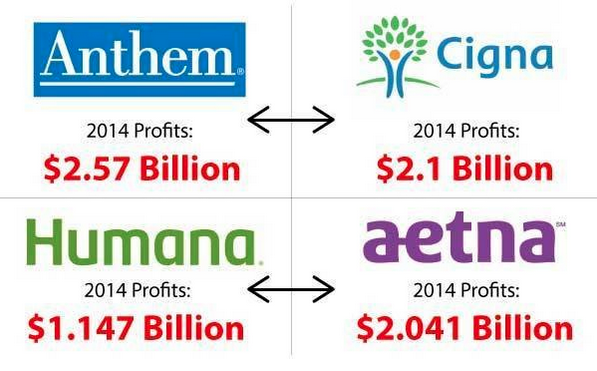
Seven Democratic senators urged the U.S. Justice Department on Wednesday to block two mergers of major health insurance companies, saying that the proposed deals would mean higher premiums and lower-quality healthcare for consumers.
The department is reviewing Aetna Inc’s $33 billion plan to buy Humana Inc and Anthem Inc’s $48 billion proposal to buy Cigna Corp. If approved, the deals, both of which were announced last July, would reduce the number of national health insurance carriers from five to three.


St. Joseph Health and Providence Health and Services have received regulatory approval for a merger that will create the nation’s third-largest nonprofit health system, officials said Wednesday.
The California Attorney General’s office signed off on the deal between the two nonprofit Catholic hospital chains. The new entity, Providence St. Joseph Health, will include 16 St. Joseph hospitals, including five in Orange County, and 34 Providence hospitals, including six in Los Angeles County.
http://www.beckershospitalreview.com/finance/achieving-financial-reporting-harmony-post-m-a.html

M&A continues picking up speed in healthcare, generally producing expected results — planned benefits plus feared fragmentation. Among the many functions that may become at least temporarily stressed is finance.
M&A, for all its advantages, is a disruptor. The amount of disruption is based on such factors as existing infrastructures, maturity of business processes, level of change and enterprise readiness to accept the change. Everything about the conjoining organizations — people, schedules, cultures and systems — is pulled together with an expectation that on the backside the newly formed enterprise will work.
For the finance team, this means dealing with data that lacks common structure, terminology, business process and technology. Finance has the unenviable task of capturing data in its varied quality and formats in a myriad of locations within the formerly separate organizations. Order must be created so that the financial data is fit for consolidation, close and reporting for the new enterprise.

The lesson is simple: Coordinating your own care is still a good idea. Don’t count on the health system to do it for you.


 HENRY KOTULA