Medicaid Reform: The Elephant in the Room

http://www.realclearhealth.com/articles/2017/01/04/medicaid_reform_the_elephant_in_the_room_110358.html

While headlines fixate on the future of the Affordable Care Act’s health insurance exchanges, a more consequential fight is brewing over the future of Medicaid. Proposed reforms would affect tens of millions of Americans and state governments across the country. Previous attempts have failed, however, and longstanding roadblocks may sink this administration’s efforts as well.

With over 70 million enrollees, Medicaid covers more Americans than any other insurer.   Responsibility for funding the program – which accounts for nearly 20 percent of all healthcare spending – is shared between states and the federal government. At a minimum, the federal government covers 50 percent of costs, with that share rising to nearly 75 percent in the poorest states and more than 90 percent for those covered through ACA Medicaid expansions. This amounts to nearly $350 billion in federal funding per year.

Importantly, this money is allocated in an open-ended manner. As states increase the generosity of their Medicaid programs, the federal government is obliged to pay its portion of the higher costs.

During his campaign, Donald Trump joined a long list of Republican lawmakers who argue that this gives states the wrong incentives. Because the federal government covers at least half of each dollar spent, they argue, states may take less care to weed out inappropriate and inefficient spending as they otherwise would.

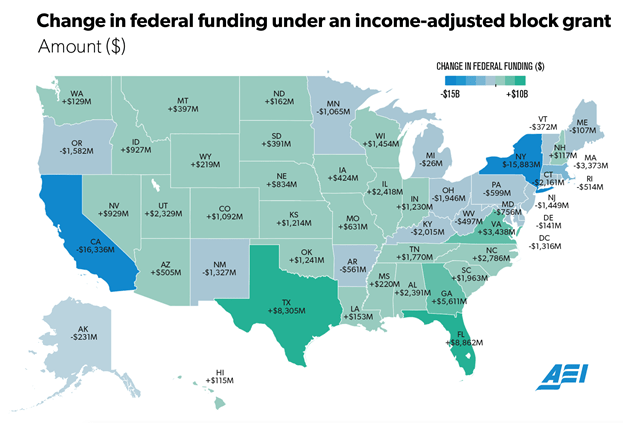
To eliminate this open-ended feature, Trump’s plan calls for federal money to be allocated in fixed lump sum payments known as block grants.

First proposed in 1981 by President Reagan, block granting of Medicaid hardly represents a novel policy option. Why then has the current system endured, and what does this portend for the resistance Trump’s efforts may encounter?

To understand, consider the most basic decision for any block grant policy: How should each state’s grant be initially determined?

Centene to stay on ACA exchanges; WellCare grows Medicaid membership

http://www.fiercehealthcare.com/payer/centene-to-stay-aca-exchanges-wellcare-adds-medicaid-members?utm_medium=nl&utm_source=internal&mrkid=959610&mkt_tok=eyJpIjoiTnpFeU1tVmxaV00yWmpRMCIsInQiOiJxQk1keWdtNzdGSUZvT2huUTZiZFJ4SDl4akhmRG1wMGE4ZzV2eGtIUXNmUGJ1TTJjbTRxRTJ4cjNcL3NvVWNZZUZlRWxnMnh2bHJVdiswWmVFR3VcL2l3RmpwWXFaZ3JBUG4ya3oyVGp5bHNoUjl4dU1wUnNNYWpTZmc1TURcL09LbyJ9

finance earnings

Unlike some of the other major for-profit health insurers, Centene has no plans to consider exiting the Affordable Care Act exchanges in 2018.

“I’m not backing off at all,” CEO Michael Neidorff said during the company’s fourth-quarter earnings call Tuesday. In recent discussions with the company’s board members, he said, “everybody is of one mind; you maintain business as usual.”

Recently, the CEOs of Anthem and Cigna both indicated they are still deciding whether to participate on the exchanges in 2018. Aetna, meanwhile, does not plan to re-enter any markets in 2018 after pulling out of many in 2017.

As of Dec. 31, Centene served about 540,000 exchange members, in line with its expectations, and it anticipates having a little more than 1 million paid members in 2017. Indications are that the demographics of these members will be consistent with years past, with 90% of them subsidy-eligible and most on silver-tier plans, Neidorff said.

While Centene is folding an “extra level of conservativism” into its expectations for its exchange products to guard against any uncertainty, it continues to expect that line of business to be profitable this year, he added.

Another ACA provision, Medicaid expansion, has also proved profitable for Centene. At the end of 2016, it had 1,080,500 members in Medicaid expansion programs in 10 states, compared to 449,000 members at the end of 2015, according to the company’s earnings statement.


Healthcare Triage News: Many with Employer Insurance Still Need CHIP to Insure Their Kids

Healthcare Triage News: Many with Employer Insurance Still Need CHIP to Insure Their Kids

Image result for Healthcare Triage News: Many with Employer Insurance Still Need CHIP to Insure Their Kids

As employer-sponsored insurance becomes more expensive for children, public programs are picking up the slack. This is Healthcare Triage News.

Covering the Coming Battle Over the ACA: What You Need to Know

Click to access PDF%20WebinarBattleOverACA12192016Adams.pdf

Image result for Battle for Obamacare

Click to access PDF%20WebinarBattleOverACAResources.pdf


California’s Projected Economic Losses under ACA Repeal

Click to access Californias-Projected-Economic-Losses-under-ACA-Repeal.pdf

Image result for California’s Projected Economic Losses under ACA Repeal


If Congress follows through on President-elect Trump’s campaign promise to repeal the Affordable Care Act (ACA), 3.7 million Californians enrolled in the Medi-Cal expansion would lose that coverage,1 and another 1.2 million individuals enrolled through California’s health benefit exchange, Covered California, would lose federal subsidies to make private health insurance more affordable.2 These two ACA provisions are the largest drivers of the historic reduction in the state’s uninsured rate from 17.2% in 2013 to 8.6% in 2015.

Not only would repeal of the ACA reverse much of these coverage gains, but California would lose approximately $20.5 billion in annual federal funding for the Medi-Cal expansion and Covered California subsidies. The economic losses associated with these lost federal dollars would be partially offset by limited economic gains from other provisions that may be included as part of the repeal of the ACA, which could yield $6.3 billion in tax cuts to California insurers and high-income households and nearly $1.3 billion in eliminated penalties for uninsured individuals and employers not offering affordable coverage.

In this brief, we estimate the effects on employment, gross domestic product (GDP), and state and local tax revenue in California with the elimination of the major health insurance expansions, reduction in taxes, and removal of penalties under a partial repeal of the ACA. A summary of these estimates is shown in Exhibit 1. We also estimate losses for select medium and large counties that would be especially harmed economically by ACA repeal because of their high share of population (more than 10%) enrolled in the Medi-Cal expansion: Fresno, Kern, Los Angeles, San Bernardino, San Joaquin, Stanislaus, and Tulare Counties.

CONCLUSION

The ACA not only significantly expanded access to health insurance in California, but it also provided economic stimulus at a time when the state was still recovering from the Great Recession. As California is one of the states that made the greatest gains in health coverage under the ACA,16 it is also one of the states with the most to lose economically if key components of the ACA are repealed. The partial repeal of the ACA would not only lead to a substantial decline in health coverage in California, but it would also lead to significant economic losses, including more than 209,000 lost jobs, $20 billion in lost GDP, and $1.5 billion in lost state and local tax revenue. Some medium and large California counties’ economies – Fresno, Kern, San Bernardino, San Joaquin, Stanislaus, and Tulare – would be especially harmed due to their residents’ high level of reliance on the Medi-Cal expansion and above-average unemployment rates.


ACA Repeal in California: Who Stands to Lose?

Click to access ACA-Repeal-in-California.pdf

Image result for ACA Repeal in California: Who Stands to Lose?

California has a lot to lose if the Affordable Care Act (ACA) is repealed. The state made significant investments in implementing the law successfully, and under the ACA cut the number of uninsured residents in half, from 6.5 million in 2013 to 3.3 million in 2015—the largest decline in the uninsured rate of any state.1 The two major reasons for this drop in uninsurance were the expansion of Medicaid and the provision of financial assistance for purchasing coverage through the state health insurance marketplace, Covered California. As a result of these policies, California experienced a significant reduction in health coverage disparities: the biggest drops in the uninsurance rate were among those least likely to have coverage before the ACA, namely those with the lowest income, young adults, part-time workers, and Latinos.2 Repealing the ACA threatens not only to leave millions without health insurance, but also to undo the progress California has made in reducing inequality of health insurance access. This brief focuses on Californians enrolled in expanded Medi-Cal (the state’s Medicaid program) and those who receive subsidized coverage through Covered California, the two groups most immediately affected if the ACA is repealed. However, many more Californians could see diminished health coverage under various Congressional Republicans’ proposals to repeal and replace the ACA.

Why hospitals really don’t want to go back to pre-Obamacare days

https://www.axios.com/why-hospitals-really-dont-want-to-go-back-to-pre-obamacare-days-2162243137.html

Image result for pre-Obamacare hospitals

Hospital executives know that if Obamacare is repealed and not replaced, the ranks of the uninsured will swell, and they will still be required to treat those patients.

That’s why they’re hit especially hard these days by the uncertainty over what will happen and when, as Republicans try to figure out how they want to get rid of the law. The biggest concerns for hospital executives: losing Medicaid payments, and having more privately insured patients who can’t pay their bills because of high out-of-pocket costs. Hospitals were just getting relief from uncompensated care, and don’t want those costs to rise again.

The primary concern: It’s not the potential loss of patients with private Obamacare insurance that worries hospitals the most. It’s the loss of patients with Medicaid coverage.

Even though state Medicaid programs pay hospitals less than Medicare or private insurers, it’s still been better than nothing. That’s why state hospital associations have aggressively lobbied for Medicaid expansion in Republican states that haven’t embraced it.

Dennis Dahlen, chief financial officer of Banner Health in Phoenix, recently said there could be “dire consequences” if Medicaid expansion is rolled back and if Republicans move toward Medicaid block grants. That would threaten revenue immediately and lead to more uninsured patients walking into the emergency room.

“Our biggest exposure and biggest concern is Medicaid funding,” Dahlen said. About 13% of Banner’s patient revenue comes from Medicaid.

Hospital leaders support keeping many elements of ACA

http://www.revenuecycleinsights.com/news/hospital-leaders-support-keeping-many-elements-aca?mkt_tok=eyJpIjoiWWpCaU1USXhZbVEzWkRCaiIsInQiOiJURzlCeG5tb05KNjN5QU9UMGIrVFBoZkxiS3Q2WHdPZDZRNXJ0TFQzemdXdVwvS3pPa3UrcWNOQTVxanpaVW5mMFFoUzk4OXc0ejg2dSs2SkRGWHErZDlqUjlhd1dTQit3c2VBaXdGSDdPK1IzQXEwdWNNaWt6YjFRQ2xyR3JZNloifQ%3D%3D

An overwhelming majority of hospital C-suite and pharmacy executives support preserving the protections in the Affordable Care Act (ACA) for patients with preexisting conditions, according to a post-election survey.

Member-based healthcare performance improvement company Vizient conducted the survey to assess how member hospitals were reacting to the planned repeal of the ACA by the Trump administration and Republican leaders in Congress. Vizient also asked executives about their top concerns for the future as well as their priorities for 2017.

Nearly 90 percent of C-suite leaders (89.5 percent) and 96 percent of hospital pharmacy executives surveyed said the ACA’s protections for patients with preexisting conditions should be kept in place.

Other findings from the survey show:

  • 68 percent of hospital C-suite leaders and 35 percent of hospital pharmacy executives want to keep incentives for expanding Medicaid coverage
  • 56 percent of hospital executives and 46 percent of hospital pharmacy leaders want to continue subsidies to help consumers pay for insurance
  • 52 percent of hospital C-suite leaders and 39 percent of pharmacy executives want to continue value-based reimbursements.

The top three priorities for all executives this year were 1) reducing clinical variation across care delivery 2) migrating toward value-based models, and 3) the integration of existing technology systems, Vizient said.

“In reviewing the survey results, central themes come through: uncertainty and concerns about financial viability,” Byron Jobe, president and chief administrative officer for Vizient, said in a statement. “There are many open questions about the future of the ACA, and what a repeal and replacement strategy could look like. As Congress wrestles with these decisions, it’s important to ensure reimbursement levels are enough to allow hospitals to continue their mission of caring for patients in their communities. Equally important, hospitals must quickly gain a clear understanding of where health policy is heading so they can begin to prepare.”

More families with employer-sponsored insurance are needing public assistance

http://www.academyhealth.org/blog/2017-01/more-families-employer-sponsored-insurance-are-needing-public-assistance

Image result for More families with employer-sponsored insurance are needing public assistance

As employer-sponsored insurance becomes more expensive for children, public programs are picking up the slack.

The Medicaid Expansion, which was responsible for a large part of the reduction in uninsurance in the United States over the last few years, was mostly aimed at adults. This is because Medicaid has traditionally covered nearly all children in poverty for some time. The CHIP program has bolstered that coverage, so that uninsurance in children fell steadily in the 1990’s and well into the 21st century.

The passage of the Medicare Access and CHIP Reauthorization Act of 2015 (MACRA) assured that CHIP coverage would continue for some time. But even before that, trouble was brewing with respect to the coverage of children. These troubles were not in the Medicaid  program, though. Issues were arising in the employer-sponsored insurance market.

As I’ve written about in many posts here before, the cost of employer-sponsored insurance has been rising quite steadily for some time. Further, the out-of-pocket costs for such insurance have also been increasing. Deductibles, co-pays, and co-insurance – not to mention premiums – can put the cost of insurance out of reach for many employees even when it is “offered” as a benefit from their job. The costs of insurance have outpaced both income and wages for more than a decade, meaning that more and more must come out of employee’s pockets if they want to maintain coverage for themselves and their children.


Koch-backed group details hopes for healthcare reform

http://thehill.com/policy/healthcare/316875-koch-backed-group-pushes-for-high-risk-pools-medicaid-freeze-in-obamacare

Koch-backed group details hopes for healthcare reform

A conservative group funded by the Koch brothers is pushing for high-risk pools and a freeze on Medicaid expansions as lawmakers try to coalesce around a replacement for ObamaCare.

Freedom Partners began circulating a memo on Capitol Hill Monday with specific reforms it thinks lawmakers should pass, including: the creation of high-risk pools at the state level to cover people with pre-existing conditions; the elimination of the ObamaCare mandate, which required everyone buy insurance or pay a penalty; and the expansion of access to health savings accounts, so people can save and pay for healthcare with pre-tax dollars.

The recommendations fall in line with what top Republicans in Congress have indicated they support.

High-risk pools offer coverage for sick people that otherwise could be denied coverage for having pre-existing conditions if ObamaCare is repealed.