Shifting the Healthcare Debate

http://click1.email.thehill.com/ViewMessage.do?m=ndkqkwkw&r=jnjbrjrv&s=ugcmvzybchhjzjhgnccmmcykhyhddfcbzpk&q=1541641771&a=view

Related image


Welcome to Wednesday’s Overnight Health Care, where Democrats have won back the House, opening the door to a shift in the health care debate.

Here’s what we’ll be watching for on health care when the new Democratic House majority takes over:

  1. Oversight. Democrats are sure to launch investigations and hearings into all sorts of actions Republicans have taken that they think undermined the Affordable Care Act, from expanding skimpier short-term health insurance plans to cutting outreach efforts. They could also bring up different industry executives to testify, for example those from drug companies. We’ve seen some of this happen already with Martin Shkreli and Heather Bresch, but Democrats may want to go even further to shame the industry for high prices.
  2. Drug pricing. Speaking of which, legislation to fight high drug prices is an early priority for House Democrats. They think it could be an area for bipartisan support, as President Trump has also focused on the issue. Democratic Leader Nancy Pelosi said Tuesday she thinks there could be “common ground” with Trump on the idea, and Trump listed the issue as a possible area of cooperation Wednesday as well. But any drug pricing action always faces an uphill climb.
  3. Pre-existing condition protections. If a federal judge rules in favor of Texas and the other Republican state attorneys general challenging the law, Congress is going to need to have a backstop in place. Republicans in the Senate already passed their versions of such legislation, but left the door open to insurers charging higher premiums for people with pre-existing conditions. If the law’s protections are truly at risk, Senate Republicans will need to back up their campaign rhetoric with action.
  4. Medicare for All. The most sweeping change Democrats have discussed does not have any real chance of being enacted into law with a Republican Senate and president. But it’s worth watching whether liberal Democrats start planning and agitating for some action on Medicare for all, with hearings, revised legislation, etc.


Medicaid wins big at the polls

It was a big night for Medicaid. Three red states voted to expand Medicaid, giving health coverage to potentially hundreds of thousands of newly eligible people.

Idaho voters approved expansion with more than 61 percent of the vote, Utah passed expansion with 54 percent and Nebraska passed it with 53 percent. In Nebraska and Utah, the approval came despite opposition from the states’ Republican governors.

Democrats also won close gubernatorial races in Kansas and Wisconsin, putting expansion on the table. In Kansas, expansion legislation passed in 2017 but former Gov. Sam Brownback (R) vetoed it. In Wisconsin, Gov. Scott Walker (R) lost to Democrat Tony Evers, who campaigned on a platform that included expansion.


The Trump administration finalized two rules today making it easier for some employers to avoid complying with the Affordable Care Act’s contraception mandate. Here’s what they do:

  • The first rule provides an exemption to the mandate for entities that object to contraception based on their “sincerely held religious beliefs.”
  • The second rule gives ax exemption to nonprofits, small businesses and individuals that have non-religious, moral objections to the mandate.

These rules are largely similar to two interim final rules released by the administration last year. But the second rule was amended to state that the moral exemptions don’t apply to publicly traded businesses and government entities.

The rules take effect 60 days after their publication in the Federal Register.

Context: These rules are already the subject of multiple lawsuits against the administration. From National Women’s Law Center President Fatima Goss Graves:

“The Trump Administration decided to finalize these outrageous rules, despite several pending lawsuits and two federal courts blocking them. It’s clear that this Administration will stop at nothing to attack women’s health care… if the Administration thinks it can move these rules forward without a fight, they’re wrong.”


On the topic of abortion, two states last night laid the groundwork to ban abortion if the Supreme Court makes changes to Roe v. Wade.

Voters in Alabama and West Virginia approved sweeping amendments to state constitutions that could put major limitations on access to abortions if Roe v. Wade is overturned by the Supreme Court.

Alabama’s amendment makes it state policy to protect “the rights of unborn children” and “support the sanctity of unborn life.” It also says there are no constitutional protections for a woman’s right to an abortion.

Fifty-nine percent of voters approved the measure.

West Virginia narrowly passed a similar amendment that states nothing in the state Constitution “secures or protects a right to abortion or requires the funding of abortion.” That vote was 52 percent to 48 percent.

Read more here.


QUICK: WHAT’S THE DIFFERENCE BETWEEN MEDICARE-FOR-ALL AND SINGLE-PAYER?

https://www.healthleadersmedia.com/quick-whats-difference-between-medicare-all-and-single-payer?utm_source=silverpop&utm_medium=email&utm_campaign=ENL_181106_LDR_BREAKING_election-polls-6pm%20(1)&spMailingID=14571750&spUserID=MTY3ODg4NTg1MzQ4S0&spJobID=1520469279&spReportId=MTUyMDQ2OTI3OQS2

What's The Difference Between Medicare-For-All and Single-Payer?

Most voters approached for this article declined to be interviewed, saying they didn’t understand the issue.

Betsy Foster and Doug Dillon are devotees of Josh Harder. The Democratic upstart is attempting to topple Republican incumbent Jeff Denham in this conflicted, semi-rural district that is home to conservative agricultural interests, a growing Latino population and liberal San Francisco Bay Area refugees.

To Foster’s and Dillon’s delight, Harder supports a “Medicare-for-all” health care system that would cover all Americans.

Foster, a 54-year-old campaign volunteer from Berkeley, believes Medicare-for-all is similar to what’s offered in Canada, where the government provides health insurance to everybody.

Dillon, a 57-year-old almond farmer from Modesto, says Foster’s description sounds like a single-payer system.

“It all means many different things to many different people,” Foster said from behind a volunteer table inside the warehouse Harder uses as his campaign headquarters. “It’s all so complicated.”

Across the country, catchphrases such as “Medicare-for-all,” “single-payer,” “public option” and “universal health care” are sweeping state and federal political races as Democrats tap into voter anger about GOP efforts to kill the Affordable Care Act and erode protections for people with preexisting conditions.

Republicans, including President Donald Trump, describe such proposals as “socialist” schemes that will cost taxpayers too much. They say their party is committed to providing affordable and accessible health insurance, which includes coverage for preexisting conditions, but with less government involvement.

Voters have become casualties as candidates toss around these catchphrases — sometimes vaguely and inaccurately. The sound bites often come across as “quick answers without a lot of detail,” said Gerard Anderson, a professor of public health at the Johns Hopkins University Bloomberg School Public Health.

“It’s quite understandable people don’t understand the terms,” Anderson added.

For example, U.S. Sen. Bernie Sanders (I-Vt.) advocates a single-payer national health care program that he calls Medicare-for-all, an idea that caught fire during his 2016 presidential bid.

But Sanders’ labels are misleading, health experts agree, because Medicare isn’t actually a single-payer system. Medicare allows private insurance companies to manage care in the program, which means the government is not the only payer of claims.

What Sanders wants is a federally run program charged with providing health coverage to everyone. Private insurance companies wouldn’t participate.

In other words: single-payer, with the federal government at the helm.

Absent federal action, Democratic gubernatorial candidates Gavin Newsom in California, Jay Gonzales in Massachusetts and Andrew Gillum in Florida are pushing for state-run single-payer.

To complicate matters, some Democrats are simply calling for universal coverage, a vague philosophical idea subject to interpretation. Universal health care could mean a single-payer system, Medicare-for-all or building upon what exists today — a combination of public and private programs in which everyone has access to health care.

Others call for a “public option,” a government plan open to everyone, including Democratic House candidates Antonio Delgado in New York and Cindy Axne in Iowa. Delgado wants the public option to be Medicare, but Axne proposes Medicare or Medicaid.

Are you confused yet?

Sacramento-area voter Sarah Grace, who describes herself as politically independent, said the dialogue is over her head.

“I was a health care professional for so long, and I don’t even know,” said Grace, 42, who worked as a paramedic for 16 years and now owns a holistic healing business. “That’s telling.”

In fact, most voters approached for this article declined to be interviewed, saying they didn’t understand the issue. “I just don’t know enough,” Paul Her of Sacramento said candidly.

“You get all this conflicting information,” said Her, 32, a medical instrument technician who was touring the state Capitol with two uncles visiting from Thailand. “Half the time, I’m just confused.”

The confusion is all the more striking in a state where the expansion of coverage has dominated the political debate on and off for more than a decade. Although the issue clearly resonates with voters, the details of what might be done about it remain fuzzy.

A late-October poll by the Public Policy Institute of California shows the majority of Californians, nearly 60 percent, believe it is the responsibility of the federal government to make sure all Americans have health coverage. Other state and national surveys reveal that health care is one of the top concerns on voters’ minds this midterm election.

Democrats have seized on the issue, pounding GOP incumbents for voting last year to repeal the Affordable Care Act and attempting to water down protections for people with preexisting medical conditions in the process. A Texas lawsuit brought by 18 Republican state attorneys general and two GOP governors could decimate protections for preexisting conditions under the ACA — or kill the law itself.

Republicans say the current health care system is broken, and they have criticized the rising premiums that have hit many Americans under the ACA.

Whether the Democratic focus on health care translates into votes remains to be seen in the party’s drive to flip 23 seats to gain control of the House.

The Denham-Harder race is one of the most watched in the country, rated too close to call by most political analysts. Harder has aired blistering ads against Denham for his vote last year against the ACA, and he sought to distinguish himself from the incumbent by calling for Medicare-for-all — an issue he hopes will play well in a district where an estimated 146,000 people would lose coverage if the 2010 health law is overturned.

Yet Harder is not clinging to the Medicare-for-all label and said Democrats may need to talk more broadly about getting everyone health care coverage.

“I think there’s a spectrum of options that we can talk about,” Harder said. “I think the reality is we’ve got to keep all options open as we’re thinking towards what the next 50 years of American health care should look like.”

To some voters, what politicians call their plans is irrelevant. They just want reasonably priced coverage for everyone.

Sitting with his newspaper on the porch of a local coffee shop in Modesto, John Byron said he wants private health insurance companies out of the picture.

The 73-year-old retired grandfather said he has seen too many families struggle with their medical bills and believes a government-run system is the only way.

“I think it’s the most effective and affordable,” he said.

Linda Wahler of Santa Cruz, who drove to this Central Valley city to knock on doors for the Harder campaign, also thinks the government should play a larger role in providing coverage.

But unlike Byron, Wahler, 68, wants politicians to minimize confusion by better defining their health care pitches.

“I think we could use some more education in what it all means,” she said.


Exclusive poll: What voters want from “Medicare for All”

https://www.axios.com/medicare-for-all-poll-midterm-elections-e7b93daf-b261-42f7-85ca-8d1bcb2eb1f0.html

Voters like some form of “Medicare for All” but are divided over what it should look like, according to our latest Axios/SurveyMonkey poll — which is about the same situation Democratic candidates are in.

The big picture: Many of Democrats’ leading 2020 prospects, and a host of candidates in the midterms, have embraced “Medicare for All,” but there’s a big variation in the policies they propose under that banner.

Between the lines: We asked our poll respondents two related questions — what they think candidates mean by “Medicare for All,” and what they want that policy to mean, if they support it at all.

By the numbers: Overall, 52% of those surveyed said they think “Medicare for All” refers to a single, government-run health care program covering everyone. That’s what Sen. Bernie Sanders, who popularized the term “Medicare for All,” has proposed.

  • Republicans were more confident in that assessment than Democrats: 61% of Republicans said Medicare for All is single-payer, compared with 51% of Democrats. A plurality of independents — 42% — said they don’t think candidates are talking either single-payer or an optional program that would compete with private insurance.

Voters were more divided over what they want “Medicare for All” to be, given the same choices.

  • 34% said they would favor a single-payer system; 33% said they would prefer an optional public plan alongside private insurance; 30% wanted neither.
  • Democrats were far more open to a single-payer system than Republicans and independents.
  • Of the five voter subgroups Axios is following in the midterm elections, African-American women and young adults were most interested in some form of “Medicare for All,” while rural voters were least interested.

Add it up, and most people — 67% — seem to be on board with either single-payer or a public option, suggesting that “Medicare for All” is popular, but that’s partly because of its multiple meanings.

Yes, but: The 2020 Democratic primary will likely bring the issue into much sharper focus.

  • In the midterms, every Democrat can pick the definition that works best for their race. But with so many candidates running for the same office in 2020, putting a finer point on “Medicare for All” will be a big part of the larger Democratic debate.


4 Key Fact Checks on Trump and Medicare for All

https://www.thefiscaltimes.com/2018/10/10/4-Key-Fact-Checks-Trump-and-Medicare-All

President Trump published an op-ed in Wednesday’s USA Today, warning in dire language of the consequences of Democrats’ Medicare-for-all proposals. “Democrats would gut Medicare with their planned government takeover of American health care,” Trump says.

The problem: Nearly every line of Trump’s piece “contained a misleading statement or a falsehood,” writes Washington Post fact-checker Glenn Kessler.

We’ll provide a few examples below, but for a more complete analysis of Trump’s problematic, misleading or outright false claims, read Kessler’s piece or this Associated Press fact-check of claims the president has made in recent speeches at campaign rallies.

Why it matters: Trump’s op-ed and other recent criticisms of Democratic health-care proposals echo other GOP attacks claiming that Medicare for all would destroy traditional Medicare. Combined, they read less like a serious policy critique and more like cynical scare tactics — a ploy to muddy the waters around an idea that’s growing in popularity but still poorly defined in voters’ minds.

“There definitely are serious questions about ‘Medicare for All,’ including the massive tax increases that would be needed to pay for it and longstanding differences in society about the proper function of government,” the AP piece notes. Trump’s attacks skirt those serious questions, and differences of opinions among Democrats on Medicare for all, in favor of false or misleading campaign-style attacks.

Will it work? It very well might, at least in the short run. But at the Washington Examiner, Philip Klein critiques Trump’s line of attack from the right, arguing that it will backfire on conservatives in the long run and actually make socialized healthcare more likely. … By perpetuating the idea that Medicare is a great program that needs to be protected at all costs (rather than an unsustainable entitlement) it only makes it easier for liberals to make the case for socialized medicine. It also makes it harder to make the case for overhauling entitlement programs to avert the looming debt crisis.”

The four key fact checks:

* “Dishonestly called ‘Medicare for All,’ the Democratic proposal would establish a government-run, single-payer health care system that eliminates all private and employer-based health care plans and would cost an astonishing $32.6 trillion during its first 10 years.”

The facts: There are numerous “Medicare for all” proposals. Some would eliminate private and employer-based plans in favor of a single federally run health insurance program, but others would introduce a public plan option alongside existing private coverage choices. A new Kaiser Family Foundation report provides a useful overview of eight different legislative proposals introduced in the current session of Congress.

Trump is right that studies, like the one he links to by the libertarian Mercatus Center, have estimated that Bernie Sanders’ plan would add more than $30 trillion to federal health care costs. Proponents of a single-payer system argue that those price tags simply represent a shift in spending from the private to the public sector — a change, they say, that will wring costs out of the system overall while also providing for universal coverage.

* “As a candidate, I promised that we would protect coverage for patients with pre-existing conditions and create new health care insurance options that would lower premiums. I have kept that promise, and we are now seeing health insurance premiums coming down.”

The facts: Trump’s Justice Department argued in an ongoing Texas court case that Obamacare’s protections for patients with pre-existing conditions should be invalidated, and his administration has pushed insurance options that could weaken such protections. Trump’s claim about premiums coming down applies only to benchmark Obamacare plans, and is based on recent comments by HHS Secretary Alex Azar. Experts say that Obamacare premiums are stabilizing in 2019, but would have fallen if not for Trump administration policies. Meanwhile, premiums for employer-provided insurance, by far the most common type in the U.S., are still rising.

* “I also made a solemn promise to our great seniors to protect Medicare. That is why I am fighting so hard against the Democrats’ plan that would eviscerate Medicare.”

The facts: “Under Trump, the date for when the Medicare Hospital Insurance (Part A) Trust fund will be depleted keeps advancing,” Kessler notes. “If the trust fund is depleted, that means the government would not be able to cover 100 percent of estimated expenses. Yet because of Trump’s tax cut, the budget deficit is soaring even as the economy is booming, in contrast to previous periods of under-4-percent unemployment. That leaves the government less prepared to deal with the consequences of baby-boom retirements.”

* “The Democrats’ plan means that after a life of hard work and sacrifice, seniors would no longer be able to depend on the benefits they were promised.”

The facts: Not true. None of the plans would cut benefits for seniors, and the most frequently cited promises to be more generous. “The Sanders plan would be a fundamental change, expanding Medicare to cover almost everyone in the country,” the Associated Press notes. “But current Medicare recipients would get improved benefits. Sanders would eliminate Medicare deductibles, limit copays, and provide coverage for dental and vision care, as well as hearing aids. A House single-payer bill calls for covering long-term care.”


Medicare for All, But All For Medicare?

https://mailchi.mp/burroughshealthcare/pc9ctbv4ft-1576037?e=7d3f834d2f

Image result for medicare for all

It’s 2018 and health insurance remains a major conundrum for America’s leaders, one hot political potato. Our current health system is worth $3.2 trillion to our economy — the most “valuable” in the world — but nearly 44 million people are without health insurance and our life expectancy falls behind thirty-six other nations.

The question remains: How can that be? And is healthcare really “a right” of all Americans?

Many other countries have successfully adopted single-payer systems, which means that no one is without coverage. Sen. Bernie Sanders (I-VT) is busy answering questions about his Medicare for All (M4A) platform, joined frequently by supporter and fellow democratic socialist and New York Congressional candidate Alexandria Ocasio-Cortez (D-NY).

“Health care must be recognized as a right, not a privilege,” he writes on his platform’s web page. “Every man, woman, and child in our country should be able to access the health care they need regardless of their income. The only long-term solution to America’s health care crisis is a single-payer national health care program.”

Summing it all up that way sounds very appealing, but making such a change would entail a seismic shift.

How Do We Really Feel?

A new Reuters/Ipsos survey shares that most of us, 70 percent, are in favor of the single-payer system: 85 percent of Democrats and 52 percent of Republicans. Perhaps even more surprising is that a mere 20 percent of us actually dislike the concept.

Under this plan, we’d all be lumped into one communal pot, run by the government, and we’d no longer have to fret over those confounding deductibles and premiums. We’d experience improved benefits, he promises, such as dental, vision and hearing.

Major tax increases would fund the plan that includes the following:

  • A 6.2 percent income-based health care premium paid by employers.
  • A 2.2 percent income-based premium paid by households.
  • Progressive income tax rates.
  • Taxing capital gains and dividends the same as income from work.
  • Limiting tax deductions for rich.
  • Savings from health tax expenditures.

    The government’s costs would increase to nearly $33 trillion during its first 10 years (2022 to 2031) says a “working paper”reportfrom Charles Blahous at the Mercatus Center at George Mason University. That number assumes enactment this year.

Emory University health policy professor Kenneth Thorpe, who has also studied M4A, says annual costs to the federal government will average between $2.5 trillion to $3 trillion.

The idea of anything “for all” has enormous appeal, but wait just a minute, says The Atlantic. This whole idea of single-payer, “an indulgent fantasy,” evolved because Republicans sought to kill the Affordable Care Act (ACA), or Obamacare, but the party couldn’t unite around a coherent alternative.  What then?

Democrats want to sweep away the complexity of our current health policy status quo, says the author Reihan Salam, who’s not all that optimistic. “All health reformers in America must confront the hospital sector.” The Blahous report says Medicare for All would slice hospital and physician payments by up to 40 percent which would significantly impact physicians and hospitals’ willingness and ability to care for Medicare patients (Medicare currently only covers 92% of costs).

Which “M” Word?

The word “Medicare” may, in fact, be misused when applied to a single-payer program, because, says Politico, Medicare isn’t single payer at all, but a “bewilderingly complex” system, “a massive public-private hybrid coverage scheme, funded mostly by taxes.

Further, Medicare’s audience is specific: seniors who receive benefits when working-age people’s pay is taxed. We’re talking about greatly expanding the beneficiary pool here: “Paying for everyone’s health care that way would be a radically different proposition, and far more expensive.

What we’re really talking about is Medicaid for All, suggests the National Review, which reminds us that “the devil really is in the details.” Medicaid is not free and is funded significantly by the Federal Government inversely related to each State’s per capita income and doctors dislike Medicaid with its low reimbursements, and consumers complain about long lines and treatment delays.

Sanders’ plan would say bye-bye to all private health insurance and would mean all abortions are free and that illegal aliens will get free health care courtesy of the taxpayer; things that many Americans will not tolerate.

Comparing Apples to Apples

Looking at the much bigger picture, proponents on the “yea” side of M4A say that its benefits far outweigh the risks. First and foremost, the entire population would have the opportunity to be healthier, since having access to health care improves health.

Currently, under the ACA, employers with 50 or more full-time employees must provide health insurance to all of them. For mega-corporations, that expenditure isn’t a huge ask, but smaller companies may find it a stretch. If the government funds health insurance, that then lightens the load for all companies that may find they can increase employee pay as a result — if they choose to do so, of course.

One point that seems to go “either way”: health care spending per capita. The United States spends nearly twice as much as other wealthy countries, topping out at $10,348 per person, according to 2016 numbers from Peterson-Kaiser. Compare that to the United Kingdom at

$4,192 and Japan at $4,519.

Given our expenditures, this is one tough pill to swallow: According to the latest report from The Commonwealth Fund, even though we spend more, “the U.S. population has poorer health than other countries” and is “failing to deliver indicated services reliably to all who could benefit.

On the “nay” side of things, opponents cite those major tax hikes and longer waiting times to see a doctor, possibly extending into weeks and months. Add to that the elimination of innovations in the private sector that lead to breakthrough discoveries, all as a result of competition being removed from the medical technology playing field. Finally, funding all of this would require “shifting” funds from other priorities already deemed “urgent,” such as the nation’s infrastructure, those crumbling roads, and bridges now made more urgent due to the disastrous effects of climate change.

There’s no indication that this problem will be quickly solved, only that discussions will continue, while any momentum to effect positive change remains questionable. Americans would like to take the healthcare insurance coverage bull by the horns, but unfortunately, understand it’s just not within their power to do so. Until then, it’s a waiting game and may be for some time.


Can ‘Medicare for All’ Carry Democrats at the Polls?

http://www.thefiscaltimes.com/2018/08/21/Can-Medicare-All-Carry-Democrats-Polls

Image result for Can ‘Medicare for All’ Carry Democrats at the Polls?

The idea of “Medicare for all” has support from top Democrats considered likely 2020 presidential contenders, including Sens. Kamala Harris of California, Elizabeth Warren of Massachusetts, Cory Booker of New Jersey and Kirsten Gillibrand of New York. But Politico’s Paul Demko reports that progressives promising a single-payer health care system have failed to win over voters in some Democratic primaries in swing districts this year:


Democratic candidates who made that a centerpiece of their campaigns in key districts this year lost their primaries, in some cases getting clobbered by rivals who offered vaguer health care plans or backed a more incremental approach. Democratic primary voters in battleground districts in Iowa, Texas, Kansas and New York passed over candidates who emphatically supported single payer.


The key quote: “The problem is Medicare for all just isn’t one of those litmus tests for Democratic primary voters,” John Anzalone, a Democratic pollster, tells Politico. “Voters are smart enough to know that Medicare for all isn’t going to happen right now, or maybe ever.”


Why it matters: While progressives may Medicare for all as a potent rallying cry, and polls show voters increasingly support the notion of a government-funded system, it’s still not a lock that the party will coalesce around such a plan, and it’s not clear how strongly the idea will motivate moderate swing-state voters. Some Democratic strategists and losing candidates argue that support for a single-payer system wasn’t the deciding factor in the contests Politico highlights, but the results still indicate just how complicated it can be for the party to turn the polling advantage it now has on health care into election — or policy — wins.


Health Care Industry Gears Up to Fight ‘Medicare for All’

http://www.thefiscaltimes.com/2018/08/10/Health-Care-Industry-Gears-Fight-Medicare-All

In anticipation of a “blue wave” election that brings more Democrats to Congress, the insurance and drug industries are gearing up to push back on the idea of a single-payer health care system.

The Hill’s Peter Sullivan reports that health-care industry forces have teamed up to form the Partnership for America’s Health Care Future, “which lobbyists say could run advertisements against single-payer plans and promote studies to undermine the idea.” The health care groups in the partnership, formed in June, include America’s Health Insurance Plans (AHIP), the Pharmaceutical Research and Manufacturers of America (PhRMA), the American Medical Association and the Federation of American Hospitals.

The idea of a single-payer or “Medicare for all” health-care system has gained momentum among Democrats, even as significant questions remain about how such a massive overhaul might be implemented and how to pay for it. “Industry groups are worried that support for single-payer is quickly becoming the default position among Democrats, and they want to push back and strengthen ties to more centrist members of the party to promote alternatives,” Sullivan writes.

The groups’ concern is more about the prospects of a Democratic single-payer platform in 2020, given that a host of the party’s potential presidential candidates have backed Bernie Sanders’ “Medicare for all” bill. “Every one of those organizations that’s in that group will look at Bernie Sanders’s single-payer and see massive losses of money,” John McDonough, a former Democratic Senate staffer who worked on the Affordable Care Act and is now at Harvard’s T.H. Chan School of Public Health, told The Hill.

The industry’s budding campaign could pose a formidable political and public relations challenge to proponents of a single-payer system. “Leaving aside whether single payer is good policy or not,” the Kaiser Family Foundation’s Larry Levitt tweeted, “it seems like the idea is going to eventually need some powerful institutional allies from somewhere to advance.”


“It Was About the Insurance Fix”

https://www.jacobinmag.com/2018/03/west-virginia-teachers-strike-medicare-for-all

West Virginia teachers are engaged in an inspiring illegal strike. They’re also showing why we desperately need Medicare for All.

On Friday, hundreds of striking teachers flooded the foyer of the West Virginia capitol building in Charleston. Holding signs that read “Whose side are you on?” they voted to occupy the building until their demands were met.

As the Supreme Court considers the Janus v. AFSCME case this very week — posing an existential threat to public sector unions throughout the country — labor movement activists should be watching the West Virginia teachers’ strike closely. The coincidence of the two events seems almost scripted: as Janus promises to gut the legal framework for public sector worker organizing, West Virginia teachers are militantly flouting the law.

Many in the labor movement contend that this level of rank-and-file engagement is the key to surviving right to work. The question is, how does a militant mood in a workforce like West Virginia’s teachers come into being? Finding the answer in this case requires paying attention the central demand that caused workers to defy union leadership and embark on one of the largest wildcat strikes in recent American history: adequate health care.

Back to the Table

Three days prior to the building occupation, the West Virginia governor’s office announced that it had reached a deal with the state teachers’ union leadership. The agreed-upon 5 percent raise for teachers and 3 percent for all public employees was supposed to mark the end of the statewide teachers’ strike. The state had already seen four days of school closures in all fifty-five counties, the result of a work stoppage involving twenty thousand teachers.

But the teachers weren’t satisfied with the deal. At the meeting where it was announced, they began to chant, “Back to the table!” and “We are the union bosses!” According to the agreement, the teachers were supposed to return to work on Thursday, but by Wednesday night all fifty-five counties were again reporting school closures. The strike was still on.

The primary source of striking teachers’ dissatisfaction is the state’s meager offering of a “task force” to fix the Public Employees Insurance Agency (PEIA), West Virginia’s health insurance program for public employees. Tax cuts have resulted in changes to the insurance plan, sending co-pays and out-of-pocket expenses through the roof as teacher pay remains among the lowest in the country. One projection shows premiums under PEIA rising as much as 11 percent per year starting in 2020.

“This has been a huge issue, causing problems for years,” said one striking teacher. “They’ve been cutting our health insurance over and over, making it really expensive to survive.” Throughout the strike teachers held signs that read “Will teach for insurance” and “I’d take a bullet for your child but PEIA won’t cover it.”

According to the strikers, the 5 percent raise offered won’t reverse the damage that rising health care costs have done to West Virginia public employees’ ability to make ends meet. Explaining why she chose to remain on strike, one teacher said, “The number one thing was we needed a permanent fix to PEIA. It wasn’t about the money at all. It was about the insurance fix.”

Pressure Point

Health care touches a nerve, one so tender that twenty thousand teachers are willing to defy their union leadership to try to force the state government to fulfill their health care demands (unlawfully, no less). This is one reason many socialists and left-wing labor activists are advocating a movement-wide focus on single-payer health care, or Medicare for All.

It’s no surprise that health care is the crux of the most combative domestic labor upsurge in years. In a poll last summer, Americans said they regarded health care as far and away the biggest challenge facing the nation.

Working-class people are watching their paychecks disappear as they shoulder an increasing share of rising health insurance costs. We live in a country where nearly half of the money raised through crowdfunding websites goes toward medical expenses, where drug costs can increase 5,000 percent overnight, where having premature twins can obliterate the entire savings of a family with insurance, and where medical debt is the number one cause of personal bankruptcy. On top of all that, we have alarmingly deficient care compared to nations with comparable resources.

It’s in this context that single-payer health care, until recently considered anathema in US politics, has garnered the support of the majority of Americans.

Workers are deeply invested in health care — not for abstract reasons, but because rising costs and confusing, extractive, punitive insurance bureaucracies are making their lives harder, with sometimes fatal consequences. The fact that health care is a pressure point for workers is reason enough to take health care seriously as a primary terrain of class conflict to fight on right now.

Social Unionism

Labor will need many more West Virginias to climb out of the ditch it’s in, and health care has an important role to play in the task of rebuilding the movement. Socialists see building a sense of class consciousness — a working class that identifies as such, knows it’s exploited by capitalists, and is united in struggle — as a necessary condition for the labor movement’s success. To that end, socialist labor strategists have proposed that unions focus on demands that benefit the entire working class, not just this or that individual union’s members.

The idea is that focusing only on narrow wins for specific groups of workers actually atomizes the class, heightening competition rather than solidarity — and resulting in a cautious, transactional union bureaucracy leading a disengaged, depoliticized membership. It also ensures that victories are temporary; without challenging capitalist power beyond the bargaining table, any gains made will be rolled back in no time.

What socialists want instead is a labor movement that advocates for ambitious policies that build worker power across society, not just for workers in a particular shop or trade. Adolph Reed Jr and Mark Dudzic call this a social-unionist orientation, observing that:

Many unions are beginning to redefine their battles against voracious profiteers and privatizers not as defensive struggles to preserve rights, privileges, benefits and conditions already lost by most of the working class, but as far reaching campaigns for the public good, and they are sinking resources into building the kind of alliances necessary to win.

Some ambitious examples of this type of unionism are offered by Sam Gindin, who calls it by its more common term, social-movement unionism:

Autoworkers could push to rejigger their workplaces so they could make the goods needed to confront the ecological crisis. Steelworkers could fight for the renovation and expansion of public infrastructure. Construction workers could demand public housing and the green retrofitting of existing housing stock.

At this particular moment, health care has an exceptional power to galvanize workers. The issue is urgent and personal; as we’re seeing in West Virginia, it inspires people to fight tooth and nail. Plus its appeal isn’t limited to particular industries — every worker needs health care, and every worker is getting squeezed.

What if unions carried out their own contract campaigns for better health care alongside a collective, movement-wide campaign for federal single-payer health care? This effort would satisfy two conditions at once: tapping into working people’s organic desire to challenge the current capitalist health care regime, and bringing individual union struggles into contact with broader movements to build power for the entire working class.

This idea is already gaining steam. A growing number of locals and internationals have endorsed the Labor Campaign for Single Payer, which maintains that labor must lead the charge in fighting for universal, decommodified health insurance. National Nurses United in particular have stepped to the fore, campaigning for “an improved Medicare-for-All system where everyone — rich or poor, young or old — has access to the same standard of safe medical care.” We need many more unions to follow their lead.

Taking it National

We won’t destroy the private health insurance industry and replace it with a democratically administered, wholly decommodified alternative that generates profit for no one without mobilizing millions of working-class people: nurses and teachers, cashiers and secretaries, anyone who’s ever had a medical debt-collection company breathing down her neck. As it happens, the kinds of mass organizing and diverse coalitions and rhetorical strategies that will be required to win single payer are also the ones required to rebuild a class-conscious workers’ movement.

Committing to an ambitious, universal campaign like Medicare for All is committing to society-wide class struggle, which is exactly what we’ll need to revitalize our imperiled unions — and to effectively challenge capital in arenas besides health care.

Fighting for single-payer health care will do the labor movement good, but so will winning it. Unions currently spend a lot of their time and resources fighting to protect their members from the vagaries of the profit-driven American health care system. In West Virginia, they’re responding to the fact that political elites (including, as Cathy Kunkel explained earlier this week, the state’s Democratic Party) are standing with business elites and passing on the costs of austerity to teachers in the form of rising health insurance costs.

The fact that we don’t have universal public health insurance plays to employers’ advantage: it puts unions on the defensive, constantly negotiating to keep workers from falling into the shark-infested waters of the private health insurance industry. By taxing the rich to pay for health care for everyone, we can empower organized labor to make more radical demands focused on workplace democracy.

Plus right now, individual workers usually have to worry about losing their health insurance when they lose their job. When that threat disappears, they’ll be much more willing to fight the boss. Under the right circumstances, the dire health insurance situation and the high stakes that accompany it can make people brave and ferocious, as we see in West Virginia. But more often they make workers guarded, afraid of rocking the boat, and easier to control. Winning single payer takes a powerful bargaining chip away from employers and deposits it directly into workers’ pockets.

Medicare for All is popular, universal, and social. The task for the Left and labor is to take the West Virginia fight national, to unite the teachers in Appalachia with nurses in California and to connect the demand for single-payer health care to the tactics of working-class militancy.

It’s to place this fight in the broader context of capitalist exploitation and domination, and articulate an alternative: a health care system that works for workers, driven by the needs of the many instead of the profits of the few.


How Medicare Was Won

https://www.thenation.com/article/how-medicare-was-won/
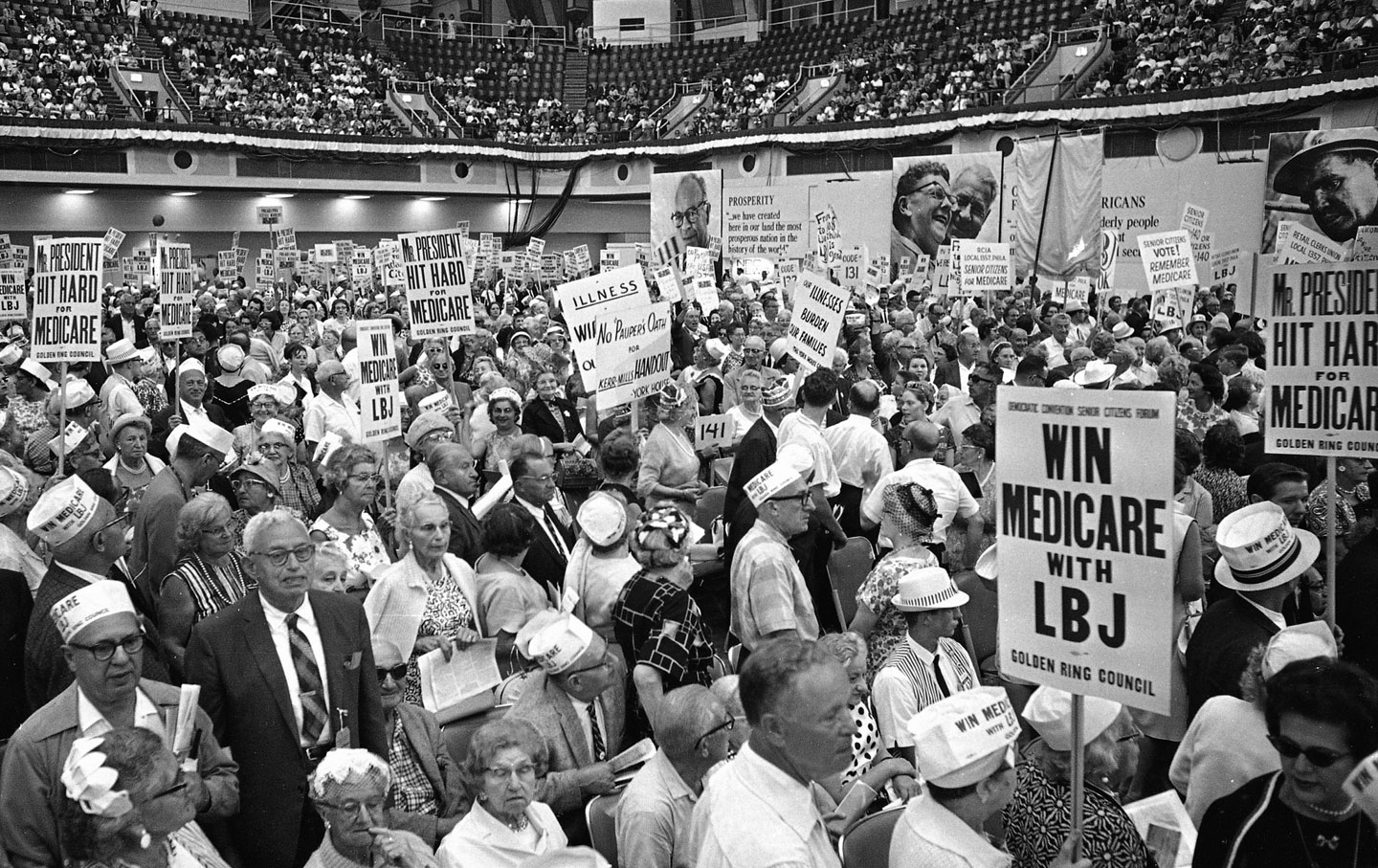
senior citizens supporting Medicare at the 1964 Democratic National Convention


The history of the fight for single-payer health care for the elderly and poor should inform today’s movement to win for Medicare for All.

In August of 1964, 14,000 retirees arrived by the busload in Atlantic City. Representing the National Council of Senior Citizens (NCSC), the former railroad workers, dressmakers, and auto assemblers marched 10 blocks up the fabled New Jersey boardwalk to the Democratic National Convention at the Convention Hall. The group, which was organized and bankrolled by the AFL-CIO, moved en masse in floral housecoats and sandwich boards with slogans like “Our Illnesses Burden Our Families” and “Senior Citizens Vote, Remember Medicare.” They intended to push President Johnson to extend public health insurance to millions of Americans.

Astonishingly, less than a year later, they won. Medicare was signed into law in July of 1965 in Independence, Missouri, at a ceremony attended by former president Harry S. Truman, whose push for national health insurance (NHI) had collapsed nearly two decades before. The landmark law created a public-sector insurance pool for Americans 65 and over, which remains today the closest thing to a robust universal entitlement in the US health-care system. Its successful passage (which also passed Medicaid, to insure the very poor) stands in sharp contrast to multiple failed efforts to install a universal single-payer system.

A half-century later, we’re witnessing the early stages of yet another popular thrust toward single payer, increasingly billed as “Medicare for All.” The nomenclature intends to evoke associations with the popular, trusted program, and is perhaps easier for Americans to latch onto than a phraseology that threatens to trigger a tedious lesson in comparative health policy. But if the conceptual jump from Medicare to Medicare for All can serve as a rough model for achieving universal health care in the United States, we should also look to the history of the social movements that achieved something that then, too, seemed impossible.

No one imagines expanding Medicare to all Americans will be easy. Nothing quite like this has ever been accomplished in the United States. Yes, dozens of peer countries have built coherent, humane, universal health-care systems out of entrenched private ones. Yes, mass movements have won major leftist reforms. Yes, advanced private industries of various nations have been nationalized. But human history offers no examples of these things happening in combination, which is what winning Medicare for All will require.

The most viable push toward NHI in American history crumbled in the late 1940s, ruthlessly crushed by not only insurers and pharmaceutical companies but also the American Medical Association. (Physicians, whose already handsome salaries began to rise in the postwar era, feared the blow that NHI could strike to their paychecks, professional prestige, and autonomy, since a government payer would also reduce their control over prices.) As such, the AMA famously shook down its membership for $25 apiece to fund the multimillion-dollar campaign that injected the phrase “socialized medicine” into mainstream American culture.

In this context, it’s perhaps tempting to view Medicare as a capitulation to industry pressure and political challenges, rather than as evidence they can be flouted. After all, Medicare (and, for that matter, Medicaid) targeted the most vulnerable patients. Many single-payer skeptics insist that Medicare managed to pass because it covered the people private insurance left behind. In his book Harry S. Truman Versus the Medical Lobby: The Genesis of Medicare, historian Monte Poen presents Medicare as a sort of compromise between the unfettered free market and the dashed dreams of the 1940s.

While it’s true that the enactment of Medicare didn’t pose nearly the threat to certain health-care-industry stakeholders that the NHI did or that Medicare for All would, it would be a mistake to fully dismiss its applicability to the current political fight. For one thing, the common talking point that Medicare extended insurance to a population who didn’t have it, rather than squashing existing private infrastructure, doesn’t bear out. A full half of elderly Americans did have private insurance plans when Medicare was signed into law. Commercial health insurers initially opposed the program, and began to support it only when it became clear a large administrative role would be preserved for for-profit insurers.

More importantly, while insurance companies certainly fought against health-care-financing reforms, physicians associations and hospitals are typically considered to have been the more significant opponents—they believed Medicare to be a likely conduit for eventual full-scale single payer (and all the government interference they assumed would come with it), and struck back with more or less the same zeal that they mustered decades earlier. As historian Jill Quadagno puts it, the AMA fought Medicare with “every propaganda tactic it had employed during the Truman era.” Such tactics included a widespread media blitz, advertising in doctors’ offices, and visits to congressmen from physicians in their districts. One tactic, called “Operation Coffee Cup,” deputized physicians’ wives to host ladies’ gatherings, at which they’d play their guests an anti-Medicare PSA starring actor Ronald Reagan.

This time, the AMA and its allies failed, but not for lack of trying. So it’s unfair to ascribe Medicare’s triumph to a lack of industry resistance, which was actually quite strong. The more crucial variable distinguishing Medicare from the NHI battles that fizzled before and since was a mass movement of people demanding it, having coalesced at a moment when powerful liberatory struggles against white supremacy and poverty had transformed what could be deemed politically possible.

Organized labor went all-in for Medicare, which took substantial pressure off unions for their retirees’ mounting health-care costs. Their enthusiasm contrasted with their relationship with universal initiatives before and since, despite their largely supporting most on paper. The reasons for labor’s tepid support for single payer have been debated by historians: For one thing, the unions’ success at collectively bargaining for employer-provided health benefits during the Truman-era reform battles perhaps reduced their motivation to prioritize national health-care solutions, the ongoing absence of which almost certainly highlighted the advantage of union membership. Since the 1970s, ever-rising health-care costs strengthened the case that labor’s interests would be served by removing health-care benefits from tense contract negotiations, but declining labor power during America’s rightward political shift tied them to a Democratic Party establishment unwilling to back single payer during the health-care debates of the 1970s and ’90s.

Today, with a slim majority of congressional Democrats vocally warming up to Medicare for All, and the ACA’s so-called “Cadillac Tax” poised to hit hard-won union-bargained health plans, the pro-labor case for single payer has never been more obvious. Indeed, each of the high-profile wildcat teachers’ strikes widely cited health-care benefits as a central demand. While the AFL-CIO has endorsed single payer, the question of whether workers will rally around Medicare for All they way they did for its namesake could well depend on how the movement’s stakeholders deal with those who stand to be displaced by the streamlining effect of large-scale reform.

But beyond institutional heft or the weight of its endorsements, the most impactful contribution organized labor made to the Medicare fight was a committed army of thousands of boots on the ground, many of them seniors who stood to benefit from the legislation or the family members who worried about how they’d care for them. Even the most precursory survey of 20th-century universal-health-care movements makes their most egregious failure stunningly obvious: They were nearly all top-down operations practically devoid of participation of ordinary people intent on changing the status quo.

By the time the NCSC marched in Atlantic City, this movement was already years in the making. It had been building momentum for the idea that would become Medicare in the 1950s, under a Republican president who, in is 1954 State of the Union address, had affirmed he was “flatly opposed to the socialization of medicine.” Rather than standing by waiting for better electoral luck, the Medicare movement fought to make theirs a winning campaign issue that would help to elect Democrats, not the other way around.

For years, the NCSC spearheaded letter-writing campaigns targeting media outlets and elected officials, and did any media outreach it could. It churned out brochures to counter the messaging of the powerful medical lobby, printing and distributing millions of pamphlets and fliers. As Blue Carstenson, then head of the NCSC, recounted later, “We had to make it a cause and we made it a cause…. We charged the atmosphere like a campaign…. We were always jammed in there and there was a hustle and bustle atmosphere. And when reporters came over they were always impressed by telephones ringing and the wild confusion and this little bitty outfit here that was tackling the whole AMA in a little apartment on Capitol Hill…. This was news. It used to make every reporter chuckle or smile.”

So too did the NCSC learn to push the buttons of electoral politics: It organized groups to testify before Congress about insurance premiums, which rose as much as 35 percent some years, like some ACA marketplace plans. And of course, Carstenson’s formidable elderly army turned out to campaign events. When Democrat George Smathers declined to support Medicare before the 1964 election, NCSC members organized town-hall meetings throughout the state—including one in Fort Lauderdale that was allegedly so successful that the organizers had to upgrade to a bigger venue three different times. Their message made appeals to all ages: Relief for seniors’ medical costs, they argued, will also reduce financial pressure on their working-age children, who’d in turn have more room in the budget to raise their own kids.

If the participants in today’s movement for Medicare for All intend to succeed, they must preempt the imminent counterattack of a health-care industry with far more fortunes at stake than the one their counterparts vanquished in 1965. This will require a mass mobilization of people making themselves seen and heard, whose demands for universal public insurance must reach a fever pitch to force candidates and current officials to capitulate. Doing so will demand a broad variety of tactics, including direct action, canvassing, printed materials, and public events, geared toward not only  persuading regular voters but also inspiring new ones.

Finally, this vision of justice must extend beyond the realm of health care alone. It is nearly impossible to imagine Medicare passing outside the political context set forth by the civil-rights movement, and the so-called War on Poverty. These years-long mobilizations of oppressed people had forced the political reckoning that fostered large-scale reform. It is no coincidence that the New Deal and the Great Society—however short they may have fallen—came about in large bursts rather than undetectable spurts.

Paradigm-shifting reforms have been delivered by broad coalitions confronting a common enemy. It’s up to advocates to compel people living under the US health-care system to see themselves and one another as part of a single constituency, from the poorest uninsured to those saddled with punishing paperwork, office staff chained to bad jobs for benefits, providers-turned-pawns of corporate conglomerates, and expectant mothers bracing themselves for exorbitant out-of-pocket costs atop weeks of unpaid maternity leave. And it must be done in solidarity with struggles on behalf of all oppressed Americans—people of color, the unhoused, the disabled, and others—whose subjugation benefits the very moneyed interests who’d prefer to keep things as they are.

All the evidence tells us that robust universal programs build solidarity, and create an impassioned base that enthusiastically defends them. Once Medicare for All is in place we can expect the same. Until then, it’s up to advocates to compel as many people as possible to envision the radically different society that stands to inherit it—and to accept nothing less.

One big thing people don’t know about single payer

https://www.axios.com/one-big-thing-people-dont-know-about-single-payer-1513306567-26ab72cc-0fa9-4fcc-82c1-835a1793698d.html

It is generally assumed that the biggest obstacle to a national health plan like Medicare for All will be the large tax increase needed to pay for it. But new polling shows another challenge: Almost half of the American people don’t know that they would have to change their current health insurance arrangements if there was a single-payer plan.

Why it matters: Current insurance plans leave a lot to be desired for many people, and it is entirely possible that some people would want to switch to a Medicare for All style plan. But the public has resisted being forced to change their health care in the past — don’t forget the uproar over the cancelled plans at the launch of the Affordable Care Act.

So requiring people to change could trigger blowback and would certainly provide a talking point to help opponents scare people about single payer.

The details: Overall, the general idea of a national health plan is pretty popular, with 53% of the American people favoring a national health plan — 30% strongly favoring it and 23% somewhat favoring it. On the other side, 31% strongly oppose it and 13% somewhat oppose it. Democrats and Republicans split on the idea, as expected.

But as the chart shows, somehow, 47% of the American people think they would be able to keep their current health insurance — even though a single payer Medicare for All style plan would do away with employer-based insurance.

  • 52% of Democrats, the group most supportive of single payer as an idea, think they will be able to keep their plan.
  • Notably, 44% of people with employer-based insurance think they would be able to keep their current plan.

Advocates of single payer consider it a virtue that employer-based health insurance would be eliminated. Health reformers on the right would also do away with employer-based insurance, but they would replace it with tax credits for private insurance, not a government plan.

There are also more targeted public insurance proposals for people who can’t get Medicaid or marketplace coverage — including a government-run public option, a Medicare buy-in for 50-64 year olds, or a Medicaid buy-in option on the ACA marketplaces. They wouldn’t threaten people’s current health care arrangements, but they are far from the rallying cry for some progressives Medicare for All may be, and they’re no slam dunks in the current political environment.

The bottom line: There is no sweeping health reform plan without tradeoffs, as we learned with both the ACA and the Republican repeal-and-replace plans. The fact that so many people don’t know that a national health plan would require them to change their insurance arrangements underscores the challenge of making the transition from a popular idea to a reality for a single-payer national health plan.