Here’s How Microsoft Plans To Modernize Healthcare

http://fortune.com/2019/02/07/microsoft-healthcare-artificial-intelligence/

Image result for microsoft healthcare bot service

Microsoft announced its new service to help healthcare companies store patient data in the cloud and a Healthcare Bot service that will be integrated with Electronic Health Records.

The tool will be based on Microsoft’s Azure cloud platform, which it describes as a secure end-to-end platform that organizations can use to store and analyze sensitive data.

“Healthcare leaders are thinking about how they bring their data into the cloud while increasing opportunities to use and learn from that data,” Microsoft wrote in a blog.

With its new healthcare push, Microsoft aims to create a system that makes health records more easily accessible and sharable between clinicians, researchers, and patients, Bloomberg reports.The corporation also sees its integrated healthcare storage as a way to attract companies to Microsoft, over its competitor Amazon Web Services.


Hospital executives believe Amazon can deliver on its hype as a healthcare disrupter

https://www.fiercehealthcare.com/tech/provider-executives-survey-amazon-ceos-reaction-data-apple-google-telemedicine-mergers?mkt_tok=eyJpIjoiTjJRMlpERTBObU0yWldOaiIsInQiOiJPMDVjRGNQVzcxMjIzOGt1ZTZva0R2YU1PXC9mYkczVEtYVHNHWmZzSHc1TjU1RGRZZ1o4VVprZStEV3R3VWdXWFwvQlRoYVg4cGpzakZIOFFkMkthRnVPbVwvNEUwQ3ptOVozRGQ0U3IyVDFENENmZTErMjc3TDhRYlwvaUlrT1oxSWgifQ%3D%3D&mrkid=959610
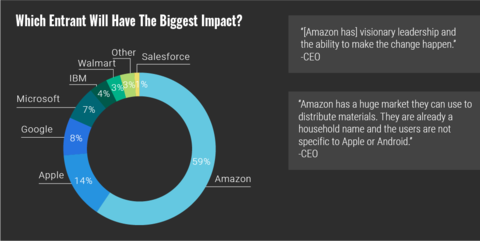
Out of all the technology giants with ambitions in healthcare, hospital executives have overwhelmingly put their faith in Amazon, according to a new survey.

A full 59% of executives say Amazon will have the biggest impact, according to the survey by Reaction Data. Respondents cited resources available to the retail and technology behemoth, the company’s current influence and name recognition.

Comparatively, 14% said Apple, with its foray into EHRs, would be the most influential, followed by Google at 8% and Microsoft at 7%

Among healthcare CEOs—which accounted for 26 of the survey’s 97 respondents—75% said Amazon would make the biggest impact.

About 80% of survey respondents were from the C-suite, including chief nursing officers, chief financial officers and chief information officers. 

While Amazon alone may be generating significant excitement in boardrooms, a previous survey by HealthEdge shows consumers are largely skeptical about Amazon’s partnership with JPMorgan and Berkshire Hathaway.

Amazon’s push into healthcare “has been a shot across the bow for the entire industry,” Rita Numerof, Ph.D., president of Numerof & Associates told FierceHealthcare. The company’s consistent and deliberate investments indicate they are serious about making substantial changes within the industry.

“Amazon is known for its relentless focus on the consumer and its ability to use data systematically to identify and meet unmet needs in an accessible manner,” she said. “Unfortunately, access, consumer engagement, and segmentation haven’t been the hallmark of healthcare delivery.”

Executives were also bullish on telemedicine, with 29% saying the technology would have the biggest impact on healthcare, followed by artificial intelligence at 20%. That’s less surprising given that nearly 75% of respondents were already using telehealth in some way.However, 51% of respondents said telemedicine is revenue neutral, and key focus areas were split equally around rural patients, follow-up care and managing specific populations.


Microsoft Healthcare is a new effort to push doctors to the cloud

https://www.theverge.com/2018/6/27/17509096/microsoft-healthcare-cloud-systems

Microsoft has been working on health-related initiatives for years, but the company is now bringing its efforts together into a new Microsoft Healthcare team. This doesn’t mean you’ll be visiting a Microsoft Store anytime soon for human virus scans, instead it’s a bigger effort to create cloud-based patient profiles, push doctors to the cloud, and eventually have artificial intelligence analyzing data.

The software maker has hired two industry veterans to help out: Jim Weinstein and Joshua Mandel. Weinstein is the former CEO of the Dartmouth-Hitchcock Health system and joins Microsoft as the VP of Microsoft Healthcare, and will work with healthcare organizations to move systems to the cloud. Mandel joins as Microsoft Healthcare chief architect, after completing a nearly two-year stint at Google as an executive for the company’s Verily venture (formerly Google Life Sciences). Mandel will be working closely with the open standards community to create an open cloud architecture for all healthcare providers.

Microsoft’s new Healthcare team appears to be a more formalized approach to the company’s Healthcare NExT (New Experiences and Technologies) company-wide initiative that kicked off last year. NExT was designed to foster health industry partnerships and bring together Microsoft’s research, AI, and cloud teams to focus on healthcare.

Microsoft is trying to find ways to move healthcare data to the cloud securely and in a way that doesn’t break strict compliance requirements for confidentiality. The new Microsoft Healthcare team will be part of Microsoft’s broader AI and Research division. “At Microsoft, we’re confident that many aspects of the IT foundations for healthcare will move from on-premise doctors’ offices and clinics to live in the cloud,” explains Peter Lee, head of Microsoft Healthcare. “We are taking concrete steps with an initial ‘blueprint’ intended to standardize the process for the compliant, privacy-preserving movement of a patient’s personal health information to the cloud and the automated tracking of its exposure to machine learning and data science.”

Lee admits the company has its “work cut out for us,” and this certainly won’t be an easy task for Microsoft. There’s an ongoing race to bring more technology to healthcare and, in particular, artificial intelligence. IBM, Baidu Google, and Alibaba are all working on similar healthcare initiatives, but IBM has struggled with its own efforts. Some analysts predict that AI use in healthcare will grow over the next decade and potentially generate huge savings for the US healthcare economy. Microsoft is clearly part of the broader race to introduce cloud technology, IoT devices, and AI into healthcare, and this new team will be responsible for that. Microsoft now plans to share more about Microsoft Healthcare later this year.