Relevance is King, and “The Top of the Funnel” is Most Relevant to The Most People

http://thinkrevivehealth.com/2017/09/relevance-is-king-and-the-top-of-the-funnel-is-most-relevant-to-the-most-people/


CVS’ recent announcement that the company is expanding its reach in chronic care management is the latest sign that the market has never been more competitive or complicated. (Are you asking yourself, “which market?”) CVS isn’t just protecting its PBM business and driving sales for its retail business. The company has plans to provide one-on-one support and coaching — in a store, via phone, or video — to people who have diabetes, asthma, hypertension, hypercholesterolemia, or high cholesterol, and depression.

This, of course, follows in the footsteps of other companies encroaching on traditional provider-territory, like Optum. OptumCare, the care delivery arm of the company, has 22,000 physicians in 30 markets and 200 surgery centers in 33 states. The combination of the two presents a formidable continuum that could provide consumers with most of the outpatient services they’ll ever need. In other words, the health system brand defined by superior service lines will continue to be less and less relevant as the “top of the funnel” becomes more competitive and more important.

Despite the fierce competition, many health systems continue to focus a large majority of marketing dollars on down-funnel service line care, such as chronic disease treatments and surgeries. There’s logic to that strategy: market and differentiate the services that are most profitable and keep you in business. The problem is that logic doesn’t work in a digital age when consumers have more choices and less patience. Their healthcare mindshare is occupied by a host of companies — like CVS Health and OptumCare — that are more relevant to their daily life than heart surgery or cancer care.

HEALTH SYSTEMS MUST ESTABLISH (AND MAINTAIN) CONTROL OVER THE TOP OF THE FUNNEL

Therein lies the problem for health systems. When Joe Public interacts with your brand, relevance is king. And as we all know, specialty care isn’t relevant to the vast majority of people most of the time. When the competitive field wasn’t as crowded and consumers weren’t showered with more than 5,000 ads every day, it was easier to make an impression that might not be relevant in the moment but could be recalled later when it mattered. That day has passed. The emphasis must shift from awareness and impressions to real engagement.

Health systems — just like any other brands — must be relevant and provide value as often as possible to stay engaged with consumers. Think about your continuum of services as a funnel (Figure 1). Primary care, urgent care, ER, and health & wellness programs sit at the top as these are the services most often used, and represent the most common entry point into your system.

They are also more subject to cost and convenience scrutiny. To maximize the path to specialty and surgical care in the middle of the funnel, health systems can’t just rely on people who go through the side of the funnel – those who did their research to determine which hospital had the best cardiovascular outcomes in the region. For most health systems, the vast majority of their down-funnel, inpatient service line volume — more than 75% — comes from prior top of the funnel activity, not from out of the blue. Health systems need to get as many people in the top of the funnel to build brand, build engagement, and feed all service lines.

Why? Because this is the best way to engage consumers and build brand loyalty. Brand loyalty develops as consumers repeatedly engage with a service over time, and they become repeat customers if they are satisfied. A good experience at the top of the funnel can lead to more profitable business in the middle of the funnel. In fact, our research and work with hundreds of health systems across the country reveals that most people who receive specialty care at a health system had at least one prior experience. And where does most engagement with the healthcare system occur? At the top of the funnel.

Back to CVS. Health systems run the risk of being expensive specialty factories if they cede control of the top of the funnel to competitors — especially competitors who are not other hospitals. The strongest relevance is at the top of the funnel, which is where prescriptions and chronic care management live along with a host of other more frequently used services. CVS Health, Optum, Walgreens, Amazon, and even Google present formidable, well-resourced companies vying for the top of the funnel in some capacity.

What’s your strategy?

Shared Savings Program ACOs Reduced Medicare Spending by $1 Billion

http://www.healthleadersmedia.com/quality/shared-savings-program-acos-reduced-medicare-spending-1-billion?spMailingID=11861186&spUserID=MTY3ODg4NTg1MzQ4S0&spJobID=1240498373&spReportId=MTI0MDQ5ODM3MwS2

Image result for Medicare ACO


ACOs under CMS’ largest alternative payment model outperformed fee-for-service providers in quality and cost savings within the first three years of program.

According to findings reported by the Department of Health and Human Services Office of Inspector General (OIG), accountable care organizations (ACOs) participating in the Shared Savings Program are learning how to achieve greater cost savings over time. The Medicare Shared Savings Program is one of the largest alternative payment models implemented by CMS to reward providers for the quality and value of their services in order to keep patients healthy and lower costs.

The OIG’s report suggests many positive outcomes of the program, including that one-third of the ACOs that reduced their spending lowered costs enough to receive a portion of the savings. CMS data on quality measures also shows that ACOs generally improved the quality of care they provided, with a rate of 82% performance improvement on the individual quality measures within the first three years of the program. ACOs also outperformed fee-for-service providers on 81% of the quality measures.

A small portion of ACOs are reported to have gone above expectations, reducing Medicare spending by an average of $673 per beneficiary, including spending reductions for high-cost services such as inpatient hospital care and skilled nursing facility care. The OIG reports that these high-performing ACOs’ frequent use of primary care services, which can lower utilization and costs for other care, and cost reductions for services such as emergency department visits, was a factor in their cost savings. These strategies are compared to other Shared Savings Program ACOs and the national average for fee‐for‐service providers, who showed an increase in per beneficiary spending for key Medicare services.

The OIG concluded that ACOs show promise in reducing Medicare spending while also improving quality. These improvements come at a critical time, as Medicare spending is predicted to grow to $1.4 trillion by 2027. A large portion of Medicare spending has been attributed to overbilling, with the Medicare program losing more money to this error than any other program government-wide.

Network adequacy standards

Network adequacy standards

Image result for Network adequacy standards

Like everything in health care, network adequacy is complicated, with numerous measures and differing regulations by program. This post offers a flavor and a bit of organization of that complexity, based on some of our recent reading.

Medicare Advantage

When is network adequacy assessed? CMS is only certain to assess a plan’s network upon application for a new contract or expansion of a contract’s service area. At its discretion, CMS may review networks at other times, for instance when a plan terminates a contract with a provider, when it changes ownership, or when there are network access complaints or plan-identified network deficiencies.

What types of entities are assessed for adequacy? There are different network adequacy standards for each of 27 practitioner specialty types (e.g., primary care, cardiology, urology) and 23 facility types (e.g., acute inpatient hospitals, outpatient dialysis, mammography).

Are all markets treated equivalently? No. CMS places each county into one of five categories: Large Metro, Metro, Micro, Rural, or CEAC (Counties with Extreme Access Considerations). Within each practitioner and facility type, there are different network adequacy standards by county type. These can change from year-to-year as well.

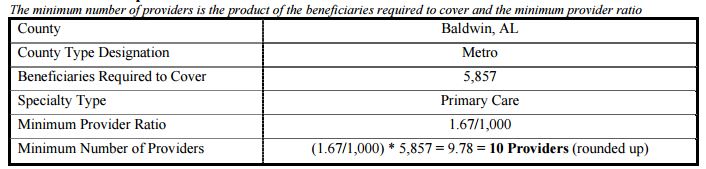
How is network adequacy measured? The gist is that each plan must contract with a specified number of providers of each type. Moreover, 90% of beneficiaries in the county must live within specified travel distance and travel time from at least one provider of each type. To calculate the minimum number of providers, each county receives a population of beneficiaries (termed “beneficiaries required to cover” in the table below) that is equal to the 95th percentile of penetration in all plans in its county type, multiplied by the total number of beneficiaries in the county. That’s a mouthful, but roughly speaking it means that CMS makes sure that each plan can serve a number of beneficiaries larger than it is ever likely to enroll.

This is rather abstract. How about a concrete example? Sure! The following tables should help. The first illustrates the calculation of the number of primary care providers a plan in Baldwin, AL must contract with (10) for 5,857 beneficiaries.

The next table shows that in Baldwin, AL, at least one primary care provider must be within 10 miles and 15 minutes of travel time for 90% of beneficiaries in the county. Additionally, a PCP who is not within the time and distance requirements of at least one beneficiary, will not count towards the minimum number of providers required. Moreover, because at least 90% of beneficiaries must be within the time and distance requirements, a plan may have to contract with more than the minimum number of providers required to meet these requirements.

Where can I learn more? Here are some potentially helpful links:

  • Most of the foregoing can be found in this CMS guidance document.
  • Additional details on how time and distance to providers are calculated can be found in this memo.
  • Here is the most recent file that specifies year-specialty-county type network adequacy regulations.

Marketplaces

The following is for federally facilitated marketplaces, but concludes with a comment about state facilitated ones.

When is network adequacy assessed? As best we can tell, network adequacy is assessed for each plan every year.

What types of entities are assessed for adequacy? CMS focuses on a subset of specialist areas and facility types that have been associated with network adequacy problems in the past: hospital systems, dental providers (if applicable), endocrinology, infectious disease, mental health, oncology, outpatient dialysis, primary care, and rheumatology. That other specialists and facility types are not necessarily scrutinized is one limitation of the approach.

Are all markets treated equivalently? No. CMS places each county into the same categories used for MA plans’ network adequacy: Large Metro, Metro, Micro, Rural, or CEAC (Counties with Extreme Access Considerations). Within each practitioner and facility type, there are different network adequacy standards by county type. Presumably, these can change from year-to-year as well.

How is network adequacy measured? The approach is similar to that for MA plans: 90% of enrollees must have access to at least one provider/facility type within specified travel distances and travel times. A key difference is that there does not appear to be a minimum number of each provider type every plan must contract with. It’s reasonable to hypothesize, therefore, that marketplace plans would have much more narrow networks than MA plans, but no direct comparison exists, to our knowledge.

Sutter will shift 10,000 Anthem Medi-Cal enrollees to community health centers

http://www.sacbee.com/news/local/health-and-medicine/article167900272.html

Image result for FQHC


In Sacramento and Placer counties, roughly 10,000 adult Medi-Cal enrollees with Anthem Blue Cross are learning this summer that Sutter’s primary-care doctors will no longer see them.

Instead, those patients are being shifted to primary-care doctors at community health centers such as Sacramento’s WellSpace Health or Auburn’s Chapa-De Indian Health, said Dr. Ken Ashley, the medical director for primary care at Sutter Medical Group. He said the change in providers will allow the patients to access more services.

“Some of the things that the (community health centers) can provide with the funding that they are receiving are things that sometimes we struggle to find for our Medi-Cal patients, things like optometry and dental, behavioral medicine,” Ashley said. “I feel like these patients are finally going to receive things I could not provide as their primary-care doctor. I’m OK with our partners helping to take care of these patients.”

Sutter, Dignity Health, UC Davis and other providers have all contributed funding and expertise to expand the network of community health centers, more formally known as federally qualified health centers.

The so-called FQHC’s have long been the primary-care delivery network for uninsured, low-income people across the country, but Sacramento did not have a strong network of the centers until the Affordable Care Act set aside funding to help them grow to meet the needs of an expanding Medicaid population.

That flood of new patients has swamped many primary-care providers and has made it harder for all patients to get appointments through commercial providers, Ashley said. Meanwhile, in meetings with the leaders of local FQHC’s, he and other leaders were hearing how those organizations had expanded services, lengthened hours and had capacity for more patients.

About a year ago at one of the meetings, Ashley said, all the attendees began to feel that, if they could shift Anthem’s adult Medi-Cal enrollees, they would improve the health of the primary-care delivery system for a broad set of customers.

“We’ve been having a difficult time getting all our patients in at the time they would like, where they would like,” Ashley said. “This is one more step to try to help allow the rest of the community to help us take care of all these patients.”

Jonathan Porteus, the CEO of Wellspace Health, also leads the Central Valley Health Network, a group of health centers up and down the Central Valley that manage almost 3 million visits a year. He said that Anthem began earlier this year investigating whether the FQHC’s truly had the capacity to absorb the adult Medi-Cal patients served through Sutter.

“We were notified – we being the federally qualified health centers – that this change was coming and that there was a keen interest to make sure that it was smooth, that people would not be left without access,” Porteus said. “The wisdom of Sutter and others has been to help our region have a network of federally qualified health centers, a true blanket of care for the first time ever. This is one of the early tests.”

Porteus said he knows that people have questions about whether the quality of care at his centers is on par with what they would receive from primary-care doctors. He said he welcomes those questions because they give him an opportunity to tell the WellSpace story.

“The Joint Commission, which is the accrediting body that accredits hospitals and shuts them down if they don’t think they’re good enough, has accredited us to be a patient-centered medical home, has accredited all our behavioral health,” Porteus said. “This is a standard many of our commercial colleagues in this community don’t have. If you went into some of these primary-care practices and asked them if they had Joint Commission accreditation for ambulatory care, they will tell you ‘no.’”

There will unquestionably be upheaval in this process for both doctors and patients, Ashley said.

Sutter’s pediatricians will continue to provide primary-care to Medi-Cal-enrolled children covered by Anthem Blue , and the insurer’s Medi-Cal enrollees also still will be able to access Sutter specialists. Sutter primary-care doctors will continue to see anyone on Regular Medi-Cal recipients whose medical providers are paid directly by the government.

4 Health Care Lessons the U.S. Can Learn from Top-Performing Countries

http://www.commonwealthfund.org/publications/lists/2017/4-health-care-international-lessons?omnicid=EALERT1254143&mid=henrykotula@yahoo.com

The recent Commonwealth Fund report, Mirror, Mirror 2017: International Comparison Reflects Flaws and Opportunities for Better U.S. Health Care, compared health care system performance in the United States with that of 10 other high-income countries. The U.S. ranked last in overall health system performance, yet as a nation we spend the most per person on health care. What can we learn from the top-performing countries? Report coauthors Eric C. Schneider, M.D., and David Squires discuss areas where the U.S. can improve in a New England Journal of Medicine “Perspective.” Here are four takeaways:

1

The best-performing health systems use universal coverage to ensure that everyone has access to care.

The United Kingdom, Australia, and the Netherlands provide universal coverage and very low out-of-pocket costs for both preventive and primary care.

2

Strengthening primary care is key to high performance.

Top-performing countries make primary care widely available, so that patients can get health services when they need them. Primary care services are available not just during regular business hours, but also at night and on weekends.

3

Streamlined payment and electronic record systems help patients and doctors.

In the U.S., health professionals and patients spend countless hours trying to sort out what benefits and services are covered by insurance and tracking down payments. The payment systems in other high-income nations use approaches such as paying providers a fee for comprehensive care of patients and standardizing lists of covered benefits and prescription drugs to make choices easier for both patients and doctors.

4

Spending more on the social safety net can reduce disparities in the delivery of care.

Compared to other countries, the United States spends relatively less on social services like affordable housing and transportation and more on medical services, even though research shows that social spending can improve the health of low-income patients, potentially reducing use of costly medical services.

Shift in physician workforce towards specialists fuels primary care shortage, potential spending growth

http://www.healthcarefinancenews.com/news/shift-physician-workforce-towards-specialists-fuels-primary-care-shortage-potential-spending?mkt_tok=eyJpIjoiTXpOa01qUXhaVGd5TnpkaiIsInQiOiJudFozOHVLS1VVNXZZRE42Y0RmTWdIZHpkOU0yNERUSmlXU0VCMlJDMEFyMmVTUUc4aVwvcXRVc0gzXC9ndUdJVjhHT1drZkkzdDhBVFhHZ3BHVjI1NmhIVHY1RmNXSENVdWtwb3RVVnVtaFNWbXNFdnBzb0JVenRcL1ZuR1p0MW0zRyJ9

Areas with more primary care physicians have lower spending per beneficiary, better care, patient satisfaction and lower death rates, authors say.

The composition of the healthcare workforce is shifting towards specialty physicians while primary care growth has gone flat, and according to a Health Affairs blog post, this trend could mean healthcare spending goes up not down.

Labor represents more than half of health care costs, and clinical workforce is a major driver of use and pricing, authors wrote, and there is plenty of support establishing a link between primary care-centered health systems and lower spending. Specifically, areas with more primary care physicians have lower spending per beneficiary, better care and patient satisfaction and lower death rates.

“Given this, many existing payment reform strategies prioritize primary care, and the success of these reforms will require a vibrant–and likely growing–primary care workforce,” the authors wrote.

Health Affairs delved into the Bureau of Labor Statistics’ Occupational Employment Statistics files between 2005 and 2015, focusing their analysis on limited our analysis to ambulatory health care services, hospitals, and nursing and residential care facilities. There was an overall net increase of 2.6 million jobs over this period, six percent of them being physicians. While the number of primary care jobs rose by roughly eight percent, the number of specialist jobs increased six times faster. Also, the overall share of the physician workforce constituted by primary care fell from 44 to 37 percent, the blog said.

These trends raise concerns for access to care and spending. While in theory, the presence of more specialists in a given market could give way to more competition, lower prices and spending and better outcomes, public payer fees are set administratively and not necessarily susceptible to competition. Hospital/physician integration, patient preference could also hinder competition.

The trend of more specialists working in health systems that charge facility fees on top of already expensive prices for care, and the notoriously large salaries specialists make will also likely drive spending upward, authors said.

In light of the aforementioned belief that the strong presence of primary care providers reduces healthcare spending, the workforce trends may be cause for concern. Moreover, they add urgency to previous recommendations from various agencies aimed at bolstering primary care, like MedPac‘s suggestion that the Medicare fee schedule be altered to reflect the value of primary care and close disparities in the fee schedule that overcompensate certain specialists. HRSAhas recommended in the past the medical school funding be funneled toward students who will work in family medicine and other categories.

“If we are to bend the cost curve, we likely need to move more aggressively on fee schedule changes, payment reform, and workforce policies,” the authors said.

Mediocre Evidence Behind Many Primary Care Decisions

http://www.healthleadersmedia.com/quality/mediocre-evidence-behind-many-primary-care-decisions?spMailingID=11361778&spUserID=MTY3ODg4NTg1MzQ4S0&spJobID=1182449350&spReportId=MTE4MjQ0OTM1MAS2

Image result for evidence based medicine

Only 18% of clinical recommendations were based on high-quality, patient-oriented evidence, a primary care research study shows.

Research-based evidence to help primary care physicians make decisions seems to be hard to come by, according to research from the University of Georgia.

Researchers, led by Mark Ebell, epidemiology professor at UGA’s College of Public Health, analyzed 721 topics from an online medical reference for generalists and found that only 18% of the clinical recommendations were based on high-quality, patient-oriented evidence. Their work appears in the journal BMJ Evidence-Based Medicine.

“The research done in the primary care setting, which is where most outpatients are seen, is woefully underfunded, and that’s part of the reason why there’s such a large number of recommendations that are not based on the highest level of evidence,” Ebell said in a statement.

The researchers used Essential Evidence, an online, evidence-based, medical reference for generalists to identify areas of care that are supported by high-quality studies and others that are not. Each of Essential Evidence’s topics are graded A, B, or C using the Strength of Recommendations Taxonomy (SORT), the study said.

They found that topics related to pregnancy and childbirth, cardiovascular health, and psychiatry had the highest percentage of recommendations backed by research-based evidence. Hematological, musculoskeletal and rheumatological, and poisoning and toxicity topics had the lowest percentage.

In addition, just 51% of the recommendations overall were based on studies reporting patient-oriented outcomes, such as morbidity, mortality, quality of life, or symptom reduction, instead of laboratory markers like blood sugar or cholesterol levels.

“Practice should wherever possible be guided by studies reporting patient-oriented health outcomes,” Ebell said. “You would want your care to be guided by studies that have demonstrated that what the physician recommends will help you live better or longer. We should all want that kind of information to guide care.”

The study authors also note that the lack of funding for primary care research stands in stark contrast to patients’ primary care usage: Primary care visits account for 53.2% of all physician office visits, according to the CDC.

Despite A Growing Appetite, Buffet-Style Flat-Fee Clinics Shutter In Seattle

http://khn.org/news/despite-a-growing-appetite-buffet-style-flat-fee-clinics-shutter-in-seattle/?utm_campaign=KHN%3A%20First%20Edition&utm_source=hs_email&utm_medium=email&utm_content=53324518&_hsenc=p2ANqtz-9WGq5KJnKg9Yj-_X9TKSyfzgZJEAJxEAS8-dm9gJC-B1iLTYB_GLl2ZfN2wigraRXz7fdxS0K__eUeIkIHKvnhmMuD0g&_hsmi=53324518

In recent years, a small but growing number of practices embraced a buffet approach to primary care, offering patients unlimited services for a modest flat fee instead of billing them a la carte for every office visit and test. But after a pioneering practice shut its doors earlier this month, some question whether “direct primary care,” as it’s called, can succeed.

Many doctors and patients say they like the arrangement. Direct primary care practices typically don’t accept insurance, which frees physicians from treatment preapprovals and claims paperwork. They say that allows them more time and energy for their patients. Patients can consult with their doctor or a nurse practitioner as often they need to, typically for around $100 a month. (Some employers buy the service for their workers.) Patients need to carry a regular insurance plan for hospitalization, specialists and other services. In the long run, the result should be better patient health and lower health care costs overall.

But some health care experts are concerned that the set-up encourages the “worried well” to get more care than they need. They describe unlimited primary care as a blunt instrument that doesn’t necessarily improve the odds that patients will get evidence-based services that improve their health. Others argue it’s important to find a way to provide cost-effective primary care within the health insurance context, not outside it.

Although only a sliver of practices do direct primary care, the number is on the rise, said Shawn Martin, a senior vice president at the American Academy of Family Physicians. He puts the figure at about 3 percent.

Seattle-based Qliance, founded in 2007, was an early leader in this type of care. With startup funding from high-profile investors Jeff Bezos and Michael Dell, by 2015 the company was serving 35,000 patients at several clinics in the Seattle area, including individuals, workers at companies like Expedia and Comcast and Medicaid patients through a contract with the state’s Medicaid insurer. The company said medical claims for Qliance patients were 20 percent lower than those of other patients because Qliance members went to the emergency room less often, were hospitalized less frequently and saw fewer specialists, among other things.

By early 2017, though, Qliance was faltering. The company had lost some large employer clients, and its patient base had shrunk to 13,000. On June 15, it closed five of its clinics. Dr. Erika Bliss, the company’s CEO, said that in general the market is reluctant to pay what it takes for primary care to flourish, and in some cases payers were resistant to rewarding the company, even when Qliance exceeded targets on quality and savings. She will continue to operate one site that provides occupational health for Seattle firefighters.

“The bottom line is it’s not for free,” she said. “You can’t do this for $25 [per person] per month. If we start doing it for $50 to $100 per month then we can start doing serious primary care.”

The closure took January Gens by surprise. A Qliance patient for a couple of years, Gens, 45, had worked with her primary care doctor there to manage crippling pain from endometriosis. The $79 monthly fee was worth every penny, she thought. She had been able to reduce the dosage of some of her medications and was awaiting a referral to start physical therapy when she learned that Qliance was shutting down. Now she’s not sure what she’ll do.

“I had felt very lucky to have found Qliance, to know I had a doctor and could always be seen when needed without causing more damage to the family budget,” Gens said. “Now it’s just gone.”

But for people who are generally healthy and without symptoms that need to be diagnosed, “unlimited primary care is no guarantee that the services that are provided will improve the health of those people,” he said.Patients who have chronic conditions that need ongoing management may benefit from direct primary care, said Dr. A. Mark Fendrick, an internist who directs the University of Michigan’s Center for Value-Based Insurance Design.

As an example, Fendrick noted that the annual checkup, one of the most popular primary care services, isn’t clinically helpful for most people, according to the Choosing Wisely initiative, a program of the ABIM Foundation that identifies overused and unnecessary medical services.

An examination of research related to direct primary care practices found that they charged patients an average $77.38 per month. “Concierge” medical practices are similar to direct primary care, but their monthly fees are typically higher — averaging $182.76 — and they generally bill insurers for their services, the study found. However, the study, published in the November-December 2015 issue of the Journal of the American Board of Family Medicine, concluded that there was a paucity of data related to the quality of care provided by these practices.

Some analysts say that while they’re sympathetic to doctors’ frustration with large numbers of patients, insurance companies’ intrusion into patient care and billing hassles, the answer isn’t to turn their backs on insurance.

“I think absolutely this type of care could be done inside insurance, but it means we have to learn how to pay within the system for the things that doctors should be doing and are doing in direct primary care,” said Robert Berenson, a fellow at the Urban Institute.

As things stand now, the direct-care model can create difficulties for some patients. Take the situation where someone goes to his direct primary care provider for an earache, but antibiotics don’t work and he needs to be referred to an ear, nose and throat specialist. That patient, who likely has a high-deductible plan to provide non-primary care services, will probably be on the hook financially for the entire cost of care provided by the specialist rather than insurance paying a share.

Qliance’s Bliss scoffs at the idea that patients may get stuck paying more out-of-pocket if they have direct primary care. Most people these days have high-deductible health plans, she said. “The reality is that unless you have Medicaid, you are on the hook no matter what.”

Offering unlimited primary care inside the insurance system is no guarantee of success in any case. One such experiment, a subsidiary of UnitedHealthcare called Harken Health with clinics in the Chicago and Atlanta areas, announced it will shut down at the end of the year.

The company confirmed that it would phase out membership at the end of the year but didn’t respond to a request for further comment.

Outcomes for High-Needs Patients: Practices with a Higher Proportion of These Patients Have an Edge

http://www.commonwealthfund.org/publications/in-the-literature/2017/mar/outcomes-high-need-patients?omnicid=EALERT1177058&mid=henrykotula@yahoo.com

Synopsis

Patients with high health care needs enrolled in Michigan primary care practices that treat a large proportion of such patients had lower health care costs, fewer hospital admissions, and fewer emergency department visits than those enrolled in practices serving smaller proportions of high-need patients. Small practices—those with one or two physicians—exhibited lower overall spending for high-risk patients, though not lower utilization of services, compared with larger practices.

The Big Picture

The finding that practices with a large proportion of high-need patients had lower levels of spending was surprising given that these patients require more time, resources, and expertise to manage their conditions effectively. The authors suggest that practices treating more high-need patients might have structural advantages over other practices or specific approaches developed over time that position them to provide better care. “It may be that practices with a greater proportion of complex patients reach a ‘tipping point’ where they have gained the experience and economies of scale necessary to effectively target care processes to this population’s unique needs,” they write. As to why smaller practices and practices with more high-need patients had lower quality-of-care scores, the authors posit that the quality measures may have been targeted toward adherence to best care practices for healthy patients or those with only one health condition rather than capture the distinct care needs of more complex patients.

The study’s results have important policy implications. Efforts to direct high-need patients to specialized sites of care that serve a high proportion of these patients have shown early promise and could be bolstered with support from policymakers and payers. In addition, there is a consistent trend toward consolidation of primary care to large practices, but these results and others affirm the value of smaller practices. Policymakers should find ways to support and preserve small primary care practices across the country.

THE HEROISM OF INCREMENTAL CARE

http://www.newyorker.com/magazine/2017/01/23/the-heroism-of-incremental-care

We devote vast resources to surgeons and the like, while starving the physicians whose steady, intimate care helps many more.

We devote vast resources to intensive, one-off procedures, while starving the kind of steady, intimate care that often helps people more.