


Cartoon – Perfect for the Job




The pediatric unit at Mercy Children’s Hospital in St. Louis will give nurses summers off work in an effort to retain staff, KMOV reports.
The nurses who choose the seasonal staffing option would still work full-time — three shifts per week for the pediatric unit’s nine-month busy season (September through May). The nurses can take off from June through August, while keeping full-time benefits, and return to their jobs in September.
“It’s exciting to see what the nurses, coming back to the unit after having three months off and doing whatever they want to do, the excitement they are going to have, the rejuvenation for their practice, maybe having a new spark, interest [or] excitement for nursing,” Justin Travis, the nurse manager for pediatrics at Mercy Children’s, told KMOV.
Seasonal staff will receive a stipend every two weeks to cover insurance costs. They also can use accrued paid time off to pay themselves during the summer and work extra hospital shifts as needed, Mr. Travis said.
The hospital is recruiting pediatric nurses for the positions. The contract year would begin in September, meaning the nurses’ first summer off would be next year.
Hospital officials said they may expand seasonal staffing options to other departments if it works in pediatrics


http://money.cnn.com/2018/06/21/news/economy/health-care-worker-shortage-ohio/index.html

In the three years since, she’s worked as a janitor at a local college, then as a quality manager at an auto supplier. But she wanted a position that offered a lot more job security – and better pay than those jobs.
When she heard about the growing demand for health care workers, she started looking around and found Mercy College of Ohio about 10 minutes away.
The school, which is based in Toledo, specializes in health sciences and offers 16 programs that train students for a variety of medical professions, including certificate programs that can be completed in as little as one semester to master’s degrees.
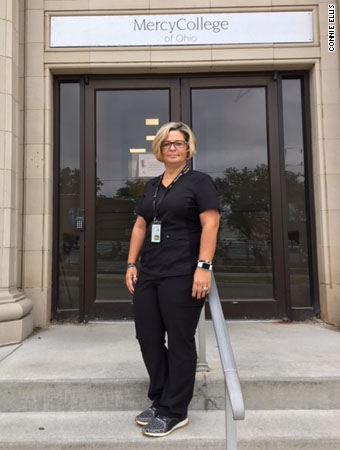
In January, Ellis enrolled to get a certificate in polysomnographic technology, which will qualify her to conduct sleep studies for patients suffering from disorders such as sleep apnea. To her, it was a perfect fit: not only could she complete the program in just 12 months, she was already accustomed to working late shifts.
“I worked nights a lot at CSX. And most sleep studies are also done at night,” she said, noting that her classmates include a former mechanic, a musician and someone who worked for a delivery company.
At job fairs and community events, Mercy College’s recruiters are seeking out students from a variety of fields, but especially the manufacturing and retail sectors — which have been hit by layoffs after big companies like General Motors, DHL and Toys R Us left scores of people looking for work.
That could prove to be a real boon for the area’s health care system, said Jason Theadore, vice president of ambulatory services and business development with Mercy Health, which partners with the college and operates 23 hospitals and 500 health care centers throughout the state.
Manufacturing workers, he said, come with the experience of working long shifts and odd hours And former retail workers can help put a different spin on customer care in a health care setting.
“People from diverse career backgrounds are helping us think differently about how we deliver care,” said Theadore.

The health care industry also desperately needs the workers. Consulting firm Mercer estimates the United States will need to hire 2.3 million new health care workers by 2025 to adequately take care of the country’s aging population.
“Right now, the labor supply just isn’t there,” said Matt Stevenson, a partner at Mercer.
With unemployment near record lows, the workers that are available often aren’t armed with the right skills.
That’s where programs like Mercy College’s comes in.
Each year, the school graduates roughly 400 students. Among its most popular short-term programs are the ophthalmic technology (training to assist ophthalmologists), community health worker, EMT/paramedic and the sleep technology certificates.
Many of the grads end up working for the Mercy Health System, which operates 23 hospitals and 500 health care centers throughout Ohio.
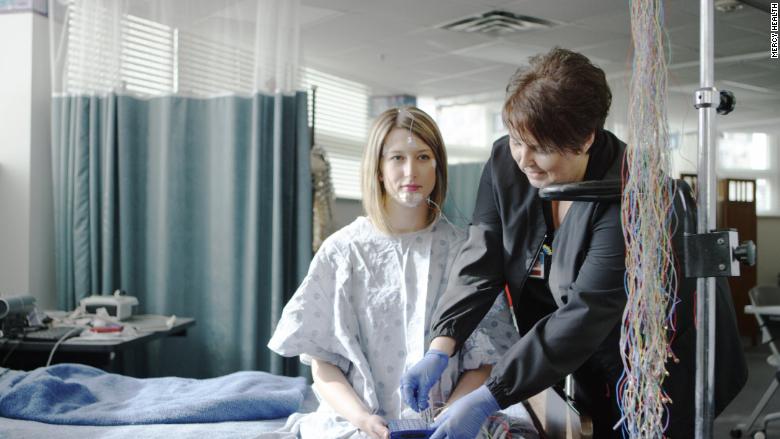
Kathy Damshroder has been teaching polysomnographic technology at Mercy College since last year.
“Everyone with this skill who wants a job has gotten one,” said Damshroder, 55, who also works as a sleep technologist at Mercy Health hospital in Toledo.
According to Mercy College, nearly all the school’s certificate graduates have been employed in their specialty.
Damshroder graduated from Mercy in 2010. Before that, she ran her own hair salon for 25 years in the nearby town of Elmore, Ohio.
“I still own it,” she said.
Like Ellis, the long-term job security of working in the health care industry appeals to her.
“And there’s bang for the buck,” she said. “Entry level pay is about $22 an hour and goes up. The other huge draws are benefits and retirement plans, which I didn’t have as an entrepreneur.”

Leadership changes are more common and important than ever. But most companies don’t get it right.
Every leadership transition creates uncertainty. Will the new leader uncover and seize opportunities and assemble the right team? Will the changes be sustainable? Will a worthy successor be developed? These questions boil down to one: Will the leader be successful?
Hardly anything that happens at a company is more important than a high-level executive transition. By the nature of the role, a new senior leader’s action or inaction will significantly influence the course of the business, for better or for worse. Yet in spite of these high stakes, leaders are typically underprepared for—and undersupported during—the transition to new roles.
Executive transitions are typically high-stakes, high-tension events: when asked to rank life’s challenges in order of difficulty, the top one is “making a transition at work”—ahead of bereavement, divorce, and health issues.2 If the transition succeeds, the leader’s company will probably be successful; nine out of ten teams whose leader had a successful transition go on to meet their three-year performance goals (Exhibit 1). Moreover, the attrition risk for such teams is 13 percent lower, their level of discretionary effort is 2 percent higher, and they generate 5 percent more revenue and profit than average. But when leaders struggle through a transition, the performance of their direct reports is 15 percent lower than it would be with high-performing leaders. The direct reports are also 20 percent more likely to be disengaged or to leave the organization.
Successful or not, transitions have direct expenses—typically, for advertising, searches, relocation, sign-on bonuses, referral awards, and the overhead of HR professionals and other leaders involved in the process. For senior-executive roles, these outlays have been estimated at 213 percent of the annual salary.4Yet perhaps the most significant cost is losing six, 12, or 18 months while the competition races ahead.
Studies show that two years after executive transitions, anywhere between 27 and 46 percent of them are regarded as failures or disappointments.5Leaders rank organizational politics as the main challenge: 68 percent of transitions founder on issues related to politics, culture, and people, and 67 percent of leaders wish they had moved faster to change the culture. These matters aren’t problems only for leaders who come in from the outside: 79 percent of external and 69 percent of internal hires report that implementing culture change is difficult. Bear in mind that these are senior leaders who demonstrated success and showed intelligence, initiative, and results in their previous roles. It would seem that Marshall Goldsmith’s advice—“What got you here won’t get you there”6—is fully applicable to executive transitions.
The pace and magnitude of change are constantly rising in the business world, so it is no surprise that senior-executive transitions are increasingly common: CEO turnover rates have shot up from 11.6 percent in 2010 to 16.6 percent in 2015.7Since 69 percent of new CEOs reshuffle their management teams within the first two years, transitions then cascade through the senior ranks. Sixty-seven percent of leaders report that their organizations now experience “some or many more” transitions than they did in the previous year.

 HENRY KOTULA