Affordable Care Act premium rates projected to increase by 10 percent

https://www.healthcarefinancenews.com/news/affordable-care-act-premium-rates-projected-increase-10-percent?mkt_tok=eyJpIjoiWkRnek5UZGlPRGsxTVRrMSIsInQiOiJPdWRXMnVoYWEyTTJmMDZxMEJGQ3ZCN3lxa1NYUTdjeWtRdlJSQUNQQmQzSStsK2RZZDJcL1NlTjVTaHd3ZzhPcHB3amloQWNUNUtWQVhIWlwvVXlKbEEzR3dNMllwaEZ4VlNTek44SVpcL0UweHdoc2IzMHhBRTg0ZDVvdXlPM05MOCJ9

An estimated 2 percent of the increase will be due to the return on the health insurance tax.

Insurers are projected to submit rate increases in the Affordable Care Act market of about 10 percent, which is higher than the roughly 6 percent increase for 2019, according to Dave Dillon, a fellow of the Society of Actuaries and senior vice president of Lewis & Ellis, Actuaries and Consultants.

An estimated 2 percent of the increase will be due to the return on the health insurance tax. Medical inflation will account for 4-8 percent of the increase, which Dillon called a normal annual trend reflecting the underlying growth in healthcare costs.

Another 1 to 2 percent will be due to the decrease in the level of the premium tax credits. A reduction in the exchange user fee for federal and state-based exchanges will allow for a .5 to 1 percent decrease in rates.

Many factors play a role in rate setting, making predictions somewhat of an educated guess. But Dillon believes one issue that won’t be a factor, unless the court hands up a decision very soon, is the question of the constitutionality of the ACA being weighed in the Fifth Circuit Court of Appeals in Texas.

The Department of Justice recently said the ACA in its entirety should be struck down, now that the individual mandate is gone.

“While there’s a lot of topics going on, they’re not necessary ones that affect 2020 rates,” Dillon said. “The Texas case hangs over everybody but not as an actionable item right now.”

Neither is the Medicare for All debate likely to influence premiums for 2020, he said.

WHY THIS MATTERS

Insurers are getting ready to file their 2020 premium rates for the on-exchange market of the ACA.

Depending on the state, such as Vermont and the District of Columbia, which have deadlines this month, the filing season kicks into high gear during the first and second weeks of June. Other states, such as Arkansas, have a deadline in July, said Dillon, who works with about 10 states on rates.

Off-exchange rates are due later in summer.

Rates will vary by state and would be influenced by a state’s implementation of 1332 waivers to allow for less expansive plans. So far, no state has taken advantage of the waivers that the Centers for Medicare and Medicaid Services began offering last fall, according to The Washington Post.

TREND

ACA premium rates stabilized for 2019 and insurers returned to the market or expanded their coverage areas.

In making his prediction for rates for 2020, Dillon looked at medical loss ratios and profit margins from the 2018 season. These were stable compared to 2017 when insurers were filing two sets of rates depending on whether cost-sharing reduction payments would be continued under the Trump Administration.

President Trump did end the CSRs. However, to make up for the loss to insurers and to lower premium increases, the Department of Health and Human Services allowed insurers in the 2019 season and again for 2020, to silver load premium increases onto silver level plans. Since most beneficiaries get the benefit of federal subsidies for health insurance through the ACA, the federal government is still bearing the cost of allowing insurers to offer lower rates.

Unlike other years, Dillon said he’s not hearing a lot about the market, which he interprets as a stabilizing trend. Insurers aren’t coming in and out of the markets as much. Regional companies may be expanding into other states, but there’s been no talk of another large insurer getting in, he said.

“I think we’re on the path to gaining some traction and stability,” Dillon said. “Obviously the ACA has put us at lowest uninsured rate ever.”

ON THE RECORD

“Consistent with previous years, insurance rates will vary widely across individual states and marketplaces,” Dillon said.


With Divided Congress, Health Care Action Hightails It to the States

https://www.rollcall.com/news/policy/divided-congress-health-care-action-states

Image result for With Divided Congress, Health Care Action Hightails It to the States

Medicaid expansion was the biggest winner in last week’s elections.

Newly-elected leaders in the states will be in a stronger position than those in Washington to steer significant shifts in health care policy over the next couple of years as a divided Congress struggles with gridlock.

State Medicaid work requirements, prescription drug prices, insurance exchanges and short-term health plans are among the areas with the potential for substantial change. Some states with new Democratic leaders may also withdraw from a multistate lawsuit aimed at killing the 2010 health care law or look for ways to curb Trump administration policies.

But last week’s biggest health care winner is undeniably Medicaid expansion, with upwards of half a million low-income Americans poised to gain insurance coverage following successful expansion ballot initiatives and Democratic victories in key governors’ races.

“In state health policy, it was a big election,” said Trish Riley, executive director of the nonpartisan National Academy for State Health Policy. “It was a year when many candidates had pretty thoughtful and comprehensive proposals.”

Boost for Medicaid expansion

Voters in three deep-red states — Nebraska, Idaho and Utah — bucked their Republican lawmakers by approving ballot initiatives to extend Medicaid coverage to more than 300,000 people.

Meanwhile, Democratic gubernatorial wins in Kansas and Wisconsin boosted the chances of expansion in those states. And Maine’s new governor-elect is expected to act quickly to grow the government insurance program when she takes office in January.

The election outcomes could bring the biggest increase in enrollment since an initial burst of more than two dozen states expanded Medicaid under the 2010 health care law in the early years of the landmark law’s rollout.

“This election proves that politicians who fought to repeal the Affordable Care Act got it wrong,” said Jonathan Schleifer, head of The Fairness Project, an advocacy group that supported the initiatives, referring to the 2010 health care law. “Americans want to live in a country where everyone can go to the doctor without going bankrupt.”

The successful ballot initiatives require state leaders to move quickly toward expansion. In Idaho, the state must submit an expansion plan to federal officials within 90 days of the new law’s approval, while Nebraska must submit its plan by April 1, according to the nonpartisan Kaiser Family Foundation. Utah’s new law also calls for the state to expand beginning April 1.

In Kansas, where Medicaid supporter Laura Kelly prevailed, state lawmakers passed expansion legislation last year only to have it vetoed by the governor. Meanwhile, Wisconsin’s new Democratic governor Tony Evers, who eked out a win over Republican incumbent Scott Walker, has said he will “take immediate action” to expand, though he faces opposition from a Republican-controlled legislature.

Expansions in the five states would bring the number of states that adopted expansion under the health law to 38, plus the District of Columbia.

Still, Democrats fell short of taking one of the biggest Medicaid expansion prizes — Florida — after Andrew Gillum’s defeat. The outcome of Georgia’s tight governor’s race was still unclear as of Monday, with Republican Brian Kemp holding a narrow lead over Democrat Stacey Abrams. Both Abrams and Gillum made health care, and Medicaid expansion in particular, central to their campaigns.

Florida might be a 2020 target for an expansion ballot initiative, along with other states such as Missouri and Oklahoma, according to The Fairness Project.

Expansion supporters also suffered defeat last week in Montana, where voters did not approve a ballot initiative that would have extended the state’s existing Medicaid expansion, which covers nearly 100,000 people but is slated to expire next year. However, state lawmakers have until June 30 to reauthorize the program, according to Kaiser.

In Maine, Democratic gubernatorial winner Janet Mills is expected to expedite expansion implementation. GOP Gov. Paul LePage stymied implementation over the past year, despite nearly 60 percent of voters approving an expansion ballot initiative in 2017.

Medicaid’s future

The midterm results carry other ramifications for Medicaid, including whether states embrace or move away from controversial work requirements backed by the Trump administration.

Gretchen Whitmer, a Democrat who won Michigan’s governor race, opposed the idea and could shift away from an existing plan to institute them that’s awaiting federal approval.

“This so-called work requirement is not for one second about getting people back to work. If it was, it would have been focused on leveling barriers to employment like opening up training for skills or giving people child care options or transportation options,” Whitmer said in a September interview with Michigan Radio. “It was about taking health care away from people.”

Kansas, Wisconsin and Maine also have work requirement proposals that new Democratic governors could reverse.

But experts also say it’s possible some states, including those with Democratic governors, could end up pursuing Medicaid work requirements if that’s what it takes to get conservative legislators to accept expansion like Virginia did earlier this year.

Nebraska Republican state senator John McCollister, who supports expansion, predicted recently that the legislature would fund the voter-approved expansion initiative. But he indicated lawmakers might pursue Medicaid work requirements too.

Marie Fishpaw, director of domestic policy studies at the conservative Heritage Foundation, warned that states expanding Medicaid would face challenges. She called expansion “a poor instrument for achieving the goal that they’re trying to achieve.”

A number of new governors, including Whitmer, could pursue the so-called “Medicaid buy-in” concept.

More than a dozen state legislatures, such as in Minnesota and Iowa, explored the idea in recent years, according to State Health and Value Strategies, part of the nonprofit Robert Wood Johnson Foundation. Nevada lawmakers passed a “Medicaid buy-in” plan last year that was vetoed by the governor.

There are a variety of ways to implement such a program, but the goal is to expand health care access by leveraging the government insurance program, such as by creating a state-sponsored public health plan option on the insurance exchanges that consumers could buy that relies on Medicaid provider networks. Illinois, New Mexico, Maine and Connecticut are among the states that could pursue buy-in programs, Riley said. States are considering the concept as a way to increase affordability and lower cost growth by getting more mileage out of the lower provider rates Medicaid pays, said Katherine Hempstead, a senior policy adviser with Robert Wood Johnson Foundation.

“So many [people] struggle with the affordability of health care,” Hempstead said. “That is an environment in which Medicaid buy-in opportunities could flourish.”

Health care law

This month’s election also carries implications for the future of states’ administration of the 2010 health care law.

States that flipped to Democratic governors could switch to creating their own insurance exchanges rather than relying on the federal marketplace, said Joel Ario, a health care consultant with Manatt Phelps & Phillips and the former head of the federal health insurance exchange office under the Obama administration. The costs of running an exchange have come down in recent years, so it’s potentially cheaper for a state to run its own, Ario said.

Trump administration actions, such as cuts in federal funding for insurance navigators that help consumers enroll and the expansion of health plans that don’t comply with the law, may make states such as Michigan or Wisconsin rethink use of the federal exchange, he said.

“If [the administration] continues to promote policies that really leave a bad taste in the mouth for Democratic governors, I think they’ll be asking questions,” Ario said.

States where governors and attorneys general offices went from red to blue are likely to pull out of a lawsuit by 20 state officials that aims to take down the health care law, he added.

Wisconsin’s Evers vowed that his first act in office will be to withdraw from the lawsuit.

“I know that the approximately 2.4 million Wisconsinites with a pre-existing condition share my deep concern that this litigation jeopardizes their access to quality and affordable health care,” Evers wrote in a letter he said he plans to send to the state attorney general.

Hempstead said that states with both Republican and Democratic leaders will likely continue to pursue reinsurance programs, which cover high-cost patients, to bolster their marketplaces.

Republican governors could also pursue waivers under a recent Trump administration guidance that allows states to circumvent some requirements of the health law under exemptions known as 1332 waivers. But experts say it’s too soon to know exactly what approaches states might take.

“It will be interesting to see what the 1332 guidance means and whether it opens doors for some things and not for others,” Hempstead said. States that shifted to Democratic governors could also look to ban some Trump-supported policies, such as expansions of short-term and association health plans that avoid the health care law’s rules.

States are also likely to take steps to address high prescription drug costs in the coming years, with a number of new governors wanting to improve transparency, explore drug importation from other countries and target price gouging, Riley said.

“There’s a long history of the states testing, fixing, tweaking and informing the national debate,” said Riley.


CMS announces new waiver flexibility in ACA market

https://www.healthcarefinancenews.com/news/cms-announces-new-waiver-flexibility-aca-market?mkt_tok=eyJpIjoiTldNeU1qQmpOMk14WXpRMyIsInQiOiJDSlRcL25VMHRkNTlLQzZqU1dERHJzWnFlUmR2MCtJcWNaT0VZVUprSWY4ejJ2a1ZlemRaZStIaVA4bWRIM3h6VlphdWJreDRwK1cwbjhNWnZ0WmFCeVQ3b2lTSTQ5Y1krdHFKQTdCQ1dPRDd2a1NOVDFBTG5ESWpNUnhQYzVvdWwifQ%3D%3D


States will have the ability to allow individuals to use ACA subsidies when buying short-term limited duration plans.

States are getting new flexibility in waivers to the Affordable Care Act, including being able to target ACA subsidies for individuals who want to buy short-term, limited duration plans, Centers for Medicare and Medicaid Services Administrator Seema Verma said today.

What is not flexible is protecting access to coverage to those with pre-existing conditions.

Verma gave no specifics on the types of waivers that will be considered, but said the agency was preparing to release a series of waiver concepts. More specifics are expected to be released in the coming weeks.

The policy goes into effect today but is expected to impact states next year, for the 2020 plan year.

IMPACT

The effect of the waivers will likely not be known until next year.

But the allowance of short-term insurance as an ACA alternative could have a more immediate effect as consumers choose plans during open enrollment starting November 1.

The Trump Administration this year extended the length of short-term plans from three months to one year, with an extension allowed for up to three years. Because these plans would not be obligated to cover the essential benefits mandated under the ACA, premiums are expected to be lower.

Opponents have said this would cause an exodus of healthy consumers from the traditional ACA market and rising prices for those left behind.

THE TREND

CMS has been taking credit for stabilizing the ACA market and lowering premiums through the use of waivers and by easing regulations.

For instance, reinsurance waivers have helped reduce premium costs, CMS said. To date, CMS has approved eight state waivers, and all but one have been a reinsurance waiver for states to develop high-risk pools to help pay the cost of high claims.

The reason for the lack of other approved waivers is due to the previous Administration limiting the types of state waiver proposals that the government would approve, CMS said.

The new Section 1332 waivers, called state relief and empowerment waivers, will allow states to “get out from under onerous rules of Obamacare,” Verma said.

WHAT ELSE YOU NEED TO KNOW

Under Section 1332 of the ACA, states can waive certain provisions of the law as long as the new state waiver plan meets specific criteria, or “guardrails,” that help guarantee people retain access to coverage that is at least as comprehensive and affordable as without the waiver; covers as many individuals; and is deficit neutral to the federal government.

The new waivers should aim to provide increased access to affordable private market coverage; encourage sustainable spending growth; foster state innovation; support and empower those in need; and promote consumer-driven healthcare, CMS said.

ON THE RECORD

“Now, states will have a clearer sense of how they can take the lead on making available more insurance options, within the bounds of the Affordable Care Act, that are fiscally sustainable, private sector-driven, and consumer-friendly,” said Health and Human Services Secretary Alex Azar.

“The Trump Administration inherited a health insurance market with skyrocketing premiums and dwindling choices,” said CMS Administrator Seema Verma. “Under the president’s leadership, the Administration recently announced average premiums will decline on the federal exchange for the first time and more insurers will return to offer increased choices.

“But our work isn’t done. Premiums are still much too high and choice is still too limited. This is a new day — this is a new approach to empower states to provide relief. States know much better than the federal government how their markets work. With today’s announcement, we are making sure that they have the ability to adopt innovative strategies to reduce costs for Americans, while providing higher quality options.”


Reinsurance in Wisconsin expected to stabilize individual market

https://www.healthcarefinancenews.com/news/reinsurance-wisconsin-expected-stabilize-individual-market?mkt_tok=eyJpIjoiTVdJMVlUVmtNMlppTUdZNSIsInQiOiJublwvXC83VVdcL2dcL1U3a3FHNGNMRHppSldoOThiRGtNQXk4UFJyZE5FUkRQeWZWZEQ1NDMxT3FZeGRhZjdGOUlnQUtaQTUyeEMrcnBSaDNKQjZLWEIzRkVCaFlNelNXSmI1R1ZrZFdOcXlzTWVUcGk3OXl5WnNRZDlaTjhjN09WM3MifQ%3D%3D

Under the Wisconsin Health Care Stability Plan, the state pays for 50 percent of the cost of claims between $50,000 and $250,000.

Wisconsin has received a federal waiver to leverage $200 million to implement a state-based reinsurance program to cover high-cost claims in the individual health insurance market.

Reinsurance covers a portion of the most expensive claims. The move helps to stabilize the individual market by reducing insurer claim costs and decreasing premiums.

Insurers don’t have the uncertainty that a small number of high-risk individuals could dramatically increase their expenses because there aren’t enough healthy consumers to balance out the risk pool.

Under the Wisconsin Health Care Stability Plan, the state pays for 50 percent of the cost of claims between $50,000 and $250,000.

The Department of Health and Human Services and the Department of the Treasury on Sunday approved the 1332 state innovation waiver under the Affordable Care Act. The five-year program starts Jan. 1, 2019 and ends Dec. 21, 2023.

The approved waiver allows the state to have access to $200 million in reinsurance funding. The federal government will pay an estimated $166 million and the state, $34 million.

The program is budget neutral to the federal government. The money comes from savings from premium tax credits. The federal waiver allows the premium tax credits to be passed through to the state, rather than going directly to the consumer.

Consumers will see the savings in an expected 3.5 percent drop in their premiums in the individual market, starting in 2019, according to a released statement from the Centers for Medicare and Medicaid Services and Wisconsin Governor Scott Walker. This compares to a 44 percent rate hike on premiums in 2018.

Walker submitted the waiver request for the state’s Health Care Stability Plan in April.

In an unrelated waiver request, Wisconsin has asked to impose work requirements as a condition of Medicaid beneficiaries receiving coverage.

While CMS Administrator Seema Verma and HHS Secretary Alex Azar have reportedly said that a judge’s decision in Kentucky barring work requirements will not stop the Trump administration from considering similar waivers, Wisconsin’s request awaits federal approval.

Last month, a federal judge blocked Kentucky’s plan to implement a work requirement waiver. In light of the action, CMS decided to reopen Kentucky’s 30-day federal public comment through August 18.


MAINE SECURES WAIVER TO RESURRECT ‘INVISIBLE HIGH-RISK POOL’

https://www.healthleadersmedia.com/finance/maine-secures-waiver-resurrect-invisible-high-risk-pool

The reinsurance program, which the state operated in 2012 and 2013, before the ACA’s transitional reinsurance took effect, is expected to reduce insurance costs in Maine’s individual insurance market.

The federal government approved another waiver application Monday under the Affordable Care Act, giving Maine the go-ahead to reinstate a reinsurance program it had operated briefly before the ACA took effect.

Maine is the fifth state to secure a Section 1332 waiver to establish a state-run reinsurance program, following closely on the heels of Wisconsin’s waiver request being granted Sunday. Alaska, Minnesota, and Oregon won their waivers last year, and two other states—Maryland and New Jersey—have similar applications pending.

Although the Trump administration has taken a number of actions that would appear to harm the individual market, approving these waivers seems to be a positive step in the opposite direction, says Matthew Fiedler, PhD, a fellow with the Brookings Institution Center for Health Policy who served as chief economist of the Council of Economic Advisers during the Obama administration.

“Reinsurance waivers will reduce premiums in the individual market in these states and will result in more people being covered. I think they’re a reasonable way for states to spend money,” Fiedler tells HealthLeaders Media. “There may be better ways to spend money to improve the individual market, but this is certainly an actionable one and one that states can implement more or less on their own.”

Maine projects that premiums will be 9% lower in 2019 than they would be without reinsurance. Those lower premiums are expected to encourage more people to sign up for coverage, reducing Maine’s uninsured population by 1.7%, according to independent actuarial projections cited by the state and federal governments.

A modest gain in enrollment could translate to a slight benefit for insurers and could reduce the burden of uncompensated care on hospitals, Fiedler says.

‘INVISIBLE HIGH-RISK POOL’

In a letter submitted last May to Health and Human Services Secretary Alex Azar, Maine Bureau of Insurance Senior Staff Attorney Thomas M. Record said the program, which is known formally as the Main Guaranteed Access Reinsurance Association (MGARA), had “become popularly known as Maine’s ‘ invisible high risk pool.'”

Record described the program as a key feature of health reform legislation Maine lawmakers passed in 2011. The program, which was active in 2012 and 2013, successfully reduced premiums in the individual market by about 20%, he said.

Despite that success, MGARA was suspended at the beginning of 2014, when the ACA’s transitional reinsurance program rendered it redundant, according to Maine’s waiver application. The federal reinsurance program ended as scheduled on the final day of 2016.

Material released by the Centers for Medicare & Medicaid Services describe MGARA as operating a hybrid-model reinsurance program that includes traditional and conditions-based components. High-risk patients with any of eight conditions will be ceded automatically. Other high-risk enrollees will be ceded voluntarily. The program will offer 90% coinsurance for claims in the $47,000-77,000 range and 100% coinsurance for higher claims up to $1 million.

For claims above $1 million, the program will cover the amount left uncovered by the federal government’s high-cost risk-adjustment program.

Maine estimates that its program will result in a net spending reduce of more than $33 million per year, for 2019 through 2023, with that federal savings to be passed along to the state to fund the program.

The program’s total expenses are projected to cost $90-104 million annually during the five-year waiver period.

Insurers and providers have responded positively to the prospect of state-run reinsurance programs, seeing the development as good news for business and patients alike. But the benefits should not be overstated.

“The one downside of these programs is that because tax credits fall dollar-for-dollar when premiums fall, they don’t really do anything to make coverage more affordable for people with incomes below 400% of the poverty line,” Fiedler says.

“That doesn’t mean they’re a bad thing. But they can only be one part of an overall strategy for making individual market insurance affordable.”


After repeal scare, Obamacare has never been more popular

https://www.cbsnews.com/news/obamacare-repeal-has-never-been-more-popular/

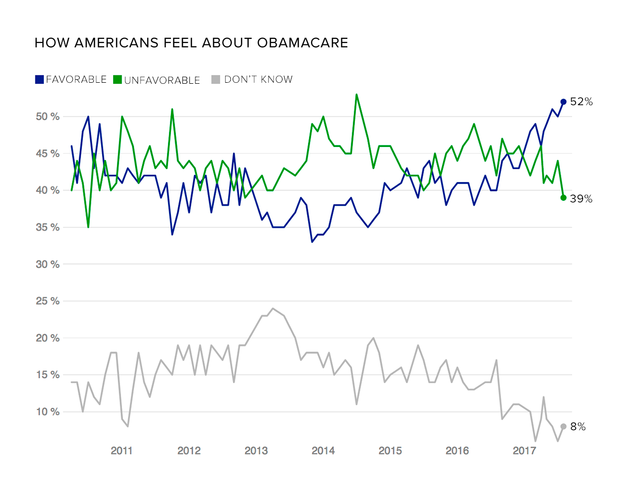
obamacare-sentiment.png

Underscoring the adage that you don’t know what you’ve got until it’s (almost) gone, the popularity of Obamacare is surging.

Only weeks after Republicans in Congress failed to repeal the landmark health reform law, 52 percent of respondents hold a favorable view of the Affordable Care Act (ACA), according to a recent Kaiser Family Foundation August poll. That’s up 10 percentage points since June of last year and nearly 20 points since November 2013, when public support for the ACA was at its nadir.

A July poll by CBS News after the repeal effort collapsed found that a plurality of Americans favor a bipartisan push in Congress to improve Obamacare.

The shift in sentiment coincides with other positive developments for Obamacare following its close call in Washington. With several large, and some smaller, insurers pulling out of the program over the past year or so, until recently it looked as if more than 92,000 participants spread out over 82 counties would have no insurer in their local health care exchanges, Cynthia Cox, associate director of Kaiser Family Foundation, said. But state insurance commissioners and other officials in states in jeopardy of losing Obamacare coverage have worked closely with insurers to negotiate continued coverage.

In Ohio, for instance, there were 20 counties without insurers, but officials ultimately convinced five health plans to cover all but one. Then, on August 24, the Ohio Department of Insurance announced that Paulding County, the last “bare county” in the country, would be covered by insurer CareSource.

In addition, the exchange marketplace overall has shown signs of stabilizing. After big financial losses in 2014 and 2015, individual market insurers saw improved performance in 2016, a trend that has continued this year, according to a different Kaiser Family Foundation study.

If Obamacare’s popularity is up, the program’s shortcomings remain clear. At last count, more than 2.6 million enrollees across 1,300 counties were expected to have only one insurer in their exchanges. More insurers also could pull out or move to sharply increase their premiums. The deadline for insurance companies to commit to participate in an exchange is September 27.

Until then, many insurers are watching closely to see if the Trump Administration will continue funding the federal cost-sharing subsidies that help low-income members pay for deductibles, co-pays and other out-of-pocket costs. Industry players are also waiting or Senate hearings to start after Labor Day in which which insurance commissioners, lawmakers and state governors are expected to testify about what can be done to stabilize the individual marketplace.

Meanwhile, some states are beginning to take matters into their own hands, moving to rewrite the ACA rules by applying for what’s known as a “Section 1332” waiver. Oklahoma is asking for a waiver to establish its own reinsurance program using some federal funds, which would cover the highest-cost individual marketplace cases. Alaska recently received approval for a similar reinsurance waiver. Oklahoma, however, is also looking ahead to more major structural changes that may spur debate.

Iowa, which is undergoing huge premium increases in its individual marketplace, has submitted a waiver that would overhaul the state’s insurance marketplace by redistributing federal tax credit money. The plan would create a single standard health plan and offer a flat tax credit based on age and income.

Critics argue this would increase health care costs significantly for Iowa’s low-income population, putting coverage out of reach for many. Proponents argue that increasing Iowa’s pool of healthy insured people is the best way to stabilize Iowa’s individual market and lower premiums for everyone.

Time Crunch Among Hurdles for Bipartisan Senate Push to Bolster ACA

https://morningconsult.com/2017/08/18/time-crunch-among-hurdles-bipartisan-senate-push-bolster-aca/

Image result for aca


The leaders of a key Senate committee say they are cautiously optimistic about reaching a deal to shore up the Affordable Care Act’s individual marketplaces, but even with a bipartisan effort, it is far from certain whether they can hash out an agreement in time.

The Senate Health, Education, Labor and Pensions Committee leaders of both parties have set a self-imposed mid-September deadline for a bipartisan agreement. To keep lingering animosity from the Obamacare repeal fight from seeping into negotiations, Chairman Lamar Alexander has made clear that what he’s seeking is far from comprehensive.

The bill will have to be “small, bipartisan and balanced,” the Tennessee Republican said in a statement Wednesday.

Above all, Democrats want to make sure insurers continue to receive payments that help them cover out-of-pocket costs for some low-income patients. President Donald Trump has threatened to cut off the payments, and the administration has kept insurers on tenterhooks by making them only on a month-to-month basis.

Without the subsidies, known as cost-sharing reductions, some insurers warn they’ll be forced pull out of the ACA markets or hike premiums. The companies need certainty about payments at the latest by Sept. 27, the final deadline for them to decide whether to sell Obamacare plans in 2018.

If the committee can reach agreement next month, it would still be a challenge to get a bill through the full Senate and House before the key deadline for insurers. And Trump would still have to sign a bill into law that extends payments he is loath to continue.

The potential for chaos was highlighted this week when the nonpartisan Congressional Budget Office released a report estimating average premiums would rise 20 percent next year and the federal deficit would grow by $194 billion by 2026 if the administration stops paying.

While some conservative hard-liners want to cut off the CSRs, Alexander and other top Republicans have shown they’re willing to work with Democrats to have Congress extend the payments.

Sen. Patty Murray of Washington, the panel’s ranking Democrat, on Thursday called for quick action.

“People across the country are facing much higher premiums next year because of uncertainty driven by the Trump Administration, so I hope Republicans will join Democrats to act quickly to protect patients and families from paying more for care they need — and then continue working in a bipartisan way to make health care more affordable, accessible, and higher quality for all,” Murray said in a statement.

Democrats also want some sort of reinsurance program, an idea that has bipartisan support and would help insurers pay for their most expensive enrollees.

But in return for extending CSRs and including reinsurance, Republicans want to give states more authority over their health care systems, and Democrats could balk at some of their proposals.

Alexander has specifically pointed to changing the ACA’s 1332 waiver program, which allows states to opt out of key ACA regulations as long as it doesn’t lead to reduced coverage, skimpier benefits, more expensive insurance or a higher federal deficit.

In remarks to reporters earlier this month, Alexander noted a proposal that would eliminate all of those requirements besides increasing the federal deficit, in order to give states “more of an opportunity to approve insurance plans.” The plan, which was included in Senate Republicans’ health overhaul bill, would also bar the administration from rejecting a waiver as long as it doesn’t increase the federal deficit.

Democrats would likely oppose that proposal, wary of allowing states to undercut key Obamacare requirements without those other conditions in place.

Sen. Tim Kaine (D-Va.) said he’s interested in a proposal from Sens. Bill Cassidy (R-La.) and Susan Collins (R-Maine) to let states replace Obamacare’s most contentious provision — the mandate requiring people to purchase health insurance or pay a penalty — with a system that automatically enrolls individuals in low-cost coverage if they don’t do so on their own.

Backers of this approach argue it would offer comparable coverage to the individual mandate while being less intrusive, allowing people to opt out.

“I think that’s intriguing,” Kaine said earlier this month in a brief interview. “We ought to have that discussion, but you can’t blow the mandate without something to bring people into the program and do what insurance needs to do, which is to spread risk.”

But auto-enrollment has raised concerns among some liberal health care analysts, including over how to implement and administer such a system. The outstanding questions cast doubt on whether it could garner enough backing to be included in the stabilization bill.

JAMA Forum: Has Obamacare Become Trumpcare?

https://newsatjama.jama.com/2017/08/08/jama-forum-has-obamacare-become-trumpcare/?utm_campaign=KFF-2017-The-Latest&utm_source=hs_email&utm_medium=email&utm_content=55126983&_hsenc=p2ANqtz-8vj_o8hQsSTd-X9YaMl68R-qSign5oJJXs7kws6IQmZfKrthFZsdW-cMXbvwUyTxd2LsnB1OGj2fS4da5pKiDsoJnTHQ

Image result for medicaid

With the failure of several bills in the Senate to repeal or replace the Affordable Care Act (ACA), the effort to significantly remake the 2010 health law is apparently on hold, if not dead. This is a dramatic turn of events that few anticipated when Republicans took control of the White House and Congress after 7 years of vowing to repeal the ACA.

So, now what?

For the foreseeable future, all the ACA’s benefits and requirements stand—expanded Medicaid coverage for 11 million people, low-income adults; premium tax credits for about 9 million low- or middle-income people buying their own insurance; guaranteed insurance for people with preexisting conditions, and requirement that people buy insurance or pay a penalty.

The biggest question at this point is whether the Trump administration will pivot towards trying to make the law work, after the president said he might just “let Obamacare fail” to gain negotiating leverage in the repeal and replace debate.

This is without a doubt an awkward situation for President Trump and Secretary of Health and Human Services Tom Price. They have bitterly criticized the ACA, and that was at some level understandable during the high-stakes Congressional debate. But now that the debate is over for the time being, the Trump administration is left running a government responsible for implementing the law.

What would it look like for the administration to run the ACA effectively?

Most immediately, open enrollment for the ACA’s marketplaces begins November 1, and insurers have to decide by late September whether they will participate. There are a host of actions the administration could take to make it successful.

Provide Clarity Around the Rules: There is still uncertainty as to whether the administration will enforce the individual mandate and continue to make $7 billion in cost-sharing subsidy payments to insurers—which have been in limbo because of threats from the administration to cut them off and a lawsuit brought by the House of Representatives challenging the authority to make them. This uncertainty is leading insurers to propose bigger premium increases than necessary to cover the anticipated growth in medical care expenses or, in some cases, to pull out of the market entirely. If the cost-sharing payments are stopped, the Kaiser Family Foundation (KFF) estimates that insurers would have to raise premiums by an additional 19% to offset the losses.

Maintaining Outreach and Consumer Assistance: There is enormous churn in the individual insurance market as people get or lose jobs with health benefits and see their incomes rise or fall. Millions of new people need to sign up for insurance each year just to maintain steady enrollment. Importantly, any decrease in enrollment is likely to be disproportionately among healthy people. So far, the administration has mostly taken steps to pare back outreach activities, cancelling ads at the conclusion of open enrollment for this year, and recently ending contracts for consumer assistance activities. It seems unlikely that President Trump will promote ACA enrollment on an online video show like “Between Two Ferns,” as President Obama did. However, a basic level of outreach is key to making the market function.

Encouraging Insurers to Participate: The ACA represents a market-based approach to health coverage, and insurers need to participate to make it work. The number of insurers selling in the marketplaces has dropped somewhat, as some carriers found they couldn’t compete and others were concerned that not enough healthy people were signing up to maintain a balanced risk pool. However, a recent KFF analysis suggests that insurers are doing much better financially this year in the individual market, following substantial premium increases. Still, there are currently 17 counties at risk of having no insurers participating in the marketplace for 2018 (out of a total of 3143), and that number could grow if uncertainty about cost-sharing payments and individual mandate enforcement persists. If there are no marketplace insurers in a county, there is no way for enrollees to access premium tax credits, and many would likely end up uninsured. The Trump administration has generally characterized insurer exits as a sign that the ACA is failing, rather than encouraging carriers to expand their service areas to fill in bare counties.

There are also ways the Trump administration can tweak the ACA through its executive powers, while still making a good faith effort to implement the law effectively.

In particular, the administration can give states flexibility to experiment through Medicaid waivers and ACA waivers under section 1332 of the law. These waivers have certain restrictions. For example, section 1332 waivers must be budget neutral for the federal government and provide coverage that is at least as comprehensive and affordable. And, certain provisions cannot be changed through waivers, such as guaranteed insurance for people with preexisting conditions and community rating (offering insurance at the same price regardless of a person’s health status). However, these waivers provide an opportunity to create a more state-based approach, which was a key goal for Republicans in the recent health care debate.

Congress could be pivotal, as well. Appropriation of funding for the cost-sharing payments to insurers could remove any ambiguity that they will be paid. Also, even if uncertainty about the cost-sharing payments and individual mandate is resolved, there are still pockets of the country, particularly in rural areas, where the individual insurance market is fragile. An infusion of federal funding to help cover the medical expenses of high-cost patients could lower premiums and bring stability to those markets. Sen Lamar Alexander (R, Tennessee), chair of the Senate Health, Education, Labor, and Pensions Committee, has announced plans to hold bipartisan hearings in early September with a goal to quickly pass legislation.

There are also potential political consequences to just allowing—or, in fact, pushing—the ACA to fail at this point. According to KFF polling, 59% of the public believes that the president and Republicans in Congress are now responsible for any ACA-related problems moving forward. So in much of the public’s view, particularly now that the Congressional debate has stalled, Obamacare may have become Trumpcare.