Here come the Millennials!

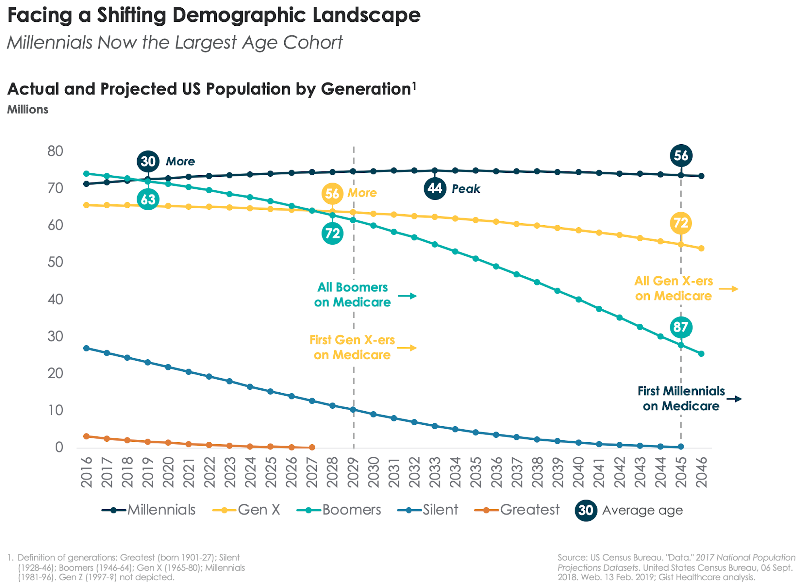
We spend an awful lot of time in healthcare talking about the Baby Boomers. No surprise, America has spent decades—six-and-a-half of them, to be exact—contending with the impact of this historically large generation on nearly every aspect of our national life. From politics to economics to culture, the Baby Boom reshaped almost every facet of our society, and healthcare has been no exception. The fact that over 10,000 Boomers join the Medicare ranks every day means they’ll have a transformative effect on how healthcare is delivered and paid for—up to and including the sustainability of the Medicare program itself. So it may come as a shock to Boomers to learn that, starting in 2019, it’s no longer All About Them. This year America passes a new milestone: Baby Boomers are now outnumbered by Millennials. As the chart below shows, Boomers (whose average age is now 63), will be surpassed this year by America’s new Largest Generation. Born between 1981 and 1996, the Millennials are now 30 years old on average, and there are 72.5M of them, compared to 72.0M Boomers—a gap that will continue to widen. (Thanks to immigration, we have another 14 years until we hit “peak” Millennial, according to Census Bureau projections.)

This demographic achievement alone ought to earn Millennials a participation trophy—obviously, not their first. (Forgive the sarcasm…we’re Gen X-ers, it’s what we do.) But this changing demographic landscape brings big implications for healthcare. Boomers are just entering their peak “senior care” consumption years now, and we’ll have a quarter-century or more of very expensive care to fund for a generation that is by all indications more riven with chronic disease but more likely to live into very old age than previous cohorts. That creates the imperative for population health approaches that allow care for seniors to be delivered in lower-acuity settings. At the same time, however, Millennials are really just entering the healthcare system. For the next several years, most of their care needs will be driven by having babies and caring for growing families. But just as the last of the Boomers get their Medicare cards in 2029, the Millennials will begin to enter their “upkeep” years—demanding a variety of diagnostics, surgeries, and procedures to keep them thriving. Who will pay for all of that specialty care, and where will it be delivered? Today’s health system planners would do well to begin to look ahead to future capacity needs, and economic models.

The Millennials bring dramatically different service expectations as well. This is a generation raised in the era of Amazon. One-click purchases, same-day delivery, frictionless transactions, personalized offerings, low institutional loyalty—all of that will shape the way this generation thinks about consuming healthcare, with huge implications for providers. This is a high-information generation, whose adult years have seen a pervasive shift from physical to digital commerce, and they’ll expect healthcare to follow that trend. Ask today’s pediatric providers how different the Millennials are as parent-consumers—you’ll quickly get the picture. Even as physicians, hospitals and others scramble to retool care delivery to more efficiently manage the swelling ranks of seniors, they’ll need to keep a close eye on the preferences of Millennials, upon whom their future fortunes will rely, and who won’t tolerate the hurry-up-and-wait ethos that still pervades American medicine.

(Spoiler alert: waiting in the wings is Gen Z, digital natives born in 1997 and after. Guess what? There’s even more of them!)


Have enough beds? Demographic trends paint an alarming picture

Have enough beds? Demographic trends paint an alarming picture

Healthcare providers know that inpatient volumes are down over historic levels. (But let’s not talk […]

Healthcare providers know that inpatient volumes are down over historic levels. (But let’s not talk about emergency department volumes—those are WAY up.)  They know this trend originates mostly with Medicare beneficiaries. They also know the causes: migration to outpatient services, observation day rules, intense focus on decreasing length of stay, and reduced readmissions as part of their quality initiatives.

What they may miss, however, is that this trend also has something to do with the declining average age of our nation’s senior population—a phenomenon that first began in 2005 and will continue until about 2020.  In 2005, the average age of our nation’s senior population was 75.2 years; in 2020, the average age is expected to be 74.4 years.

This fact is important because older seniors consume significantly greater healthcare resources than younger seniors. Today, those over 65 represent about 15 percent of the total U.S. population. By 2020, one out of six Americans will be 65 or older, rising to 22 percent by 2040. Understanding how this population is distributed among age cohorts is critically important not only in understanding current trends in reduced utilization, but also in preparing for the future.

Taking a Closer Look
This increasing proportion of the population that are seniors is important because the average Medicare beneficiary consumes about four times the hospital-based services as the average commercially insured person.
But it is just as important to look more closely at consumption patterns within the senior population. Those between ages 75 and 84 consume about 60 percent more services than seniors ages 65 to 74. Those age 85 and above consume about two-and-a-half times as much.

According to U.S. Census forecasts, in 2021, the over-75 population will make up the lowest percentage of the senior Medicare population in recent history, at about 41 percent. By 2040, seniors older than 75 will constitute 55 percent of the total senior population. This fact alone would suggest that we are in for a reversal of declining volume patterns—but by how much?

The answer is that if nothing is done to further reduce admissions and days per 1,000 for the senior Medicare population, inpatient days should almost double from about 70 million today to about 130 million in 2040 on the basis of demographic changes alone. That represents a need for some 220,000 additional beds at 75 percent capacity by 2040—never mind all the other healthcare services that will be needed. But even as there is general recognition among healthcare leaders of the advent of an aging population, there is also the general sense that somehow, we will not need the same level of resources to meet that demand as we do today.

Where does that sense of assurance come from? Apparently, it stems from the belief that unnecessary and excess utilization exists purely due to financial reasons, and that even more of the care delivered on an inpatient basis could be performed on an outpatient basis or at home with better monitoring and intervention through new technologies. But there also appears to be an ignoring of the well-known trend for the population becoming increasingly co-morbid at ever-younger ages. Additionally, some believe that increased focus on addressing social determinants of health, which impact 64 percent of health outcomes, will reduce need for medical services.

All of these assumptions may be true, in theory. In practice, however, as a senior healthcare executive and registered nurse said to me recently, “People are really sick. You have no idea.” There is also the enormous question of how one staffs and gets paid for programs and investments that might reduce demand for hospital-based services. The economics of today’s medicalized approach to health care is unprepared to address this.

A Critical Issue for Leadership
This is an issue that should be of paramount importance to healthcare providers. As seniors comprise a greater portion of our population, demand for inpatient and post-acute services will significantly increase. The hope and dream expressed in the view that hospital-based utilization might be reduced springs from a terrible reality: Hospitals in general, with the possible exception of high-end tertiary/quaternary services, lose money on government-reimbursed volume—and this will only get worse as cost inflation continues to exceed government reimbursement trends.

The prospect of the demand for inpatient days nearly doubling over the next 20 years paints a horrifying financial picture. Who, then, would not want to hope that something magical will happen to prevent a scenario that logic and data tell us is likely to occur?

It’s time for healthcare leaders to take a hard look at the trends around senior aging and have tough discussions with their executive teams and boards about the impact these trends could have on their organizations’ futures—and what they should be doing now to prepare.


Envisioning the “asset-light” hospital of the future


Across December we have been sharing our framework for helping health systems rethink their approach to investment in delivery assets, built around a functional view of the enterprise. We’ve encouraged our clients to take a consumer-oriented approach to planning, starting by asking what consumers need and working backward to what services, programs and facilities are required to meet those needs. That led us to break the enterprise into component parts that perform different “jobs” for the people they serve. We think of each of those parts as a “business”, located at either the market, regional or national level depending on where the best returns to scale are found (and on the geographic scale of any particular system). First we shared  our view of the “access business”, pushing systems to create a broad web of access points across their market, with the goal of building consumer loyalty over time. Last week we described our vision for the “senior care” business, where an array of assets traditionally providing postacute care, including rehabilitation and skilled nursing facilities (SNFs), home health, and even hospital-at-home programs, could expand their capabilities to manage chronic disease exacerbations in elderly patients in lower-acuity, lower-cost settings. This week we’ll describe how the changes in these outpatient care settings will affect the profile of the traditional acute care hospital.
 
Shifting demographics will dramatically change the patient mix of American hospitals across the next decade. As Baby Boomers age into their Medicare years, ED and hospital beds will fill with elderly patients admitted for exacerbations of chronic diseases like congestive heart failure and diabetes, their care reimbursed at public-payer rates. Over time it’s easy to imagine hospitals starting to look like giant SNFs, filled with elderly patients receiving nursing care and drugs. With current cost and labor structures, this shift will be financially unsustainable for hospitals, as Medicare payment for many medical admissions does not cover the cost of the inpatient admission, forcing hospitals to pursue alternative care settings for these patients. As we described last week, as many as half of chronic disease admissions could be managed by an expanded “senior care” platform. Adding to this potential shift of medical admissions to an outpatient setting, we anticipate that an expanded postacute and home care platform could also accelerate the shift of inpatient surgeries to an ambulatory setting. If surgery centers could manage patients for 24- to 48-hour stays, and hospital-at-home capabilities supported recovery at home, some experts believe that a majority of non-emergent inpatient surgeries—including many orthopedic and general surgery cases—could shift away from the hospital. If this shift to alternative settings bears out, demand for traditional “med-surg” beds could decline significantly, even in the face of demographic shifts.  
 
The graphic below describes an alternative vision for the future acute-care hospital that takes into account these changes. This “hospital of the future” will be asset-light, focused on providing higher levels of emergency, medical and surgical care, with capacity weighted toward more intensive patient management. The acute care facility will be supported by a network of connected and expanded ambulatory resources, including outpatient surgery, postacute services, home care and access services, all enabled by remote monitoring technology. While payment changes covering expanded outpatient care will accelerate this movement, we believe that payer and patient mix shifts alone will provide motivation for hospitals to pursue these strategies. The cost of adding a new med-surg bed now tops $2M in most markets—trimming even a few beds that may not be needed will provide capital that can go a long way in expanding outpatient capabilities to support lower-acuity care.