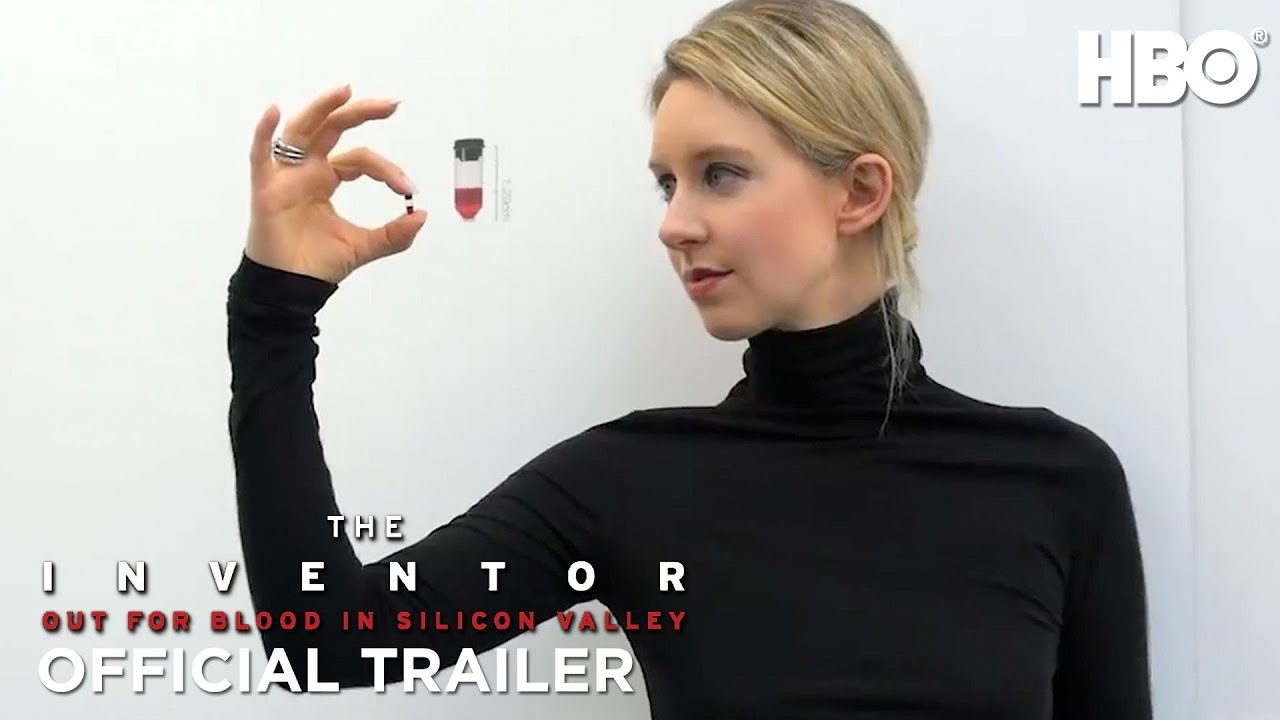
HBO’s Elizabeth Holmes Theranos documentary exposes American health care

https://www.cnet.com/news/hbo-documentary-on-elizabeth-holmes-theranos-lie-exposes-american-health-care/?utm_source=Sailthru&utm_medium=email&utm_campaign=Issue:%202019-03-20%20Healthcare%20Dive%20%5Bissue:19979%5D&utm_term=Healthcare%20Dive

Image result for HBO's Elizabeth Holmes Theranos documentary exposes American health care

“The health care system has become horribly perverted,” says Alex Gibney, director of The Inventor: Out for Blood in Silicon Valley.

Nobody likes having a needle stuck in their arm. And nobody likes having money sucked out of their wallet, either. So when smart young entrepreneur Elizabeth Holmes emerged from Silicon Valley claiming to have a cure for a broken health care system, politicians and journalists and investors couldn’t wait to shower her with praise and money.

But the story of Holmes’ company comes with a sting. Her black outfits helped create an image of a new Steve Jobs-esque voice in Silicon Valley, but after faking demos and lying about patient treatment Holmes and her partners are now awaiting trial on charges of fraud.

The Theranos fraud exposes fundamental problems with Silicon Valley, the health care industry and the myth of the genius inventor from Thomas Edison to Steve Jobs. New documentary The Inventor: Out for Blood in Silicon Valley, now available to stream on HBO, reveals the whole bloody mess.

I asked the film’s Oscar-winning director, Alex Gibney, if we fetishize the idea of a genius inventor. “We do,” he told me by phone from San Francisco, “and it’s bullshit.” Having tackled corruption and deceit in films about Enron, the Church of Scientology and the White House, Gibney describes Holmes as “a variation on a theme” of the type of people he’s seen before. “Elizabeth was afflicted with the notion that the end justifies the means,” Gibney says. “She thought she was entitled to make mistakes because her intention was pure and worthy and socially vital. But the mind plays tricks with you when you start down that path, as you rationalize your behavior in ways that can become quite dangerous and delusional.”

Big-name investors from both inside and outside Silicon Valley fell for Holmes’ delusion, including Rupert Murdoch, who invested $125 million into Theranos. But the question remains whether the profit-driven private sector is even suited to solving health care problems. “Reports show the health care system in the US has become horribly perverted,” says Gibney, “through this patchwork system of insurance and private enterprise and then also government legislative initiatives. Medicare is not allowed to negotiate directly with drug companies, how crazy is that?”

Everyone can agree that fixing problems in health care is a noble cause, but relying on Silicon Valley and the private sector also lined up with other political agendas for the politicians who backed her. “This notion of the entrepreneur lets government off the hook,” Gibney says.

The director does credit Holmes with highlighting problems in the laboratory testing industry. “They’re incredibly opaque with their pricing,” he points out. Patients don’t pay directly for blood tests, so depending on the circumstances, the illness or even the state, lab companies can charge outrageous prices to insurance companies to complete the test.

The health care system “is designed to enrich companies rather than to serve the health of patients,” says Gibney. “It’s full of all sorts of bad incentives.”

While things clearly need to be improved, the Silicon Valley style of disruptive innovations may not be what we as patients need. Taking control of your own health is a “a very cool-sounding libertarian notion,” but Gibney cautions that “we’re not doctors.” He’s concerned about the idea of treating patients as customers, seducing us with promises of competitive prices and greater choice. “That’s good for sneakers,” he says, “but I’m not sure a consumer/producer relationship is necessarily good for health care. You want a patient/doctor relationship, and blood testing is part of it.”

Silicon Valley has adapted the credo of “move fast and break things,” which means iterating and making mistakes until you find the right path. But you can’t make mistakes when people’s lives are at stake. And real people were put at risk when Theranos pushed ahead with a contract with Walgreens to carry out blood tests for ordinary people.

“That was a line Elizabeth crossed,” says Gibney. “If she had just wasted a lot of investors’ money on a machine that didn’t work, there wouldn’t really be a story here. It was when she put people at risk, that was the problem.”

Gibney is concerned that Holmes will be portrayed as a one-off, “one rotten apple in an otherwise pristine barrel.” But he thinks the Theranos fraud shows cracks across Silicon Valley, the health care industry and capitalism as a whole. “I tried to indicate there are bigger problems in Silicon Valley in terms of lying, in terms of becoming disruptors in ways that may make people a lot of money but may not always be a good thing.”

Within Theranos, a culture of silence and paranoia couldn’t suppress the lies forever. And so Theranos employees blew the whistle on the deceit.

“I think all of us should be aware that there are certain cultural, and also legal, impediments to hearing the bad news,” says Gibney, who highlights the use of nondisclosure agreements to gag employees. These legal contracts are supposed to protect trade secrets, but they can also be used to prevent insiders from calling out corruption. “Look at Harvey Weinstein,” Gibney says. “NDAs are rapaciously used by people to cover up misdeeds.” 

Yet for some reason, we have a strange relationship with those insiders who do come forward. “It’s sort of like they’re showing us up,” says Gibney. He recalls being asked the same two questions over and over after making The Smartest Guys in the Room, his film about the corruption within Enron: “One was about this guy who got away with it, sailed off with $200 million and married a stripper. But the other question was about Sharon Watkins, the whistleblower, and it was always, ‘Who does she think she is? How come she’s so holier-than-thou?’ Of all the lessons to take away from Enron, she’s not really the malefactor, but it seemed to really get under people’s skin.”

Gibney has made a career out of exposing corruption from the business sector to the CIA to the White House. “Part of us is secretly thrilled by people who are conning the game,” he says. “But we always at the end want to see them punished, so it’s kinda like a double pleasure. You wanna see ’em sneak around — and then you wanna see the hammer come down.”

“I’ve been spending a lot of time on problems,” Gibney says as we wrap up the interview. “I’m starting to think about doing films about people who are coming up with solutions.”


Why the Theranos saga and Holmes’ trial is good for innovation

Why the Theranos saga and Holmes’ trial is good for innovation

The criminal trial of Theranos CEO Elizabeth Holmes will help entrepreneurs see the legal ramifications of hyping and under-delivering presumed medical advances and be ultimately be good for innovation.

“Fake it until you make it” is an oft-repeated phrase among entrepreneurs promising to revolutionize, disrupt or transform.  It can, however, have severe consequences for the healthcare sector when doctors and patients place their trust in the new or evolving venture.  The criminal trial of Elizabeth Holmes, who faces a 20-year prison sentence, will help healthcare entrepreneurs see the legal ramifications of over-promising and under-delivering presumed medical advances.

This trial will generate headlines. More importantly, it will be a teachable moment for all of us trying to innovate our way through a deeply complicated and entrenched healthcare system – especially regarding patient-empowering technology. Holmes, and the company she founded, Theranos, marketed a means to disrupt traditional diagnostic business models where two large companies dominate a $54 billion market.  The idea was to put patients in control of blood testing, using less amounts and creating a faster, lower-cost alternative.   The business model envisioned consumers using Theranos equipment at retail locations including drug stores and supermarkets.  As the marketing phrase goes, that was the “steak,” or substance to her pitch, but there was also “sizzle.”

The young, telegenic, and articulate Holmes became the widely-known public face of the company. Wearing black turtlenecks to draw comparisons to Steve Jobs and calling one of her blood-test devices “Edison” to align herself with the famous inventor, the media could not resist the story.  That part worked: Theranos at one point was valued at $9 billion.  Holmes declared her lab-test device was “the most important thing humanity ever built.”  Much of the narrative she created about Theranos will now be used as evidence in her criminal trial just as it was in a separate Securities and Exchange civil fraud case in March.

Here is something we already know from the federal indictment handed down last month: prosecutors will cite Theranos press releases, media interviews, and promotional materials to support allegations that Holmes knowingly committed criminal fraud.  In one example, the U.S. Attorney’s office for the Northern District of California cites a specific interview in which Holmes told a media outlet that Theranos could run “any combination of tests” from a single small blood sample.  The indictment goes on to list public statements such as one on the company’s website that, “one tiny drop changes everything.”

In the Securities and Exchange Commission civil case, which Holmes settled, media interviews with the business press, which in turn were said to solicit investors, are likewise cited as evidence of financial fraud.  The SEC’s civil complaint states that in 2013, “Holmes and Theranos began publicly touting Theranos’ proprietary analyzers in interviews with the media, notwithstanding Theranos’ use of commercially-available analyzers for patient testing.”  Here too, several interviews with financial media outlets were used as examples including an e-mail exchange between Holmes and a reporter in which she tried to shape the story.   As is widely known, the generally favorable media coverage that accelerated in 2013 abruptly ended.

Her company came under the scrutiny of The Wall Street Journal in 2015 when company whistleblowers went public raising questions about the underlying technology.  This put Holmes and her company on the government’s radar.   The narrative soon changed to actions intended to correct the company’s mistakes. Most notably, Theranos voided or corrected nearly a million blood-test results, calling into question untold numbers of health decisions made between doctors and patients.

Judges and juries take an especially harsh view of potentially harmful impacts on consumers.  The FBI agent who investigated the case described charges of misleading consumers and doctors as endangering “health and lives.”  Likely the most serious charge among the 11 counts Holmes faces is being unable to produce accurate and reliable results for numerous blood tests, including the detection of HIV, despite assertions to the contrary.

Yet Holmes is only the most recent and well-known among many healthcare practitioners who face charges or convictions of fraud.  We can go back to the patent medicine movement in the early 1900’s, where a popular advertising slogan at the time was “a cure for what ails you.”  In the late 1800’s there was actually a real-life snake oil salesman who traveled the country and gave demonstrations with live reptiles on how he made his product.  Such antics with fake medicine led to the passage of the Pure Food and Drug Act in 1906.  So, a century later, why does this keep happening?

One recurring theme leading to healthcare fraud is what medical scholars have labeled “eminence-based” medicine.  Simply put, this is an over-reliance on personality and stature from the individual believed to have authority on a particular medical subject.  The term is a play on the words “evidence-based” medicine, where facts are supposed to be used to evaluate medical advances.

Some lessons are already being learned. Early stage and start-up blood-testing companies are emphasizing peer-reviewed data and clinical trials.  One telling insight from an entrepreneur, as reported in Marketwatch, describes Theranos as a “big crater in the industry.”  The founder of privately-held Athelas, a blood-testing firm, said Theranos, if executed correctly, “would make a massive impact in a really old, archaic industry.”

Faking it until you make it may work to a certain point and allow entrepreneurs a limited degree of latitude among investors as they develop technical approaches to support business models.  As an entrepreneur myself, I am well aware of the need to convincingly show the promise of an invention – even before it is fully finished. However, it becomes financial fraud — potentially criminal activity — when you are not honest about the risk.  Medical and consumer fraud, when patients are sucked into the hype and subsequently misled, becomes exponentially more serious. Neither is acceptable. The bottom line: Holmes’ trial will offer insight leading to less hype and more high-quality innovation.


Caught in the Theranos Wreckage

The high-profile investors, including Ms. DeVos and Mr. Murdoch, collectively invested about $600 million in the company Theranos

Even some of the world’s richest people may get duped, according to newly unsealed documents in a lawsuit filed on behalf of investors in the failing blood-testing company Theranos.

High-profile investors who collectively lost hundreds of millions of dollars included Walmart’s Walton family, the media mogul Rupert Murdoch, as well as Betsy DeVos, the secretary of education and her relatives.

The list of investors, which was first reported by The Wall Street Journal, came to light as part of a class-action lawsuit brought in 2016 by Robert Colman, a retired Silicon Valley investment banker, who claims that Theranos misled investors about its business and technology.

Theranos, founded by Elizabeth Holmes when she was a 19-year-old Stanford University dropout, promised to revolutionize the lab industry using a few drops of blood from a simple finger-prick to look for everything from diabetes to cancer, at a fraction of the cost of a traditional blood test.

The company became a Silicon Valley fairy tale, with investors awarding the privately held company a valuation of around $9 billion. But the story began to unravel in October 2015 after The Wall Street Journal, owned by Mr. Murdoch’s News Corp., began questioning whether the tests worked. Theranos became the subject of federal investigations into its testing and claims of proprietary technology, which were called “nanotainers.” Much of the time the company had to resort to using conventional blood testing methods, unable to get federal approval for any test but one for Herpes.

Theranos and its founder also became embroiled in a series of lawsuits, involving investors as well as one of its key partners, Walgreens, a large drugstore chain, where it offered its tests. The company reached a settlement with Walgreens last August.

In March, the Securities and Exchange Commission charged Ms. Holmes with fraud, accusing her of exaggerating and lying about her technology to attract investors. As part of the S.E.C. action, Ms. Holmes agreed to pay $500,000, give up control of her company, and is barred from serving as an officer or director of any public company for 10 years. She and Theranos did not admit nor deny the allegations.

Theranos still faces the class-action lawsuit, and may still be subject to a criminal investigation by the United States attorney in San Francisco. The company’s future is unclear. The company did not respond to requests for comment.

Theranos had always boasted a star-studded list of investors and directors — its board included the former secretaries of state George P. Shultz and Henry A. Kissinger, two former United States senators, and Gen. Jim Mattis, the current secretary of defense. But while some high-profile investors’ links to Theranos had been previously known, the new documents provide a detailed list of financial amounts.

The Walton family invested about $150 million in 2014 through two separate entities, according to the investor list. Mr. Murdoch put in about $125 million, and the extended family of Ms. DeVos invested about $100 million.

“It’s obvious that they are highly disappointed in them as a company and as an investment,” said Greg McNeilly, the chief operating officer of The Windquest Group, the holding company of Ms. DeVos and her husband. Mr. McNeilly said the $100 million was a joint investment across multiple generations and branches of her family, and described the share held by Ms. DeVos and her husband as “minor.”

Other prominent investors, according to the list, included the Cox family; the Atlanta billionaires who own the media conglomerate Cox Enterprises and who invested $100 million; and a company affiliated with Mexican billionaire Carlos Slim that put in about $30 million. Robert K. Kraft, the owner of the New England Patriots, invested $1 million.

Representatives for Mr. Kraft, the Walton family, Cox Enterprises and News Corp. declined to comment.


Theranos, founder Elizabeth Holmes and former president charged with ‘massive fraud’

https://www.bizjournals.com/sanfrancisco/news/2018/03/14/theranos-elizabeth-holmes-sunny-balwani-fraud.html?ana=e_sfbt_bn_breakingnews&u=FAuoHGaGEPdmk4X6khnaiw045b16af&t=1521046882&j=80495961

Image result for elizabeth holmes

Theranos Inc., founder Elizabeth Holmes and former President Ramesh “Sunny” Balwani were charged Wednesday by the Securities and Exchange Commission with conducting “an elaborate, years-long fraud” that raised $700 million around their needles-less blood diagnostics company.

Theranos and Holmes have agreed to “resolve” the charges against them, the agency said in a statement, which includes Holmes giving up a majority of voting control and a reduced equity stake in the company. That latter part is significant since critics of the company said change couldn’t come to the company until Holmes gave up control.


Theranos secures $100M loan, avoids bankruptcy

https://www.beckershospitalreview.com/healthcare-information-technology/wsj-theranos-secures-100m-loan-avoids-bankruptcy.html

Image result for theranos

Theranos’ outlook for 2018 improved after securing a $100 million loan from Fortress Investment Group, which will help the troubled blood-testing company dodge bankruptcy, according to the Wall Street Journal

Theranos CEO Elizabeth Holmes wrote in an email to shareholders that the loan is subject to the company “achieving certain product and operational milestones.” She said the deal provides Theranos with “sufficient liquidity through 2018.”

Through the loan, Fortress assumes 4 percent of Theranos’ equity. The investment group specializes in distressed asset investing.

The expose on Theranos that WSJ published in October 2015 prompted a series of events that left what was once a well-funded and perceived-to-be promising startup as an embattled and gutted company. It was reported in April that Ms. Holmes owes the startup $25 million. The company settled several lawsuits this year, including one with Walgreens, and recently moved its operations and staff from Palo Alto, Calif., to a manufacturing facility in Newark, Calif.


Theranos agrees not to operate labs for two years

http://www.sfgate.com/business/article/Theranos-agrees-not-to-operate-labs-for-two-years-11079274.php

The Theranos lab in Newark Calif., seen on April 12, 2015. The company announced a settlement Monday with the Centers for Medicare and Medicaid Services that resolves all legal and regulatory proceedings between the federal agency and the embattled Palo Alto blood diagnostics firm. Photo: CARLOS CHAVARRIA, NYT

Theranos has reached a settlement with the Centers for Medicare and Medicaid Services that resolves all legal and regulatory proceedings between the federal agency and the embattled Palo Alto blood diagnostics firm, the company announced Monday.

Theranos has agreed to pay a penalty of $30,000 and cannot operate a clinical laboratory for the next two years.

As part of the settlement, the federal agency, which regulates blood testing labs, has withdrawn its revocation of Theranos’ lab operating certification.

Theranos, founded in 2003 by CEO Elizabeth Holmes, had been a high-flying startup that promised to revolutionize blood testing before a Wall Street Journal investigation alleged that the company misled people about the accuracy of its blood testing technology.

It is unclear whether the settlement has any bearing on investigations into the company by the Department of Justice and U.S. Securities and Exchange Commission. The company faces lawsuits from investors and Walgreens, its ex-partner that had been using Theranos blood-testing technology in dozens of stores before terminating the relationship.

CMS fines, cuts off testing at Theranos, bans Holmes

CMS fines, cuts off testing at Theranos, bans Holmes

goodbye

The other shoe has dropped for Theranos. Late Thursday night, the embattled diagnostics company disclosed that it is officially being sanctioned by the Centers for Medicare and Medicaid Services.

In a press release issued at 11:35 p.m. Eastern time, the wounded unicorn said CMS has moved to revoke the CLIA certificate for Theranos’ laboratory in Newark, California. Company executives — mainly founder and CEO Elizabeth Holmes — will be barred from owning, operating or directing a clinical lab for two years once the sanctions take effect 60 days from now.

Walgreens terminates partnership with Theranos

http://www.beckershospitalreview.com/hospital-management-administration/walgreens-terminates-partnership-with-theranos.html

Walgreens Theranos

http://www.npr.org/sections/thetwo-way/2016/06/13/481888422/walgreens-cuts-ties-with-blood-test-company-theranos

Theranos made one critical mistake that has caused it the most grief

http://www.businessinsider.com/the-biggest-mistake-theranos-made-2016-5?nr_email_referer=1&utm_content=BISelect&utm_medium=email&utm_source=Sailthru&utm_campaign=BI%20Select%20Weekend%202016-05-21&utm_term=Business%20Insider%20Select

Blood Drawing  standard


CMS may ban Theranos founder Elizabeth Holmes for 2 years, sanction company, WSJ says

http://www.healthcarefinancenews.com/news/cms-may-ban-theranos-founder-elizabeth-holmes-2-years-sanction-company-wsj-says?mkt_tok=eyJpIjoiT0RZMFptTmtNMlJsTUdVMiIsInQiOiJuZjAwWEdTaDd6S0hXT0NjTlwvMXlTZ0oySVBWN3RFUFBcL1JGeDVWMFBSMEp4ekR6cFJXUjRhOEIrUkNVbEZuZFlBanQ0a3FPZ2Nzem1QbnQzZUxITDRKTlFVcjFTazRpc2ZVb0doR0lQTGRBPSJ9

If the company doesn’t respond to the satisfaction of the regulators, CMS will impose the sanctions.