


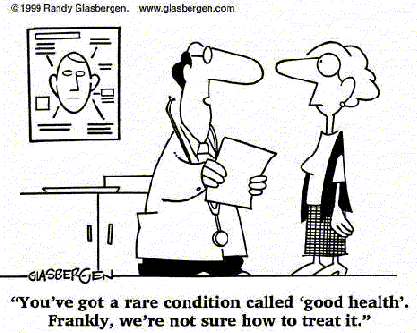
Cartoon – A Needs led service

http://www.healthcaredive.com/news/4-forces-that-will-influence-medical-cost-trends-in-2017/421162/

The healthcare industry is in a transformational period. The rising use of retail clinics, MACRA, population health efforts and the Medicare Part B demonstration are but a few examples of disruptive conversations being had in board rooms. Yet, all of these discussions are underscored by the one topic underlying most business conversations: the almighty dollar.
There’s been plenty of digital ink given this year to the costs surrounding the industry. Just last week, a new Kaiser Family Foundation report outlined how the cost for the most popular ACA plan – the silver plan – is expected to rise on average 10-11% next year. Healthcare costs are generally expected to increase each year but, for context, the average silver plan increased an average of about 5% the previous year, according to the report.
However, a new PricewaterhouseCoopers’ (PwC) report stated while health prices are increasing, they are being tempered by the demand for value. PwC’s Health Research Institute (HRI) projects the medical cost trend – the projected percentage increase in the cost to treat patients from one year to the next – won’t increase or decrease next year but will stay the same as 2016: a 6.5% growth rate for 2017.
The report shows there’s a push and pull between healthcare services utilization and narrow networks focusing on value that could shift the medical cost growth rate in future years. “When medical growth outpaces general inflation, a flat trend is not good enough,” the report states.
“As a result, 2017 will be a tough balancing act for the health industry,” the report states, adding, “Healthcare organizations must simultaneously increase access to consumer friendly services while decreasing unit cost. Employers, worried that this current trend is at an inflection point that could turn back up, will demand more value from the health industry.”
HRI highlighted four factors that will influence the 2017 medical cost trend.

The findings suggest the market shifts are triggering entities such as medtech and pharma companies to bust out of their former molds, beyond products such as pills, to adopt customer-centric service solutions.
CEOs should look toward innovative business models that can help them monetize emerging opportunities, according to Frost & Sullivan Transformational Health Industry Analyst Kamaljit Behera.
“Collaboration and open-source innovation are key ingredients for future restructuring,” Behera stated. “Companies such as Apple, Google, IBM Watson and Intel will continue to compete outside their domain, forcing traditional healthcare companies to change their dominant business models.”
The company further pointed toward Walmart looking to become a primary health provider and Medtronic’s Diabetes Management’s move to an intelligent-based solutions business model, and suggested the use of “actionable health outcome data” will form the basis of the industry landscape. The future can expect to see more around crowdsourcing, mass customization, open innovation and data collection based on customer preferences – with scalability being the most critical factor for success, according to Behera.
The growing demand for value has indeed been providing some counterbalance against increasing healthcare costs, a PricewaterhouseCoopers’ (PwC) report similarly found earlier this year, with demand for consumer friendly services adding to the mix.
http://www.wsj.com/articles/catholic-health-initiatives-dignity-health-in-merger-talks-1477335251

Hospital operator Catholic Health Initiatives, which has struggled after rapid expansion and a foray into health insurance, is in merger talks with Dignity Health to create one of the nation’s largest nonprofit hospital systems by revenue.
Catholic Health Initiatives and Dignity Health said in a statement they are in talks regarding “aligning their organizations.” A person familiar with the matter said the talks involve a merger.
The deal would combine 103 hospitals owned by Catholic Health Initiatives, based in Englewood, Colo., with 39 hospitals operated by San Francisco-based Dignity Health. Combined revenue for the new organization would reach $27.8 billion annually, based on the most recent financial statements.

In January, Vermont will become the first state in the nation to move to a voluntary all-payer accountable care organization model, the CMS announced Wednesday.
The Vermont program is modeled after a similar one from Maryland, but the Maryland program covers only hospitals. The Vermont ACO will cover Medicare, Medicaid and commercial payers, requiring those who participate to pay similar rates for all services.
The CMS is giving Vermont $9.5 million in start-up funding to support the transition. The demonstration, funded through a 1115 waiver, will last five years.
“This model is historic in terms of its scope, aiming to include almost all providers and people throughout the state in an all-payer ACO model to drive improved quality, better care coordination, healthier people, and smarter spending,” the CMS’ Chief Medical Officer Patrick Conway said in a statement.
“We will become the first state in America to fundamentally transform our entire health care system so it is geared towards keeping people healthy, not making money,” said Vermont Gov. Peter Shumlin, who earlier this year traveled to Washington to negotiate a deal with HHS Secretary Sylvia Mathews Burwell.
The state aims to have 70% of its insured residents covered by an ACO by 2022. The model will be considered an advanced alternative payment model under the new Medicare reimbursement program, making participants eligible for a performance bonus.

Emergency rooms and hospitals are among the most expensive places to get health care. One of the big selling points for Obamacare was the idea that if people get insurance, they’ll have better preventive care and end up in the ER a lot less.
Today we have new data that buries that idea.
Though people with insurance are taking advantage of more preventive care, they’re also still going to the ER. A prior study, done by the same economists, found when you give people insurance, they use more health care services — more doctor’s visits, flu shots, prescriptions, even hospitalizations.
Dr. Renee Hsia, of the University of California San Francisco Emergency Department, said she treats many insured patients.
“We have noticed that as our patient population gets older and frailer and we have more complex diseases, there are higher-acuity things presenting to the ED,” she said.
Hsia said other reasons the insured keep showing up include patients’ doctors sending them to the ER, or people can’t get a primary care appointments quickly.
Harvard economist Kate Baicker, one of the co-leads on the paper, said people need to be clear about the impact of insurance.
“Insurance makes the emergency department affordable,” she said. “People didn’t go [when they were uninsured] because of the big bill they got when they showed up. Now that it’s more affordable, people go more.”
Based on their findings, Baicker said insurance also improves people’s financial security and reduced their rate of depression.

Since the introduction of Obamacare, a growing number of physicians are part of what are called Accountable Care Organizations, where physicians, nurses and other providers are responsible for the health of their patients and the costs of that care.
The shifting landscape is rearranging incentives, and leading doctors into corners of their work they’ve rarely visited.
On a late Friday afternoon last month, the Family Health Associates practice in Charleston, West Virginia is empty.
Empty except for Dr. Julie DeTemple and her staff.
“I should be home and I’m here typing away doing my notes, charting,” DeTemple said.
The primary care doctor has had to adjust from examining patients – why she got into the business – to examining data.
Her quality time with spreadsheets has ramped up this year, now that’s she’s co-founded the Aledade West Virginia ACO, made up of 11 physician practices in the state.
The physicians constantly meet, looking for ways to improve care and cut out wasteful spending.

The healthcare landscape is changing, even as Obamacare bumps along.
In the past six years, we’ve seen the rise of Accountable Care Organizations, now numbering more than 800, where doctors or hospitals work together to streamline care. For physicians that means they now get some compensation through contracts that reward improving health and controlling costs, as opposed to simply making money for every service provided regardless of the outcome or expense.
There are now an estimated 28 million Americans enrolled in these ACOs, and that means, at least for some, their care looks radically different than even just a few years ago. That’s particularly true for some of the sicker people in the country.
People like 76-year-old Millard Scott.
Scott, who lives in the small town of Williamson, West Virginia, population 3,000, suffers from Chronic Obstructive Pulmonary Disease. When his COPD kicks up, struggling to breathe is Scott’s big problem.
 HENRY KOTULA