

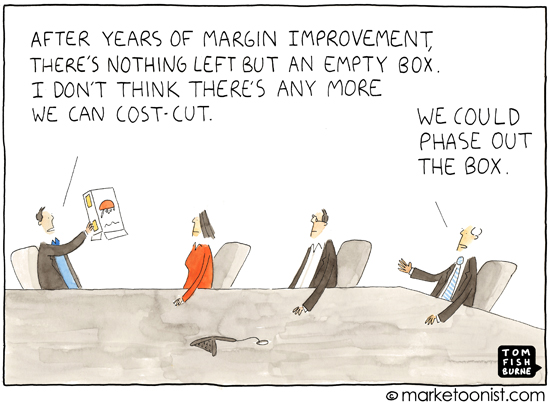
Cartoon – Cost Cutting Today


Supplier marketing tactics continue to artificially prop up physician and patient demand for high-end products, including some with unintended negative consequences from both a financial and quality standpoint. This has been the situation for decades, but is fast becoming an untenable situation for hospitals—especially those that have failed to calculate the true cost of ownership.
I recently unearthed a reference sheet I penned in 2003, when drug-eluting stents first hit the market, offering steps healthcare providers could take to prepare for the financial impact of the then-new technology. It could just as easily been written about bioresorbable stents now taking hospital finances by storm. My suggestions, in short:
• Do a deep-dive analysis of how supplies are currently being utilized for stent procedures
• Determine the expense of treating patients impacted by the new stent (based on conversion estimates)
• Share the results with your finance team and negotiate carve-outs with payers
• Perform a supply expense projection
• Share the analysis with your physicians
• Combine intelligence gained from physician discussions with expense projection to estimate proportion of patients who will receive the new stent
• Share projections with hospital board of directors
• Develop and implement guidelines for use with medical staff, based on approved uses and clinical studies
But planning for the impact and actually limiting it are two different things entirely. The challenges in preserving cardiovascular service line margins have barely budged over the years, even as the consequences of inaction have grown exponentially. Year after year, a handful of high-end products make headlines with the only certainty being that costs will ramp up 5 to 10 percent. Below are what I see as the five perennial culprits.

Donald J. Trump once declared that campaigning for “substantial” changes to Medicare would be a political death wish.
But with Election Day behind them, emboldened House Republicans say they will move forward on a years-old effort to shift Medicare away from its open-ended commitment to pay for medical services and toward a fixed government contribution for each beneficiary.
The idea rarely came up during Mr. Trump’s march toward the White House, but a battle over the future of Medicare could roil Washington during his first year in office, whether he wants it or not.
“Let me say unequivocally to you now: I have fought to protect Medicare for this generation and for future generations,” Senator Joe Donnelly of Indiana, a Democrat running for re-election in 2018, said this week in a video message to constituents. “I have opposed efforts to privatize Medicare in the past, and I will oppose any effort to privatize Medicare or turn it into a voucher program in the future.”
For nearly six years, Speaker Paul D. Ryan has championed the new approach, denounced by Democrats as “voucherizing” Medicare. Representative Tom Price of Georgia, the House Budget Committee chairman and a leading candidate to be Mr. Trump’s secretary of health and human services, has also embraced the idea, known as premium support.
And Democrats are relishing the fight and preparing to defend the program, which was created in 1965 as part of Lyndon B. Johnson’s Great Society. They believe that if Mr. Trump chooses to do battle over Medicare, he would squander political capital, as President George W. Bush did with an effort to add private investment accounts to Social Security after his re-election in 2004.
Democrats will “stand firmly and unified” against Mr. Ryan if he tries to “shatter the sacred guarantee that has protected generations of seniors,” said Representative Nancy Pelosi of California, the Democratic leader.
Republicans have pressed for premium support since Mr. Ryan first included it in a budget blueprint in 2011. As he envisions it, Medicare beneficiaries would buy health insurance from one of a number of competing plans. The traditional fee-for-service Medicare program would compete directly with plans offered by private insurers like Humana, UnitedHealth Group and Blue Cross Blue Shield.
http://money.cnn.com/2016/11/21/news/economy/medicaid-trump/index.html

Think less federal funding, more state control, fewer participants and higher costs for those in the program.
Here’s how Medicaid works now:
Nearly 73 million Americans are on Medicaid or the related Children’s Health Insurance Program (CHIP). The programs cost $509 billion in fiscal 2015, with the federal government shouldering 62% of the bill and states paying 38%.
While Democrats say the program is a vital part of the safety net, Republicans have long criticized it as being bloated, inefficient and rife with fraud. They want to limit the federal government’s financial responsibility, while giving states more direct control over whom to enroll and what kind of coverage participants receive.
On the campaign trail, Trump was emphatic about having the government provide coverage to the poor, even as he vowed to dismantle Obamacare.
“You cannot let people die on the street, ok?,” he said at a CNN town hall in February. “The problem is that everybody thinks that you people, as Republicans, hate the concept of taking care of people that are really, really sick and are gonna die. We gotta take care of people that can’t take care of themselves.”

Donald Trump and Republicans in Congress are vowing to repeal and replace the Affordable Care Act, the signature health care overhaul of President Obama.
Trump has offered a few ideas of where he’d like to see a health care overhaul go, such as a greater reliance on health savings accounts, but he hasn’t provided a detailed proposal.
The absence of specifics on health care from the president-elect makes the 37-page plan that Speaker of the House Paul Ryan has released the fullest outline of what Republicans would like to replace Obamacare. Some health policy analysts say it looks a bit like Obamacare light.
“Republicans through this plan have embraced, I think rightfully so, the basic idea that everybody in the U.S. should have health insurance,” says Jim Capretta, a health policy fellow at the American Enterprise Institute. “And people who are outside the employer system should get some level of financial help through a tax credit, because, frankly, that’s similar to the tax break that is available through employer coverage.”
Republicans had been criticized for years for promising to repeal the ACA and offering nothing as a replacement. Ryan unveiled the proposal at AEI in June.
http://www.seattletimes.com/business/trumps-path-on-health-care-law-intersects-with-a-lawsuit/

President-elect Donald Trump says he wants to preserve health insurance coverage even as he pursues repeal of the Obama-era overhaul that provided it to millions of uninsured people.
How his administration handles a pending lawsuit over billions of dollars in insurance subsidies will reveal whether Trump wants an orderly transition to a Republican-designed system or if he’d push “Obamacare” over a cliff. Stripping away the subsidies at issue in the case would put the program into a free-fall.
The question in the House v. Burwell case couldn’t be more technical: whether the Affordable Care Act specifically states in its hundreds of pages that the government can pay money to help reduce out-of-pocket costs for low-income consumers on HealthCare.gov and state insurance markets.
Those subsidies for deductibles and copayments are paid directly to insurers, on top of the law’s tax credits that reduce premiums for consumers. Since the ACA’s basic coverage is fairly skimpy, the cost-sharing subsidies make it work for millions of people when they seek treatment. For example, subsidies can bring a $1,500 hospital copayment down to $100.
House Republicans have taken the Obama administration to court. They argue that the law lacks a specific congressional “appropriation” for the subsidies, estimated to total $9 billion next year. A federal district judge in Washington, D.C., agreed with the House and the case is now on appeal.
http://www.thefiscaltimes.com/2016/11/22/Health-Care-Industry-Panic-Over-Obamacare-Repeal

The pledge by President-elect Donald Trump and congressional Republicans to swiftly repeal the Affordable Care Act — followed by months or even years of deliberation over a replacement – is no doubt troubling news to many of the roughly 20 million Obamacare beneficiaries.
House Speaker Paul Ryan (R-WI) and Senate Majority Leader Mitch McConnell (R-KY) have vowed to jam through legislation as early as January to dismantle the heart of President Obama’s signature 2010 health insurance program, while leaving the question of precisely how they would replace it and when that new system would be put in place unanswered.

 HENRY KOTULA